
Towards a New Architecture: Complete Chapter-by-Chapter Summary

Welcome to the world of *Toward an Architecture* by Le Corbusier. This isn't just a book about buildings; it is a foundational manifesto that demands we rebuild our world with the precision of a machine and the harmony of the cosmos. Imagine a world where architecture stops being a relic of the past and starts functioning as a vital tool for human health and moral well-being.
Le Corbusier argues that the traditional, ornate houses of the past are actually traps. They are like tuberculosis patients, suffocating their inhabitants with poor light, stale air, and claustrophobic spaces. These outdated structures don't just fail to protect us; they actively destroy our health and erode our family values. We are stuck in a cycle of clinging to these decaying shells out of a false sense of nostalgia, treating old houses like religious relics that must never change. But culture evolves, and so must our homes.
The solution lies in embracing the "Engineer's Aesthetic." Just as a car or a ship is designed with logic, efficiency, and a clear purpose, our homes should be. They need to be machines for living in—functional, healthy, and stripped of unnecessary decoration. By using modern materials like reinforced concrete and mass-producing standardized components, we can create affordable, high-quality housing that fits the rhythm of modern life. It's time to stop worshipping the past and start building a future where every person has a home that truly supports their life.

A great era has begun, yet architecture is suffocating in the stifling grip of custom. Look at this contrast: on one side, the bold, rational steel of the modern age; on the other, the heavy, decaying opulence of the past. We are told that humanity stubbornly clings to these unhealthy, decaying houses purely out of a misguided religious devotion to the past.
But let's be honest: clinging to the old isn't about love; it's about fear. These old homes are like tuberculosis patients, slowly consuming our vitality with their poor ventilation, dark light, and damp air. They don't just fail our bodies; they erode our morals. Families dissolve, spirits break, and life becomes a struggle against the very walls meant to shelter us.
The truth is simple and often ignored: a house is a tool, just like a plow for a farmer or a hammer for a craftsman. When a tool becomes obsolete, we discard it. Why should we treat our homes differently? The problem isn't a lack of resources; it's a refusal to evolve. We have the technology to build healthy, efficient living spaces today, but we are trapped by the ghost of yesterday's styles. It is time to stop worshipping the past and start building for the future.
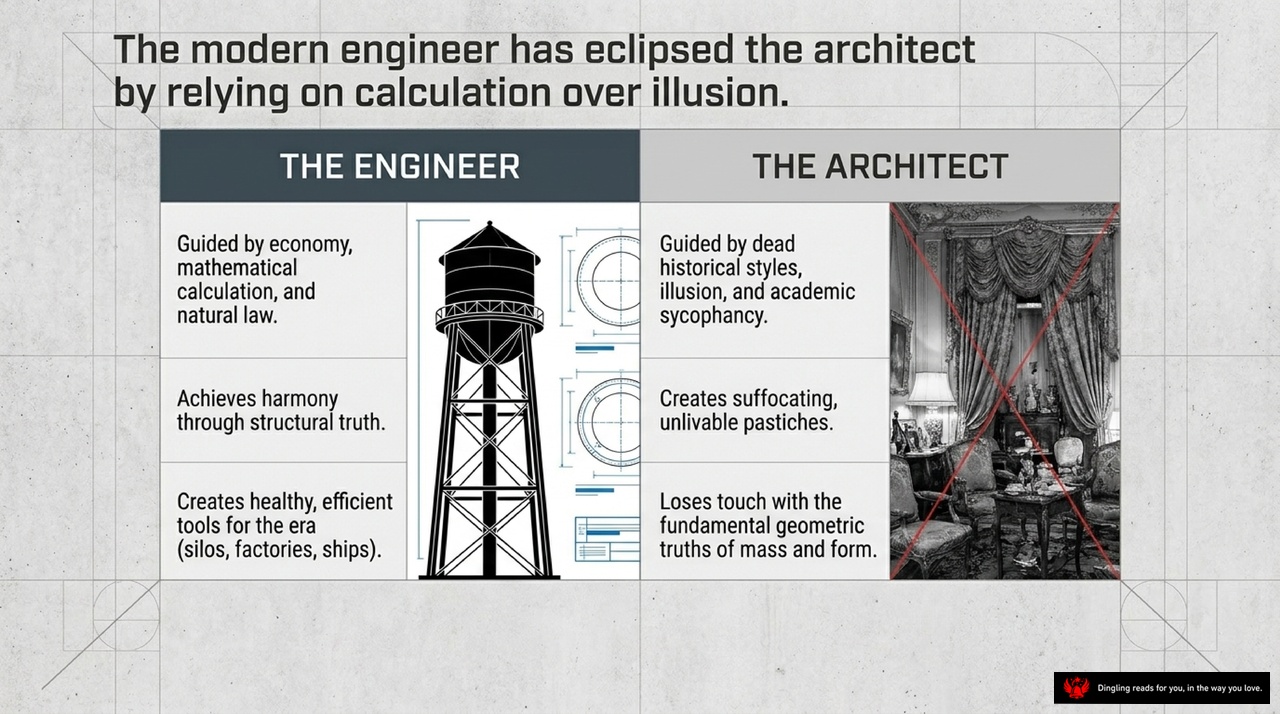
Look at this slide. It lays out a stark contrast between two worldviews: The Engineer and The Architect.
On the left, we see the Engineer. Guided by economy, mathematical calculation, and natural law, the engineer achieves harmony through structural truth. Their creations—like the water tower and factory silos—are healthy, efficient tools for the era. They don't rely on illusion; they rely on logic.
On the right, we see the traditional Architect. Guided by dead historical styles and academic sycophancy, the architect creates suffocating, unlivable pastiches. The image of that ornate, over-decorated room isn't just a style choice; it represents a loss of touch with the fundamental geometric truths of mass and form.
The slide's main point is clear: The modern engineer has eclipsed the architect by relying on calculation over illusion. While the old school of architecture clings to outdated styles that ignore human needs, the engineer embraces the living conditions of our time. They build for function, for health, and for the future. It's a choice between a living, breathing structure and a static, suffocating museum piece.
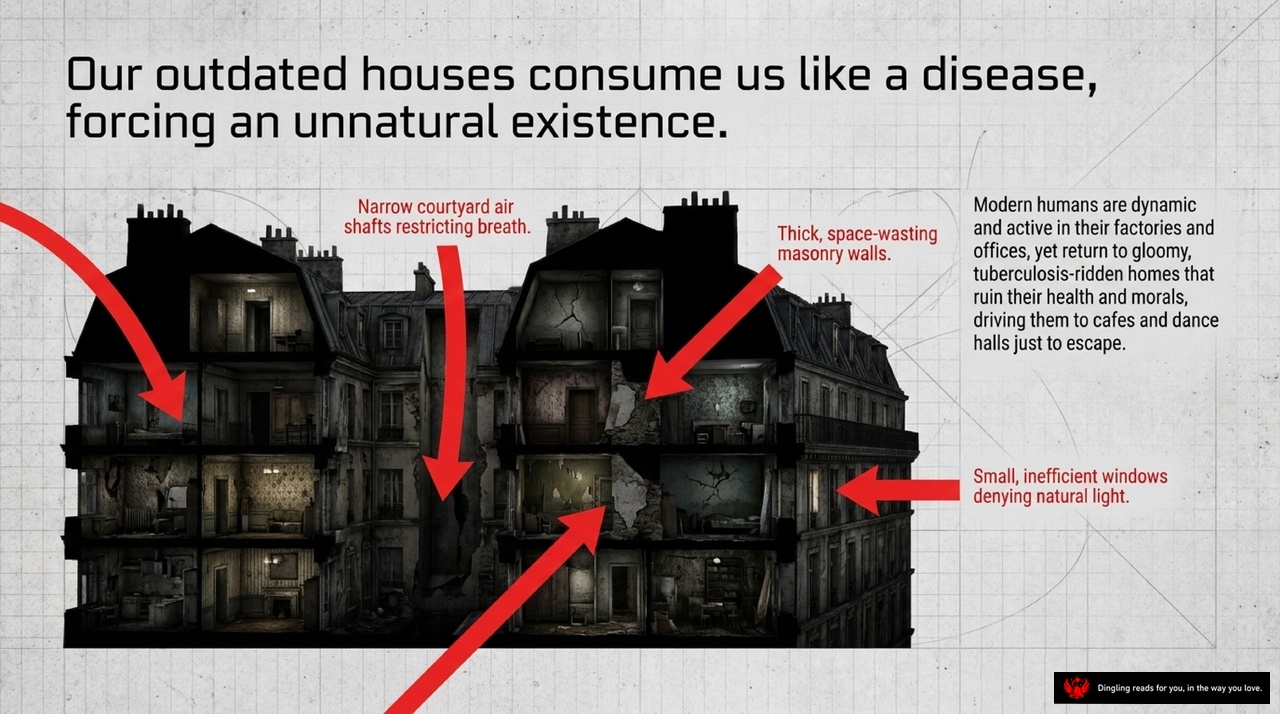
Our outdated houses are literally consuming us like a slow-acting disease, forcing us into an unnatural existence that feels suffocating. Look at this cross-section of the typical old home: it's a trap designed to drain our vitality.
First, notice those narrow courtyard air shafts. They restrict our breath, creating a stale, claustrophobic atmosphere that feels like we're holding our breath every time we walk through the door. Then, look at these thick, space-wasting masonry walls. They are heavy, cold, and inefficient, acting as barriers rather than shelters. They waste precious space that could be used for living, breathing, and connecting.
And don't forget the small, inefficient windows. They deny us natural light, leaving the interior in a gloomy, perpetual twilight. This isn't just an aesthetic flaw; it's a health crisis. Modern humans are dynamic, active, and creative in our factories and offices, yet we are forced to return to these dark, tuberculosis-ridden homes to rest. The result? We are physically and morally ruined. We can't find peace in our living spaces, so we are driven to escape to cafes and dance halls just to feel alive.
The diagnosis is clear: these old structures are not homes; they are cages. We need to stop worshipping these outdated relics and start building "sanatoriums"—spaces that prioritize health, light, and air. It's time to treat our housing not as a religious artifact, but as a vital tool for survival, just like a car or a machine. Only by breaking free from these gloomy, inefficient boxes can we reclaim our health and rebuild the foundation of our moral lives.
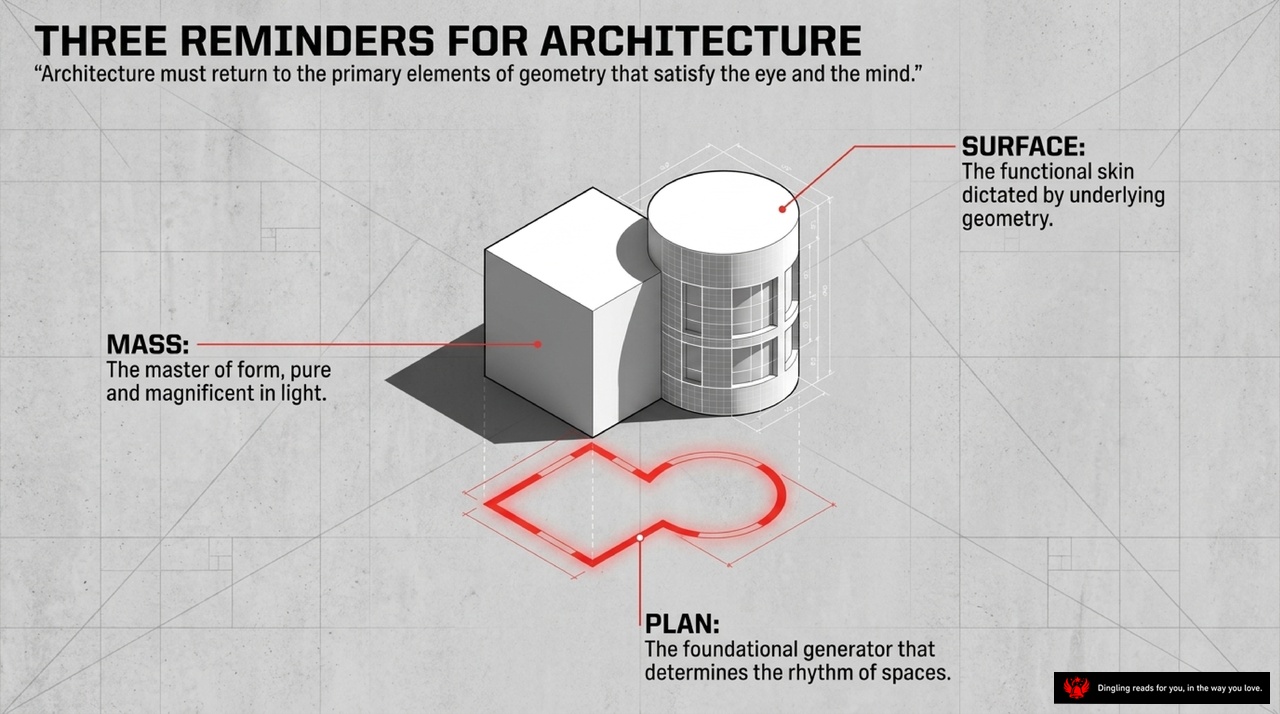
Look at these three core reminders for architecture: Mass, Surface, and Plan. Think of them not just as design elements, but as the fundamental language of the built environment. Mass is the master of form, the pure and magnificent body that interacts with light. It's the skeleton that gives structure and presence to the space. Then you have the Surface, which acts as the functional skin dictated by that underlying geometry. It's the layer that wraps the mass, responding to needs and defining the building's character without hiding its true form. Finally, there is the Plan. This is the foundational generator, the DNA of the entire project. It is the starting point that determines the rhythm and logic of all the spaces within. Without a clear plan, the mass and surface lose their direction. Together, these three elements create a harmony that satisfies both the eye and the mind, ensuring that every building is not just a shelter, but a coherent expression of order and purpose.
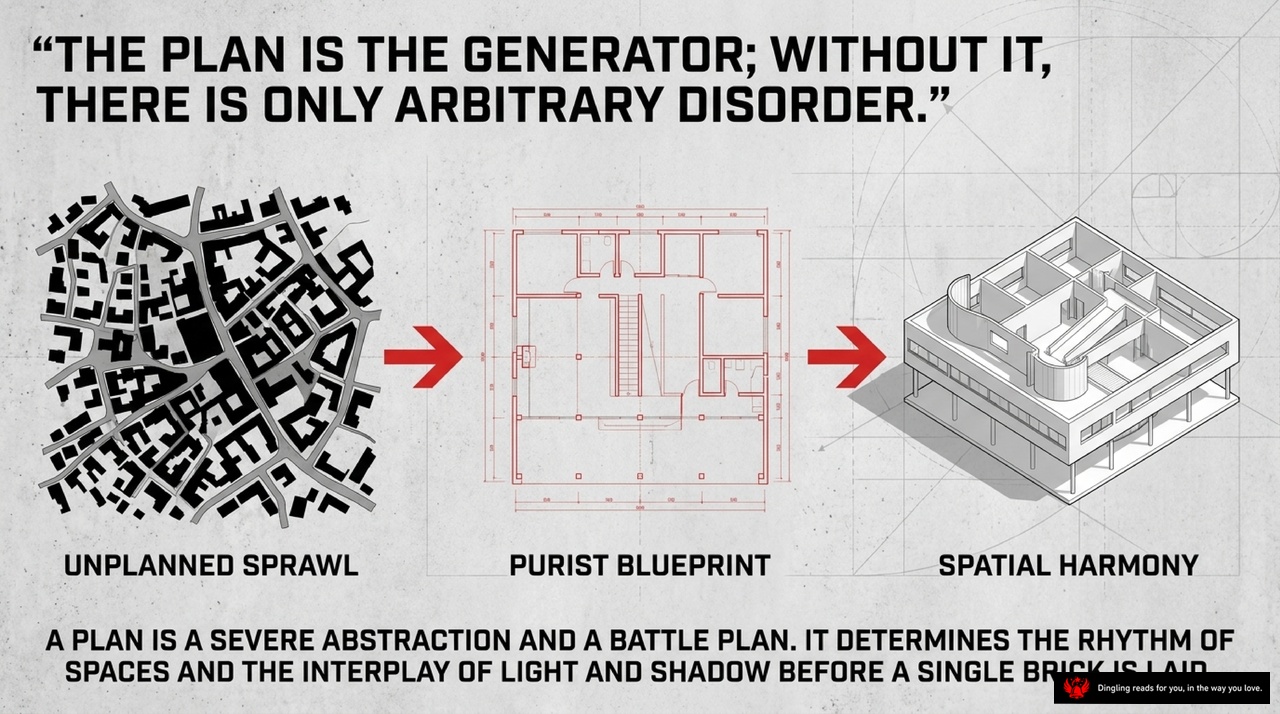
A plan is the generator; without it, there is only arbitrary disorder. Look at this progression: we start with unplanned sprawl, a chaotic mess of disconnected shapes. Then we move to a purist blueprint, a severe abstraction that acts like a battle plan. Finally, we achieve spatial harmony.
The text reminds us that a plan determines the rhythm of spaces and the interplay of light and shadow before a single brick is even laid. It is a battle plan against chaos. When we look at the history of great architecture, from the Parthenon to modern industrial cities, the secret to their beauty isn't decoration. It's the underlying logic of the floor plan.
Without a rigorous plan, you get confusion. But with a masterful plan, you create order. This order allows light to flow, allows people to move naturally, and creates a sense of peace. As the text suggests, true architecture is a performance of blocks under light, but that performance only makes sense if the stage—the floor plan—is designed with mathematical precision and a clear vision. So, before we worry about the style or the materials, we must first ask: does our plan have a logical soul? Because without that plan, we are just building disorder.
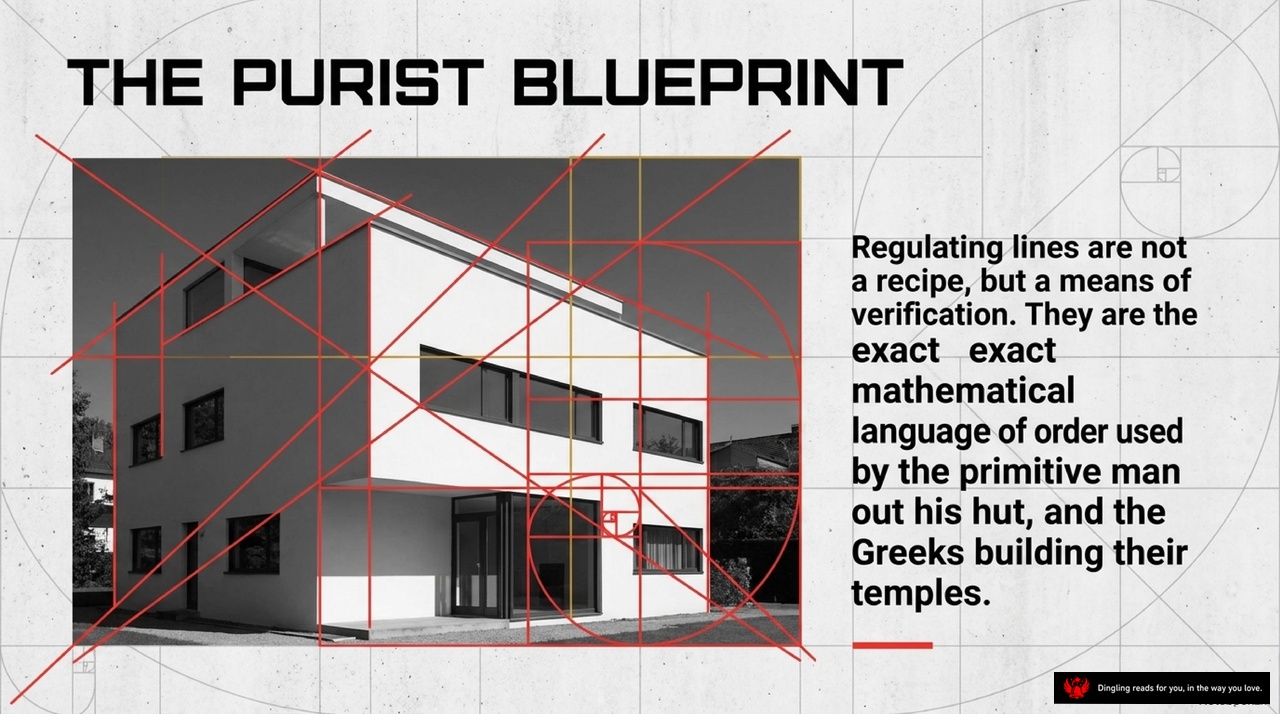
The slide before us, titled "The Purist Blueprint," captures the very essence of what it means to build for the modern age. Look at that stark, white structure overlaid with red geometric lines and golden spirals. These aren't just artistic flourishes; they are the DNA of a new architecture. The text on the right makes it crystal clear: "Regulating lines are not a recipe, but a means of verification."
Think about it. For centuries, we've been told that building is about copying old styles—adding fancy columns or decorative moldings just because they looked good in a palace from two thousand years ago. But that approach is broken. It's like trying to fix a modern smartphone by using a hammer from the stone age.
The image on your screen shows us the opposite. It shows that true order comes from mathematics and nature itself. Those red lines represent the exact, precise language of geometry that a primitive man used to build his first hut, and that the Greeks used to construct their temples like the Parthenon. It is the same language we need today.
This is the core of what we call "Engineer's Aesthetics." It's not about being cold or robotic; it's about finding harmony. When you align your design with the fundamental laws of the universe—using simple shapes like cubes, cylinders, and spheres, and organizing them with strict mathematical ratios—you create something that feels right. It feels alive. It resonates with the human soul because it mirrors the order we see in nature.
So, when you look at that building, don't just see a house. See a machine for living. See the triumph of logic over chaos. The red lines are the proof that this design works. They verify that every angle, every window, and every wall has a purpose. This is how we stop building monuments to the past and start creating homes for the future. This is the blueprint for a healthier, more moral, and truly beautiful society.
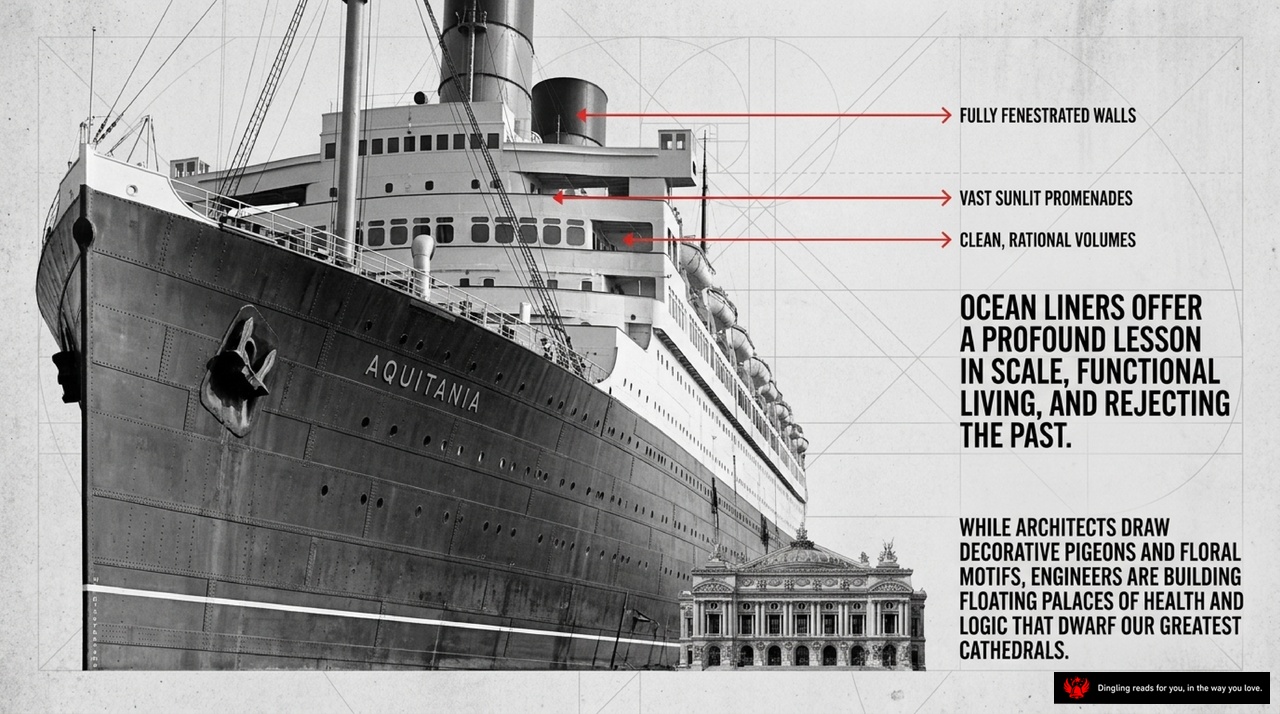
Look at this massive ocean liner, the *Aquitania*. It's not just a ship; it's a manifesto for a new way of living. Notice how the design breaks away from the ornate, decorative past. The image highlights "fully fenestrated walls," "vast sunlit promenades," and "clean, rational volumes." This is the essence of the engineer's aesthetic. While traditional architects were obsessed with copying history—adding fake pigeons and floral motifs to their buildings—engineers were doing something revolutionary. They were building floating palaces based on logic, health, and pure function.
Think about it: these ships are like the great cathedrals of their time, but instead of relying on ancient styles, they use math and science to create something truly beautiful. The text reminds us that while old houses were like tuberculosis patients, sucking the life out of us with their dark, damp, and inefficient designs, these new structures offer a cure. They prioritize sunlight, fresh air, and logical layouts. This shift from "style" to "function" is the only way forward. We need to stop worshipping outdated homes and start building tools that actually serve us—healthy, efficient, and dignified spaces that fit the modern world. The future isn't in the past; it's in the rational, clean lines of a ship that moves forward with purpose.
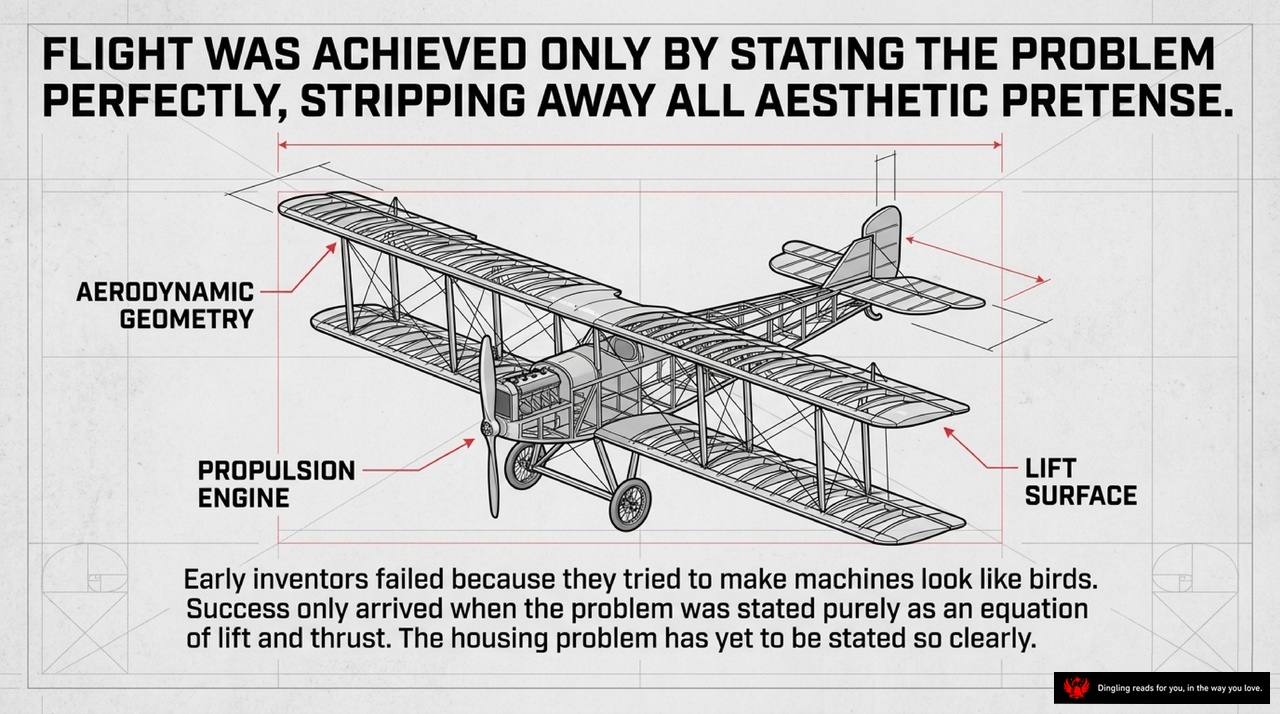
Look at this blueprint of an early airplane. It breaks down the machine into its purest parts: the aerodynamic geometry, the propulsion engine, and the lift surface. This diagram captures a profound truth that the book emphasizes: flight was only achieved by stating the problem perfectly and stripping away all aesthetic pretense.
Early inventors failed because they tried to make machines look like birds, obsessed with form over function. Success arrived only when the problem was stated purely as an equation of lift and thrust. The text argues that we are still stuck in this old way of thinking regarding housing. We cling to outdated, inefficient houses just because they feel familiar, treating them like religious relics rather than essential tools for survival.
Just as the airplane needed to ignore bird-like shapes to fly, our homes need to ignore old-fashioned styles to truly serve us. The book calls for a shift from viewing a house as a monument to viewing it as a machine for living. We need to define the housing problem with the same clarity and rigor that engineers applied to flight. Only by stripping away the unnecessary decoration and focusing on the core needs—light, air, and function—can we build a future that is not only healthy but also morally sound. The era of pretending our homes are works of art is over; the era of treating them as efficient, life-saving tools has just begun.

Perfection isn't a lucky accident; it requires the establishment of a rigorous standard. As we look at this evolution from a boxy early car to a streamlined masterpiece, notice how the design strips away the unnecessary to reveal the machine's true essence. It starts with a logical skeleton, evolves into aerodynamic form and structural integration, and finally settles into a minimalist essence. This transformation isn't about chasing trends or applying old-fashioned styles like Louis XV or Gothic ornamentation—those are just feathers on a woman's head, irrelevant to the building's soul. True beauty comes from logic, analysis, and economy. Once we set a standard, relentless competition strips away the superfluous, leaving only what is beautiful and necessary. Just as the airplane and the automobile were perfected through rigorous engineering and standardized parts, our homes must follow the same path. We need to stop treating houses as status symbols or museums of the past and start viewing them as efficient tools for living. By embracing this engineer's aesthetic, we can create spaces that are not just structurally sound, but genuinely harmonious with our modern lives.
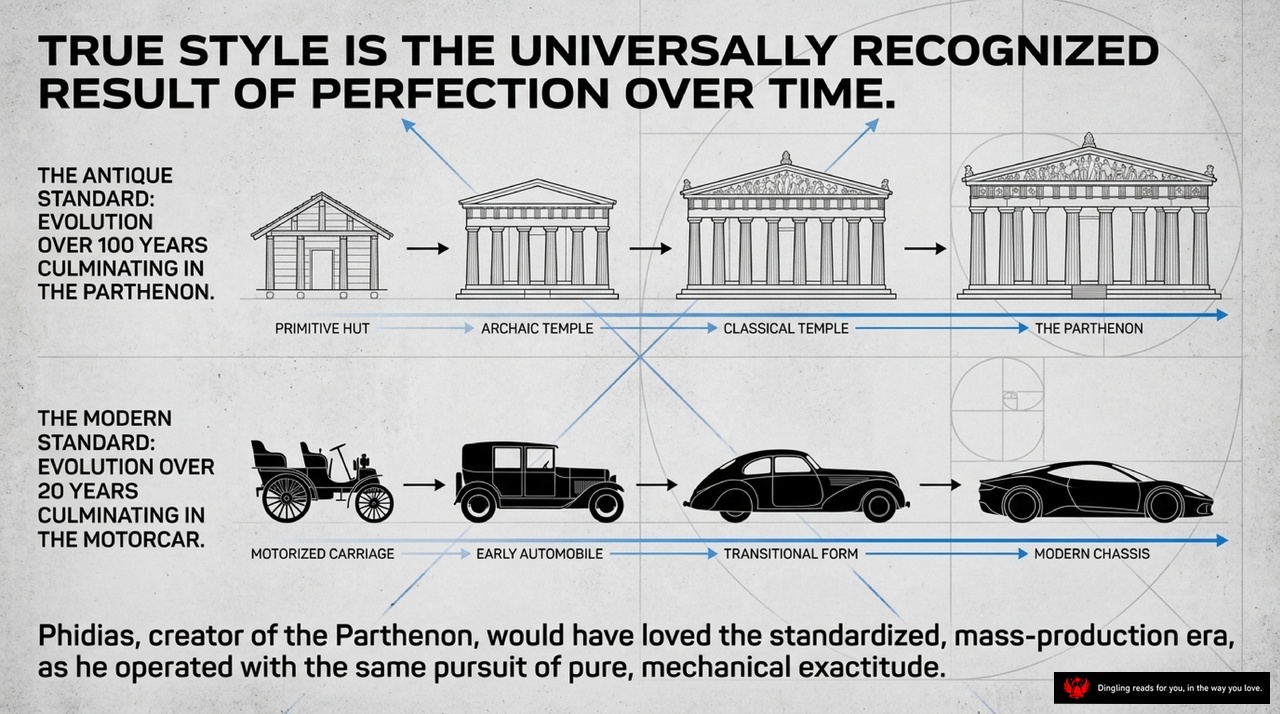
True style isn't about chasing fleeting trends or copying the past; it's the universally recognized result of perfection over time. Look at how the ancient standard evolved: from a primitive hut to an archaic temple, then a classical temple, and finally culminating in the Parthenon. This wasn't accidental; it was the evolution of over 100 years, refining a form until it achieved a kind of mechanical exactitude. Phidias, the creator of the Parthenon, would have loved our modern era. Why? Because he operated with the same pursuit of pure, mechanical exactitude that engineers do today.
Now, look at the modern standard. We've condensed that same journey into just 20 years. From the motorized carriage to the early automobile, through a transitional form, and landing on the modern chassis. This rapid evolution shows that true style emerges when we stop decorating and start perfecting function. Just as the Parthenon became the peak of its era through rigorous calculation and form, the modern car has become the peak of its era through standardized production and aerodynamic logic.
The lesson here is profound: whether you are building a temple or a sports car, the path to greatness is the same. It requires a deep understanding of the underlying principles, a relentless pursuit of efficiency, and the courage to let the form emerge naturally from the function. When we align our designs with universal laws of physics and human needs, we don't just build structures; we create a style that feels inevitable, timeless, and universally beautiful. That is the power of true style.
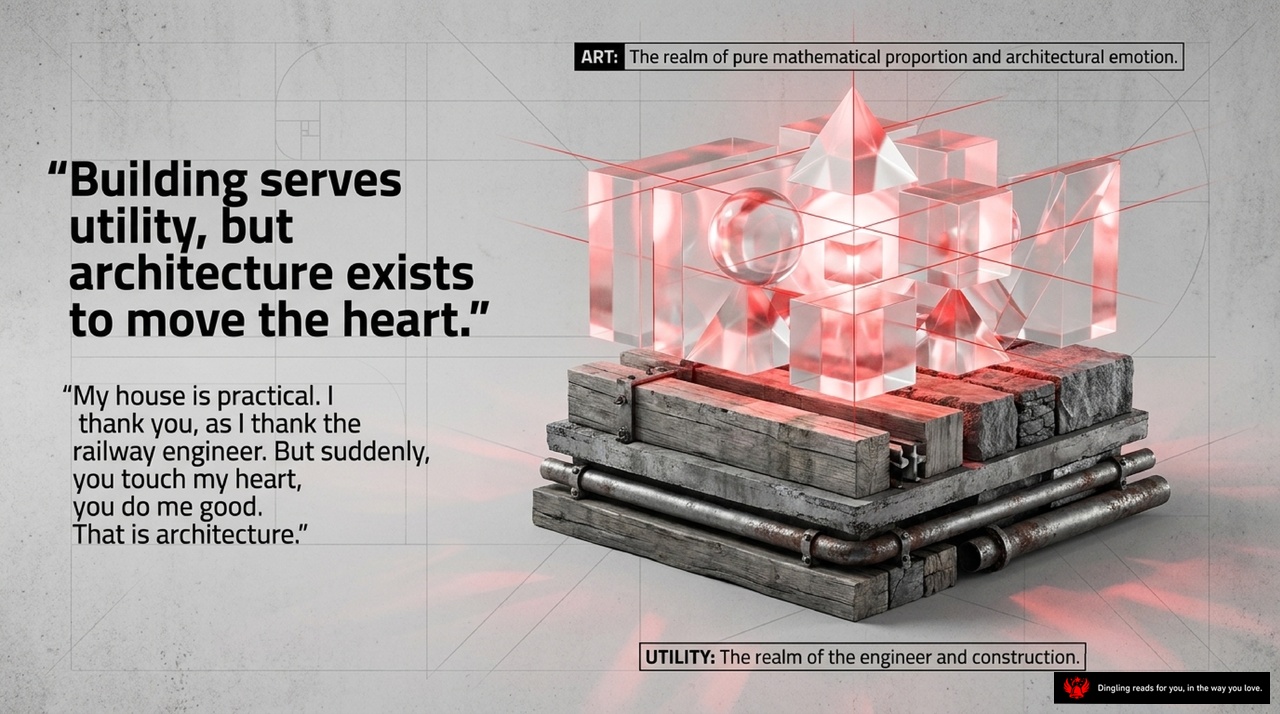
Building serves utility, but architecture exists to move the heart. This slide captures the fundamental tension between the engineer and the architect. On the right, we see a stark contrast: the base represents utility—the realm of the engineer and construction, built from raw, heavy materials like wood and steel pipes. It is practical, grounded, and functional. Rising from this base are the transparent, glowing geometric forms representing art—the realm of pure mathematical proportion and architectural emotion.
The quote on the left clarifies this dynamic perfectly. The author admits that his house is practical, just like the work of a railway engineer, which he respects. However, true architecture happens only when something touches the heart. It is that moment where a structure transcends mere shelter and becomes an emotional experience.
Think about your own life. You might appreciate a well-built car for its efficiency, but you only truly love a car that feels beautiful, that evokes a sense of freedom or power. Architecture is the same. We need the engineer's logic to make it stand, but we need the architect's vision to make it matter. Without that emotional connection, a building is just a shelter; with it, it becomes a home.
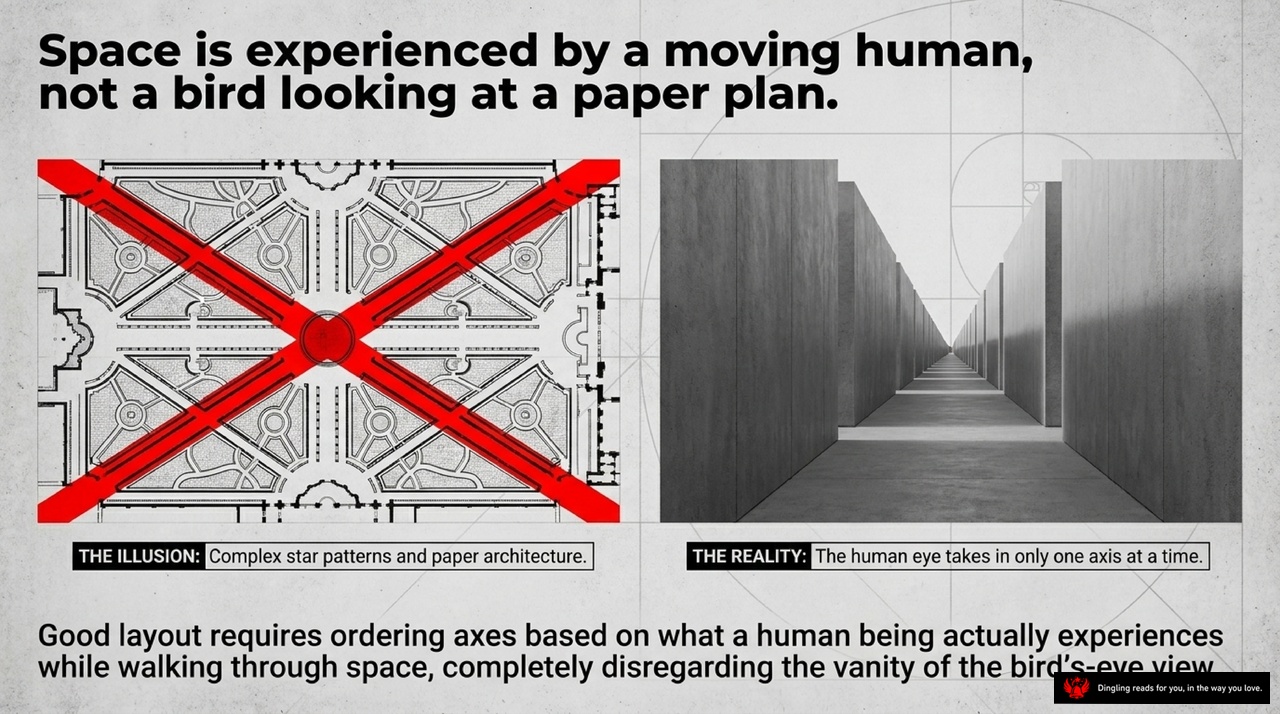
Space is experienced by a moving human, not a bird looking at a paper plan. Look at this slide: on the left, we see a complex star pattern and elaborate paper architecture, marked with a giant red X. That is the illusion. Architects often get lost in these abstract, two-dimensional drawings, obsessed with radial axes and symmetrical patterns that look good on a sheet but make no sense when you walk through them.
But on the right, we see the reality. Think about the human eye. We don't see the whole room at once; we take in only one axis at a time as we move forward. A good layout requires ordering these axes based on what a human being actually experiences while walking through space, completely disregarding the vanity of the bird's-eye view.
If you design a house like a map, you create a confusing maze. But if you design it like a journey, focusing on the sequence of walls, light, and openings that a person encounters step-by-step, you create true harmony. The human body is the true architect, and your design must serve that moving perspective, not a static, frozen image.
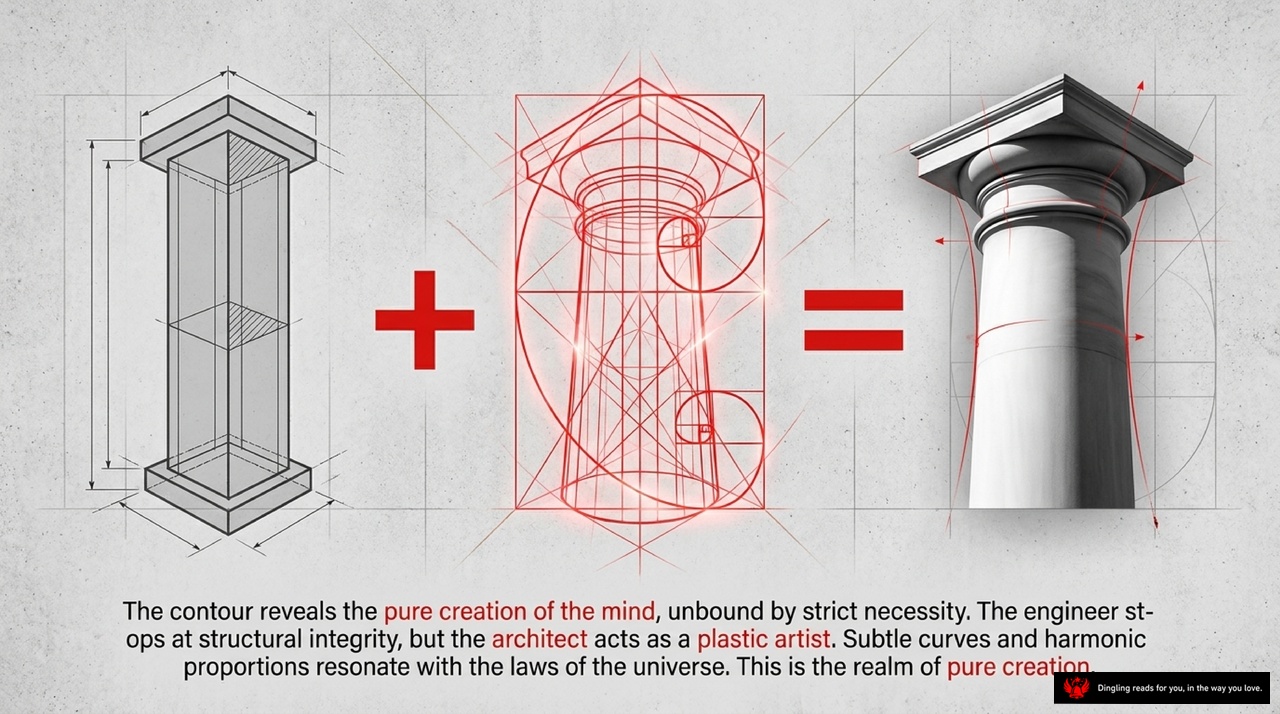
Look at this equation: rigid geometry plus pure creative contour equals true architectural beauty. On the left, we see the engineer's domain—strict structural integrity, unbound by anything but necessity. But on the right, we see the architect's realm, where subtle curves and harmonic proportions resonate with the laws of the universe.
The text reminds us that while the engineer stops at structural safety, the architect acts as a plastic artist. This is the realm of pure creation. It's not about following old styles or historical trends; it's about unbinding the mind from strict necessity. When we combine the logical precision of engineering with the imaginative freedom of art, we get something that truly touches the soul. That's where real beauty lives—not in copying the past, but in creating something new that fits the rhythm of our world.
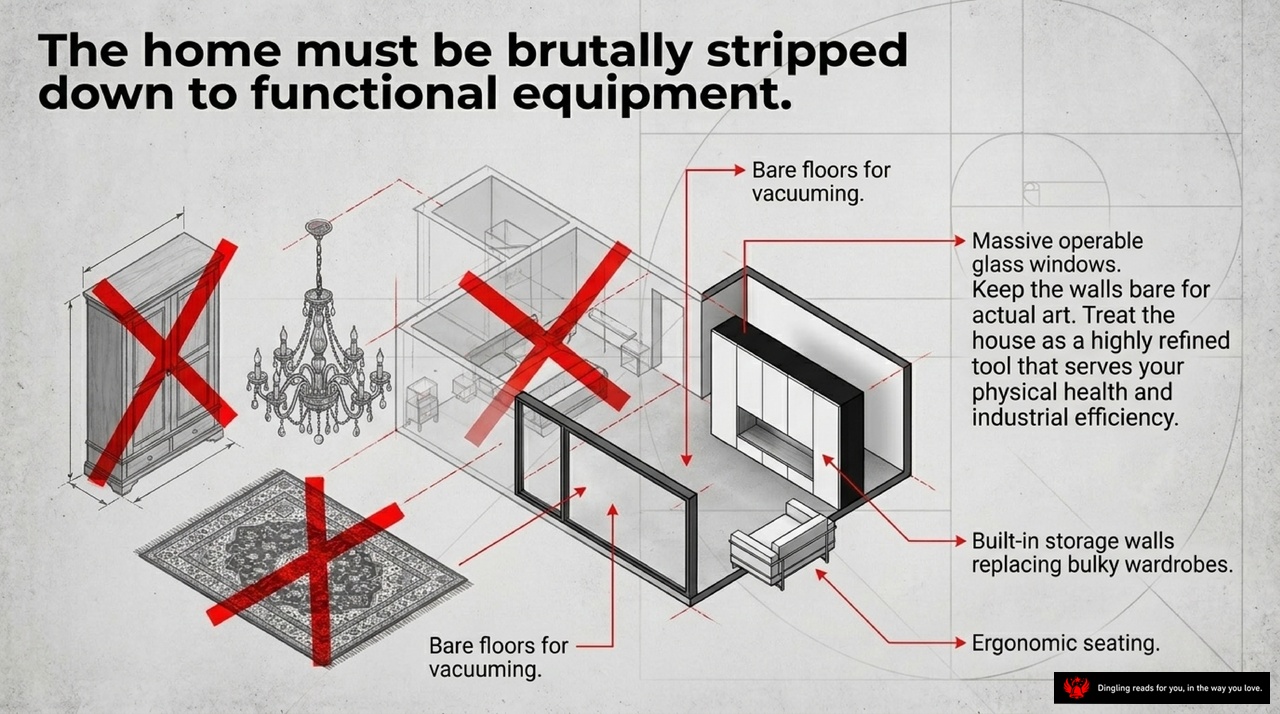
Look at this blueprint. It's a radical declaration: the home must be brutally stripped down to functional equipment. No more ornate wardrobes, no heavy chandeliers, and absolutely no carpets. These are the things we've been told are essential, but they are actually the enemies of a healthy life.
Imagine a living space where the walls are bare, ready to display real art instead of hiding behind wallpaper. Imagine massive operable glass windows that flood the room with light, treating the house not as a museum of the past, but as a highly refined tool for your physical health and industrial efficiency. We need built-in storage walls to replace those bulky, outdated wardrobes, and we need ergonomic seating that actually supports our bodies.
Why the red crosses on the furniture? Because we've been living in a lie. We've been clinging to old, suffocating styles—like those heavy rugs and dusty lamps—just because they feel familiar. But familiarity isn't health. Just like a clogged lung hurts your body, an outdated home hurts your spirit. It traps you in a dark, inefficient shell that breeds misery and moral decay.
The solution is simple and bold: treat your house like a machine designed for modern life. Strip away the unnecessary decoration and focus on what truly matters: light, air, function, and efficiency. When we do this, we stop worshipping the past and start building a future that actually serves us. This isn't just about design; it's about liberation. It's time to break the chains of tradition and embrace a home that works as hard as we do.
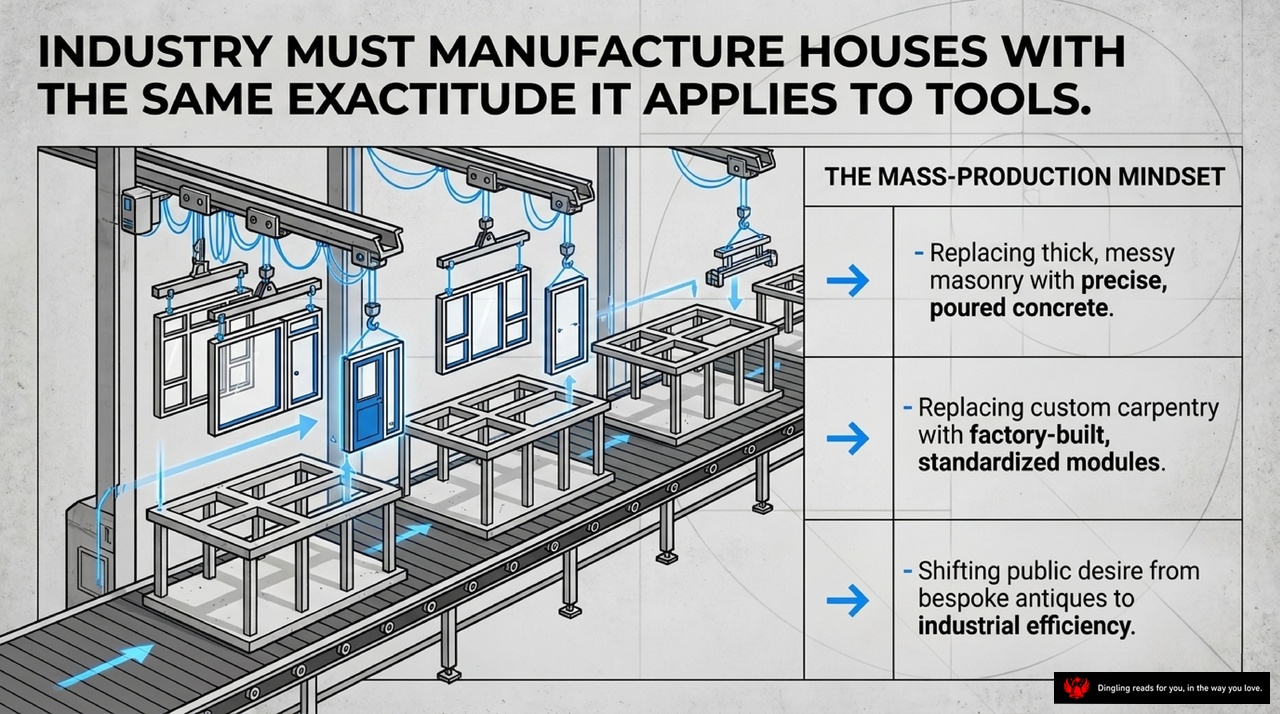
Imagine a factory floor where houses are being assembled with the same precision as automobiles. Instead of messy masonry and custom carpentry, we see precise poured concrete and standardized modules moving down the line. This is the mass-production mindset, and it represents a fundamental shift from the past.
For too long, we've been trapped in old houses that act like tuberculosis, slowly destroying our health and moral fiber. These outdated structures are relics of a bygone era, clinging to a false sense of intimacy that is actually harmful. Just as a wrench or a plow is a tool designed for a specific time, a home must be a tool for the modern age.
The solution lies in applying industrial efficiency to housing. We need to replace the heavy, inefficient methods of the past with the clean, rational logic of engineering. By treating a house like a well-designed machine—prioritizing function, light, and health over decorative styles—we can finally create living spaces that support life rather than suffocate it. It's time to stop worshipping the past and start building the future.
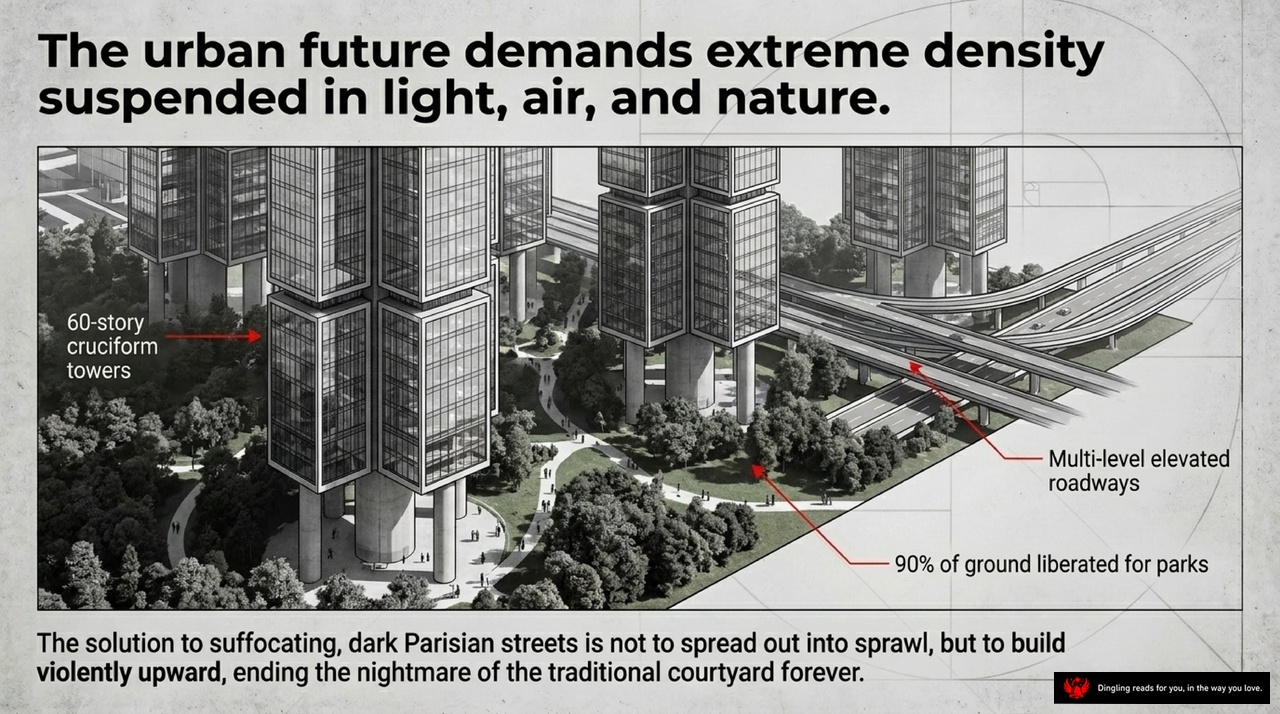
The urban future demands extreme density suspended in light, air, and nature. Look at this vision: towering 60-story cruciform structures rising above the city, while multi-level elevated roadways handle traffic without cluttering the streets below. Most importantly, ninety percent of the ground is liberated for parks and green spaces, transforming the city into a living garden.
This is the antidote to the suffocating, dark streets of the past. We cannot solve our urban crisis by spreading out into sprawl; that only destroys our land and fragments our community. Instead, we must build violently upward. By concentrating our density in these efficient towers, we free up the surface for nature, health, and community life.
This approach ends the nightmare of the traditional courtyard forever. It shifts the focus from owning a piece of land to accessing a high-quality environment. It treats the city not as a collection of isolated properties, but as a unified, functional machine where efficiency meets beauty. When we embrace this vertical density, we don't just build taller; we reclaim our right to breathe, to walk in the sun, and to live in harmony with nature. This is the only path forward for a modern city that values both human well-being and environmental stewardship.
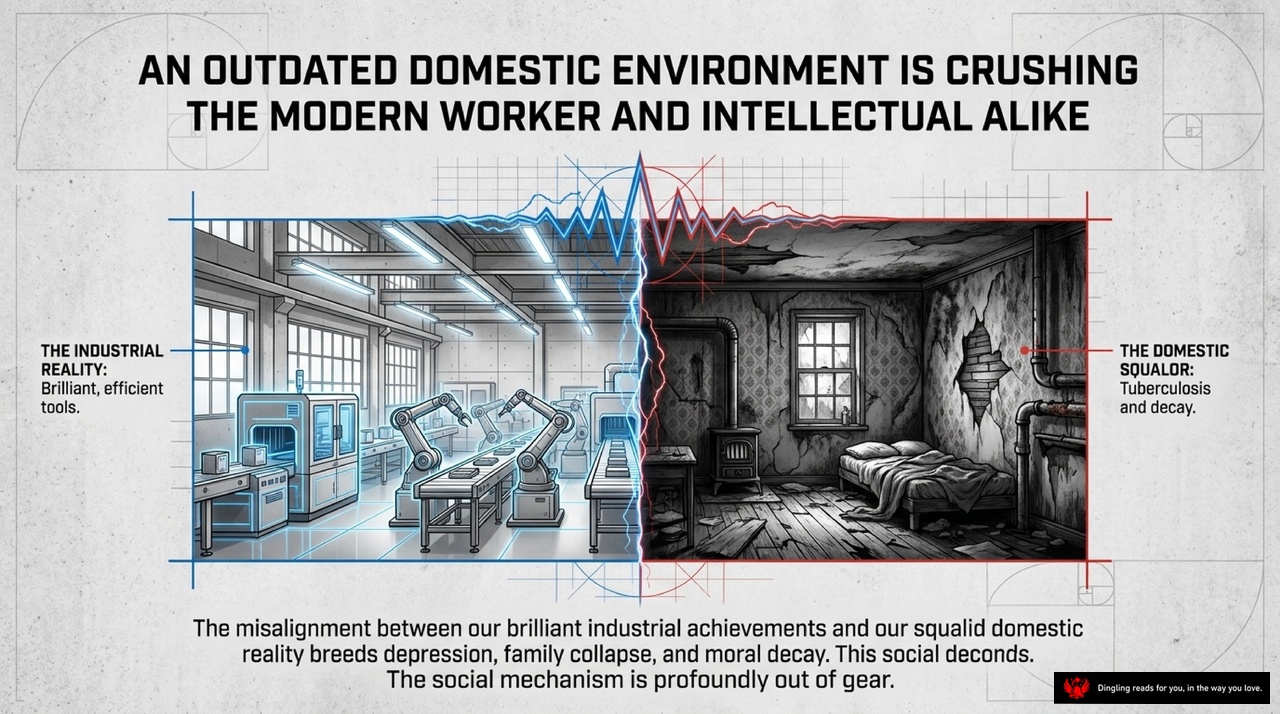
Look at this stark split. On the left, we see the Industrial Reality: brilliant, efficient tools working in perfect harmony. But on the right? That is the Domestic Squalor: tuberculosis and decay. This graphic exposes a brutal truth that was tearing modern society apart. While engineers were building magnificent machines, the average worker and intellectual was being crushed by an outdated home environment.
This misalignment between our brilliant industrial achievements and our squalid domestic reality breeds depression, family collapse, and moral decay. It is a profound social deconstruction. The social mechanism is simply out of gear. People worked in clean, efficient factories, only to return to dark, damp, and decaying homes that acted like a slow poison. This wasn't just an architectural failure; it was a public health crisis and a moral crisis. We were living in the past while the future was being built right outside our doors.
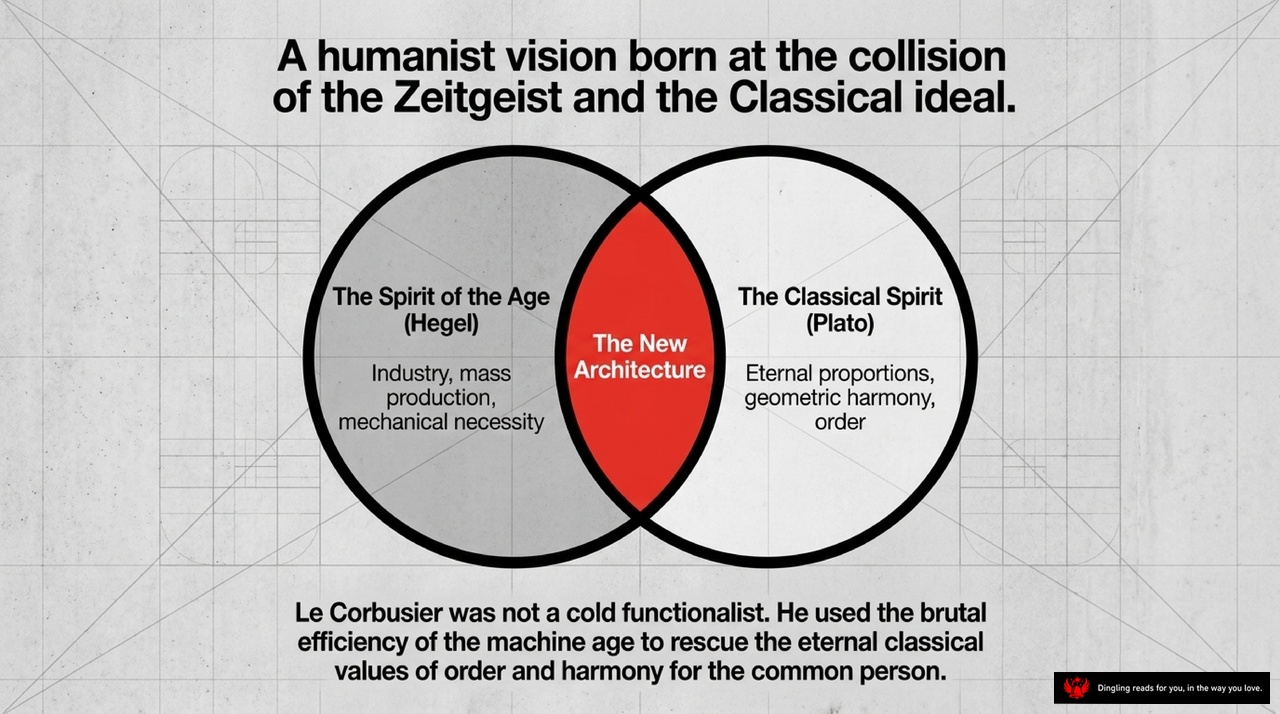
A humanist vision born at the collision of the Zeitgeist and the Classical ideal. Look at this diagram: on the left, we have the Spirit of the Age, championed by Hegel—driven by industry, mass production, and the mechanical necessity of the modern world. On the right, we see the Classical Spirit, rooted in Plato's eternal proportions, geometric harmony, and timeless order. The red intersection? That is Le Corbusier's revolutionary answer: The New Architecture.
He wasn't a cold functionalist. Instead, he brilliantly used the brutal efficiency of the machine age to rescue those eternal classical values of order and harmony for the common person. Think about it: just as the automobile and the ocean liner evolved through rigorous calculation and standardization to become the perfect machines of their time, Le Corbusier argued that housing must follow the same logic. He believed that by applying mathematical precision and industrial methods, we could create homes that are not just shelters, but healthy, moral, and beautiful environments. This synthesis of modern efficiency and classical beauty is what makes his vision so enduring.
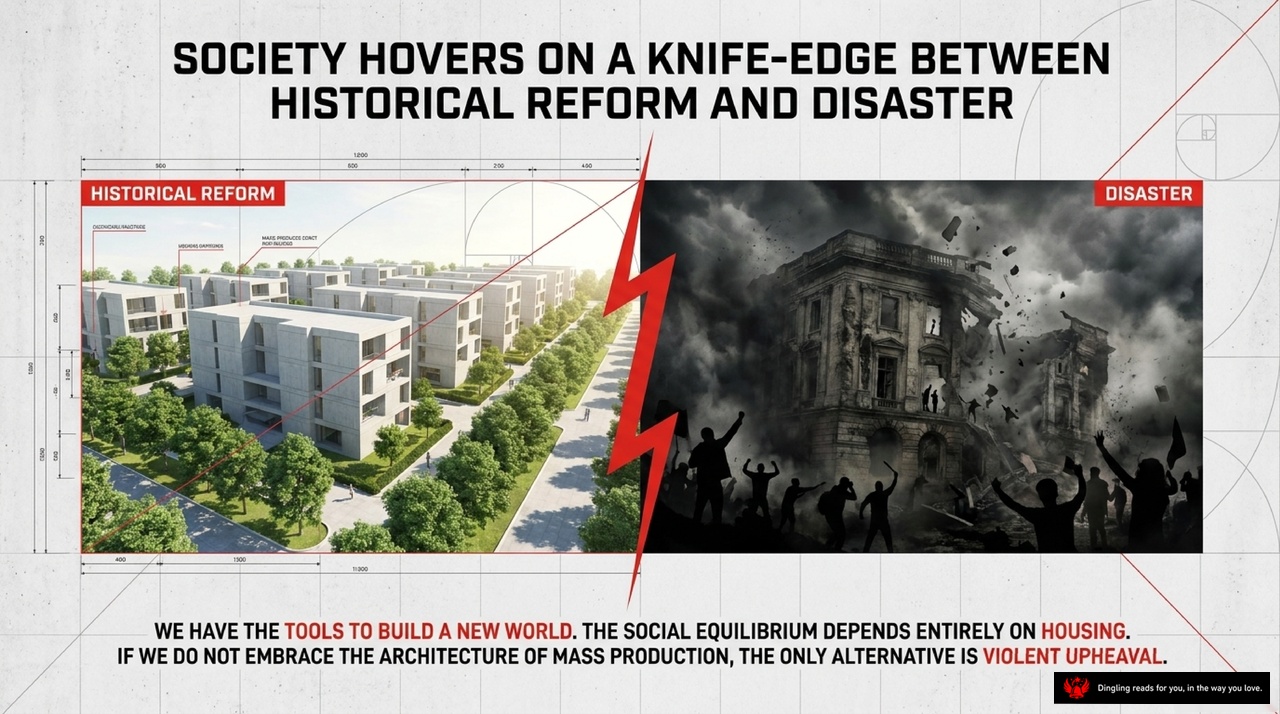
Society is currently balancing on a razor's edge between the path of historical reform and the abyss of disaster. As we look at the slide, the contrast is stark: on one side, we have the orderly, sunlit promise of mass-produced housing; on the other, the chaotic destruction of violent upheaval. The message is clear—our social equilibrium depends entirely on how we handle housing.
If we fail to embrace the architecture of mass production, the only alternative left is violent revolution. We have all the tools necessary to build a new world, but we are stuck in the past. For decades, architects have been trapped by outdated styles and emotional attachments to old, decaying homes. These obsolete structures are like tuberculosis patients, slowly consuming the health and morality of their inhabitants. They are dark, damp, and suffocating, turning families into isolated prisoners.
The solution lies in the engineer's approach. We must treat housing not as a museum piece or a status symbol, but as a practical tool—just like a car or a machine. By utilizing modern materials like reinforced concrete and standardized components, we can produce healthy, affordable homes in a fraction of the time it used to take. This isn't just about construction; it's about saving society. It is the only way to align our living spaces with the modern spirit, ensuring that our homes support life rather than destroy it.

The ultimate choice of the modern era is right in front of us. The New Architecture demands that we strip away the illusions of the past. By marrying the relentless logic of industrial mass production with the eternal geometric truths of the cosmos, we can create machines for living that elevate the human spirit. This isn't just about building walls; it's about forging a harmony between our daily lives and the fundamental laws of the universe.
Look closely at the question that defines our path: The tools to rebuild our world are already in our hands. Will we choose the harmony of Architecture, or the collapse of Revolution? This is the critical crossroads. If we cling to outdated styles and inefficient, unhealthy homes, we risk social collapse. But if we embrace the rational, efficient, and beautiful solutions that engineers and modern industry offer, we can build a future that is not only functional but spiritually uplifting. The choice is ours, and the tools are ready.