
Tristes Tropiques: Complete Chapter-by-Chapter Summary

Welcome to *Tristes Tropiques* by Claude Lévi-Strauss. Set against the misty, ancient depths of the Amazon rainforest, this book isn't just a travel diary; it's a philosophical memoir of disillusionment. Lévi-Strauss strips away the romantic myth of exploration to reveal a harder truth: the inevitable entropy of human civilization. He argues that what we often call "discovery" is actually a collision where the vibrant, raw life of the tropics gets corrupted by the chaotic energy of the expanding West. Instead of finding pure, untouched treasures, travelers often only bring back contaminated memories. The book challenges the very idea of progress, suggesting that our modern world, with its mass culture and uniformity, is far less rich than the diverse, complex societies we seek to observe. It's a profound invitation to question our assumptions about the past, the present, and the future of humanity itself.
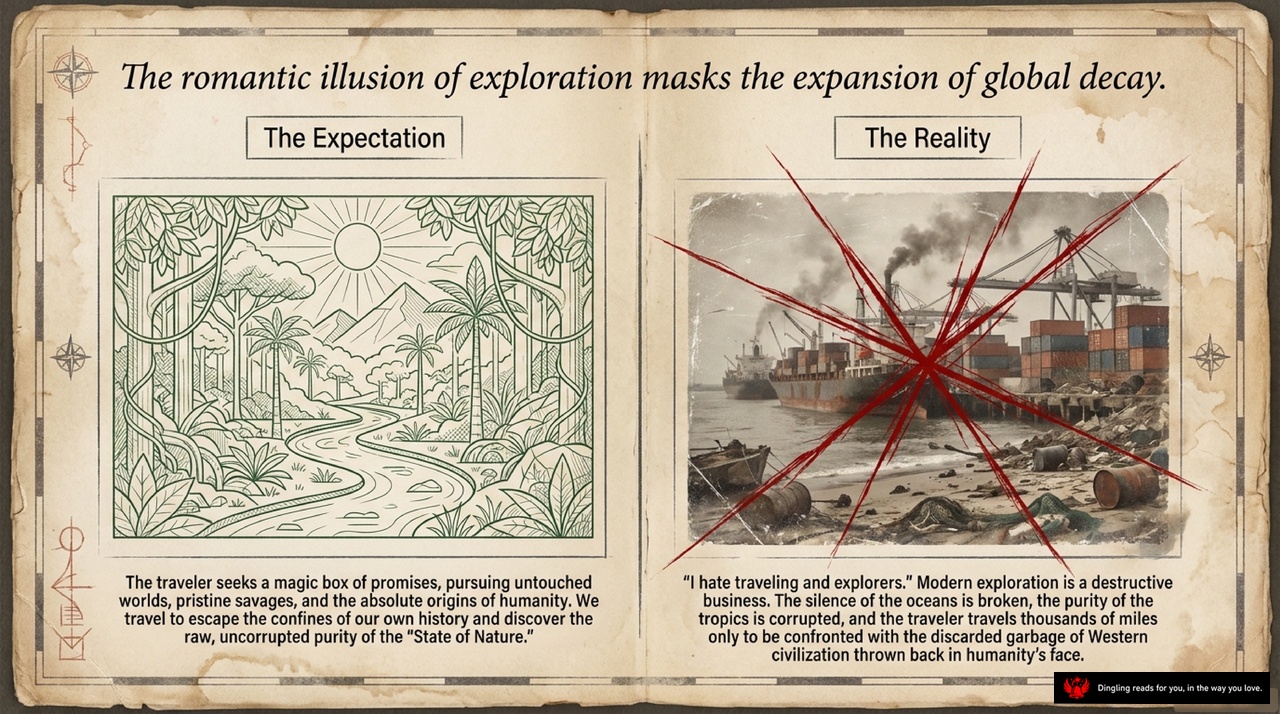
The romantic illusion of exploration masks the expansion of global decay. On the left, we see "The Expectation": a pristine jungle, untouched by time, where the traveler seeks a magic box of promises—pursuing raw, uncorrupted purity and the absolute origins of humanity. We travel to escape our own history, dreaming of a "State of Nature" that never truly existed. But look at "The Reality" on the right. That idyllic scene is shattered by the harsh truth: modern exploration is a destructive business. The silence of the oceans is broken, and the purity of the tropics is corrupted. Instead of discovering new worlds, the traveler travels thousands of miles only to be confronted with the discarded garbage of Western civilization thrown back in humanity's face. From shipping containers choking the docks to the toxic waste littering the shore, we see that our quest for the exotic is often just a journey to find our own decay. We aren't escaping our history; we are just running in circles, carrying our own waste into the wilderness, hoping to call it something else.

Anthropology anchors abstract thought to tangible human history and space. On the left, we see "The Loop: French Philosophy"—a closed circle representing a system of intellectual gymnastics that relies on verbal juggling rather than reality. It forces complex truths into rigid binaries, becoming a closed aesthetic exercise of the mind meditating upon itself. But on the right, we have "The Grounded Line: Anthropology." This is the discipline bridging physical science and human history. It demands that the researcher physically step out of their society, utilizing space and geographical distance to understand the immense, cumulative labor of thousands of generations across diverse environments. While philosophy often gets trapped in its own circular logic, anthropology breaks that loop by grounding ideas in the real world. It moves us from abstract debate to the messy, vibrant reality of actual human lives lived in specific spaces and times.

The daily cosmic drama of the sunset foreshadows the fate of all civilizations. It's not just a pretty show; it's a complete theatrical performance that replays the battles, victories, and defeats of creation.
As the sun dips below the horizon, luminous clouds mimic solid architecture, projecting a brief, impossible grandeur. But this spectacle is fleeting. It leads directly into the collapse—the rapid, imperceptible shift where vibrant structures freeze into agonizing, immutable forms, ultimately dissolving into the dark void of the night sky.
In the 1930s, I witnessed this exact cycle firsthand in Brazil. I saw the "Overture" of the late afternoon, a golden haze masking the preparation of hidden forces, creating an illusion of permanence. But beneath that beauty, the struggle was already setting in. The vibrant, wild towns I admired were built on borrowed time, like temporary structures at a world's fair. They lacked the deep, enduring history of Europe. Within a few decades, the lush forests were cut down, the soil was stripped bare, and the grandeur turned to dust.
The sunset doesn't just end the day; it reveals the fragility of our own civilization. We are constantly building new structures, only to watch them freeze and dissolve before they can truly mature. The drama of the sunset is the drama of our history—a constant cycle of creation and inevitable collapse.

The anthropologist sacrifices their own social roots to observe those of others. This isn't just a trade-off; it's a fundamental paradox that defines the very nature of our work. Look at the diagram: we are caught between two worlds, paralyzed by the impossibility of truly belonging to either.
On the left, we see "The Rejection of the Self." Driven by a deep alienation from our own culture, we often reject its norms, seeking truth in distant lands. We become symbols of our own society's remorse, fleeing the familiar to find what we've lost. But on the right, we face "The Inaccessibility of the Other." Despite our efforts to identify with the indigenous subject, the researcher can never truly integrate. We are reduced to mere observers, condemned to watch the destruction of the purity we sought, forever unable to step fully into their shoes.
At the center sits the ethnographer, caught in this tension. As the text reminds us, we are "caught between two worlds." We are unable to adopt the values of the observed culture, yet we remain forever estranged from our own. This is the core dilemma: to understand another, we must distance ourselves from ourselves, creating a space where connection is possible, but where true integration remains an impossible dream.

This slide presents a stark structural diagnosis of human suffering, contrasting the Americas with India and Asia. On the left, under "The New World," we see a landscape defined by vast, empty spaces where nature dwarfs human presence. The suffering here stems from isolation—a melancholy of being cut off from history, where survival is a lonely struggle against an overwhelming physical universe.
In sharp contrast, the right column depicts "The Old World." Here, nature has been entirely consumed, replaced by a compressed, ruined landscape of human dust. We see agonizing hyper-density, where millions are forced into proximity, poisoning the social environment. The economic extraction is not about clearing land for a new frontier, but utter resource depletion after five thousand years of habitation. This leads to a profound degradation of humanity, where survival demands self-abasement and treating other people as sub-human just to secure basic resources.
Essentially, one hemisphere suffers from the tragedy of being erased by time and space, while the other suffers from the tragedy of being crushed by its own numbers and history. It's a powerful reminder that the nature of our pain depends entirely on the structure of the world we inhabit.

The tragedy of the tropics isn't just a story of the past; it's a relentless cycle of extraction and abandonment that we are still watching unfold. As we look at this map, we see a brutal progression: first comes the wood, stripping the infinite jungle down to disposable resources. Then the violent gold rush, where 18th-century mining camps rise and fall as quickly as veins run dry.
But the real destruction begins with the agricultural fire. We clear the land for sugar and coffee, ruthlessly exhausting the soil until it's worthless, only to push the frontier westward and repeat the process. Finally, we reach rubber, where desperate adventurers displace entire indigenous populations, leaving behind impoverished soils and ghost towns.
This is the synthesis: "First yellow, then white, gold finally turns black." The New World was never truly cultivated; it was merely consumed. We treated the land not as a living partner, but as a resource to be mined and discarded. This pattern of expansion and exhaustion reveals a darker truth about our civilization: we don't build a future; we just consume the present until there is nothing left.

Extreme demographic density fundamentally degrades human equality. Look at this scene: it's not just a drawing of old buildings; it's a portrait of a society pushed to its breaking point.
The slide breaks this down into three critical points. First, we have "The Toxic Environment." In places like India, the environment isn't just about geography or weather; it's defined by the sheer mass of human bodies. When millions are packed together, filth and starvation stop being exceptions and become the natural baseline of existence. It creates a sociological sickness where survival itself feels impossible.
Second, this leads to "Asiatic Cruelty." True equality becomes impossible in such a crowded system. To survive, individuals are forced to artificially widen the gap between themselves and those with resources. They use abasement, self-mutilation, and even desperate prayer as tools just to extract the bare minimum for sustenance. It's a brutal hierarchy born out of necessity.
Finally, we see "The Warning." India is not an anomaly; it is a preview of what happens when a global system becomes closed and overpopulated. When the sheer mass of consumers exceeds the available resources, the inevitable result is a degradation of human equality. We are looking at a future where humanity is crushed under the weight of its own numbers.
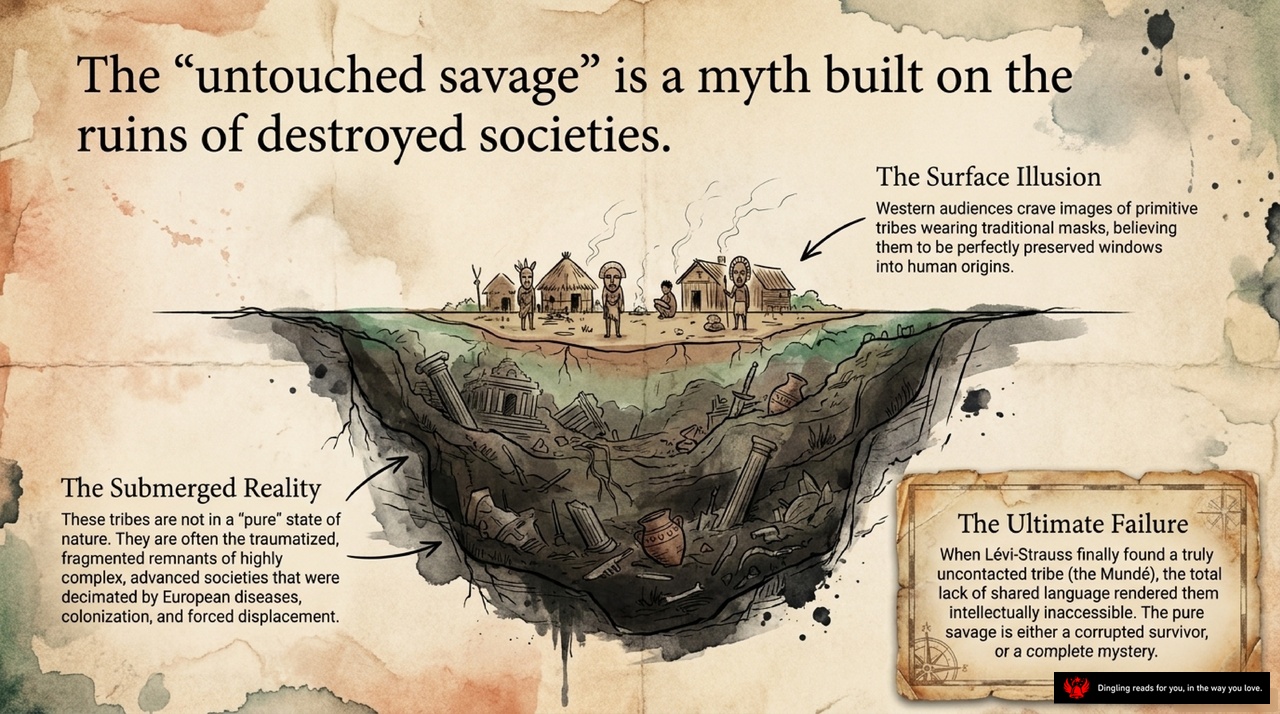
The "untouched savage" is a myth built on the ruins of destroyed societies. Look at this image: above the water, we see what the West loves to imagine—pristine tribes in masks, perfect windows into human origins. But beneath the surface lies the submerged reality. These aren't pure survivors; they are traumatized fragments of complex societies decimated by disease, colonization, and forced displacement. When Lévi-Strauss finally found a truly uncontacted tribe, the lack of shared language made them intellectually inaccessible. The pure savage is either a corrupted survivor or a complete mystery. We are looking at an illusion, not a truth.

Initiation rites are desperate mechanics to extract power from the fringes of nature. Think about it: in a rigid society where your path is strictly governed by custom with no room for personal advancement, what happens when a youth feels trapped? They don't just wait; they gamble. They step completely outside the protective order of society, pushing their physical and mental limits to the absolute edge of survival through extreme fasting, self-mutilation, and isolation.
This isn't random barbarism. It's a calculated structural gamble. By venturing into the chaos of the wild, the individual attempts to capture supernatural power from nature's fringes, hoping to elevate their social standing. It's a high-stakes trade: they sacrifice their safety in the civilized world to buy a new identity and status from the untamed wilderness.
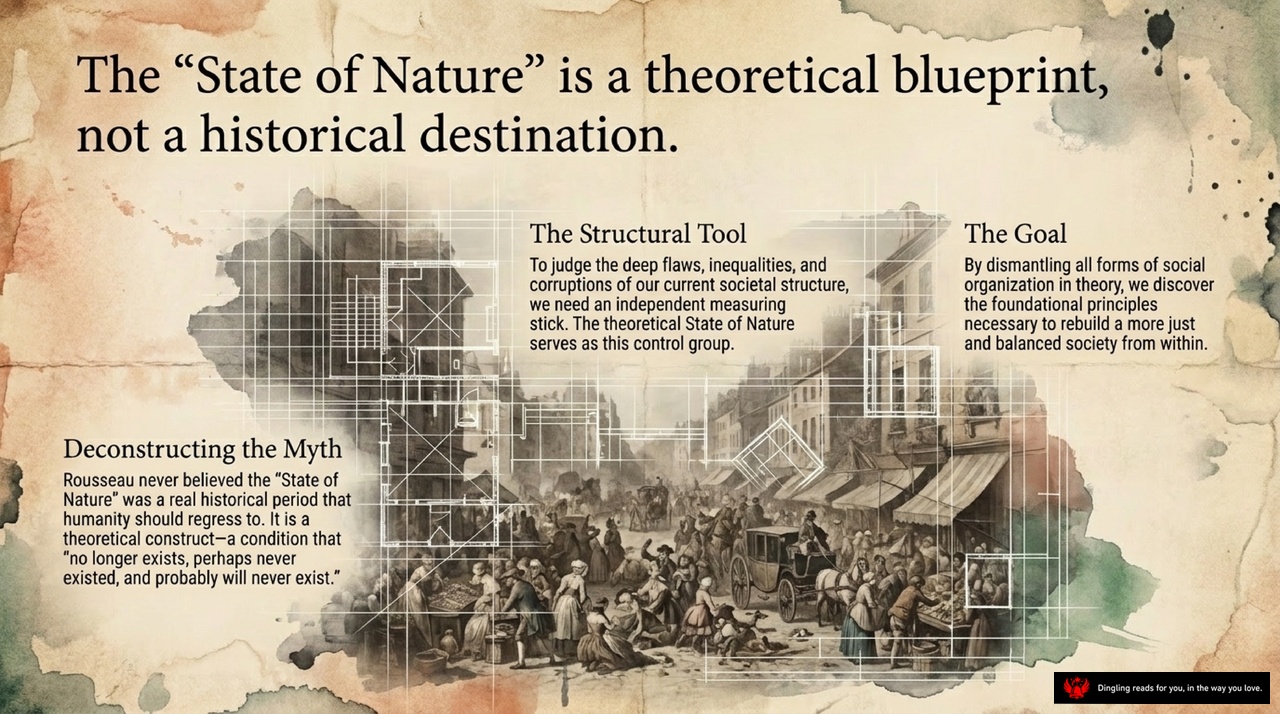
The "State of Nature" is a theoretical blueprint, not a historical destination. This slide challenges a common misconception about Rousseau: he never believed humanity should regress to a mythical past. Instead, this concept is a tool—a control group—to help us judge the deep flaws and inequalities in our current society. By imagining a world without social organization, we can strip away the noise and discover the foundational principles needed to rebuild a more just and balanced society from within. It's not about going backward; it's about using that theoretical lens to understand what truly matters.
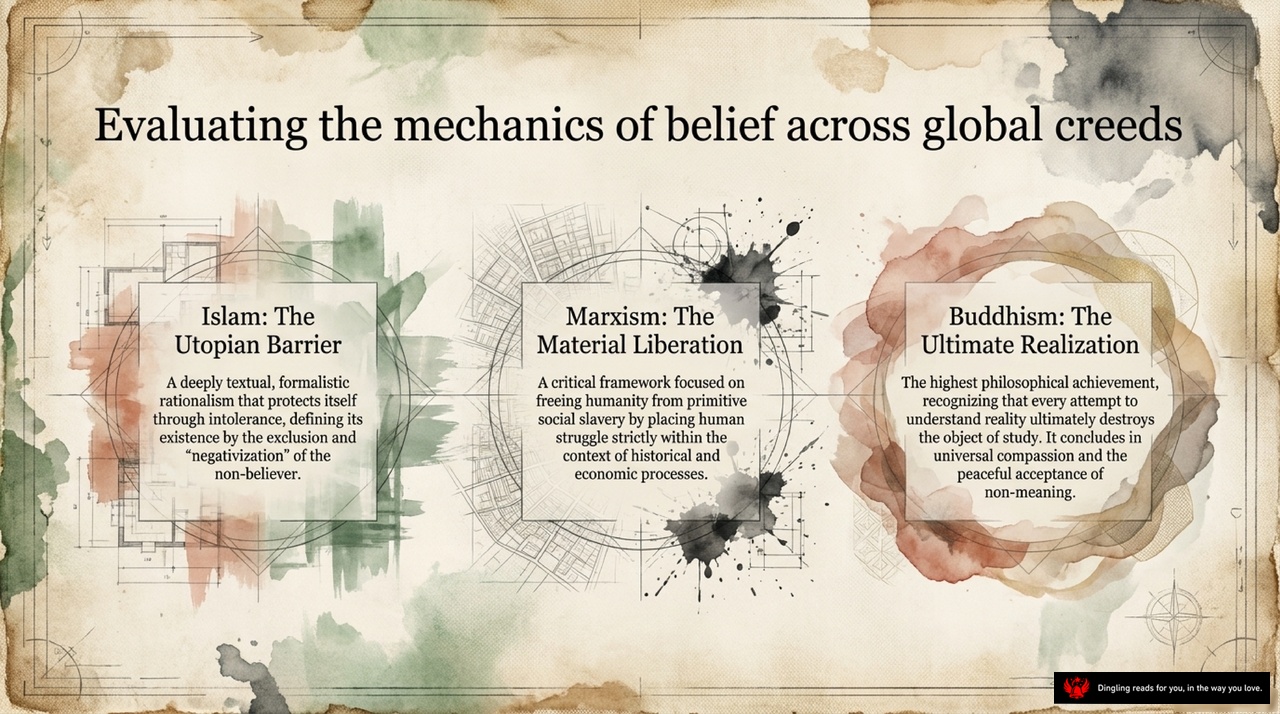
Today's slide pulls back the curtain on how different global belief systems actually function—not just what they say, but their underlying mechanics. We're looking at three distinct approaches to reality.
First, Islam is framed here as "The Utopian Barrier." It's described as a deeply textual and formalistic system that protects itself by drawing hard lines. It defines its existence by excluding the non-believer, essentially using a kind of "negativization" to maintain its purity. It's a rationalism built on boundaries.
In the center, we see Marxism as "The Material Liberation." This is a critical framework focused entirely on freeing humanity from what it calls "primitive social slavery." It places human struggle strictly within historical and economic processes, offering a path to liberation through structural change rather than spiritual retreat.
Finally, on the right, Buddhism is presented as "The Ultimate Realization." This is the highest philosophical achievement in this comparison. Its core insight is radical: recognizing that every attempt to understand reality ultimately destroys the object of study itself. It concludes not in a new doctrine, but in universal compassion and the peaceful acceptance of non-meaning.
Together, these three models show us that belief isn't just about faith; it's a complex set of tools for navigating the human condition, from building barriers to dismantling systems, or simply letting go.
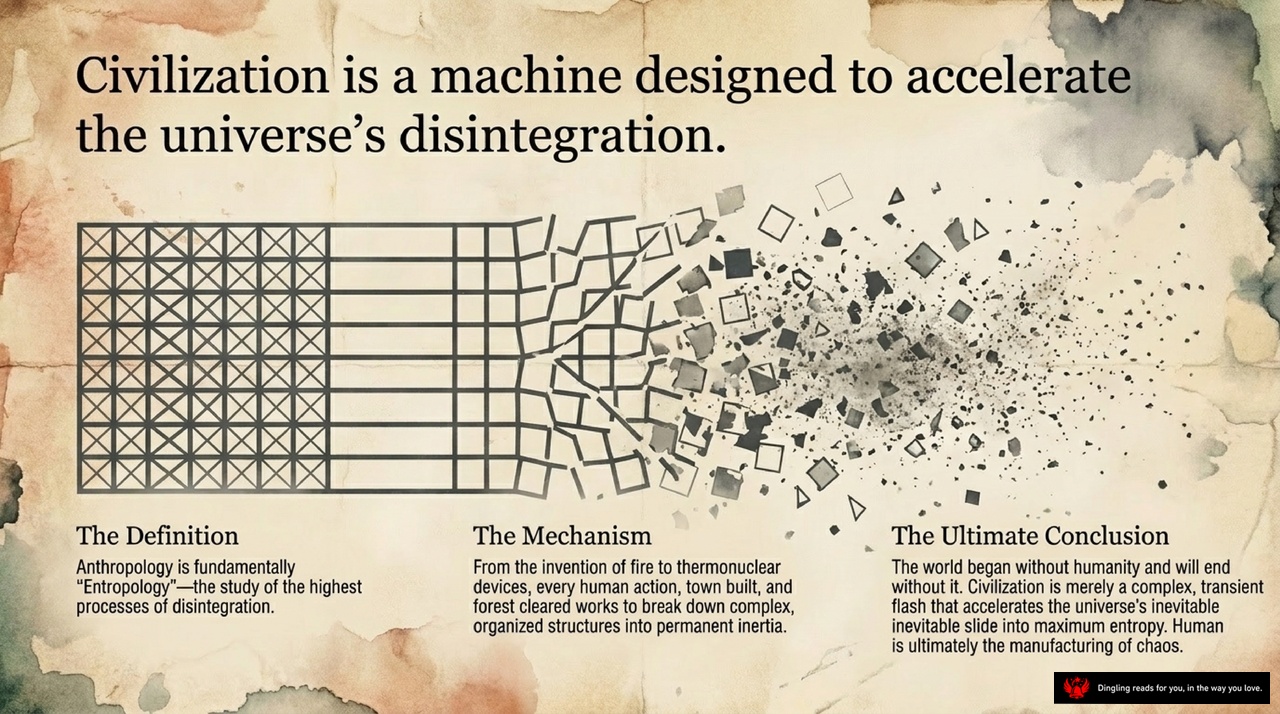
Civilization is not a sanctuary; it is actually a machine designed to accelerate the universe's disintegration. As we look at this slide, notice how the orderly grid on the left shatters into chaos on the right. That visual perfectly captures the core argument of our book: Anthropology is fundamentally "Entropology"—the study of the highest processes of disintegration.
Think about the mechanism driving this. From the invention of fire to thermonuclear devices, every human action, every town we build, and every forest we clear works to break down complex, organized structures into permanent inertia. We are constantly manufacturing chaos. The world began without humanity and will end without it. Civilization is merely a complex, transient flash that speeds up the universe's inevitable slide into maximum entropy. We are not the architects of order; we are ultimately the manufacturers of chaos.

True grace isn't found in grand conquests or the noise of our frantic activities; it lives in the quiet, silent communion we share with the non-human world. Look at this image: on one side, the gray, choking smoke of industry and the illusion of the ego trapped between society and the void. On the other, the vibrant, living presence of a daffodil and a cat, representing the final privilege we possess. Since we cannot stop the entropic machine we've built, our only true refuge is the ability to briefly suspend our frantic activity and listen. Meaning doesn't come from dominating nature, but from those fleeting, silent harmonies we share with what we have not yet destroyed. It is in the complex scent deep within a daffodil, or the brief, mutual gaze shared with a cat, that we find the true consolation of our existence.
We traveled to the edges of the earth seeking pristine origins, only to find the accelerating decay of our own civilization reflected back at us. We are the agents of our own entropy, consuming space, history, and meaning until nothing remains. If the ultimate destiny of civilization is to break down complex structures into inertia, how will we choose to spend our remaining consciousness before the inevitable silence?