
Ulysses: Complete Chapter-by-Chapter Summary
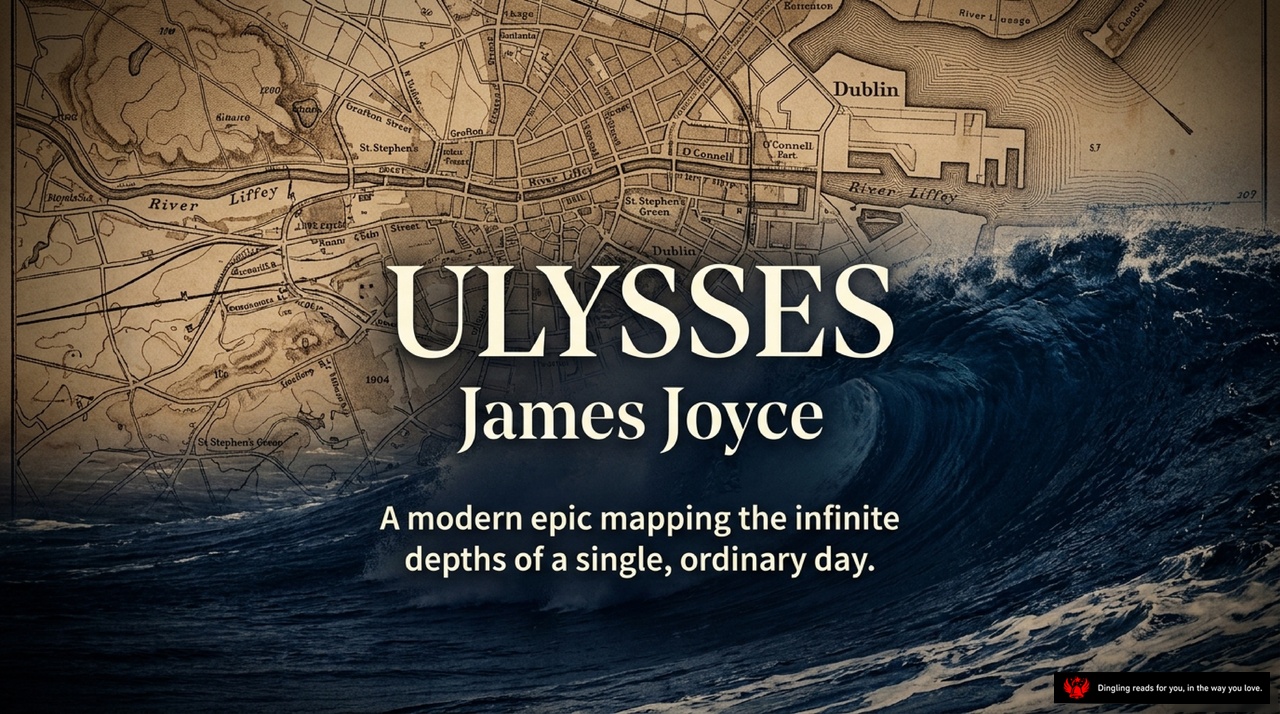
Welcome to the world of *Ulysses* by James Joyce. This isn't just a book; it's a modern epic that maps the infinite depths of a single, ordinary day. Picture this: the city of Dublin, laid out like an old map beneath a crashing ocean wave. That's the setting for our journey. We are diving into the consciousness of ordinary people, turning their everyday thoughts into something monumental. Join us as we explore the river Liffey, the streets of Dublin, and the hidden stories of Leopold Bloom and Stephen Dedalus.
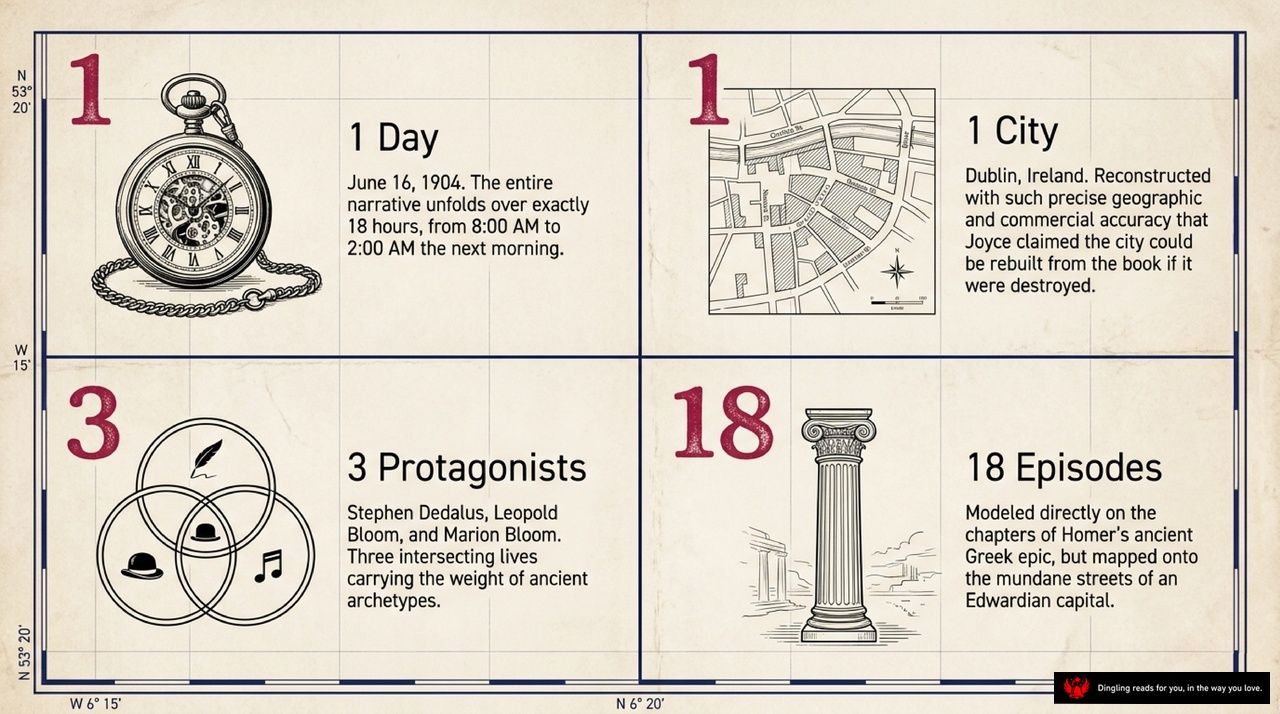
Welcome to the world of *Ulysses*, where a single, ordinary day in Dublin transforms into an epic journey of the human soul.
Look at this grid. It breaks down the novel's structure into four powerful pillars.
First, we have **One Day**. June 16, 1904. The entire narrative unfolds over exactly eighteen hours, from 8:00 AM to 2:00 AM the next morning. It's a real-time experiment, capturing the relentless flow of time as it moves through the city.
Second, we have **One City**. Dublin, Ireland. It's not just a backdrop; it's a character itself. The story is reconstructed with such precise geographic and commercial accuracy that Joyce claimed the city could be rebuilt from the book if it were destroyed. Every street, shop, and landmark matters.
Third, we meet **Three Protagonists**. Stephen Dedalus, Leopold Bloom, and Marion Bloom. These are three intersecting lives carrying the weight of ancient archetypes. They represent the intellectual, the everyman, and the heart of the family, all moving through the same space but often in parallel universes.
Finally, we have **Eighteen Episodes**. The structure is modeled directly on the chapters of Homer's ancient Greek epic, but mapped onto the mundane streets of an Edwardian capital. It's a brilliant collision of high myth and low reality, proving that a day in the life of a man can be as significant as the journey of a hero.
This is how Joyce turns the ordinary into the extraordinary.

In the heart of Dublin, two worlds collide in a chaotic symphony of sound and spirit. As the sun sets over the city, the air fills with the haunting melody of "Love and War," sung by the repentant Ben Dollard and the jovial Father Conleary. For Bloom, this moment is a sanctuary; he sits in the corner of O'Moore's, lost in the music, clutching a rubber band, his mind drifting to the letter he's about to write for Martha—a note filled with secret longing and hidden desire.
But the night is far from quiet for Stephen Dedalus. Bursting into the scene in a garish clown's outfit, he brings a storm of his own. He mocks Bloom's quietude, rattles on about his own literary grievances, and then unleashes a tirade about Shakespeare, claiming the Bard's wife was unfaithful and that the ghost in *Hamlet* is Shakespeare himself. It's a brilliant, arrogant, and utterly brilliant insight that leaves everyone stunned. Stephen argues that artists are just mirrors, reflecting their own lives and tragedies onto the stage, turning their pain into art.
As the night deepens, Stephen's behavior spirals into madness. He pays the bawdy housekeeper, Bella Cohen, with an exaggerated, almost theatrical generosity, only to be met with ridicule and abuse. Then, the vision of his dead mother haunts him—a grotesque figure in leprosy clothes, accusing him of sin and urging him to repent. Enraged, Stephen smashes the chandelier with a cudgel and bolts out into the street, where he is immediately confronted by soldiers who mistake his drunken ramblings for an insult to a woman. He collapses, unconscious, a broken poet in the cold Dublin night.
Bloom finds him. In a moment of unexpected tenderness, he tends to Stephen's wounds, wiping away the debris and murmuring his name. As Stephen lies there, drifting in and out of consciousness, Bloom's own memories surface—the face of his dead son, Rudy, in a tiny suit, reading a book. It's a shared grief, a connection across the divides of faith and class. Bloom stays with Stephen, a silent guardian in the chaos, while the city around them continues its relentless, indifferent turn.

Look at this slide, "The Homeric Blueprint." It's a fascinating map that draws a direct line between the ancient myths of Greece and the gritty, modern streets of 1904 Dublin. On the left, we have the classic world of *The Odyssey*: the cunning hero Odysseus fighting his way through mythical seas, his son Telemachus searching for his father and identity, and Penelope, the ultimate symbol of faithful patience.
Now, look at the right side—this is where Joyce takes us. He swaps the gods for real people. Odysseus becomes Leopold Bloom, a mild-mannered advertising canvasser navigating the anti-Semitic tensions of Dublin. His searching son, Telemachus, is Stephen Dedalus, a cynical, debt-ridden intellectual desperately looking for a spiritual father figure. And finally, Penelope is reimagined as Molly Bloom, a sensual, fiercely independent concert singer who, instead of weaving cloth, is weaving memories in her mind.
This comparison isn't just a literary game; it shows how Joyce takes the grand, epic structure of mythology and compresses it into a single, ordinary day. He proves that the struggles of heroes—returning home, finding identity, and enduring love—are not just for kings and gods, but for every ordinary person walking the streets.

The Trinity of June 16: Mind, Body, and Soul.
Look at this visual breakdown of James Joyce's masterpiece. We see three pillars holding up the entire novel. On the left stands Stephen Dedalus, labeled "The Mind." He represents intellect, theology, and art. His chapters are dense with philosophical musings and Shakespearean theories, all fueled by a paralyzing grief over his mother's death. He is the thinker, the observer, the one wrestling with the abstract.
In the center, we have Leopold Bloom, "The Body." He is the anchor of our reality. His narrative is grounded in the visceral realities of eating, digestion, and observing the city's mechanics. He represents commerce, the physical senses, and a deep, often overlooked empathy. While Stephen looks up at the stars, Bloom is down here feeling the heat, tasting the food, and connecting with the human condition in its most tangible form.
Finally, on the right, sits Molly Bloom, "The Flesh & Earth." She represents nature, unfiltered emotion, and affirmation. She exists entirely in the private sphere of the bedroom, serving as the ultimate, unedited conclusion to the novel. Her consciousness is a stream of pure life, a chaotic and beautiful tapestry of memory and desire that ties everything together.
Together, these three form the trinity of June 16th. Stephen provides the intellectual framework, Bloom provides the physical experience, and Molly provides the emotional core. It is a perfect triad of consciousness, showing us that to be fully human, we need the mind to think, the body to feel, and the soul to simply be.

Good evening. Tonight, we dive deep into the night in Dublin, where the boundaries between reality and hallucination begin to blur. We are with Leopold Bloom, a man whose mind is as complex as the city itself.
As the clock strikes midnight, Bloom returns home, exhausted and carrying the weight of a strange day. He finds his wife, Molly, awake. Her mind is a whirlwind of memories, drifting from the mundane to the romantic. She thinks about the night before, the awkward dance at the picnic, and the sharp, sweet voice of a woman named Stark who sent him wilted flowers. These small, human moments collide with grander, forgotten dreams of her youth in Gibraltar. She recalls the thrill of the bullfight, the terror of being trampled, and the protective care of a friend named Hester. But the most vivid memory is her first kiss with a young man named Malachi. It was a moment of pure, youthful passion under the walls of the Moorish quarter, a secret love she kept hidden in a book.
Now, in her middle age, Molly feels the ache of loneliness. The letters she receives are dry and routine, unlike the fiery passion of her past. She wishes for a real love letter, something that acknowledges her beauty and her needs, rather than the polite, distant words of men who are easily distracted. She wonders about her husband, sleeping soundly at the foot of the bed, indifferent to her inner turmoil. She imagines a younger version of herself, vibrant and desired, and even entertains the idea of learning Italian or Spanish to reconnect with her lost youth.
But the night is not just about Molly's internal monologue; it is also about the chaotic energy of the city. Earlier, we saw Stephen Dedalus collapse in the street, a young man whose mind is fracturing under the weight of guilt and anger. Bloom, the compassionate outsider, stayed to care for him, wiping him clean and offering comfort. Now, as Bloom returns to his own bed, the contrast is stark. Molly dreams of a young stranger who might represent a new beginning, while Bloom, in his quiet room, is simply trying to rest.
This scene captures the very essence of the stream of consciousness technique. We are not just told what happens; we are pulled inside the minds of these characters, experiencing their fragmented thoughts, their sensory details—the smell of the sea, the taste of food, the sound of a church bell. It is a raw, unfiltered look at the human condition, showing us that even in the quietest moments, our minds are never truly silent. They are always running, connecting the past to the present, and searching for meaning in a world that often feels chaotic and unpredictable.

Welcome back to the journey through Joyce's Dublin. Today, we're tuning into a "Symphony of Evolving Styles." Imagine the narrative not as a straight line, but as a complex, shifting waveform that grows increasingly erratic and intense. We are looking at four distinct movements in this literary composition.
First, we have Episode 11, "Sirens." Think of this not as a story, but as a musical fugue. The language itself becomes the instrument, prioritizing rhythm, sound, and auditory motifs over traditional sentence structure. It's a sonic experience where you hear the story before you read it.
Moving forward to Episode 15, "Circe." Here, the style takes a surreal turn, resembling a hallucinatory stage play script. In this world, inanimate objects come to life and speak, while the characters' subconscious fears manifest physically. It's a descent into the psyche where the boundaries between reality and nightmare dissolve.
Then, we arrive at Episode 14, "Oxen of the Sun." This movement mimics the chronological evolution of the English language itself. It starts with archaic, Latinate prose and evolves into 20th-century street slang, paralleling the birth of a child. It's a linguistic journey from the womb to the modern world, capturing the very history of speech within the narrative.
Finally, we reach Episode 18, "Penelope." This is Molly's closing soliloquy, a massive, 40-page psychological outpouring. It features virtually zero punctuation, creating a breathless, intimate flow that ends with the ultimate affirmation: "yes I said yes I will Yes." It is a raw, unfiltered declaration of life and love.
Together, these episodes form a symphony where the form of the writing changes to match the emotional and psychological state of the characters. From the rhythmic haunting of the Sirens to the chaotic, punctuated freedom of Molly's final words, Joyce is showing us that style is not just decoration—it is the very heartbeat of the story.

The Battle for Publication wasn't just a literary footnote; it was a high-stakes war fought in courtrooms, bookstores, and the shadows of 1920s Dublin. As you can see, the journey began in New York, where the novel was serialized but quickly halted. The US Post Office, acting on obscenity charges regarding the Nausicaa episode, confiscated and burned entire issues. This wasn't just censorship; it was an act of destruction.
But the story didn't end there. In 1922, the fight moved to Paris. Sylvia Beach, the fearless owner of Shakespeare and Company, took the massive risk of publishing the complete novel. It was smuggled across borders, becoming a symbol of resistance against the rigid moral laws of the time. By the 1920s, the book was banned globally by US and UK customs. Even literary giants like T.S. Eliot and Ernest Hemingway found themselves in the underground, championing a work that the establishment deemed dangerous.
It took until 1933 for the ban to be lifted in the United States. Judge John M. Woolsey made a landmark legal decision, ruling that the book was a sincere psychological exploration, not mere obscenity. This victory marked a turning point, proving that art could survive even the strictest scrutiny.
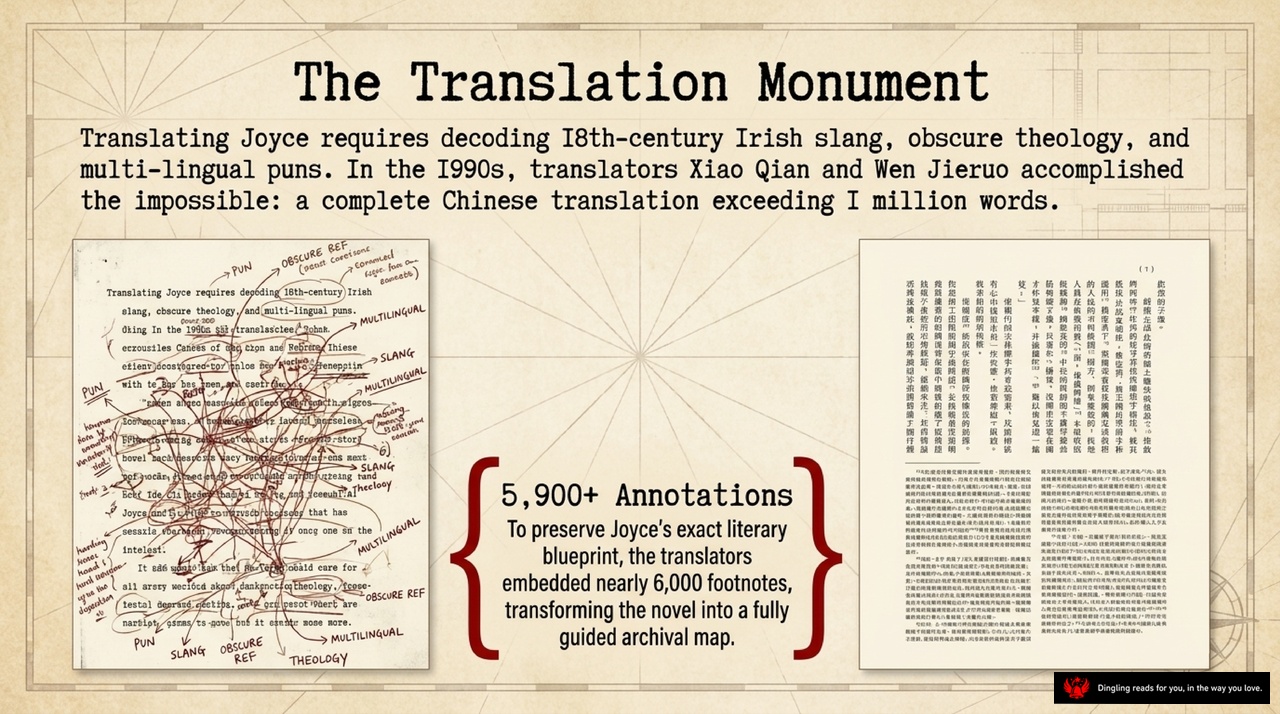
The Translation Monument isn't just a title; it's a monument to one of the most ambitious literary feats in history. Think about the sheer scale of James Joyce's *Ulysses*. Translating it into Chinese in the 1990s wasn't just about swapping words; it was an archaeological dig. Translators Xiao Qian and Wen Jieruo faced a mountain of obstacles: decoding 18th-century Irish slang, unraveling obscure theology, and cracking multi-lingual puns that would stump most native speakers.
But they pulled off the impossible. They produced a complete Chinese translation exceeding one million words. To do this, they didn't just translate the text; they translated the entire world of Joyce. They embedded nearly 6,000 footnotes directly into the novel, creating what you see here: a fully guided archival map. With over 5,900 annotations, they preserved Joyce's exact literary blueprint, turning a dense, chaotic masterpiece into a navigable journey for a new audience. It's a stunning reminder that great translation isn't about erasing differences; it's about building a bridge so sturdy that the original spirit survives intact on the other side.
Imagine a single, ordinary day in Dublin, and suddenly, the ancient myths of heroes and battles dissolve into the quiet, chaotic reality of everyday life. Just as the text suggests, the true epic isn't found on distant battlefields, but hidden within the internal struggles of people navigating their daily routines.
Consider Stephen Dedalus walking through the city. To him, this ordinary day contains the entirety of the human experience. He debates the nature of Shakespeare's ghost, contemplates the betrayal of his mother, and feels the weight of his own identity. In his mind, uncharted epics are unfolding right now.
Now look at Leopold Bloom. His day is a series of small, seemingly insignificant moments: a funeral, a missed lunch, a strange encounter with a blind man, and a moment of deep empathy for a young girl named Gretta on the beach. Yet, in his mind, he is also living a grand narrative. He carries the ghosts of his dead son, his troubled father, and his complex marriage with Molly.
The story of *Ulysses* teaches us that we are all the protagonists of our own lives. Whether you are a celebrated poet grappling with guilt or a quiet man navigating the noise of the city, your ordinary day is an adventure. What uncharted epics are unfolding in your own mind right now?