
Unpaid Housewife: Complete Chapter-by-Chapter Summary

Welcome to today's session on *The Unpaid Housewife* by Chizuko Ueno. This isn't just a book about housewives; it's a radical investigation into the hidden economic engines that power our world. We often assume that the economy is a self-contained machine, but Ueno reveals that it actually runs on two invisible peripheries: nature and the family. Nature provides our raw materials and absorbs our waste, while the family acts as a human factory, supplying the workforce and caring for those who can no longer work.
The core argument is that this system relies on "unpaid labor"—the invisible work of raising children, caring for the sick, and maintaining households. This labor is essential for capitalism and patriarchy to function, yet it remains uncounted and uncompensated. Ueno challenges the idea that this work is merely an act of love or a natural female duty, arguing instead that it is economic labor that has been systematically devalued. By exposing how society treats care work as a "private" obligation rather than a public necessity, she forces us to ask a difficult question: Who actually pays for our way of life? The answer, she shows, is everyone, except the women who do the work.

On this slide, we see a powerful shift in how we understand women's struggles. On the left, we have "The Traditional View," which treats women like a broken system that needs fixing. It blames the individual, saying a woman is unhappy simply because she failed to adapt to the perfect role society gave her. It's like looking at a person inside a box and saying, "You're standing wrong."
But look at the right side: "The Feminist Sociological View." This is the breakthrough. It stops blaming the woman and starts examining the box itself. The image shows a woman surrounded by invisible walls labeled "Patriarchy," "Economy," and "State." This is the core insight from my work: women's suffering isn't a personal failure; it's the result of a rigid social structure designed to keep them in place.
As I wrote in *The New Family*, this shift is everything. The old view asked, "Why is the housewife unhappy?" The feminist view asks, "How did the system make the housewife unhappy?" We realized that the market isn't a closed loop; it relies on a hidden outer ring—the family—where women do unpaid reproductive labor. By treating this invisible architecture as the real problem, we move from social pathology to structural analysis. Feminism, as I define it, isn't just about personal grievances. It is the structural teardown of an unequal system. We aren't trying to fix women; we are trying to dismantle the walls that confine them.

The modern economy often tricks us into believing it's a self-contained machine, running on its own logic. But as this diagram reveals, the market is actually just the center of a much larger, invisible system. It relies on two critical "peripheries" that are systematically treated as free.
First, look up to **Nature**. The market treats the planet as an infinite resource bank, endlessly siphoning energy and raw materials while dumping industrial waste back into it without cost. Nature isn't a partner; it's a utility.
Second, look down to **The Family**. Here lies the second hidden engine. The market extracts human capital—laborers and workers—from families, treating them as free inputs. In return, it "discharges" human waste: retirees, the sick, and the disabled, pushing them back into the family to be cared for. The market mistakes this family for a self-sustaining, closed loop, but in reality, it's a massive unpaid subsidy.
The takeaway is stark: the modern economy only functions by siphoning unpriced energy from nature and unpaid reproductive labor from the family. Without these invisible peripheries, the market simply cannot spin.

The Industrial Lifecycle Divergence shows a stark split in how men and women navigate life under industrial capitalism. On the top path, men enter adulthood as "soldiers" on the economic battlefield, valued solely for their productivity. Once they lose their market value due to age or illness, they are discarded as "industrial waste," sent back to the family to be cared for by women until death. Meanwhile, the lower path represents women, confined to the family periphery. Their role is to produce new soldiers and maintain the existing ones, effectively acting as the rearguard. This diagram captures a cruel reality: the market treats men as disposable tools, while women are burdened with the invisible labor of sustaining both the workforce and the discarded members of society. This structural divergence is the root of gender inequality, where women's essential reproductive and care work is systematically undervalued and erased from the economic equation.

Defining Labor: The Transferability Test. Look at this flowchart. It asks a simple but powerful question: Can this activity be outsourced to a third party? If the answer is no, it's a personal life activity—things like eating, sleeping, or learning that are intrinsic to being human. But if the answer is yes, it's labor. Cooking, cleaning, nursing, and even child-rearing can all be done by someone else for a fee.
Here is the critical insight from the text: When labor that can be outsourced is trapped outside the market and isolated from compensation, it becomes Unpaid Work. Calling it "love" is merely a mechanism to avoid paying for it. This distinction exposes a harsh reality. For decades, society has treated the essential work of reproduction—raising children and caring for the elderly—as a private, free gift of "love" rather than recognizing it as valuable economic labor. By refusing to pay for these services, we don't just ignore their cost; we actively devalue the people performing them. This structural blind spot is why we see such a massive gender gap in unpaid work, trapping women in a cycle of invisible effort while the market profits from the free labor generated within the home.

Welcome back. Today we're diving into the heart of a system that has long hidden the true cost of care. Look at this chart: "Pricing the Priceless: The Calculus of Unpaid Labor." It breaks down exactly how society undervalues the work that keeps us alive.
We see three different ways to measure this labor. On the far left, we have "Opportunity Cost," which tries to value time based on what a woman could earn in the formal market. But the chart notes this is rarely used because it threatens male wage dominance. In the middle, we see "Replacement Cost - Specialist," which values work by hiring market professionals like chefs or private nurses. This is expensive and unrealistic for daily life.
But look at the far right: "Replacement Cost - Generalist." This is the model governments universally adopt. It values caregiving at the rate of a low-wage, unskilled domestic helper. By classifying life-or-death work as low-skill, minimum-wage labor, the system intentionally devalues women's contributions to protect the broader economy. This isn't just an accident; it's a calculated strategy to keep the "priceless" looking cheap.

Imagine a boat designed to carry a single family, but suddenly forced to hold the weight of an entire society's care needs. This is the reality of the modern nuclear family, a concept visualized as "The Overloaded Ark."
Historically, caregiving was a shared responsibility across large, multi-generational communities. But today, the state has essentially offloaded the burden of infants, the sick, and the elderly onto private homes. Instead of being supported by a community or a public system, these societal dependencies are shoved off the state's ledger and into the living room.
The result is a catastrophic imbalance. The modern family now sails with only one designated caregiver: the woman. She is the sole load-bearer, holding up a stack of massive blocks labeled Childcare, Sick Care, and Elder Care. The boat itself—the nuclear family structure—is structurally designed to sink under its own weight. This isn't just a personal struggle; it is a systemic crisis where dependency has been privatized, leaving the family isolated and drowning under responsibilities that were once the job of the collective.

Today's slide breaks down the four pillars of welfare pluralism: the State, the Market, Civil Society, and the Family. Think of these as the four legs supporting our social safety net. The State and Market operate on redistribution and exchange—taxes, safety nets, and paying for services. Civil Society runs on reciprocity, like mutual aid networks where neighbors help neighbors. But look closely at the Family quadrant. It's highlighted in red and cracked, operating on gift and duty, often relying on unpaid, coerced labor. This visual tells a stark story: when the State and Civil Society fail to provide, the entire weight of human dependency collapses into this fractured Family system. We see clearly that our current imbalance forces everyone's care needs onto the family, specifically onto women, leaving this pillar broken and overburdened.
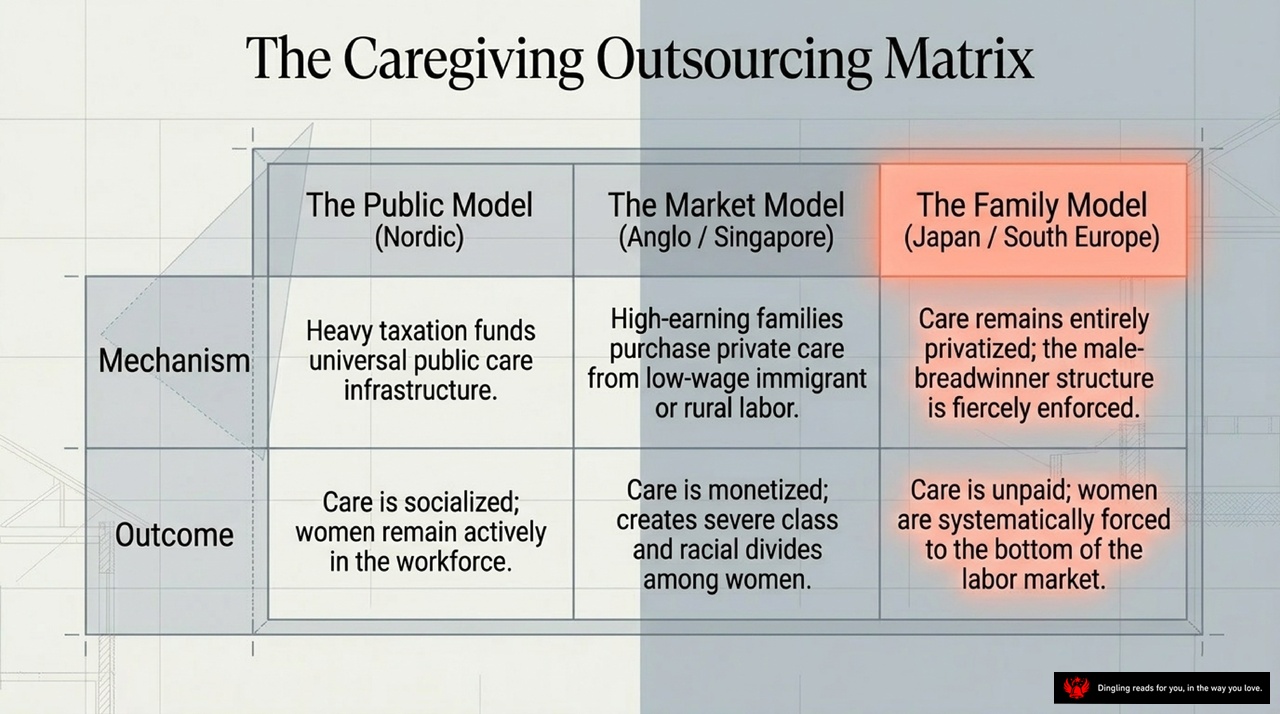
The slide you see here breaks down the "Caregiving Outsourcing Matrix," a crucial framework for understanding why women in different countries end up in such vastly different positions.
On the left, we have the Nordic Public Model. Here, heavy taxation funds universal care infrastructure. The mechanism is socialization, and the outcome is that women remain actively integrated into the workforce because care isn't left to them alone.
In the middle is the Market Model, seen in places like the Anglo-Saxon world and Singapore. High-earning families purchase private care, often from low-wage immigrant or rural labor. This monetizes care, creating severe class and racial divides among women themselves.
Finally, highlighted in red, is the Family Model found in Japan and South Europe. Here, care remains entirely privatized and is fiercely enforced by a traditional male-breadwinner structure. The outcome is stark: care is unpaid, and women are systematically forced to the bottom of the labor market.
This matrix explains the root of our crisis. When a society chooses the Family Model, it doesn't just ignore women's labor; it actively extracts it for free, creating a system where women are the invisible foundation upon which the entire economy is built.

The chart on your screen illustrates what I call "The Silent Strike"—a predictable demographic collapse driven not by a conspiracy, but by women reacting rationally to systemic burdens. Look at the graph: the "Public Model," with high social support, yields the highest birth rates because women aren't penalized for motherhood. Conversely, the "Family Model," which relies on the outdated "Male Breadwinner" structure with zero support, results in the lowest birth rates.
The takeaway is stark: when society refuses to share the cost of reproducing human life, women simply refuse to produce it. This isn't about women not wanting children; it's about the economic reality that making a child in a system with no safety net is a rational financial loss. As I've argued throughout my work, the market cannot function as a closed loop because it depends on the "family" as an external buffer that absorbs the costs of raising and caring for the next generation. When we force all these costs onto the individual family, specifically onto women, we create a system where having children becomes an unaffordable luxury. The decline in population is essentially the aggregate result of millions of women making the same logical choice: to opt out of a system that offers them no support and only immense burden.
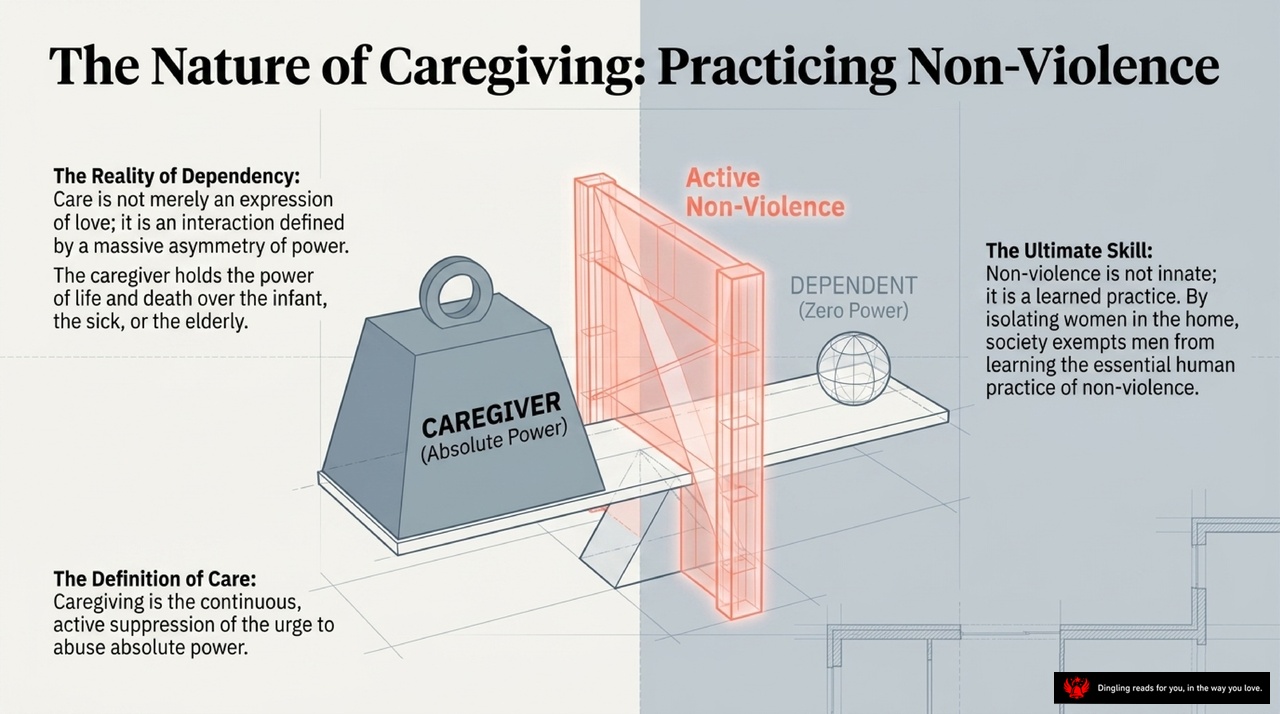
Caregiving is often mistaken for an act of pure love, but the reality is far more complex. It is fundamentally defined by a massive imbalance of power. As the slide illustrates, the caregiver holds "absolute power," wielding the very life and death of the dependent, who holds "zero power." This dynamic creates a scenario where the caregiver has the potential to abuse this authority at any moment.
True caregiving, therefore, is not just about being kind; it is the continuous, active suppression of the urge to abuse that absolute power. We must view this as "Active Non-Violence." Non-violence isn't something we are born with; it is a skill we must learn and practice. Society often fails to teach this, especially by isolating women in the home and exempting men from learning these essential human practices.
Ultimately, a healthy caregiving relationship requires a shift in perspective. It cannot be a one-sided performance where the caregiver sacrifices their own well-being to please the dependent. Instead, good caregiving is a collaboration where both parties can find joy and satisfaction. If we force caregivers to suppress their own emotions to maintain a facade of happiness, we end up exploiting them, which inevitably harms the person they are trying to care for. We need to build a society where even the weakest among us can be respected as weak, creating a world where everyone can safely be vulnerable without fear of abuse.
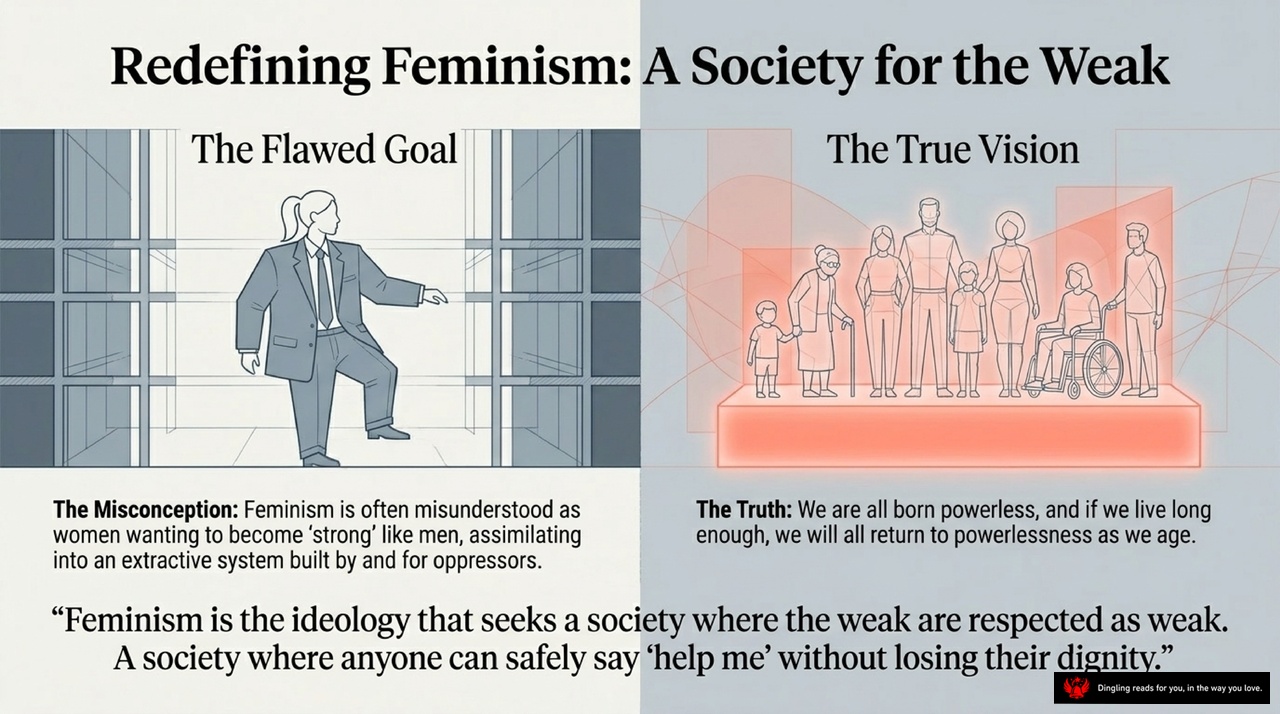
Let's reframe what feminism actually means. For too long, we've been sold a flawed version: the idea that feminism is just about women trying to become "strong" like men, climbing the corporate ladder, and mimicking the very systems that have oppressed us. This slide calls it "The Flawed Goal"—a lonely figure in a suit, chasing a definition of power that isn't really power at all. It's about assimilation into an extractive system built by oppressors, pretending that if we just act like the men in charge, we'll finally be equal.
But the truth is much deeper, and much more human. Look at the other side of this image: "The True Vision." This isn't about women becoming men. It's about creating a society for the weak. Think about it: we are all born powerless. As infants, we are entirely dependent on others. And no matter how much we achieve, how much money we make, or how high we climb, we all eventually return to a state of vulnerability. We age, we get sick, we lose our mobility, and eventually, we all face the end of our lives. We all become the "weak."
The real goal of feminism, as this slide explains, is to build a society where being weak doesn't mean being pitied or discarded. It's a society where anyone can safely say, "Help me," without losing their dignity. Whether you are a child, an elderly person, someone with a disability, or just a person having a bad day, you deserve to be respected exactly as you are.
This shifts the entire conversation. It's not about the "strong" dominating the "weak." It's about recognizing that everyone is a "weak" person at some point in their life, and that our strength lies in how we support each other when we are vulnerable. It's about building a community where care is a right, not a privilege. So, let's stop chasing a false ideal of male-like strength and start building a world where everyone, regardless of their current power level, is treated with the respect they deserve.
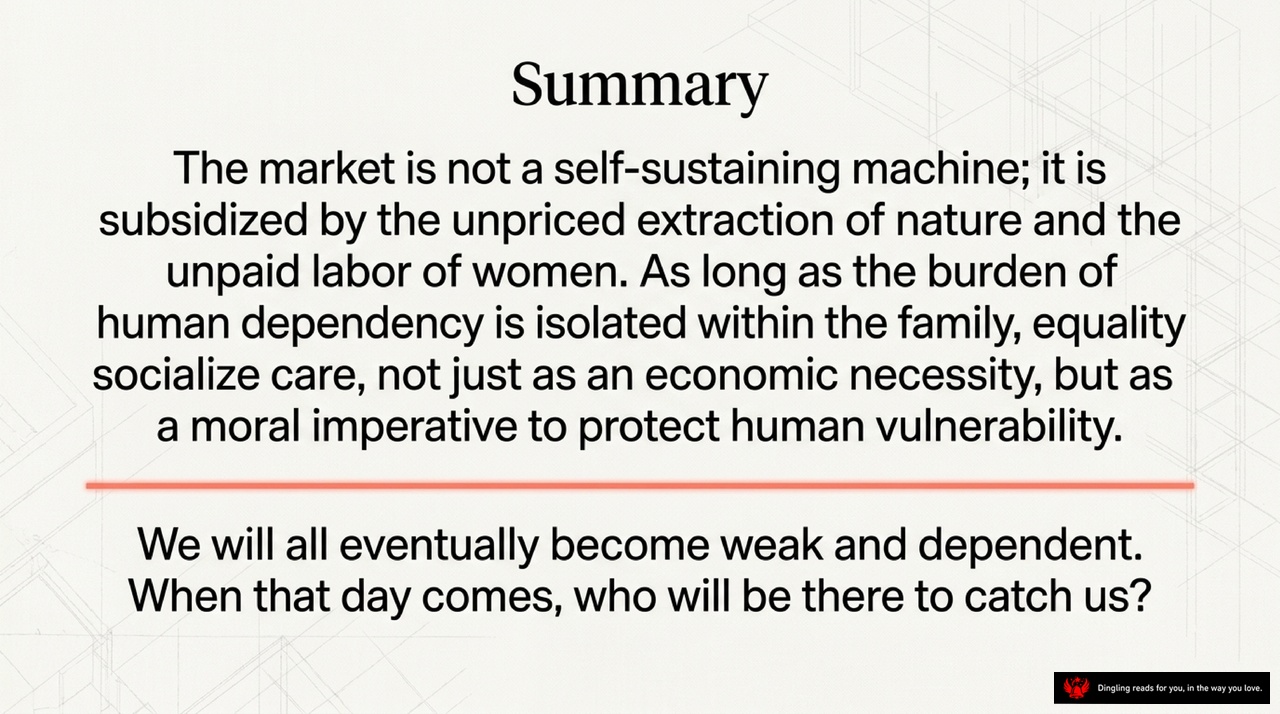
The market isn't a self-sustaining machine; it runs on two invisible subsidies: the unpriced extraction of nature and the unpaid labor of women. For decades, we've treated the family as a private sanctuary, isolating the heavy burden of human dependency—caring for the young, the sick, and the elderly—away from the public eye. But this isolation is a myth. We are all eventually weak and dependent. When we fall, who will be there to catch us? The answer lies in shifting care from a private moral duty to a public necessity. If we keep this burden locked inside the home, we fail not just women, but everyone. True equality means socializing care, recognizing that protecting human vulnerability is not just an economic requirement, but a moral imperative for all of us.