


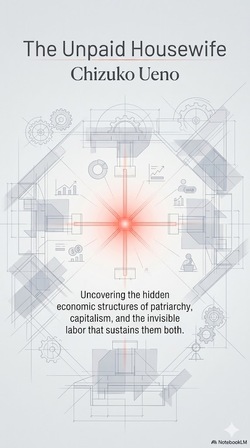
A powerful argument showing that unpaid housework is essential labor exploited by economic systems.
Your Review
A powerful argument showing that unpaid housework is essential labor exploited by economic systems.

Ueno brilliantly exposes how capitalism and patriarchy collude to exploit women's unpaid care work, making invisible labor visible through a powerful structural framework.

Ueno exposes unpaid care work as real labor.


Ueno dismantles the myth that housework is a labor of love, proving it is unpaid work exploited by capitalism and patriarchy to sustain the economy.

Ueno exposes how capitalism and patriarchy collude to force women into unpaid care roles that keep our entire society running while erasing their value.

Ueno brilliantly exposes how capitalism and patriarchy trap women in unpaid care work, using her mother's painful story to show why this invisible labor must be valued and shared by society.

Ueno argues that capitalism and patriarchy force women into unpaid care roles, making the 'overloaded ark' metaphor for modern families feel terrifyingly accurate and urgent for anyone who has ever felt exhausted by never-ending household duties while expecting society to simply understand or appreciate this invisible work without offering fair compensation or structural support to reduce the burden on individual women who are often blamed for systemic failures instead of recognized as essential workers whose labor keeps the entire economy running smoothly.

Ueno's explanation of how capitalism and patriarchy collude to exploit unpaid care work really changed my perspective on why working mothers feel so exhausted every single day.

Reading this made me realize my own tiredness comes from unpaid work I never got paid for.

Ueno brilliantly proves that unpaid care work is a systemic engine for capitalism, not just a personal choice or act of love.

Ueno proves unpaid care is economic infrastructure, not just love, showing how capitalism relies on women's invisible labor to subsidize corporate profits while framing this exploitation as a natural duty. Her framework reveals that treating care as a private family problem ignores the systemic reality where states and markets offload these essential costs onto individual women, creating an overloaded ark that inevitably sinks under the weight of burnout and gendered inequality across both paid and unpaid spheres of modern society.

The book says women are forced into unpaid roles by systems, yet some men still claim housework is a sacred duty that women should do freely.

Ueno exposes how capitalism and patriarchy trap women in unpaid care roles that society ignores.

Ueno argues that treating care as love hides the fact that it is essential unpaid labor needed for the economy to function properly for everyone.
This book is a must read for everyone.

Ueno explains how capitalism relies on unpaid female labor, which makes no sense if we call it love.

Ueno connects capitalism and patriarchy to show why care work is systematically undervalued and erased from economic stats, making invisible labor visible as a critical pillar of society rather than a personal choice, which forces us to confront the structural exploitation keeping families afloat while women bear the burden alone without fair compensation or recognition.

Ueno argues capitalism relies on women's free care labor to function, treating it as invisible while men benefit from subsidized profits, creating a system where mothers are expected to work extra hours without pay, which explains why the gender wealth gap persists and why families struggle when childcare costs rise beyond what minimum wage earners can afford, making the myth of choice a dangerous lie that ignores structural barriers.

Ueno brilliantly connects capitalism and patriarchy to show why care work remains invisible and unpaid, arguing that framing it as a 'labor of love' erases the real economic value women provide to society, a insight that forces us to rethink the structure of our families and the economy itself rather than blaming individual women for struggling under such an unfair system that relies on their free work to function.

Thought-provoking with room for debate. Thumbs up.