
Walden: Complete Chapter-by-Chapter Summary

Welcome to Walden, a deliberate journey into the woods to confront the essential facts of life and discover what it truly means to be awake.
Imagine stepping away from the noise of the city and into a quiet forest where the only sound is the wind and the water. This is the story of Henry David Thoreau, who decided to live simply by himself at Walden Pond for two years and two months. He built his own cabin, farmed his own beans, and learned that life doesn't need to be complicated.
In this book, Thoreau challenges us to stop working just to survive and start living to understand. He argues that we are often enslaved by our own possessions, carrying heavy burdens of debt and desire that distract us from what really matters. He reminds us that the necessities of life are simple: food, shelter, clothing, and fuel. Anything beyond that is often just a distraction.
As Thoreau writes, "I went to the woods because I wished to live deliberately, to front only the essential facts of life, and see if I could not learn what it had to teach, and not, when I came to die, discover that I had not lived."
This is an invitation to wake up, to slow down, and to find the freedom that comes from living with intention.
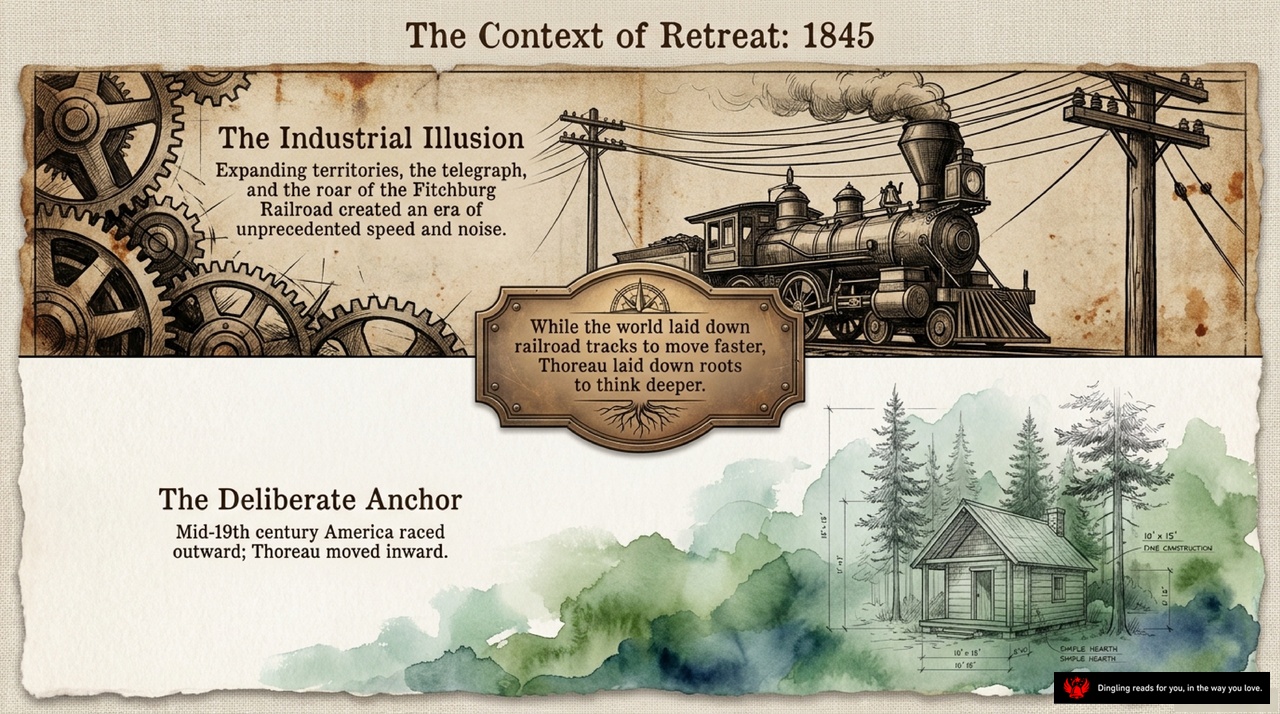
In 1845, America was obsessed with speed. The Fitchburg Railroad was roaring, laying down tracks that promised to connect the world in an instant. The Industrial Illusion was in full swing, convincing everyone that expanding territory and moving faster were the only paths to progress. But while the rest of the nation raced outward, Thoreau made a deliberate choice to move inward. He laid down roots instead of rails, choosing to think deeper rather than go faster.
This wasn't a rejection of the world, but a rebellion against its frantic pace. Thoreau realized that true progress isn't measured by how quickly you can travel, but by how deeply you can live. He built a simple cabin by the lake, not to escape society, but to understand it. In a time when everyone was chasing the latest trends and the next big thing, he found freedom in simplicity and clarity. He proved that you don't need to be carried away by the train to reach your destination; sometimes, the most powerful journey is the one you take right where you stand.

Look at this image. It captures a profound truth about modern life: we are often trapped in a cycle of "Quiet Desperation."
On the left, we see "The Inherited Burden." This isn't just about physical land; it's about the psychological weight of possessions. We inherit farms, houses, and tools, thinking we own them, but in reality, we become slaves to them. These assets are "easily acquired but nearly impossible to shed." They anchor us to a place and a lifestyle we might not even want, making us prisoners of our own property.
On the right, we see "The Copper Coin." This represents the trap of the modern economy. We dedicate our prime years—our most valuable time—to laboring for other people's currency. We chase debt and promised payments, running on a treadmill that never stops. The image shows a man under immense "compressive stress," bent over under a load that has exceeded his "load-bearing capacity." He is on the brink of "structural failure."
The central message, highlighted at the bottom, is the ultimate irony of this trap: "We spend the best part of our lives earning money in order to enjoy a questionable liberty during the least valuable part of it."
Think about it. We trade our youth, our energy, and our freedom to build a life that often feels more like a burden than a blessing. We build bigger houses to feel secure, yet we end up less free. We work harder to earn more, yet we find ourselves trapped in endless cycles of debt.
This slide asks a hard question: Are we building a life, or are we just maintaining a cage? True freedom, as Thoreau suggests, comes from letting go of these inherited burdens and the endless pursuit of the "copper coin." It means realizing that we don't need to be slaves to our possessions or our paycheck. We need to reclaim our time and our spirit, choosing a life that is light enough to carry, rather than heavy enough to break us.

Imagine a world where your home isn't a golden cage trapping you, but a simple, functional box you built with your own hands. This slide contrasts "Civilized Society" with "The Deliberate Life," and the difference is striking. On the left, we see a life of excess: clothing worn to impress, shelter that feels like a luxurious prison, food that breeds sluggishness, and fuel used just to artificially bake ourselves. But on the right, we see the power of simplicity. Here, clothes are strictly for retaining vital heat; shelter is a modest structure providing real protection; food is clean fuel cultivated through personal labor; and fuel becomes an inner spiritual warmth rather than an external dependency.
Think about your own life. How often do we build our homes just to impress neighbors, only to become slaves to the mortgage? Or how we buy clothes to fit a trend, ignoring the fact that a hero's worn-out shoes are far more durable than a servant's new ones. Thoreau reminds us that true beauty grows from the inside out, like a bird's nest. We don't need those excessive decorations or artificial heating to feel alive. By stripping away the unnecessary, we reclaim our time and our freedom. The deliberate life isn't about deprivation; it's about choosing what truly matters. When you build your own life, you stop being a prisoner of things and start being the master of your destiny.
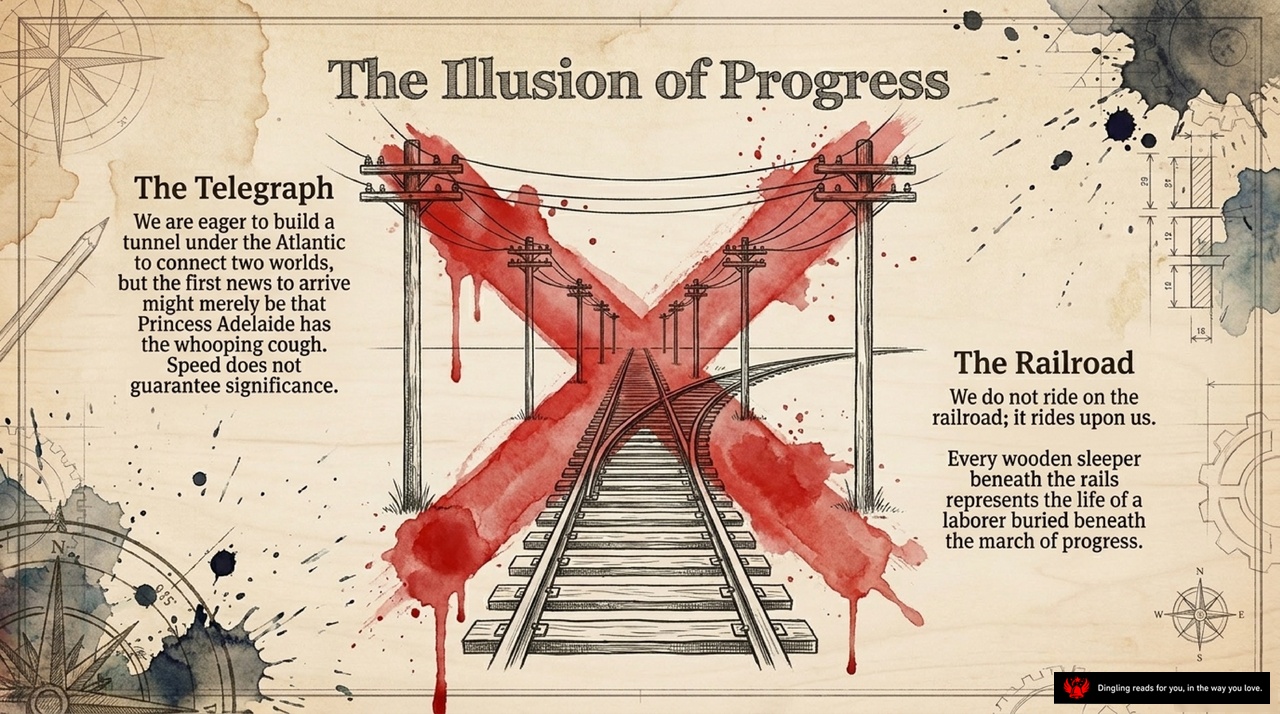
We are often told that progress is the highest good, that speed and new inventions guarantee a better life. But today, I want to challenge that comforting illusion. Look at this slide: "The Illusion of Progress." It asks us to question the very things we celebrate as civilization's greatest achievements.
On the left, we see the Telegraph. We are so eager to build a tunnel under the Atlantic to connect two worlds, convinced that instant communication is the ultimate solution. Yet, the slide reminds us of a sobering truth: the first news to arrive might merely be that Princess Adelaide has the whooping cough. Speed does not guarantee significance. Just because we can transmit information instantly doesn't mean we are connecting minds or solving real problems; we are often just rushing to share trivialities.
On the right, we see the Railroad. The text warns us, "We do not ride on the railroad; it rides upon us." We think we are the masters of these machines, but in reality, our lives are dictated by the train schedule. We adjust our entire existence to fit the rhythm of the engine. Furthermore, the slide points out a hidden cost: "Every wooden sleeper beneath the rails represents the life of a laborer buried beneath the march of progress." Every time we applaud the efficiency of the train, we are ignoring the human lives sacrificed to build the tracks we casually ride upon.
So, what is the lesson here? True progress isn't about how fast we move or how many new gadgets we own. It's about whether we are truly living. Are we building bridges that connect us to each other, or just tunnels that isolate us in our rush? Are we riding the railroad, or has the railroad taken over our lives? The slide suggests that we must look past the noise of modernity and ask ourselves: Is this advancement actually making us more human, or just faster at being lost?
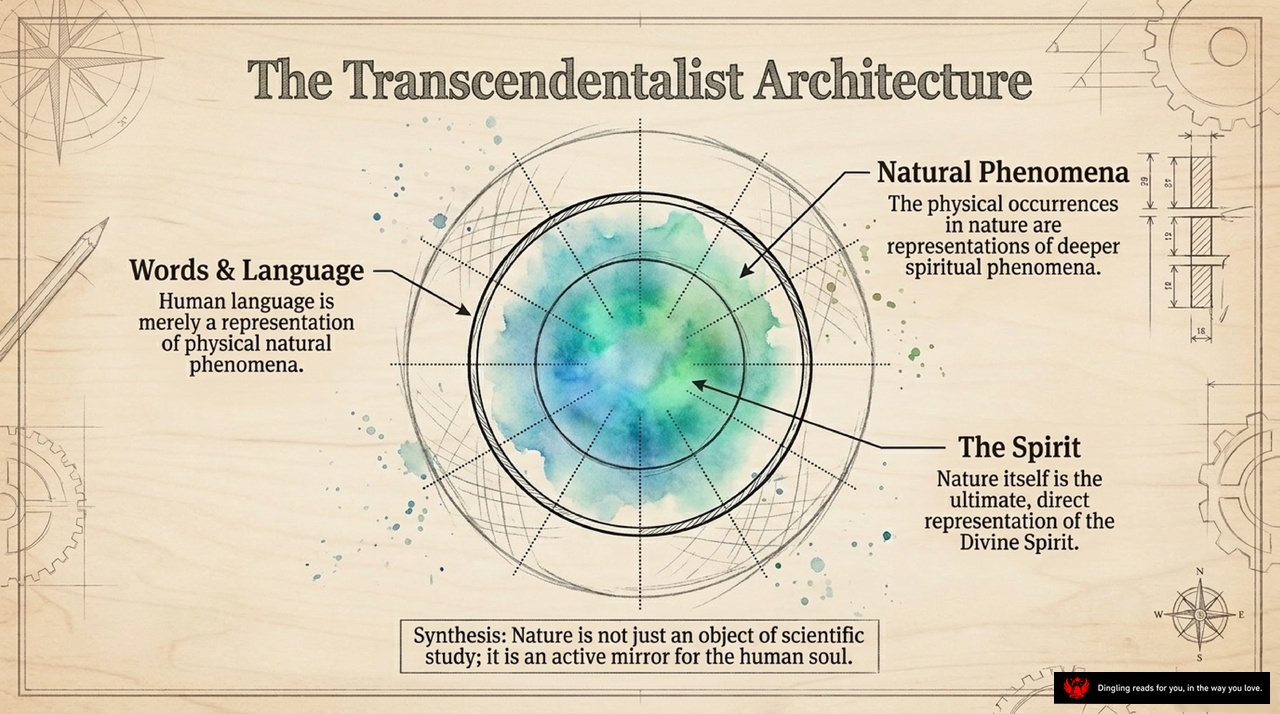
Welcome to the final chapter of our journey through Walden. Today, we explore the "Transcendentalist Architecture"—a blueprint for how nature, language, and spirit truly connect.
Look at this diagram. It illustrates a profound truth: Nature is not just an object for scientific study; it is an active mirror for the human soul. At the very center lies "The Spirit." In Thoreau's words, nature itself is the ultimate, direct representation of the Divine Spirit. It is the raw, unfiltered reality that connects us to the infinite.
Moving outward, we see "Natural Phenomena." These are the physical occurrences we observe daily—the changing seasons, the flowing water, the growing trees. Thoreau reminds us that these physical occurrences are merely representations of deeper spiritual phenomena. The forest isn't just wood; it's wisdom. The lake isn't just water; it's reflection.
And finally, at the outermost layer, we find "Words & Language." Human language is merely a representation of physical natural phenomena. We use words to describe the world, but often we get so lost in our descriptions that we forget the reality they point to. As Thoreau famously argued, we must stop being just readers and become observers of life itself.
This synthesis is the core lesson: we must look past the superficial layers of society and language to touch the living reality beneath. Only by immersing ourselves in the present moment can we truly understand the noble things in life.
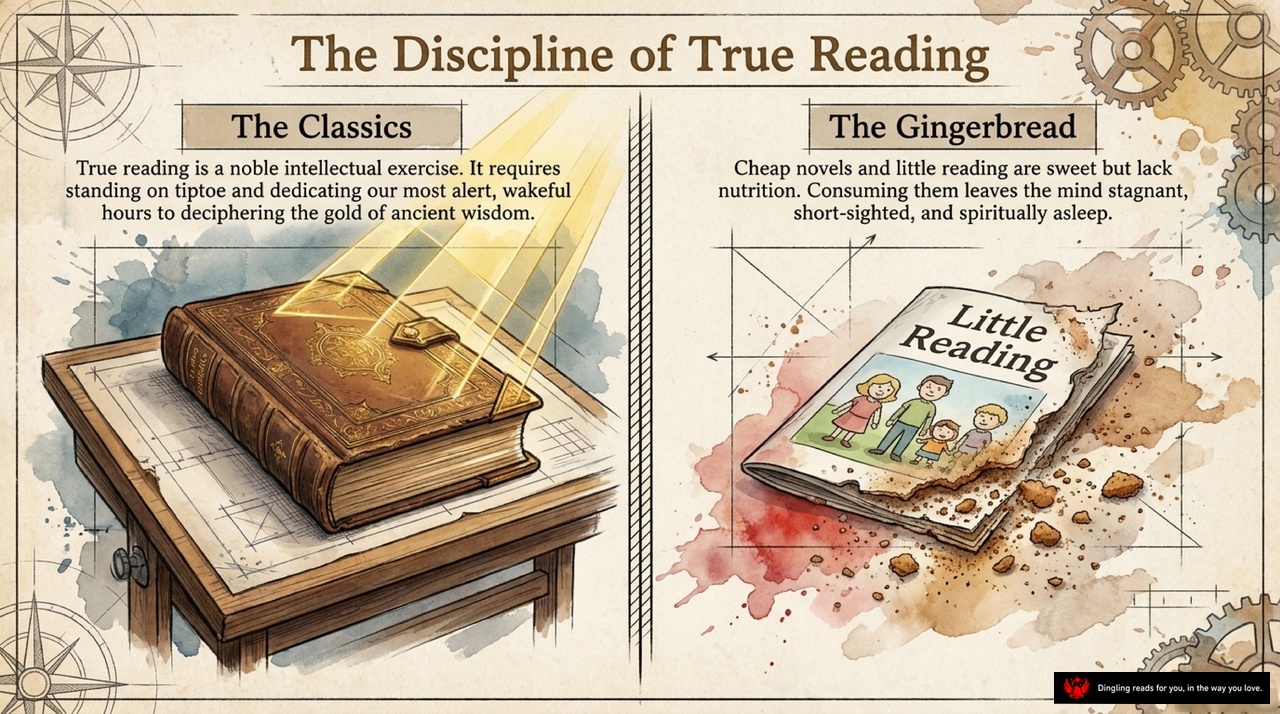
True reading isn't just about turning pages; it's a noble intellectual exercise that demands we stand on tiptoe and dedicate our most alert hours to uncovering the gold of ancient wisdom. Think of the classics as a feast of real nutrition, unlike the "gingerbread" of cheap novels and shallow stories we often consume. While those quick reads might offer a fleeting sugar rush, they leave the mind stagnant, short-sighted, and spiritually asleep.
In our modern rush, we often mistake entertainment for education, filling our lives with content that lacks depth. But true growth comes from engaging with the highest thoughts of humanity, treating every book as a timeless oracle that never goes out of date. We need to build a bridge across the abyss of ignorance, transforming our towns into universities of the mind rather than just centers of commerce. So, before you pick up your next book, ask yourself: is this nourishing my soul, or is it just empty calories for my attention? Choose the discipline of true reading, and you'll find a life that is far richer than the one you've been settling for.

Look at this beautiful contrast between the mechanical and the eternal. The top part of our slide, "The Mechanical Intrusion," captures that relentless, jarring sound of the train whistling and clattering through the woods. It's a constant reminder of a frantic, commercial world rushing past, shattering the silence of nature.
But look at the bottom, "The Eternal Language." Here, the sound transforms. It becomes the melodic calls of the birds and the wind whispering through the pines. This is nature's true voice. As Thoreau reminds us in his closing thought on this page: "Let the train whistle till it is hoarse. What matters is the eternal language of nature."
He is telling us that while we cannot stop the noise of the industrial age, we must not let it drown out the deeper, more meaningful sounds of our own lives. True freedom isn't about escaping the world entirely, but about tuning our ears to hear the eternal language beneath the mechanical clamor.

We often mistake being surrounded by people for being truly connected, but Thoreau challenges us to rethink solitude. As this slide illustrates, there is a vast difference between physical proximity and spiritual connection. We live in a world of "physical proximity" where society is often too cheap and close; we are densely packed yet lose our value to one another. Thoreau famously noted that we are "more lonely in a crowded parlor than in the deep woods." He observed that while we rush to build houses and fill our days with trivial social rituals, we often feel isolated even when we are right next to our neighbors.
True companionship, however, comes from "spiritual connection." As the image suggests, a person thinking or working is always alone, regardless of their physical location. It is in this solitude that we find the most profound company. Thoreau wrote, "I have never found the companion that was so companionable as solitude." He realized that while others were busy maintaining appearances or chasing material success, he could engage with the deep, unspoken language of nature. He wasn't alone because he was connected to the trees, the lake, and the rhythm of the earth. He learned that true freedom isn't about escaping people, but about escaping the need for their constant validation. When we stop performing for others and start living authentically, we discover that we are never truly alone. Solitude, when embraced, becomes the richest form of companionship we can ever know.

The Bean-Field: Labor as Cultivation.
Imagine a field not just for beans, but for the soul. In this slide, we see the deliberate rhythm of hoeing from dawn until dusk. It wasn't merely about agriculture; it was a disciplined practice in focus and simplicity. As the image illustrates, every furrow and every row represents a step inward.
When we labor deliberately, the true harvest isn't the crop of beans. It is the cultivation of patience, observation, and an unshakable inner peace. The action of clearing the land sows seeds of patience and removes the touts that distract us. Ultimately, we reap inner peace. This is the mind's harvest—the sowing of the soul and the gathering of the mind's true rewards. Labor, when done with intention, becomes the most profound form of spiritual cultivation.
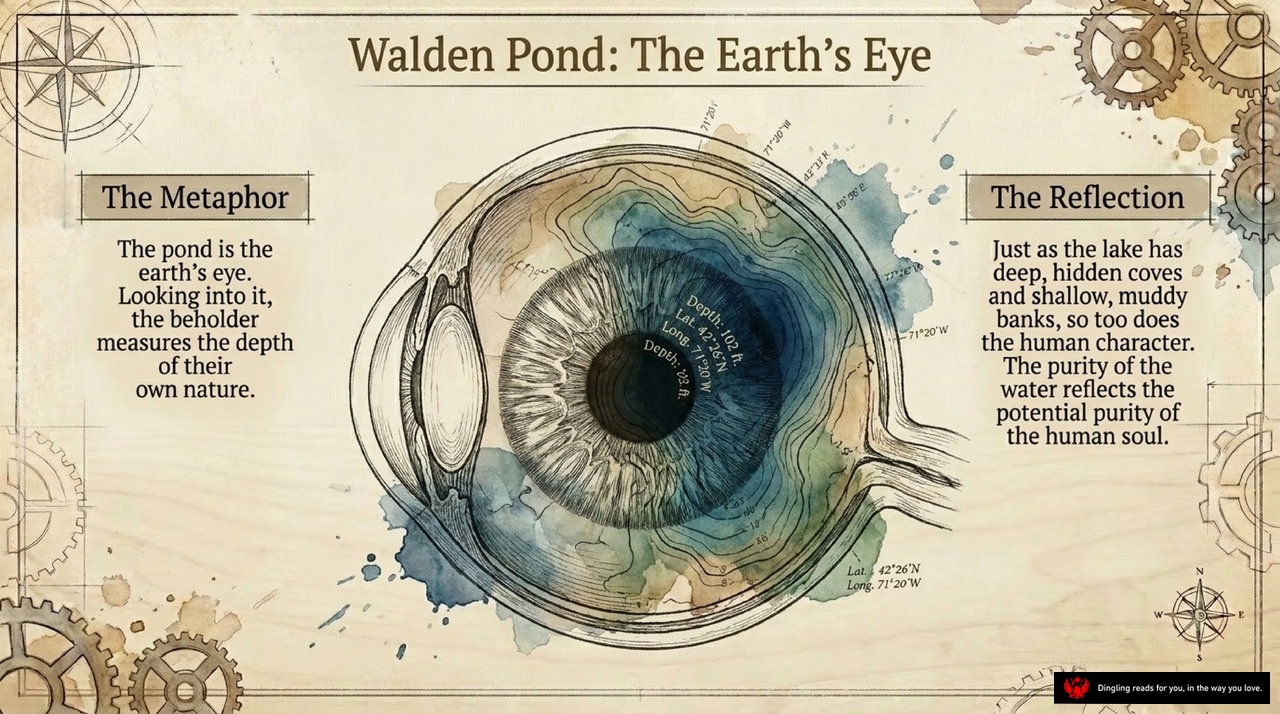
Walden Pond: The Earth's Eye. Imagine this lake not just as a body of water, but as a mirror, a living organ, and the very eye of our planet. When we look into it, we aren't just seeing blue depths; we are measuring the depth of our own souls.
Think about the reflection on the right. Just as the lake has deep, hidden coves and shallow, muddy banks, so too does human character. The purity of the water reflects the potential purity of the human soul. If the water is clear and still, it suggests a mind at peace; if it is turbulent and murky, it mirrors a troubled spirit.
Now, look at the metaphor on the left. The pond is the earth's eye. When you gaze into it, the beholder measures the depth of their own nature. It is a simple, yet profound truth: we are what we reflect. The text reminds us that the lake's surface changes with the light, sometimes appearing as deep as the sky, other times transparent like glass. Yet, beneath that surface lies a world of life—fish, stones, and ancient secrets.
This image challenges us to stop looking at the world as an external object and start seeing it as an extension of ourselves. As Thoreau suggests, the lake is young and fresh, never growing old wrinkles. In the same way, our potential for growth is endless. We must dive deeper, past the superficial layers of our daily routines, to find the clarity and purity that lies within. Are you willing to look into the eye of the earth and truly see yourself?

Imagine a world where the very shape of a river, a leaf, and the human body are dictated by the same ancient, sacred design. This is the core of what we call "The Living Earth." Look at the thawing sandbank in spring; it proves that the earth is not dead, fossilized rock, but living poetry. This fundamental architecture connects us all.
But this connection isn't just about biology; it's about transformation. Consider the concept of "The Thaw." Spring brings absolute forgiveness. The winter of quiet desperation melts away, offering the total renewal of the soul. Just as the ice breaks and life returns to the water, we are constantly invited to shed our old selves.
This cycle of rebirth is deeply rooted in nature's patterns. Notice the progression from a lobe to a globe, to a lap, to a flap, and finally to a leaf. It's a journey of unfolding. The thawing sand lobe, the intricate leaf structure, and the anatomical lobe are not separate entities; they are different expressions of the same creative force. When we align ourselves with this natural rhythm, we move from a state of stagnation into a state of vibrant, living poetry. We learn that just as the earth renews itself every season, we too have the power to thaw, to forgive, and to be reborn.

Imagine a map not of foreign lands, but of your own soul. This slide, titled "Exploring the Inner Continent," challenges us to stop mapping the coastlines of the world and start sailing the unmapped seas of our spirit. Society sends massive expeditions to chart foreign coasts, yet it leaves the vast oceans of the human mind completely uncharted. We spend our lives in the "Gulf of Illusion," chasing external validation while ignoring the "Forests of Wonder" within us.
The image presents a stark choice between "The Critique" and "The Call to Action." On one side, we see the danger of staying in the "Cape of Solitude" or the "Mountains of Despair"—comfortable but spiritually stagnant. On the other, the map urges us to become a Columbus to whole new continents and worlds within you. True exploration requires the courage to sail the private, unmapped seas of your own spirit, rather than relying on the safe, crowded routes of conventional society. Don't just read about the journey; step onto the boat and discover the new land that lies just beyond your current horizon.

To live deliberately means stripping away the noise of the modern world and rejecting the illusions of societal progress. It's about discovering the profound, unshakeable truths hidden within nature and ourselves. True wealth isn't found in what you possess, but in the clarity of your own mind.
But here is the hard question: Are you truly awake, steering the course of a deliberate life, or are you simply a sleepwalker trapped in the quiet desperation of the modern world?
Most people are busy building bigger houses, chasing trends, and filling their days with trivial tasks, thinking this is success. But as we see in the text, true fulfillment comes from simplicity. It comes from waking up early enough to watch the sun rise, from choosing to live in a small cabin rather than a mansion that traps you, and from finding joy in the simple act of planting beans or reading a classic book.
The modern world tries to tell you that you need more stuff, more speed, and more approval from others. But the forest whispers a different truth. It tells you that you are never truly alone if you are connected to the earth, and that the most important work you can do is to observe your own life with honesty.
So, I want you to ask yourself today: When you close your eyes at night, are you proud of the day you lived, or do you feel like you just drifted through it? Don't wait for a grand moment to change. Start by simplifying. Start by waking up. Because the moment you stop sleepwalking, you reclaim your life.