
What is Education: Complete Chapter-by-Chapter Summary

Welcome to our exploration of Karl Jaspers' profound question: What is Education?
Imagine standing in a vast, ancient library, surrounded by towering shelves of knowledge, yet bathed in a single beam of light shining down from above. That light represents the true purpose of education, as Jaspers describes it. It is not merely about filling your mind with facts or training you to be a machine. Instead, it is a philosophical journey designed to awaken the existential freedom of the human soul.
True education transcends mechanical training. It refuses to treat students as objects to be controlled or disciplined. In fact, Jaspers warns that when education becomes just another form of control or when it relies on rigid plans, it actually stifles the very spirit it claims to nurture. It turns living individuals into predictable parts of a system, stripping away their unique humanity.
So, what is the alternative? Real education is a dialogue—a meeting of minds where the teacher and student stand as equals. It is about awakening the potential within you, helping you discover your own path to truth and moral responsibility. It's not about giving you ready-made answers; it's about teaching you how to ask the right questions. It is the art of guiding you to look inward, to understand your own existence, and to become a complete, free human being.
This is the essence of education: not the accumulation of data, but the liberation of the soul.

Look at these three pillars. They represent the fundamental question: What is education, and more importantly, what is it *not*?
On the left, we see "Care or Breeding." This approach focuses on tending to physical and biological growth. The outcome? You get a healthy organism, but at a cost: human development gets reduced to a mechanical, animalistic process. It's about keeping the machine running, not awakening the soul.
In the middle stands "Control." Here, the focus is on forcing the will of the master upon an objectified subject. The result is obedience and uniformity. While this creates a compliant workforce, it extinguishes individuality and inner freedom. It's a system of coercion that leaves no room for the human spirit to breathe.
But the true light shines on the third pillar: "True Education." This isn't about biology or control. Its focus is on soul-to-soul existential communication. When we look at the outcome, it's transformative: it awakens self-awareness, grants existential freedom, and forges a spiritual connection to truth.
The distinction is clear. Real education is not about making people useful tools or obedient followers. It is a profound, liberating dialogue that allows the human being to become fully themselves.
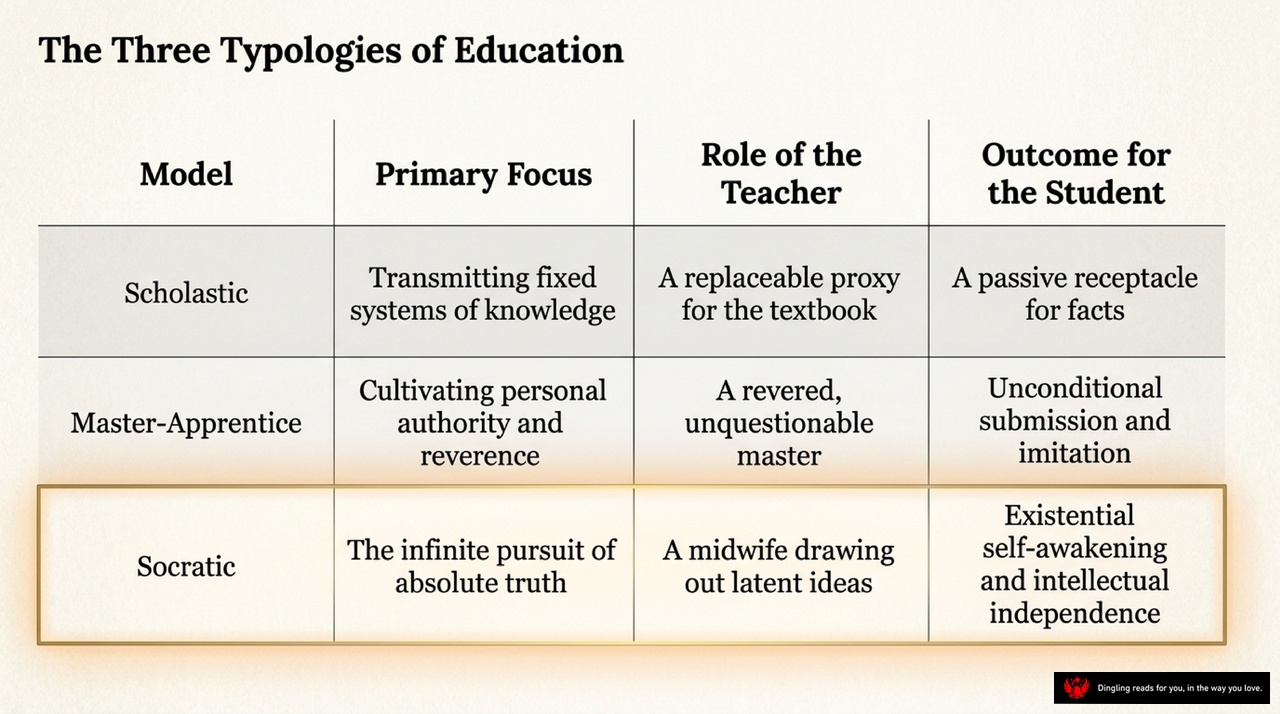
Let's dive into the three distinct models of education that have shaped our world, as outlined on this slide. We see three columns: the Model, the Primary Focus, the Role of the Teacher, and the Outcome for the Student.
First, we have the Scholastic model. Here, the focus is simply on transmitting fixed systems of knowledge. The teacher becomes just a replaceable proxy for the textbook, and the student? They turn into a passive receptacle for facts. It's about memorization, not understanding.
Next is the Master-Apprentice model. This approach focuses on cultivating personal authority and reverence. The teacher is seen as a revered, unquestionable master, and the student's outcome is unconditional submission and imitation. It's a relationship built on hierarchy and dependency, where the student never truly questions the path laid out by the master.
Finally, we have the Socratic model, which is highlighted here. This is where things get transformative. The primary focus shifts to the infinite pursuit of absolute truth. The teacher isn't an authority figure to be obeyed, but rather a midwife drawing out latent ideas within the student. There are no fixed answers to hand out. Instead, the outcome is existential self-awakening and intellectual independence. The student learns to think for themselves, moving from dependency to a deep, personal connection with truth. This is the model that truly empowers the human spirit.
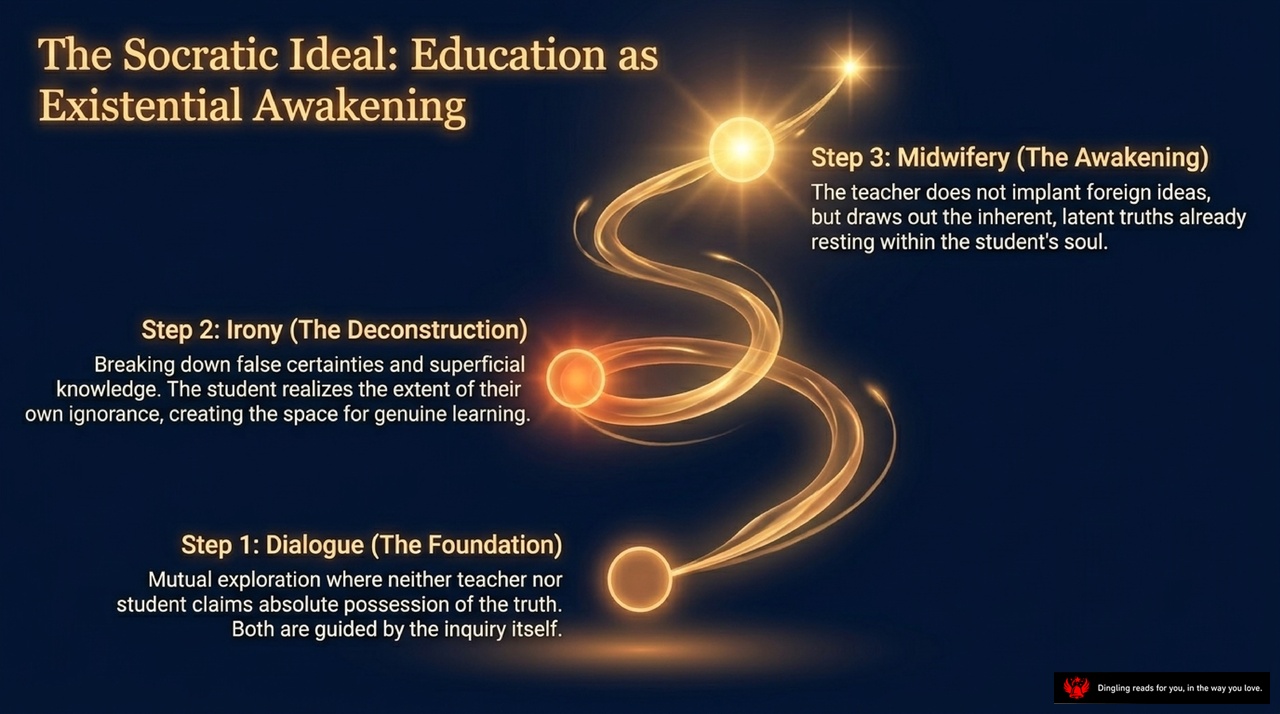
Look at this spiral of light. It perfectly captures the Socratic Ideal: education as an existential awakening. This isn't about filling a bucket; it's about lighting a fire.
The journey starts at the bottom with Step 1: Dialogue. Here, neither the teacher nor the student claims to own the truth. It's a mutual exploration where both are guided simply by the inquiry itself. No one is the authority; the question is.
Then, we move up to Step 2: Irony. This is the deconstruction phase. The teacher breaks down false certainties and superficial knowledge. It's a moment of crisis where the student realizes the extent of their own ignorance. Paradoxically, this realization creates the necessary space for genuine learning to begin.
Finally, we reach the top at Step 3: Midwifery. This is the awakening. The teacher doesn't implant foreign ideas. Instead, they draw out the inherent, latent truths already resting within the student's soul. Through this process of questioning and deconstruction, the student discovers the answers they already possessed. It's a profound shift from external instruction to internal discovery.
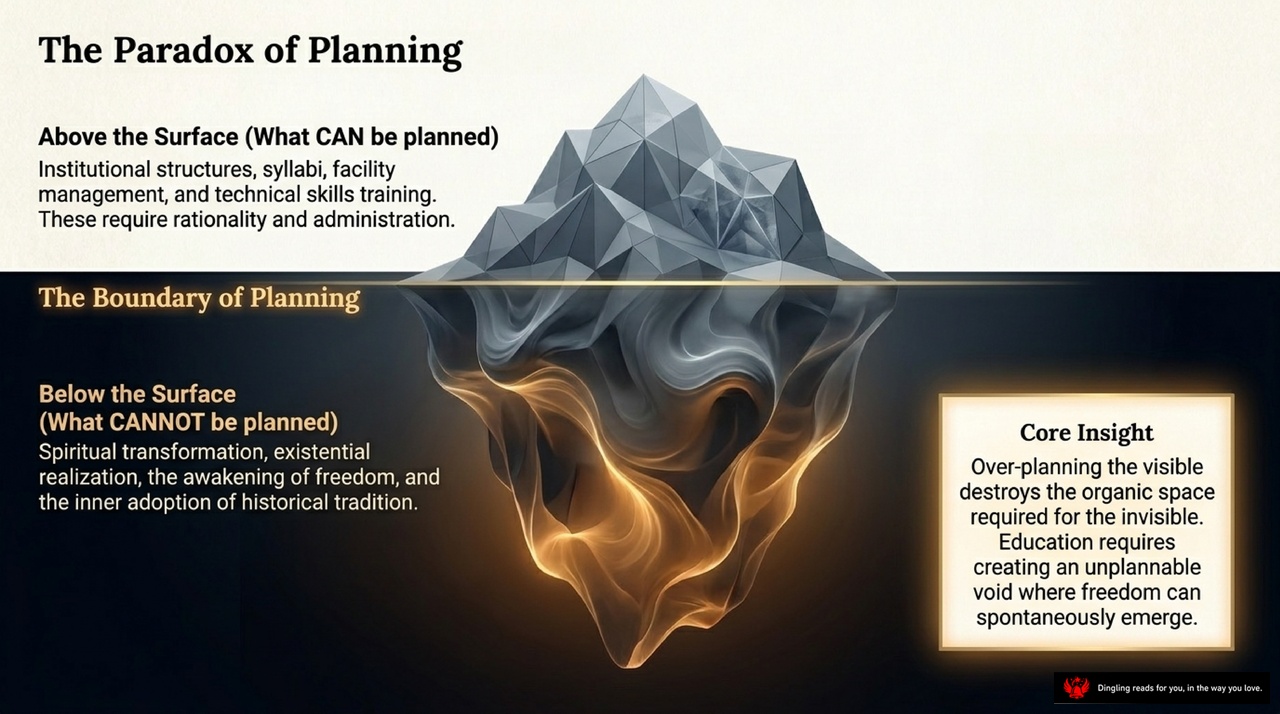
The Paradox of Planning reveals a crucial boundary in education: what we can organize versus what must remain wild. Above the surface, we can plan syllabi, manage facilities, and train technical skills. These are the visible structures requiring rational administration. But look below the surface. Here lies the invisible realm of spiritual transformation, existential realization, and the awakening of freedom—things that simply cannot be planned.
If we over-plan the visible, we destroy the organic space required for the invisible to emerge. True education isn't about filling a schedule; it's about creating an unplannable void where freedom can spontaneously take root. As the text warns, trying to engineer a perfect future or force a specific outcome often turns students into mere instruments of a system. The most profound growth happens not when we control every step, but when we trust the process enough to let the unexpected unfold. Education requires us to respect this limit, to step back from the need to dictate, and instead cultivate the conditions where human potential can breathe and grow on its own.
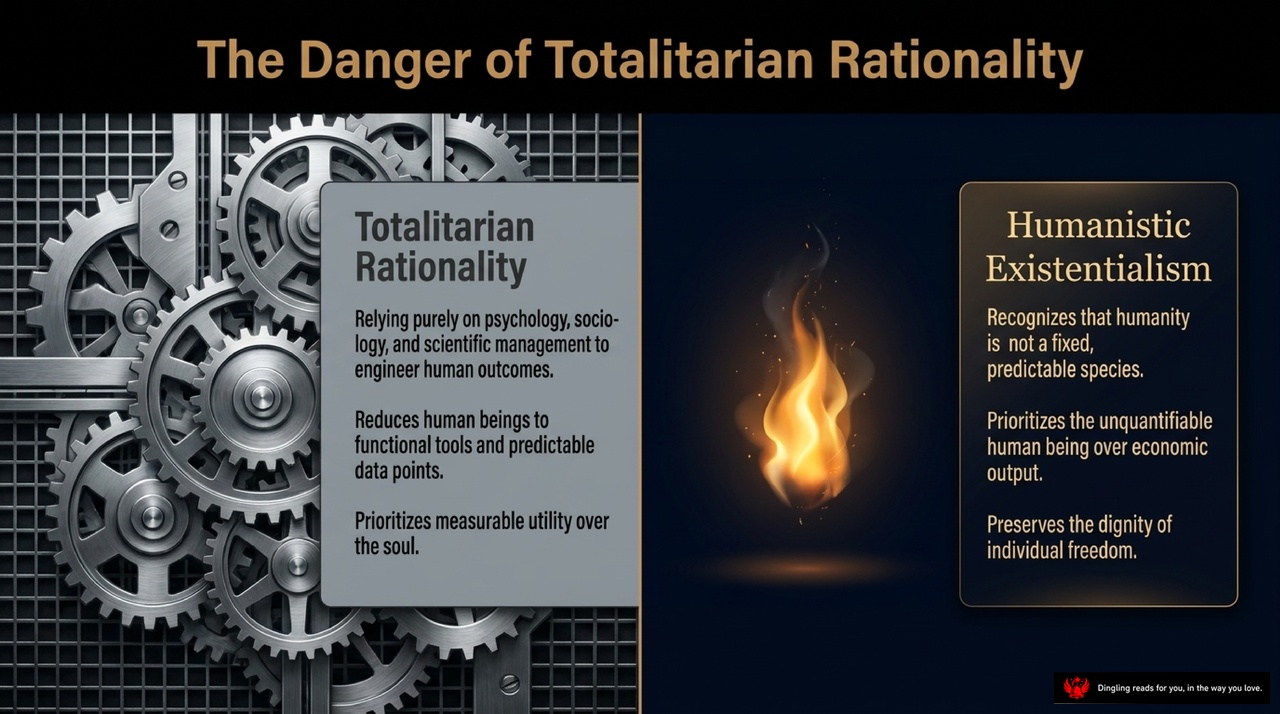
Today's slide highlights a critical distinction that often gets lost in modern education: the danger of "Totalitarian Rationality" versus the liberating power of "Humanistic Existentialism."
On the left, we see the cold machinery of totalitarian rationality. This approach relies purely on psychology, sociology, and scientific management to engineer human outcomes. It treats people like cogs in a giant gear system—reducing complex human beings to mere functional tools and predictable data points. In this worldview, measurable utility is king, and the soul is sacrificed at the altar of efficiency. It's a system that prioritizes control over character, and output over the individual.
But on the right, we find the flame of Humanistic Existentialism. This is the necessary antidote. It recognizes a fundamental truth: humanity is not a fixed, predictable species that can be fully engineered. Instead, it prioritizes the unquantifiable aspects of the human being—our freedom, our dignity, and our unique potential—over cold economic output.
The core conflict here is between a world where we are managed and a world where we are empowered. True education, as we've discussed throughout our session, isn't about fitting students into a pre-determined industrial mold. It's about preserving the dignity of individual freedom and allowing the unpredictable, vital spark of the human spirit to flourish. We must choose the fire of existentialism over the cold steel of totalitarian planning, because only by honoring the unmeasurable parts of ourselves can we truly become free.

Look at this magnificent tree. It's a powerful metaphor for how language and tradition shape our very souls. Notice the roots, buried deep in the earth, surrounded by ancient texts. These are the roots of Classical Tradition and Language. They represent historical consciousness and the mastery of language. Think of them as the fundamental soil of the human soul. Without this deep grounding, we have nothing to stand on.
Now, look at the trunk. This represents the individual student. As we absorb this spiritual heritage from the roots, the greatness of the past becomes our second nature. It's not just about memorizing facts; it's about letting history live within us, transforming our character.
Finally, see the branches reaching up into the starry night sky? These symbolize our present-day intellect. The text reminds us that only by being deeply rooted in historical truth can our minds reach freely toward the infinite possibilities of the future. If we cut the roots, the branches wither. True freedom and innovation come from a deep connection to who we are and where we've come from. This image perfectly captures the idea that education is not just about filling a bucket, but about nurturing a living, growing tree that reaches for the stars.
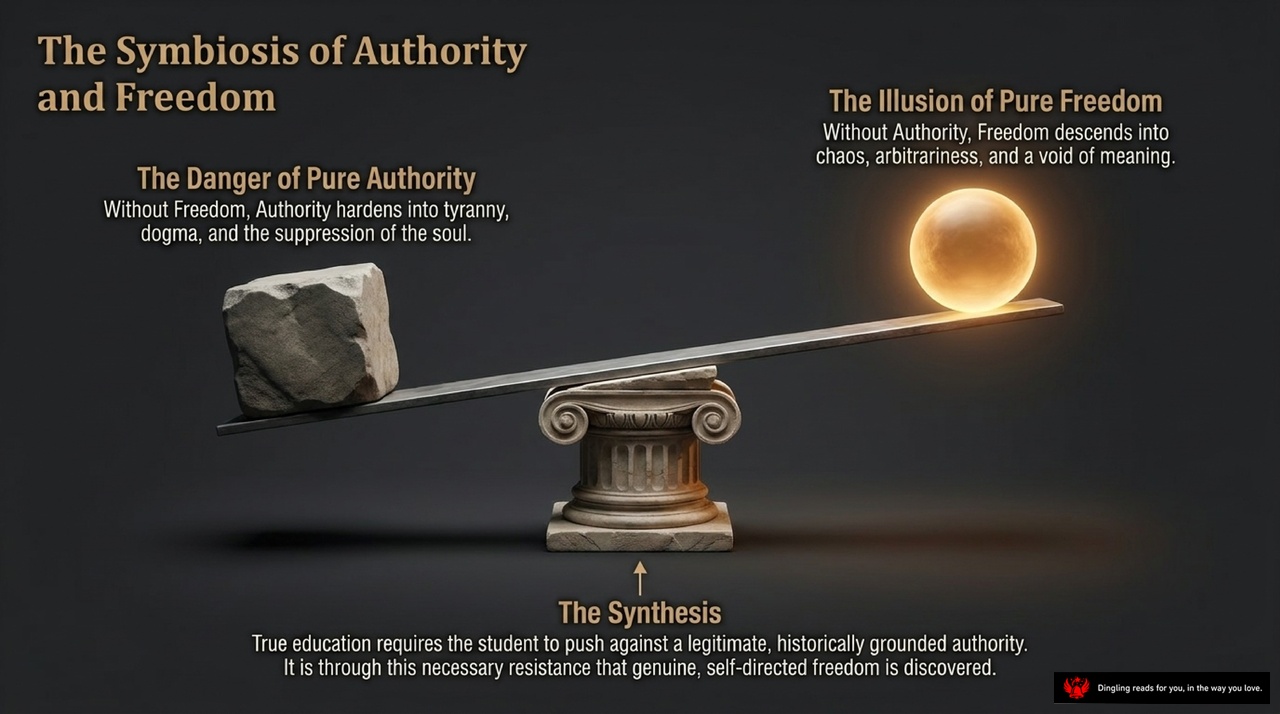
Imagine a seesaw resting on a classical column, perfectly illustrating the delicate balance between two forces that shape our lives: Authority and Freedom. On one side sits a heavy, unyielding rock, representing the danger of pure authority. Without the counterweight of freedom, authority hardens into tyranny, dogma, and the crushing suppression of the soul. It becomes rigid, lifeless, and ultimately destructive to the human spirit.
On the other side, we see a glowing sphere, symbolizing the illusion of pure freedom. Left unchecked, freedom descends into chaos, arbitrariness, and a terrifying void of meaning. Without the grounding structure of authority, there is no direction, no stability, and no shared reality to anchor us.
The image suggests that true education isn't about choosing one side over the other. Instead, it requires a synthesis—a dynamic tension where the student actively pushes against a legitimate, historically grounded authority. It is through this necessary resistance that genuine, self-directed freedom is discovered. As we explore the text, we see that true education is not about blind obedience or reckless independence. It is a dialogue where the teacher awakens the student's potential, not by handing them answers, but by guiding them to discover the truth within themselves. This process transforms authority from a tool of control into a bridge to freedom, ensuring that we remain neither slaves to tradition nor lost wanderers in the wilderness of our own making.
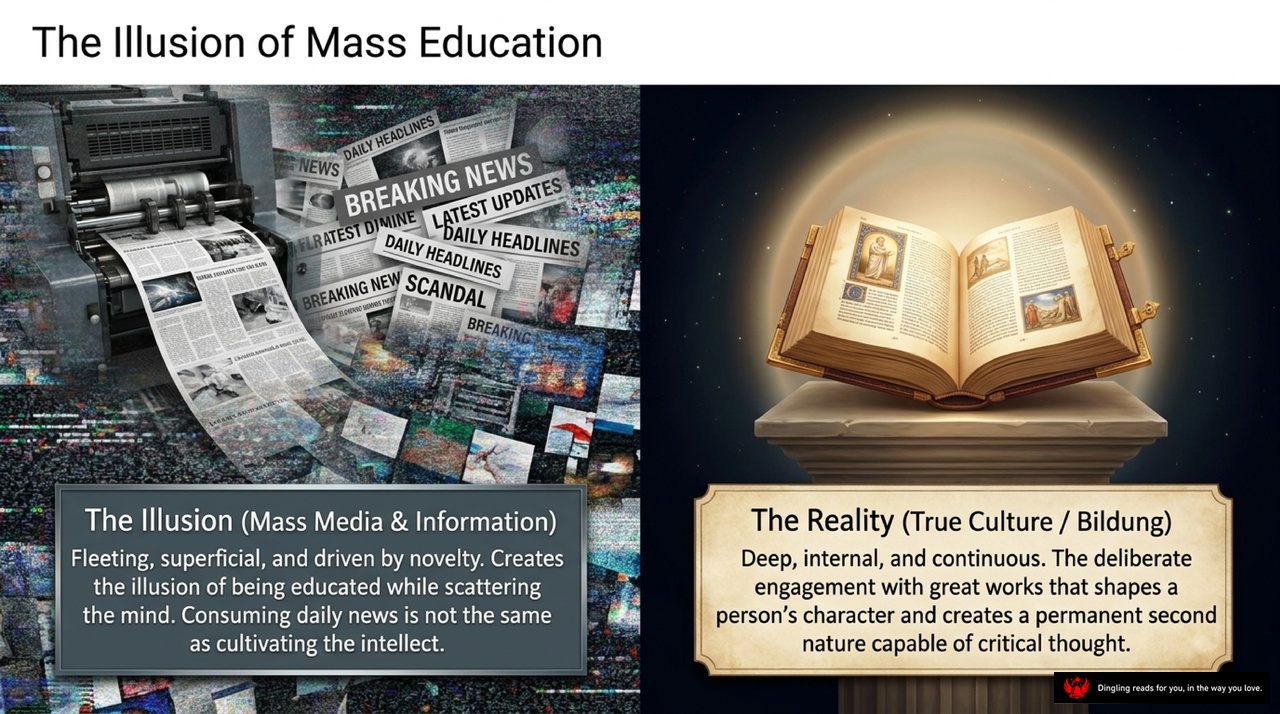
The slide contrasts two very different paths to learning. On the left, we see the "Illusion of Mass Education," represented by that relentless stream of breaking news and daily headlines. It's fleeting, superficial, and driven purely by novelty. Consuming this constant flow of information might make you *feel* educated, but it actually scatters your mind rather than cultivating it. It's the difference between being informed and being wise.
On the right, we see the reality: True Culture, or what the text calls *Bildung*. This is deep, internal, and continuous. It's not about how much data you can consume, but about the deliberate engagement with great works that shape your character. This is the kind of learning that creates a permanent second nature within you—one capable of critical thought and independent judgment.
The core message here is a warning against the modern trap of mistaking information for intelligence. Real education isn't a product you consume like a newspaper; it's a slow, transformative process where you build your own spirit. As the text suggests, true education is about awakening your potential and guiding your own thinking, not just filling your head with facts that you'll forget tomorrow.

Imagine the university not just as a building or a collection of courses, but as a grand temple dedicated to the pursuit of absolute truth. Today, we're looking at the four pillars that hold this structure up. At the very top, like the pediment of a classical temple, lies the university's ultimate goal: the relentless pursuit of absolute truth. This isn't about memorizing facts; it's about seeking the fundamental reality that connects us all.
But what supports this roof? Four distinct pillars stand side by side, each vital to the whole. First, we have Research. This is the relentless pursuit of the unknown, the drive to expand the very boundaries of what we know as human beings. It's about pushing past what is comfortable to discover what is real.
Next to it stands Teaching. Crucially, this isn't just about transferring information. It's about transmitting the method of scientific inquiry itself. It's teaching students how to think, how to question, and how to verify, rather than simply filling their minds with answers they can recite.
Then we have Education, or what the Germans call *Bildung*. This pillar is about shaping the whole person. It's not just intellectual; it's about cultivating intellectual character and developing the entire human being, integrating their mind, spirit, and actions into a coherent whole.
Finally, the fourth pillar is Communication. This is the living, Socratic dialogue and unhindered exchange among minds. It's the recognition that truth isn't found in isolation but emerges through the friction and harmony of free discussion between equals.
When these four pillars stand strong, supported by the roof of truth, the university fulfills its highest purpose. It becomes a place where the past, present, and future meet not to teach us what to think, but to help us discover how to think for ourselves.
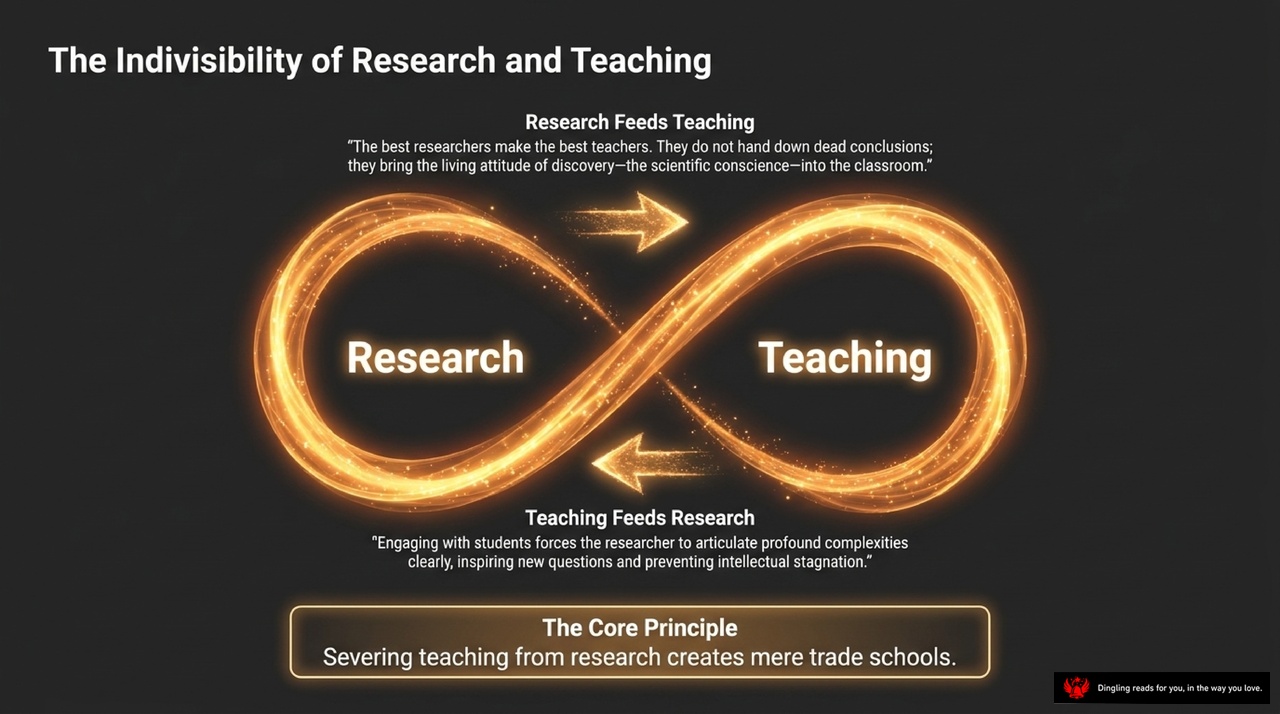
The image before us beautifully illustrates a concept that is often misunderstood but fundamentally essential for any true education: the indivisibility of research and teaching. Notice the glowing infinity loop connecting "Research" and "Teaching." It's not a circle where one leads to the other and stops; it's a continuous, living cycle where each fuels the other.
As the slide explains, "Research Feeds Teaching." The text reminds us that the best researchers make the best teachers because they don't just hand down dead conclusions. Instead, they bring a living attitude of discovery—the scientific conscience—right into the classroom. When a teacher is actively engaged in research, they don't just teach facts; they teach the thrill of finding answers, modeling for students how to think critically and embrace the unknown.
But the loop goes the other way too. Look at the bottom part: "Teaching Feeds Research." Engaging with students forces a researcher to articulate profound complexities clearly. When you try to explain a complex idea to a novice, you often discover gaps in your own understanding. This interaction inspires new questions and prevents intellectual stagnation. Teaching isn't just an output of research; it's a vital engine that drives further research.
The core principle at the bottom drives this home: severing teaching from research creates mere trade schools. If we pull them apart, we lose the soul of education. We end up with institutions that only train workers for specific tasks, stripping away the creativity, the critical thinking, and the human spirit that define true learning. So, let's remember: the most powerful educational environment is one where the teacher is always a learner, and the student is always a participant in the discovery of truth.

Imagine a world where the old aristocracy of blood and wealth has been replaced by something far more resilient and vital. In a true democracy, we don't need an elite chosen by birthright; we need a "Spiritual Aristocracy" forged entirely by the fire of rigorous education. As our slide beautifully illustrates, this new elite isn't defined by social class or financial status. Instead, it emerges from a powerful filter of rigor. This filter doesn't accept everyone; it demands intellectual courage, the willingness to endure the hardships of true learning, and an uncompromising dedication to the truth. It's a system that rejects the mechanical, soul-crushing methods of industrial training. Instead, it embraces the Socratic ideal of dialogue, where teachers and students stand as equals, engaging in a shared quest for wisdom rather than a one-way transfer of facts.
But why does this matter for our democracy? Because a true democracy can only survive if it allows this spiritual aristocracy to emerge organically from all levels of society. Without these individuals—those who have been tempered by the pursuit of truth and the cultivation of a deep, reflective spirit—our society risks drifting into a utilitarian nightmare where everyone is a skilled worker but no one is a wise human being. We must stop treating education as a mere job training program and start viewing it as the essential craft of creating a soul that can guide the state. It is only through this organic rise of a wisdom-based elite that we can hope to preserve the very freedom we cherish.
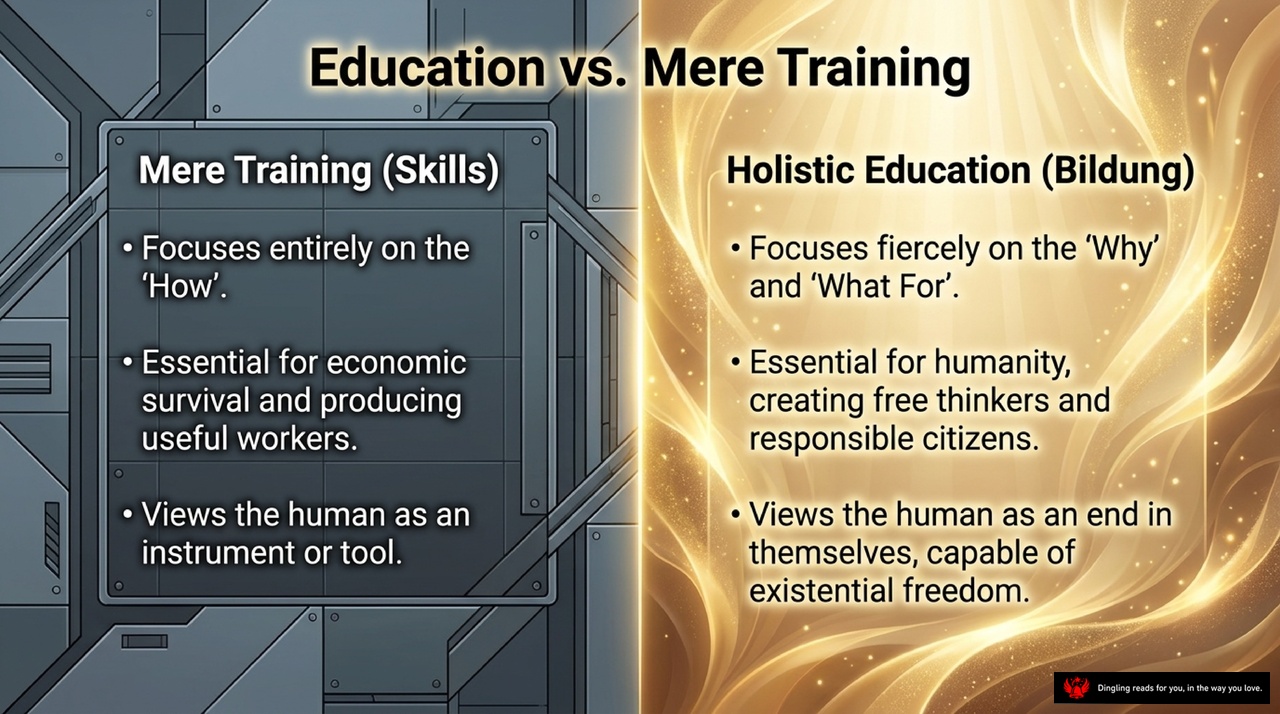
Today's slide draws a sharp line between two worlds: one of cold efficiency and the other of deep humanity. On the left, we see "Mere Training," a system that focuses entirely on the "How." It's about producing useful workers and ensuring economic survival, viewing people essentially as instruments or tools to be used. It's practical, yes, but it strips away the soul.
Contrast that with the golden side: "Holistic Education," or *Bildung*. This isn't just about skills; it's a fierce focus on the "Why" and the "What For." It aims to create free thinkers and responsible citizens, treating every human as an end in themselves, capable of existential freedom.
The text reminds us that true education is never just about filling minds with facts or training them to follow orders. It's a spiritual awakening, a dialogue where the teacher doesn't just supply answers but awakens the student's own potential. While mechanical training turns us into cogs in a machine, holistic education nurtures the spirit, connecting us to history and truth. In a world that often demands just the "how," we must insist on the "why," because only then do we stop being tools and start becoming fully human.

Today's slide outlines the grand architecture of becoming human—a synthesis of how we evolve from mere biological beings into fully realized souls. Look at the golden path winding upward; it represents our journey, but notice the three pillars supporting it.
First, we are **Grounded in Tradition**. This isn't about blindly following the past, but rooting ourselves in classical texts and historical consciousness. Without this foundation, our search for meaning has no anchor.
Second, we are **Awakened by Socratic Dialogue**. This is where the real magic happens. Instead of being fed answers, we are cultivated through irony, relentless questioning, and what Socrates called the "midwifery of ideas." It's about sparking your own internal power to discover truth, rather than having it imposed from the outside.
Finally, this entire structure aims at **Existential Freedom**. The ultimate goal isn't a programmed mind or a robot following orders; it is an awakened soul. We are structured by the university not just to teach facts, but to support the indivisibility of living research and teaching, guiding us toward a life where we are free to be ourselves.

True education isn't about mechanically programming our minds; it's about the deliberate awakening of the soul. Think of it as a lifelong dialogue between history, authority, and our own innate freedom. We often get it wrong by engineering schools solely for economic utility and measurable output, treating students like machines to be fixed rather than humans to be awakened. But if we continue down this path, what will remain of our humanity once the training is complete? The real work happens when we stop forcing knowledge into students and instead guide them to discover truth for themselves. It requires a shift from controlling minds to cultivating spirits, ensuring that education doesn't just produce workers, but fosters the kind of free, critical thinkers capable of shaping a better future.