
What Makes You a Buddhist: Complete Chapter-by-Chapter Summary
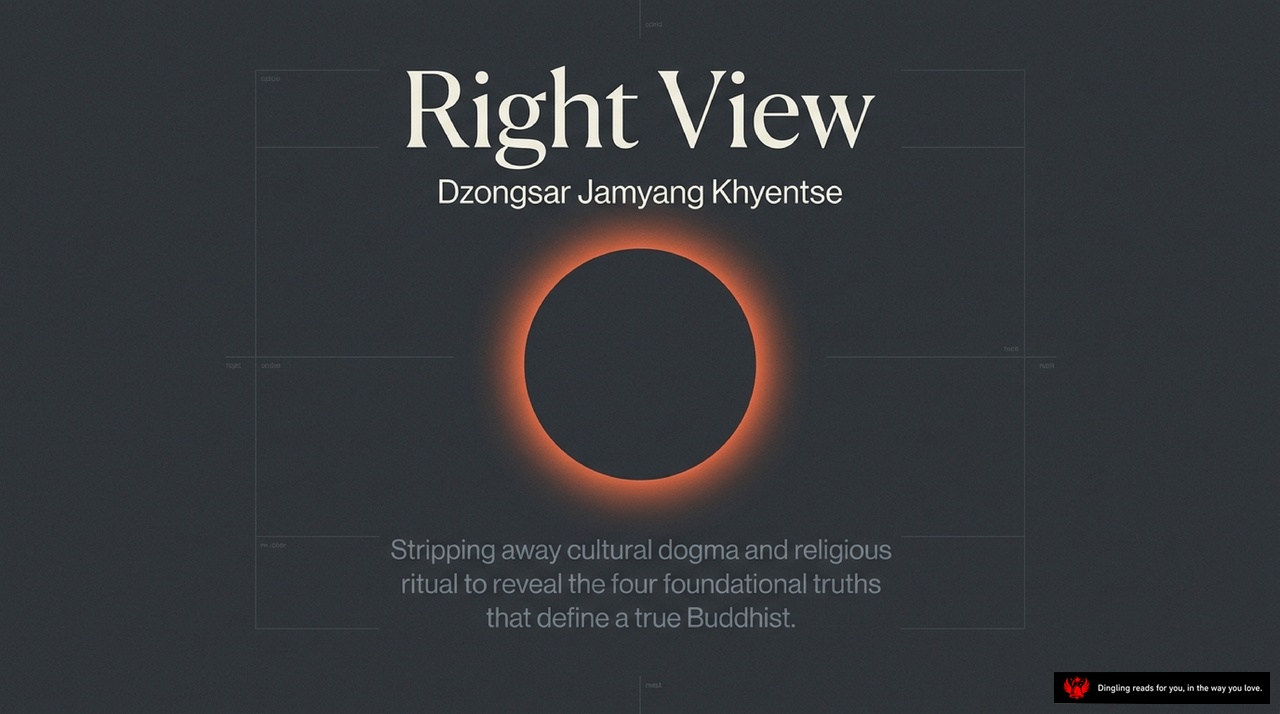
Welcome to a journey that strips away the noise of dogma and ritual to reveal the very heart of what it means to be a Buddhist. Today, we are exploring the concept of "Right View," a term coined by the great Dzongsar Jamyang Khyentse.
Imagine a total solar eclipse. That is the essence of this view: stripping away the bright, distracting layers of cultural tradition and religious performance to see the dark, foundational truth underneath. It's not about blind faith or following ancient scripts; it's about looking directly at the four truths that define a true Buddhist.
The core of this Right View is understanding impermanence. We often act as if our lives are a series of problems waiting to be solved, like a game we are trying to win. We think, "Once I retire, once I buy that house, once my kids succeed, then I'll be happy." But the Buddha taught us that this is a trap. Everything is in a constant state of flux. The moment you think you've solved a problem, a new one arises. The moment you feel safe, the ground shifts.
We are like the Prince Siddhartha, who was shielded from the harsh realities of aging, sickness, and death. He lived in a palace of illusions, believing that if he just fixed the external world, he could find happiness. But he eventually realized that clinging to the idea of a permanent, perfect life is the root of all suffering. The universe doesn't stop; it never stops. To accept this isn't pessimism; it is the only way to be free from disappointment.
Right View means seeing that nothing exists independently. You, your relationships, your job, even your beliefs—all are temporary combinations of causes and conditions. When those conditions change, you change. When they dissolve, you dissolve. This isn't a scary thought; it's a liberating one. It frees you from the desperate need to control everything and the fear of losing it.
So, what does this look like in real life? It means letting go of the fantasy that there is a "perfect" version of you waiting for you in the future. It means embracing the present moment exactly as it is, with all its uncertainty and fleeting beauty. It's about realizing that the "self" you cling to is as solid and real as a mirage in the desert.
By adopting this Right View, you stop running on a treadmill of endless desire and fear. You stop waiting for the storm to pass and start learning to dance in the rain. You realize that the only true constant is change itself. And in that acceptance, you find a profound peace that no amount of money, fame, or perfection could ever buy. This is the path to a truly awake life.

What Buddhism actually is: A BRUTAL uncompromising deconstruction of reality.
Look at this mosaic on the left. It's not just a pretty picture of incense, shaved heads, or meditation retreats—that's what we *think* Buddhism is. It's a simplified, safe version we've built to feel comfortable. But the text on the right cuts through that illusion: Buddhism is actually a brutal, uncompromising deconstruction of reality.
Let's talk about why that word "brutal" matters. It's not about violence; it's about truth. Siddhartha, the Buddha, didn't start out as a spiritual guru. He was a prince with a golden life, protected from suffering by his father. But when he finally saw the raw truth of aging, sickness, and death, he realized that our entire comfortable world is built on a lie. We think we can control things, that we can build a perfect life or find a permanent partner. But the Buddha saw that everything is a temporary combination of conditions. An egg needs water and heat to become hard; a relationship needs two people and time to exist. The moment any condition changes, the thing itself changes or disappears.
This is the "brutal" part. It shatters our ego. We cling to the idea of a solid "self," but the Buddha showed that there is no permanent you. You are just a stream of changing thoughts and experiences. When we realize that our beloved possessions, our status, even our own identity are all just fleeting illusions, it feels terrifying. It feels like losing everything. But that's the point. By stripping away these false layers, we stop suffering. We stop being trapped by the fear of loss because we finally understand that nothing was ever truly ours to begin with. It's a harsh wake-up call, but it's the only way to find real freedom.

Imagine a teacup sitting right in front of you. Now, look closely at what this cup represents. The text on the slide makes a brilliant distinction between "The Culture" and "The Truth." On the left, we see the culture: the rituals, the rules, the chanting, and the traditions. These are just the vessel. They are the cup itself. And just like this cup, culture changes based on where you are and what era you live in. What was considered sacred or proper in one time and place might look completely different in another.
But then, look at the right side. That is "The Truth." This is the core philosophy. The slide puts it perfectly: "You can change the cup, but if the tea isn't pure, it isn't Buddhism." This is the most important takeaway. The form of the practice—the cup—doesn't matter. What matters is the substance inside.
So, what makes that tea pure? The text at the bottom gives us the answer. It says, "What makes you a Buddhist isn't the cup you hold. It is whether you accept the tea: The Four Seals."
Think about your own life. Are you defining your faith by the rituals you attend or the traditions you follow? Or are you looking at the core principles? Buddhism teaches that all compounded things are impermanent. It's about understanding that nothing stays the same, that everything is in a constant state of change. It's about seeing through the illusion of a permanent self. If you truly embrace these truths—the Four Seals of impermanence, suffering, non-self, and emptiness—then you are practicing Buddhism, regardless of the cup you are holding. Don't get lost in the design of the cup; focus on the purity of the tea.
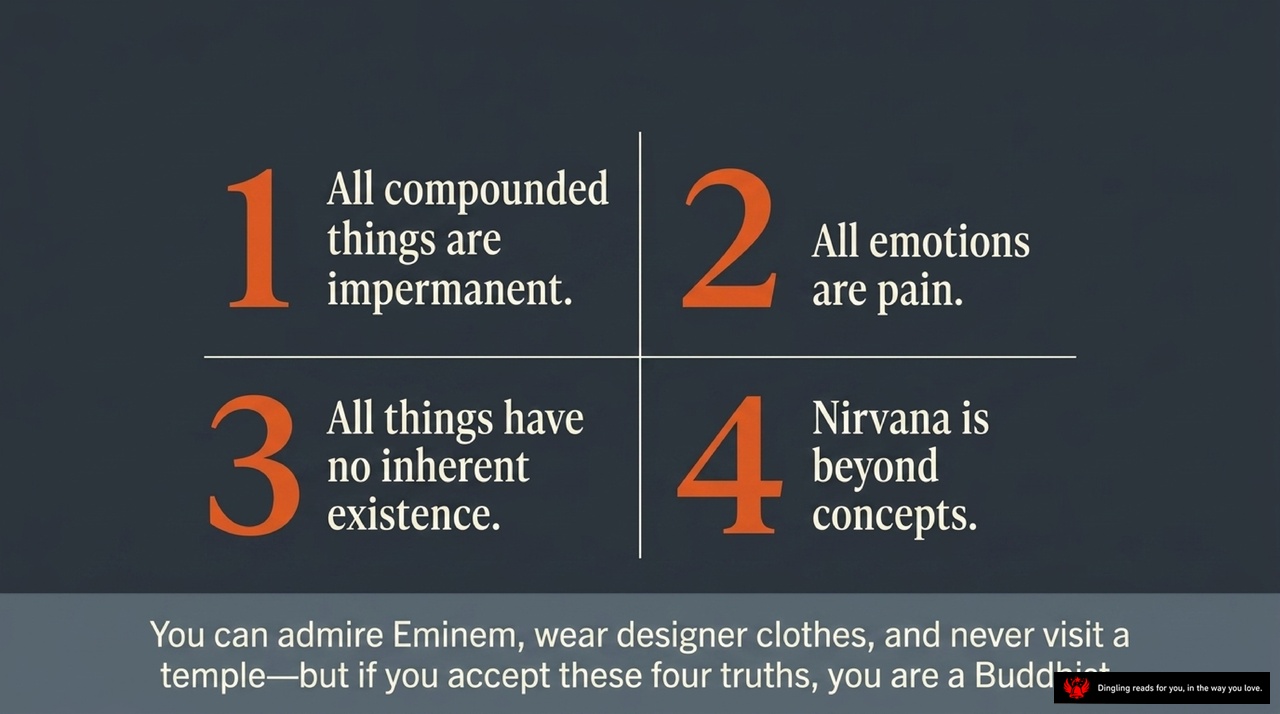
Friends, look at these four truths. They aren't just ancient philosophy; they are the operating system for a life that actually works. First, everything compounded is impermanent. That's the hard truth we all dodge: nothing stays the same. Second, all emotions are pain. Not just suffering, but the pain of uncertainty itself. Third, all things have no inherent existence. You are not a solid, unchanging thing; you are a collection of shifting parts. And finally, Nirvana is beyond concepts. It's not a place you go to; it's a state of mind you realize right here.
Here's the kicker at the bottom of this slide: You can admire Eminem, wear designer clothes, and never visit a temple. But if you accept these four truths, you are a Buddhist. Why? Because the label doesn't matter. What matters is your relationship with reality.
Think about it. We spend our lives trying to build a permanent identity, a perfect career, or a flawless relationship. We act like we're in a movie where we control the script. But the first truth shatters that illusion. If everything is impermanent, then your job title, your bank account, and even your personality are just temporary arrangements.
And that leads directly to the second truth: all emotions are pain. When you cling to something that is changing, you are setting yourself up for inevitable disappointment. Love hurts because it's conditional. Anger hurts because it's reactive. The moment you realize that your feelings are just weather passing through, not the sky itself, you stop getting soaked.
The third truth takes it even deeper. Nothing exists on its own. You are dependent on your parents, your food, your culture, and your thoughts. There is no "you" hiding behind all that. This is why we feel so fragile. We try to protect a self that doesn't really exist. When you see through this, the pressure to be perfect evaporates.
So, what does this mean for you today? It means you can keep listening to your favorite music and enjoying your clothes. But you stop believing in the magic of them. You stop thinking that if you just buy the right bag or find the right person, you'll finally be safe. You realize that true freedom isn't about having more; it's about letting go of the need for things to be permanent.
Nirvana isn't a distant paradise with golden clouds. It's the quiet confidence that comes from knowing that even if everything falls apart, you are okay with it. Because nothing ever really falls apart. It just changes. And that, my friends, is the ultimate relief.
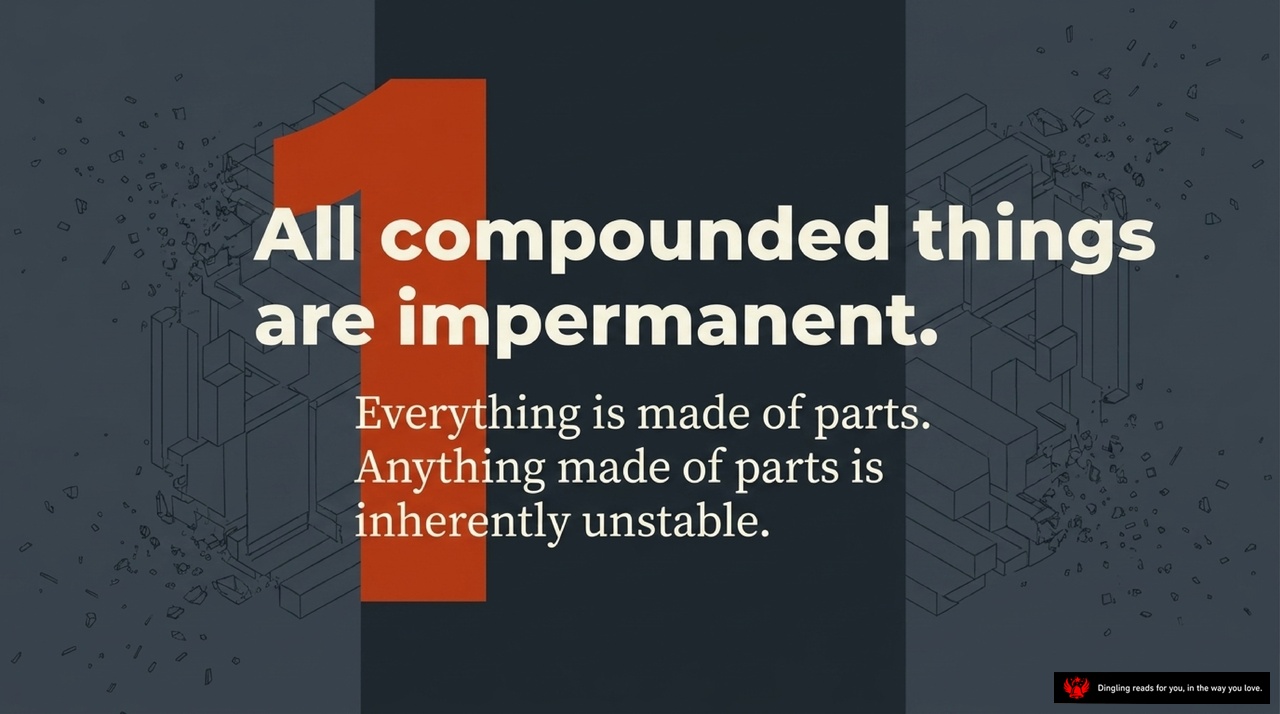
Look at this first principle: "All compounded things are impermanent." The slide breaks this down simply: "Everything is made of parts. Anything made of parts is inherently unstable." This is the bedrock of Buddhist wisdom, and it changes how you see reality forever.
When you understand that everything is just a collection of parts, you realize that nothing can stay the same. Think about your life right now. Your body is made of cells, your thoughts are fleeting moments, and even your relationships are a constant dance of changing dynamics. If you remove just one part, the whole structure shifts. This isn't a pessimistic view; it's a scientific fact about how the universe works.
Consider the concept of "compounded things." It's not just physical objects like your phone or a building. It includes your emotions, your memories, and even your sense of self. Your "self" is compounded from your thoughts, your body, and your experiences. Since all of these are constantly changing, the idea of a permanent, unchanging "you" is an illusion. This realization liberates us from the anxiety of trying to control things that are destined to change.
When we accept that impermanence is the only constant, we stop fighting reality. We stop clinging to people, jobs, or possessions, knowing that their nature is to eventually dissolve. This doesn't mean we don't care about them; it means we care more deeply because we know they are precious precisely because they are temporary. By letting go of the desperate need for permanence, we find true freedom in the present moment.

Imagine you are in a kitchen, ready to make a boiled egg. You have the egg, you add water, you turn on the heat, you wait for the right amount of time, and you ensure the environment stays stable. Once all these conditions align, the result is inevitable: a boiled egg. No matter how hard you pray or try, you cannot uncook it. This simple diagram illustrates a profound truth about the entire universe.
The slide breaks down "The Anatomy of Creation and Destruction" into these exact ingredients: Egg, Water, Heat, Time, and an Uninterrupted Environment. It tells us that once these conditions come together, the outcome is fixed. Every action, object, and phenomenon in our lives relies on this fragile web of conditions. Because these conditions are constantly shifting, everything is in a state of flux. The egg is cooked; it can never be uncooked.
This concept, known as "Dependent Origination," is the core of what we call the "Composite Nature" of reality. Nothing exists in isolation. Your life, your relationships, even your thoughts are all "composite things" formed by countless causes and conditions. Just like that boiled egg, if you remove the heat or the water, the result changes instantly. The text reminds us that we often live as if things are permanent, as if our success or our failures are fixed states. But in reality, they are just temporary arrangements of conditions.
Understanding this liberates us from the fear of loss and the obsession with control. We realize that nothing is truly "ours" in a permanent sense. We are just the temporary result of our own unique set of conditions. By accepting that everything is in a constant state of becoming and unbecoming, we stop fighting against the inevitable flow of life. We find peace not in freezing time, but in understanding the fluid nature of our existence.
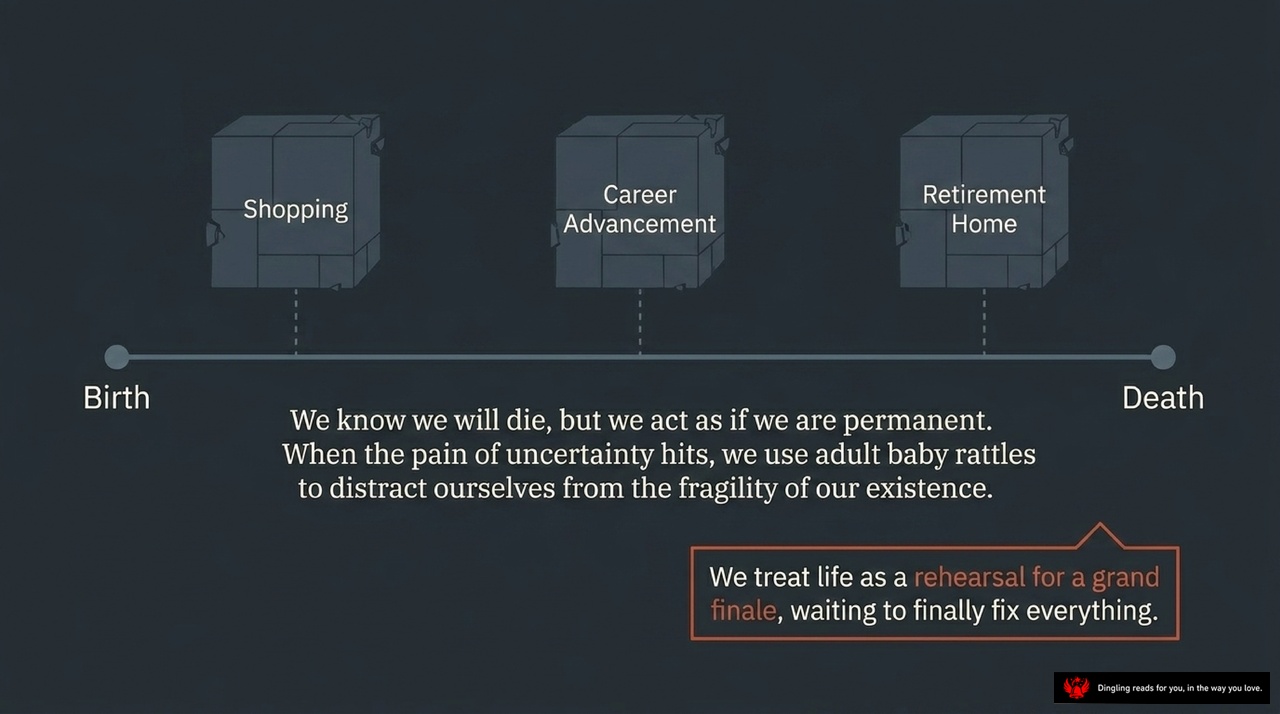
Look at this timeline. From birth to death, our lives seem to be a straight line leading to a grand finale. We map out our existence with three main milestones: Shopping, Career Advancement, and finally, a Retirement Home. We act as if we are permanent, as if this script will never change.
But here's the hard truth: We know we will die, yet we live as though we are immortal. When the pain of uncertainty hits, we use adult baby rattles to distract ourselves from the fragility of our existence. We treat life as a rehearsal for a grand finale, waiting to finally fix everything. We believe that if we just buy the right things, climb high enough on the corporate ladder, or save enough for that perfect retirement home, we can solve the problem of being alive.
But the reality is far more fluid. Nothing stays the same. The very act of trying to "fix" life is what keeps us trapped in the illusion of permanence. We are constantly in a state of becoming, not being. By clinging to the idea of a perfect ending, we miss the only thing that is truly real: the present moment, exactly as it is, with all its impermanence.

Imagine a world where nothing ever changes. If global warming, poverty, and depression were permanent, they would be eternal sentences. We'd be trapped in a cage, unable to alter our reality. But the universe operates on a different principle: impermanence. This isn't a doomsday prophecy; it is pure scientific fact. Because everything is compounded, you possess the power to alter the conditions. You can dismantle enemies, build wealth, or escape suffering—simply because none of them are permanent. When you realize that even the most painful situations are just a collection of changing factors, the despair of permanence transforms into the power of impermanence.

Have you ever felt that every emotion you experience—joy, anger, love, or grief—is actually a form of pain? This slide captures a profound truth from the Buddha's teaching: "All emotions are pain," because they are all rooted in the illusion of the ego.
Think about it. When you feel happy, you're clinging to a specific moment, fearing it will end. When you feel angry, you're defending a fragile sense of self that feels threatened. Even your love is often tied to the expectation that someone or something will remain unchanged. The Buddha realized that as long as we believe our emotions stem from a permanent, independent "self," we are trapped in a cycle of suffering. We chase pleasure and try to avoid pain, but both are just fleeting sensations in a constantly changing world.
The key isn't to suppress these feelings or pretend they don't exist. Instead, it's about seeing through the illusion. When you realize that there is no solid "you" behind the emotions, just a stream of changing conditions, the grip of pain loosens. You stop fighting reality and start flowing with it. This shift doesn't mean you become emotionless; it means you become free from being controlled by your emotions. You can feel deeply without being destroyed by it. That is the path to true peace.

Look at this shield being battered by arrows. This isn't just a metaphor; it's a map of the human mind. On the left, we see the four stages of the ego's construction: starting with **Ignorance**, where we fail to see that we are just a temporary collection of parts. Then comes **The Ego Label**, where we slap the word "I" or "Me" onto this collection, turning a fleeting process into a solid identity. This leads to **Paranoia & Defense**, that exhausting, constant need to protect and validate this imaginary "Me." Finally, we have **The Sniper's Arrows**.
On the right, these arrows represent the specific weapons the ego uses to defend itself. There's **Desire**, which blinds us to logic, chasing only what the ego wants. Then **Pride**, which requires constant external validation to feel real. And **Jealousy**, the toxic comparison of our illusion to someone else's. As the slide notes, even worldly "love" carries the seed of pain because it's tied to conditions and the ultimate fear of loss.
This is the core conflict we face. We build a fragile fortress of our identity, and then we spend our lives either defending it against the world or attacking others to feel superior. But as the text reminds us, the ego is a mirage. The "I" we are so desperate to protect doesn't exist in the way we think. When we realize that our identity is just a story we tell ourselves—a story made of changing thoughts, feelings, and experiences—we can stop defending it. We can stop getting hit by the sniper's arrows. Instead of fighting the illusion of the self, we can see through it, find peace, and stop the endless cycle of pain and validation.

The image in front of us captures a powerful truth that Siddhartha discovered: the solution to our inner chaos isn't suppression, but awareness. Look at that tangled knot of lines beneath the watchful eye—it represents our emotions, our anxieties, and the constant noise in our minds. We often try to silence them, to force them down, but that just makes the knot tighter.
Siddhartha taught us a different path. He didn't defeat his emotions by crushing them; he defeated them by simply observing them. The text reminds us that when you look at an emotion as just a temporary collection of conditions, it instantly loses its power. It's like a child throwing a tantrum under the watchful eye of a calm adult. The child still feels the anger, but the tantrum stops because the dynamic has shifted.
This is the essence of the "Solution: Awareness, Not Suppression." We live in a world that constantly tells us to push away our difficult feelings, to be productive and positive all the time. But true freedom comes from the opposite. It comes from stepping back, looking at the mess with clarity, and realizing that nothing is solid or permanent. When we stop fighting the flow of our experience, the knot begins to untangle itself. We don't need to fix the world or our feelings; we just need to see them clearly, exactly as they are.
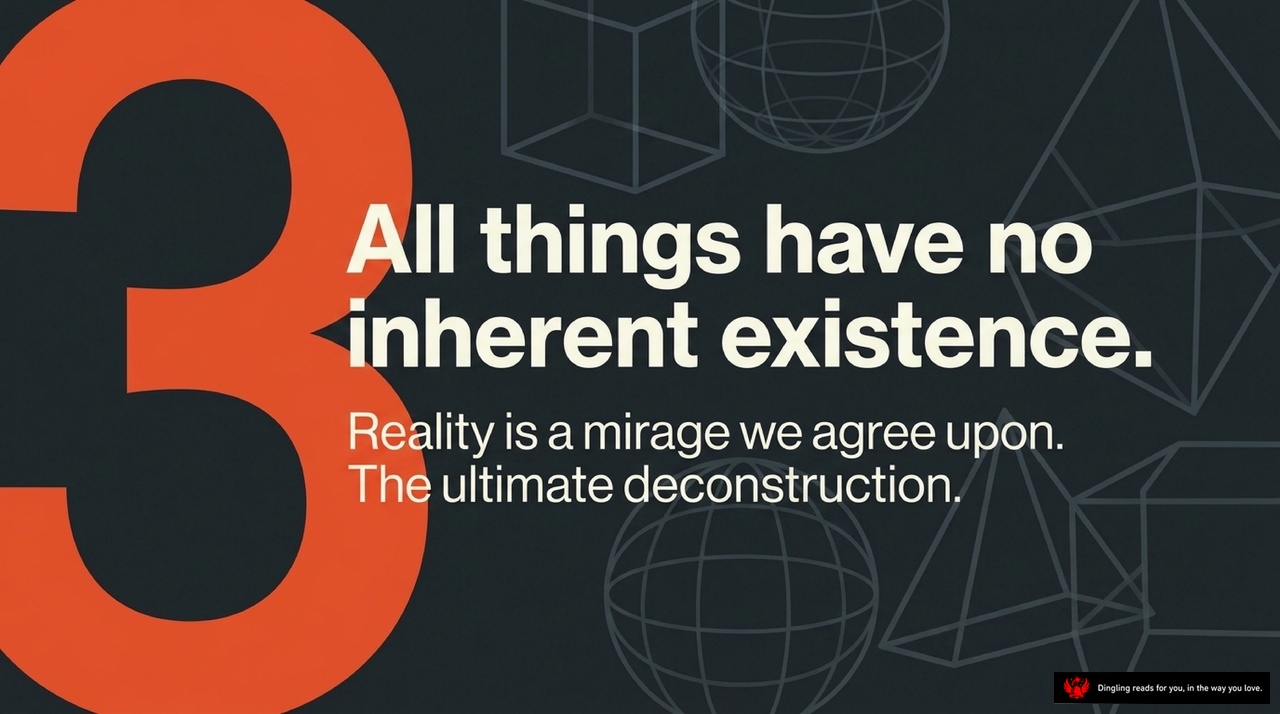
Today's slide presents a profound truth from the Buddha: "All things have no inherent existence." It reminds us that reality is a mirage we agree upon, representing the ultimate deconstruction of how we see the world.
Consider this: You look at a table, a friend, or even yourself, and you assume these things exist independently and permanently. But the Buddha teaches that nothing exists in isolation. Everything is a "composite phenomenon"—a temporary assembly of countless causes and conditions. Think of a cooked egg. It doesn't just appear out of nowhere; it requires the egg itself, water, heat, a stove, and even the absence of a power outage. Remove any one of these factors, and the result changes or disappears entirely. This is the essence of "dependent origination."
Because everything relies on other things to exist, nothing can be truly permanent or independent. The moment something is formed, it is already in the process of decaying or changing. There is no solid core to your identity, your emotions, or the world around you. The Buddha used the metaphor of a dream to explain this. Just as characters in a dream feel real while you are asleep but vanish instantly upon waking, our daily experiences feel solid, yet they are merely projections of our minds based on specific conditions.
This isn't about denying that life happens or that suffering is real. It's about seeing through the illusion that these things have a fixed, unchangeable nature. When you realize that your fears, your relationships, and even your sense of self are fluid and dependent, you stop clinging to them as if they are absolute truths. This realization breaks the cycle of suffering. You stop expecting the world to remain static, and you stop trying to force it to fit your desires. By understanding that nothing has inherent existence, you find freedom from the anxiety of control and the pain of loss.
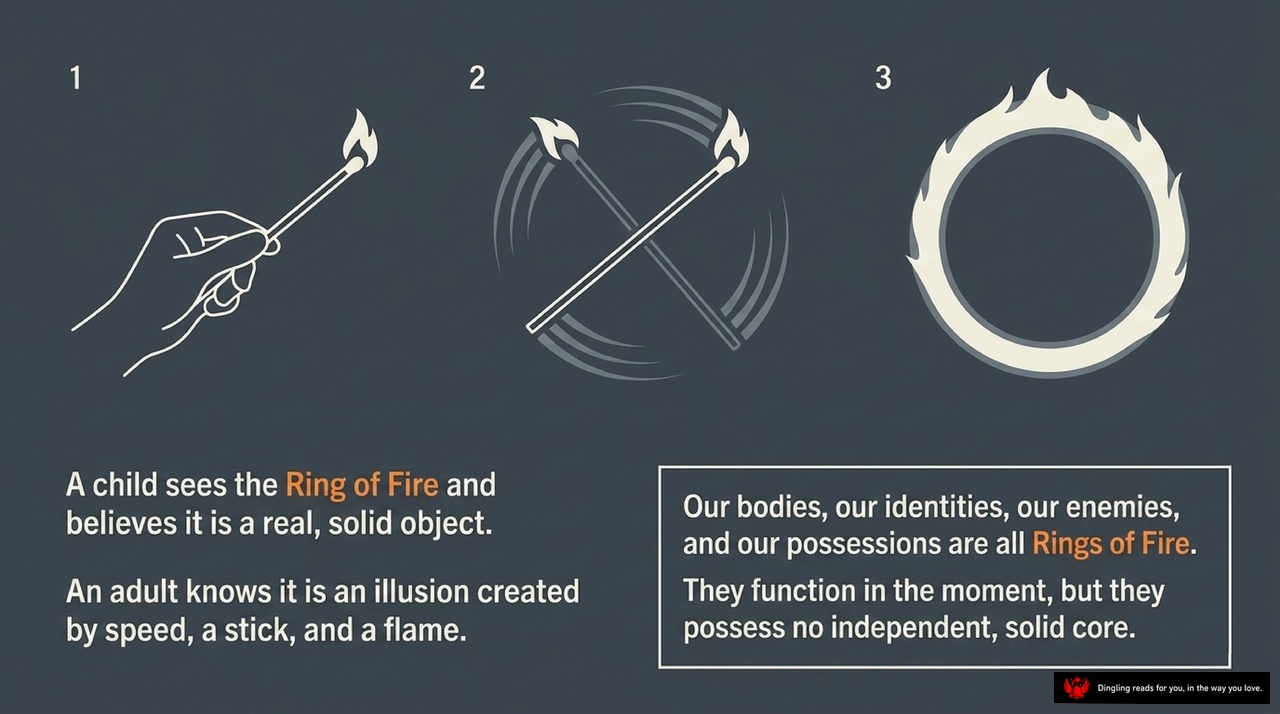
Have you ever tried to make a fire ring by spinning two burning sticks? To a child, it looks like a real, solid object of fire—a magical "Ring of Fire." But an adult knows the truth: there is no actual ring there. It's just an illusion created by the speed of the sticks and the flame.
This simple trick is a powerful metaphor for our entire lives. The slide reminds us that our bodies, our identities, our enemies, and even the things we own are all like these "Rings of Fire." They function right now, they seem real, and we treat them as if they have a solid, independent core. But deep down, they possess no such core. They are just illusions created by the rapid coming together of countless conditions.
Just as the spinning sticks create the ring, your life is a fleeting combination of causes and effects. The moment the sticks stop spinning, the ring vanishes. Similarly, the moment the conditions change, so do we. We often try to hold onto these "rings"—our jobs, our relationships, our status—believing they are permanent. But they are not. Understanding this illusion doesn't mean we should stop living or stop caring. Instead, it frees us from the crushing weight of expecting these temporary arrangements to last forever. When we see the world clearly, like the adult seeing the sticks, we stop fighting against the inevitable changes and find a deeper peace.

Imagine a world where reality is just a group opinion. If everyone agrees a designer bag is worth $5,000, it suddenly becomes "real." This is the trap of shared consensus. Our logic is limited because we define truth based on what we collectively agree upon, labeling things good or bad solely from our narrow vantage point. But here's the deeper truth: emptiness does not mean nothingness. It means things only exist relative to the mind perceiving them. Without a mind to perceive them, the value, the color, and even the existence of that handbag vanish. We are constantly chasing external validation, building our entire sense of self on these shifting consensus traps, only to find ourselves floating in a void of our own making. True freedom comes from realizing that the world isn't out there waiting for us to approve it; it's here, appearing only because we are looking at it.

Look at this image. It perfectly captures the core of Buddhist wisdom: the difference between suffering and liberation.
On the top half, we see a silhouette of a person terrified by a snake. This represents **Samsara**, or suffering. The text describes it as "the agonizing fear of a snake." It highlights a crucial truth: the physical panic feels intensely real, but the cause is actually an **illusion**. We are often trapped in a state of fear, reacting to things that aren't truly there, just like that man fleeing a shadow that isn't a snake.
Now, look at the bottom half. The snake is gone, replaced by a coiled tie. This symbolizes **Nirvana**, or liberation. The text explains this as "turning on the light." Notice something important: the snake doesn't magically disappear. You simply realize it **never existed** in the first place. Liberation isn't about fighting the illusion and destroying it; it's about changing your perspective. When you turn on the light of wisdom, the fear vanishes because the threat was never real to begin with.
The footer drives this home: "The Buddha cannot magically erase your pain. He can only turn on the light so you..." It reminds us that no external force can fix us. We have the power within us to shift our view from the darkness of illusion to the clarity of truth. That is the path from suffering to freedom.
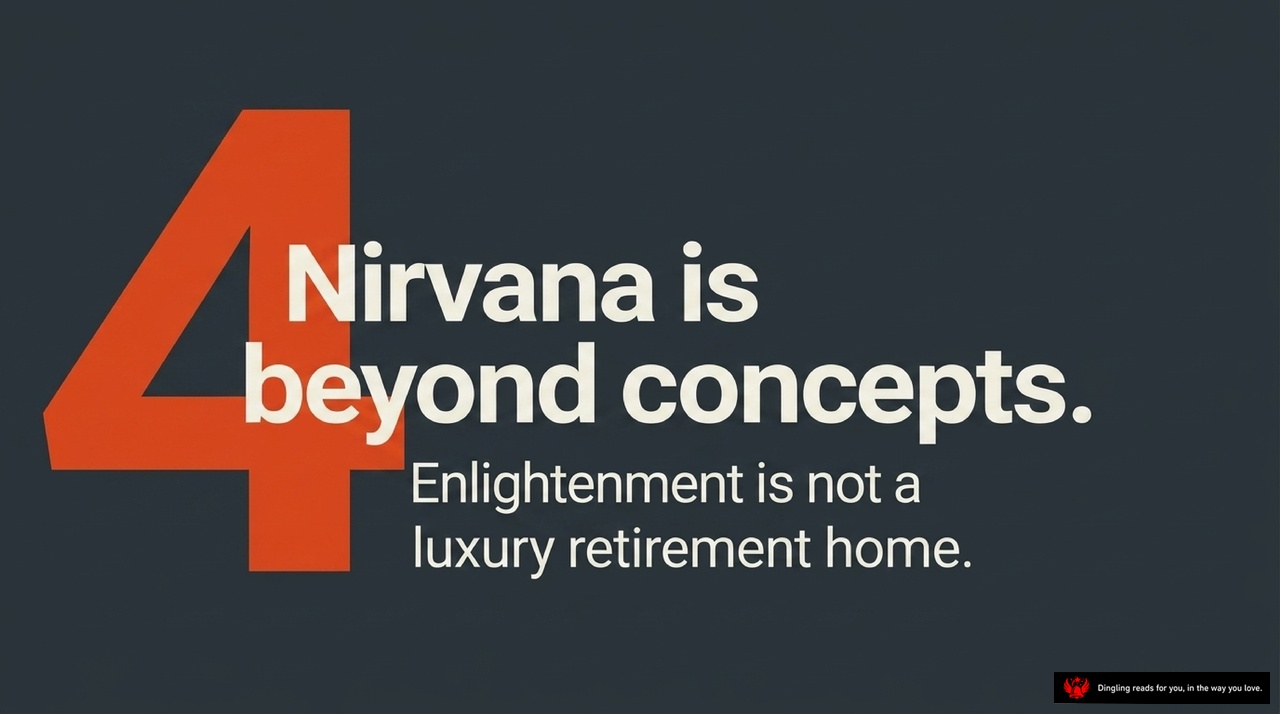
Nirvana is beyond concepts. Enlightenment is not a luxury retirement home.
We often imagine awakening as a golden ticket to a perfect afterlife—a stress-free paradise where everyone is kind, money is infinite, and we never have to deal with the messy reality of human existence. It's the ultimate escape plan, a place reserved only for the "good" people after we've checked all the boxes. But the Buddha shattered this fantasy. He taught that Nirvana isn't a location you travel to, nor is it a state of permanent bliss where all suffering magically vanishes forever.
Instead, Nirvana is a shift in perception. It is the moment you stop chasing the illusion of a permanent, independent self and realize that everything—your thoughts, your emotions, even your body—is in a constant state of flux. When you truly see that nothing is solid or permanent, the grip of suffering loosens. You aren't running away from life; you are waking up to it.
The Buddha made it clear: enlightenment is available right now, in this very moment. It doesn't require waiting until you're old, wealthy, or dead. It requires the courage to face the truth of impermanence. When you accept that change is the only constant, you stop fighting reality. You stop expecting life to stay the same. And in that acceptance, you find a profound freedom. You realize you are the master of your own mind, not a slave to it. So, don't look for Nirvana in the clouds or in a distant future. Look at your breath, look at your thoughts, and see the endless flow of reality. That is where freedom lives.
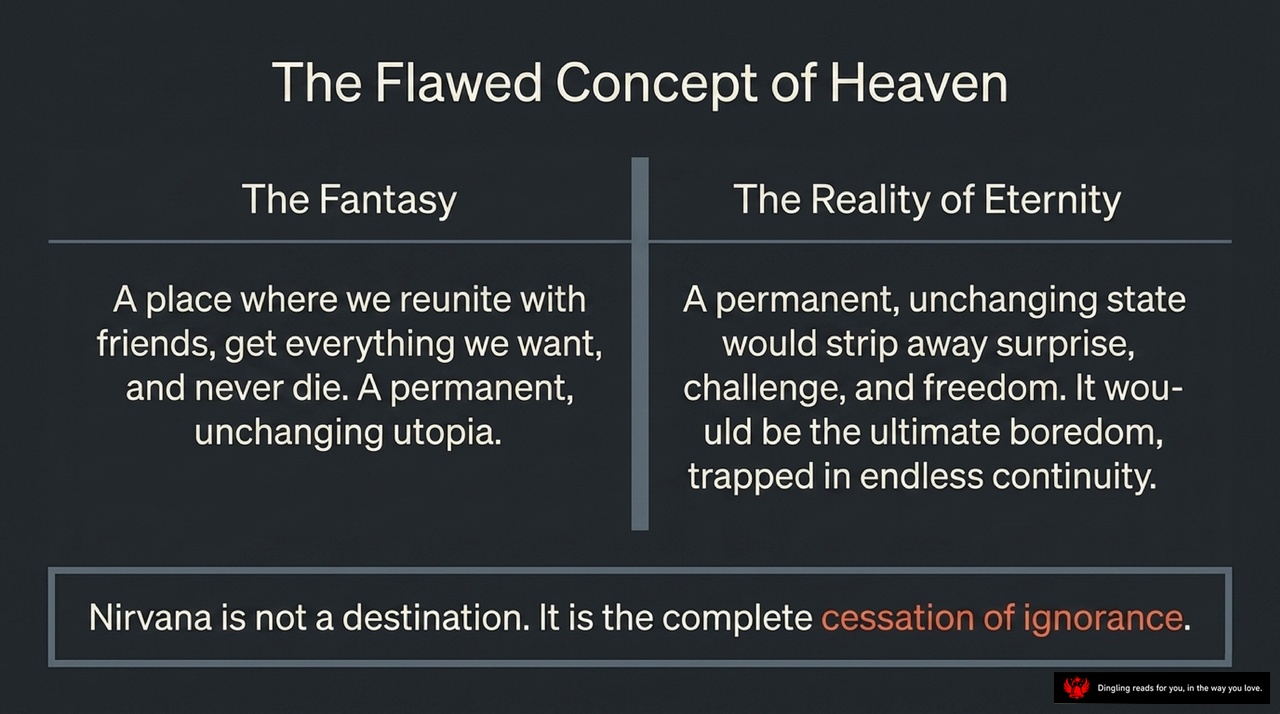
So, let's talk about the biggest trap we all fall into: our idea of Heaven. We often imagine it as the ultimate fantasy—a place where we reunite with lost friends, get everything we've ever wanted, and simply never die again. It's a permanent, unchanging utopia where no one ever suffers. But here's the hard truth: that's not reality. That's just a comforting story we tell ourselves.
If eternity actually meant a permanent, unchanging state, it would strip away the very things that make life worth living: surprise, challenge, and freedom. Imagine being stuck in endless continuity, with no new experiences and no way to grow. That wouldn't be paradise; it would be the ultimate boredom. It would be a prison of your own making.
This is why the slide makes such a crucial distinction. On the left, we have "The Fantasy"—that static, perfect world. On the right, we have "The Reality of Eternity," which sounds terrifying but is actually the only way to be truly free.
And this leads us to the core of what Nirvana really is. We often mistake it for a destination, like a place you travel to when you finally "fix" your life. But that's wrong. Nirvana is not a destination. It is the complete cessation of ignorance. It's not about escaping to a better place; it's about waking up right here, right now, to the fact that everything changes, and that's okay.
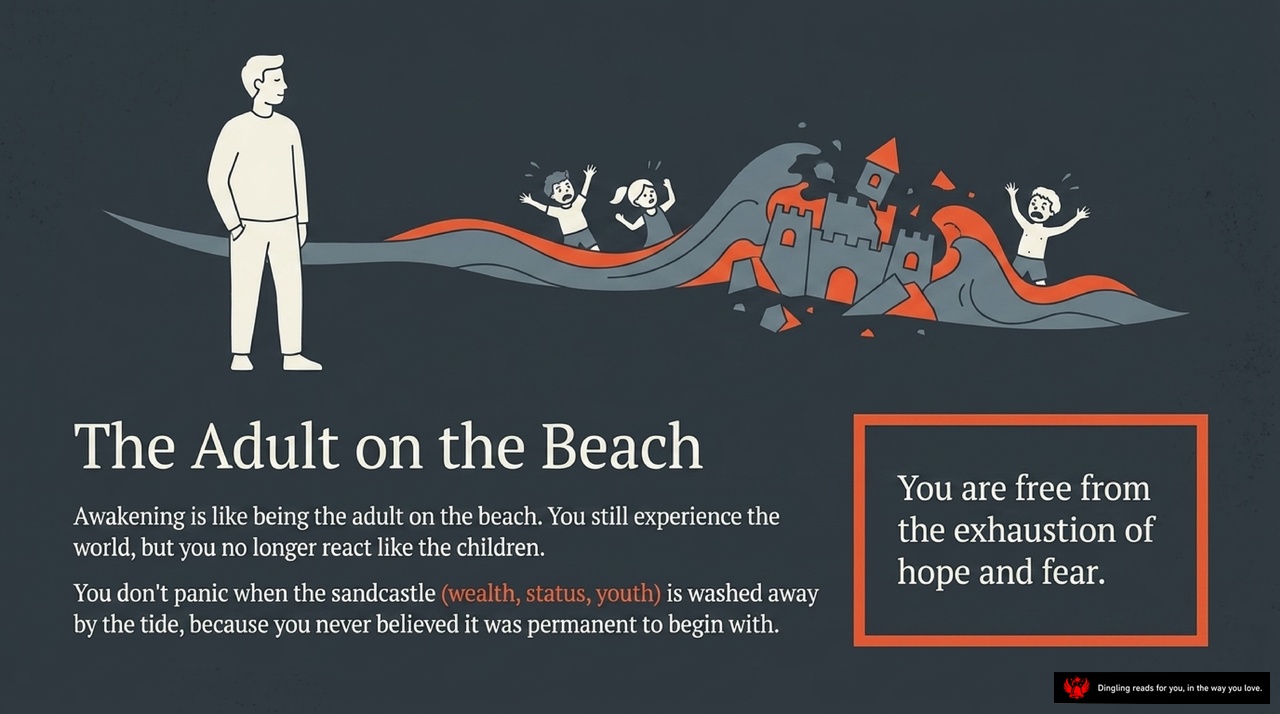
Imagine standing on a beach, watching a sandcastle crumble as the tide rolls in. On one side, you see children screaming in panic, terrified that their creation has been destroyed. On the other, there is a calm adult who simply watches, unbothered. Why the difference? It's because the children believed the sandcastle was permanent, while the adult never made that mistake in the first place.
This image perfectly captures the essence of awakening described in our text: "Awakening is like being the adult on the beach. You still experience the world, but you no longer react like the children." We spend our lives building sandcastles of wealth, status, and youth, desperately trying to make them last. We panic when the tide of time washes them away, believing we have lost something permanent. But the enlightened adult knows a profound truth: "You don't panic when the sandcastle is washed away by the tide, because you never believed it was permanent to begin with."
This shift in perspective brings a surprising freedom. As the slide highlights, "You are free from the exhaustion of hope and fear." When you stop clinging to the illusion of permanence, you stop suffering from the inevitable disappointment of change. The children's tears are the sound of our own attachment to things that were never ours to keep. By embracing the reality of impermanence, we stop fighting the tide and find peace right where we stand on the beach.

Imagine a boat gently floating on a river, carrying you across the dark waters of ignorance. In Buddhism, this vessel isn't just a metaphor; it's a practical tool. The slide you see right now, titled "The Placebo of Religion," perfectly captures this journey. It breaks down the path into three distinct stages: the placebo, the boat, and the ultimate goal.
Let's start with the first section, "The Placebo of Religion." Think of karma, rituals, moral codes, and even good deeds. These aren't the ultimate truth themselves. Instead, they function like powerful placebos. They are the stepping stones we see in the image on the left, helping us calm our minds and reduce the immediate harm of our suffering. They are the medicine we take when we feel sick, giving us the confidence that we can heal.
Now, look at the center of the image, labeled "The Boat." This is where the real work happens. These rituals and moral guidelines are tools designed to stabilize us. They are the boat that keeps us from drowning in chaos, allowing us to eventually grasp the profound concept of emptiness. Without this boat, the river of ignorance would be too turbulent to cross.
Finally, we arrive at the right side, "The Ultimate Goal." This is the most critical part of the message. The slide explicitly states that once you have successfully crossed the river of ignorance, you must abandon the boat. To be truly enlightened, you must eventually let go of 'Buddhism' itself. Why? Because the boat was only a means to an end. Once you reach the other shore, keeping the boat becomes a burden, just as clinging to the very teachings that helped you frees you from them.
The image beautifully illustrates this paradox: we need the path to leave the shore, but we must leave the path behind to truly arrive. It's a reminder that no system, no religion, and no set of rules is permanent. They are temporary aids for a permanent awakening.

Imagine a jigsaw puzzle where every piece represents a different way we see the world. Without the right perspective, charity becomes just an ego trip, morality turns into puritanical judgment, and meditation feels like sitting down as a paperweight—useless and heavy. But when we shift our view, everything changes. Suddenly, you can walk through the chaos of the modern world completely untouchable. You participate in the dream of daily life, yet you know you are dreaming. This is the power of understanding impermanence and the nature of reality.
Consider how we often treat death. We see images of it everywhere, turning a profound truth into entertainment or a marketing tool, pretending it's far away while we rush to buy villas or new cars. We blow out candles on birthdays, forgetting we are just one year closer to the end. We live as if there is a permanent "self" to protect, a fixed identity that defines our worth. But the Buddha taught us that everything is a combination of conditions, constantly changing. There is no solid, unchanging core to your being. When you realize that even your beliefs, your relationships, and your sense of self are just temporary arrangements of causes and effects, the fear of loss begins to dissolve.
You stop needing to control everything because you understand that nothing is truly under your control anyway. You stop judging others harshly because you see their actions as results of their own confusion and suffering, not inherent evil. You stop clinging to material things or social status because you know they are as fleeting as a mirage. This doesn't mean you withdraw from life or become indifferent. On the contrary, it means you engage with the world more deeply and compassionately. You can enjoy a beautiful sunset or a delicious meal without feeling an urgent need to own them forever. You can love your family without fearing their inevitable departure. By seeing the dream for what it is, you find a freedom that no external circumstance can ever take away. You are no longer a victim of the script you were given; you become the author of your own peace.

Buddhism isn't about fitting into a cultural box; it's about putting on a lens of absolute truth. As the slide suggests, this means embracing the reality of impermanence and seeing through the illusion of a permanent "self" that causes so much pain. We often try to wake up to a utopian heaven, but the Buddha teaches us that true awakening comes from waking up from the exhausting dream of reality itself.
Think about that powerful question at the bottom: "If everything you fear losing is just a patterned necktie in a dark room, what would you do differently when the lights turn on?" We spend our lives fighting to protect things we can't keep, clinging to identities and possessions as if they are solid. But the truth is, everything is a "composite phenomenon"—a temporary arrangement of causes and conditions. Just like that dissolving ring in the image, nothing exists independently or forever. Even your most cherished memories, your relationships, and your sense of self are constantly changing.
When we realize that the things we are terrified of losing are actually fragile illusions, the panic starts to fade. We stop trying to freeze time or force life into a perfect shape. Instead, we learn to live fully in the present moment, accepting that change is the only constant. This isn't a depressing view; it's a liberating one. It frees us from the exhausting cycle of expectation and disappointment, allowing us to engage with life deeply without the fear of losing it.