
When Breath Becomes Air: Complete Chapter-by-Chapter Summary
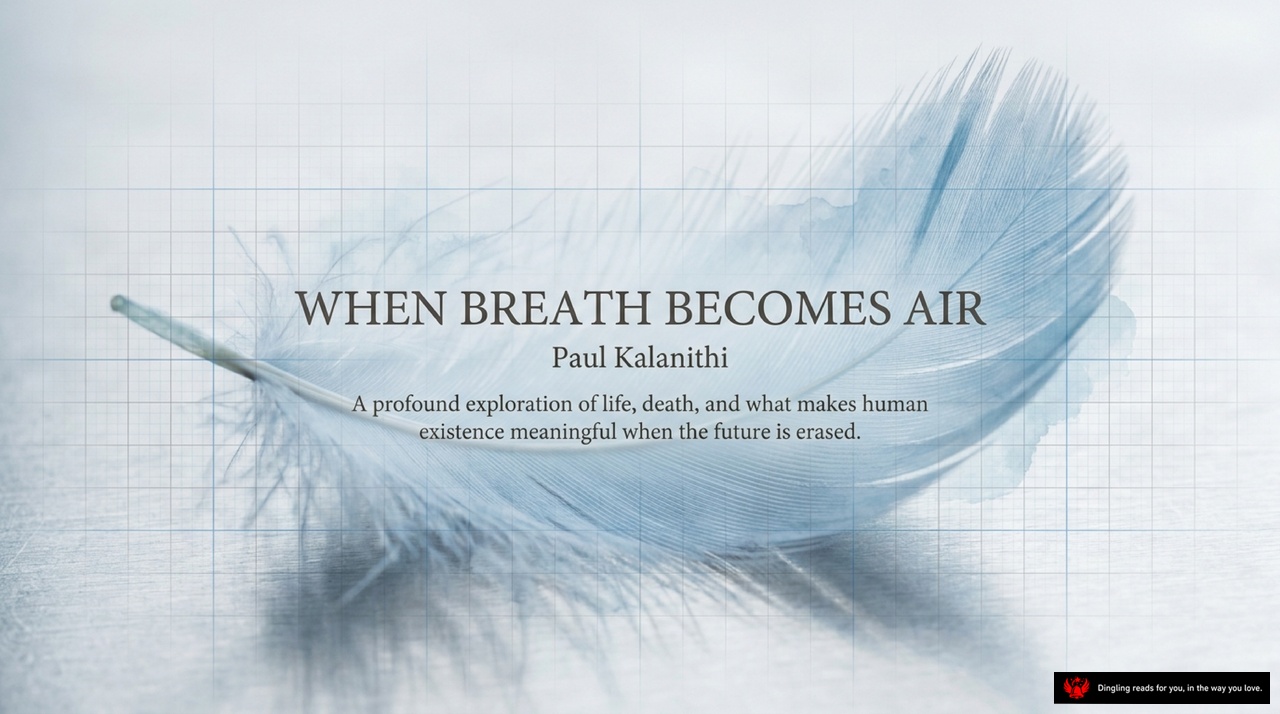
Today, we're diving into a book that doesn't just tell a story, but confronts the very core of what it means to be human. The title is *When Breath Becomes Air* by Paul Kalanithi.
Imagine a single feather resting on a grid, symbolizing fragility and the vastness of the unknown. That is exactly where this book begins—not with a grand diagnosis, but with the quiet, terrifying realization that the future has been erased.
Paul Kalanithi was a brilliant neurosurgeon on the verge of greatness, standing at the peak of his career. But then, the cancer arrived, and suddenly, he became the patient. This book is his profound exploration of life, death, and the search for meaning when the horizon disappears. It asks us the hardest question of all: What makes our existence meaningful when we no longer know how long we have left?
Join me as we walk through his journey, from the operating room to the bedside, and discover how he found purpose even in the face of the end.

Standing on the precipice of a promised future, a brilliant neurosurgeon is abruptly forced to confront his own mortality. For years, Paul Kalanithi delivered terminal diagnoses to others, standing confidently in his white coat as the one holding the answers. But at 36, that script flipped upside down. He found himself looking at a CT scan riddled with tumors, staring at a diagnosis of lung carcinoma with multiple metastases. The patient was himself.
The stark reality of the image—tumors scattered across his lungs, a spine deformed by the disease—shattered his carefully constructed life. He was no longer the surgeon controlling the outcome, but a patient passively receiving it. Standing next to his wife, Lucy, they faced the same brutal truth: there was no other diagnosis. The escape, the denial, the hope for a quieter future—all of it collapsed in an instant.
Now, the brilliant mind that once planned out complex surgeries had to grapple with a single, terrifying question: what does it mean to live when death is no longer a distant possibility but a looming reality? The doctor who once explained the finality of death to others was now the one staring into the abyss, ready to rewrite the story of his own life.

Imagine a triangle where three worlds collide: Literature, Biology, and the search for Meaning. This isn't just a diagram; it's the map of a life I lived. On the left, Literature explores the mind and the vocabulary of the soul, giving us the words to describe our deepest fears and hopes. On the right, Biology and Neuroscience explain the physical reality—the brain, the laws of physics, and the organic mechanisms that generate our world. But where do they meet? In the center lies "The Scalpel," or Neurosurgery.
This is the ultimate crucible. It is the only place where the biological brain and the human soul physically intersect on the operating table. As a neurosurgeon, I wasn't just fixing tissue; I was navigating the very seat of consciousness. Every cut risked altering who a person was. We are constantly balancing the drive to cure with the need to preserve the essence of a human being. This diagram captures the tension that defined my career: using the precision of science to heal the mystery of the human experience.
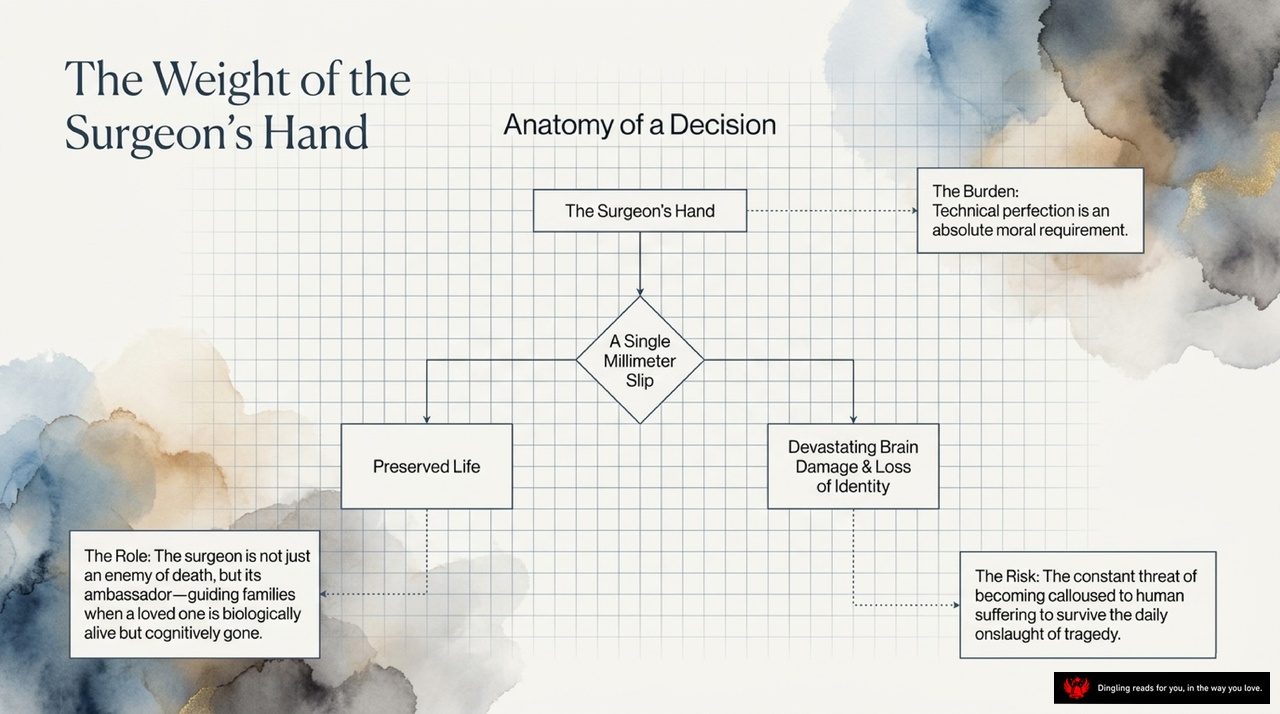
The weight of a surgeon's hand isn't just about the tools we hold; it's about the terrifying burden of perfection that sits on our shoulders. As the diagram illustrates, for a neurosurgeon, technical flawlessness isn't just a skill—it's an absolute moral requirement. We operate under the shadow of a single millimeter slip. In that tiny margin of error, the outcome isn't just a statistic; it's the difference between preserved life and devastating brain damage that erases a person's very identity.
Think about the role we play. We aren't just enemies of death; we are ambassadors for our patients when their loved ones are biologically alive but cognitively gone. But with that comes a constant, crushing risk: the danger of becoming calloused to human suffering. We risk losing our empathy to the daily onslaught of tragedy, hardening our hearts just to survive the work.
This is the anatomy of a decision. Every incision is a gamble between saving a life and saving a soul. It forces us to confront the hardest question in medicine: are we willing to take the risk of losing a patient's personality to save their physical life? The pressure is immense, but it's exactly this weight that defines who we are.
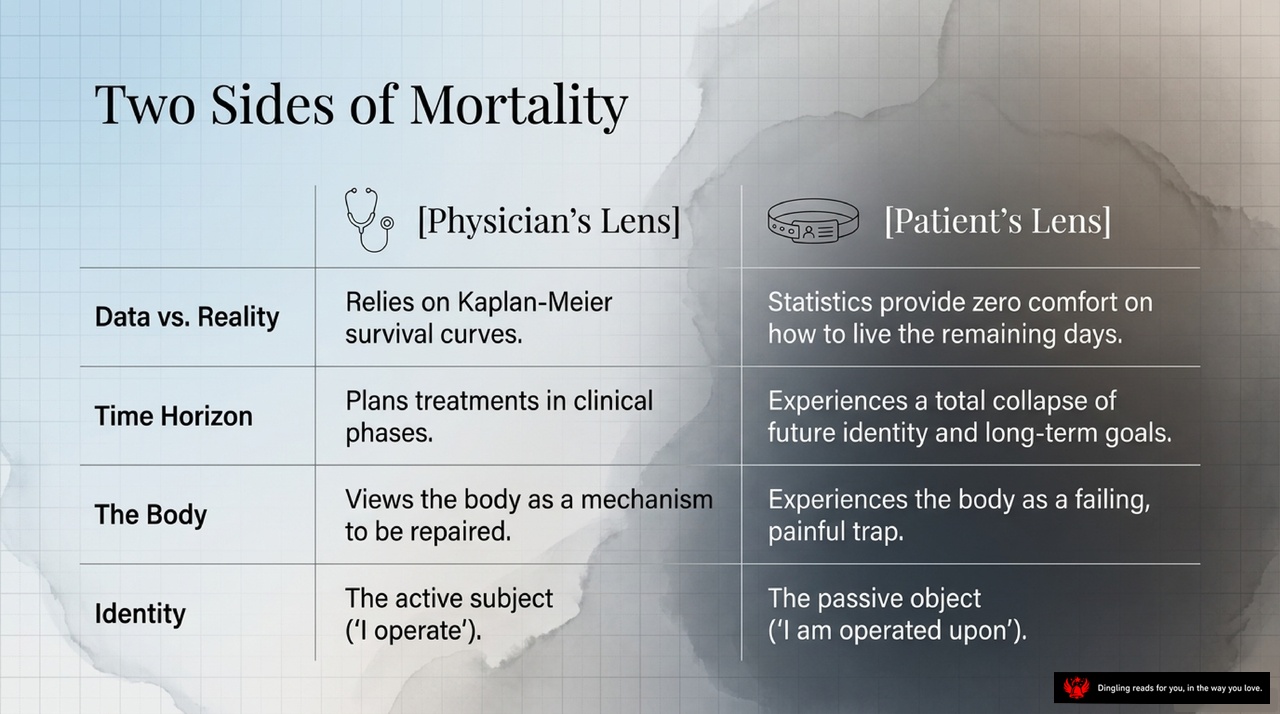
Look at this slide. It breaks down the "Two Sides of Mortality," contrasting how a physician sees death versus how a patient experiences it.
From the doctor's perspective, everything is data and mechanics. We rely on Kaplan-Meier survival curves to predict the future. We plan treatments in clinical phases, viewing the body simply as a mechanism to be repaired. We see ourselves as the active subject—the one who operates, the one in control.
But for the patient, the reality is entirely different. Statistics provide zero comfort on how to live the remaining days. Instead of a timeline, they experience a total collapse of future identity and long-term goals. The body isn't a machine to fix; it feels like a failing, painful trap. Most painfully, the patient shifts from being an active subject to a passive object—someone who is operated upon, stripped of agency.
This gap between the physician's lens and the patient's lens is the core of what we face. We must learn to step out of our own data-driven world and truly see the reality of the person in front of us.
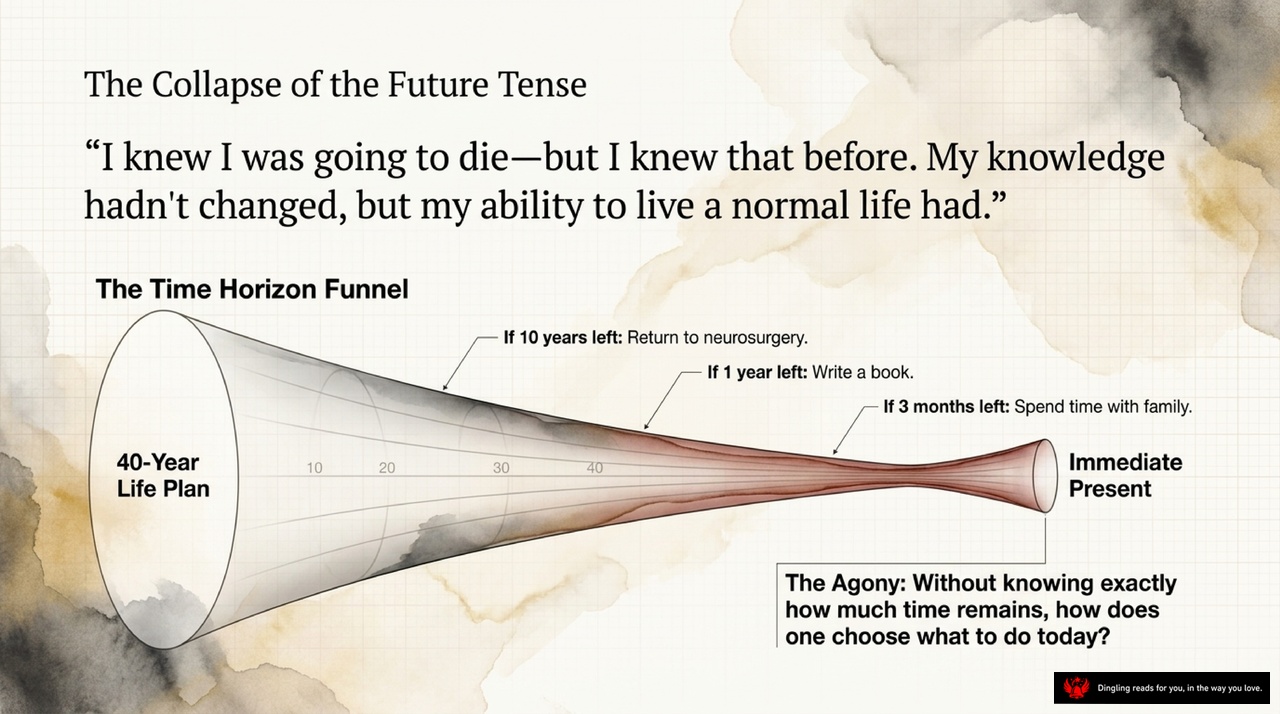
The collapse of the future tense. This is the moment when the abstract concept of "tomorrow" shatters into the brutal reality of "now."
Look at this diagram, the Time Horizon Funnel. On the left, we have a standard 40-year life plan—a long, wide cylinder where the future feels infinite and safe. But as you move toward the immediate present, the funnel narrows drastically. The author illustrates this with a terrifying clarity: if you have 10 years left, you return to neurosurgery; if you have one year, you write a book; if you have only three months, you spend time with family. The options disappear the closer you get to the end.
This is the agony of not knowing exactly how much time remains. When you don't know the deadline, how do you choose what to do today? That was the question haunting the author when his CT scan revealed the truth. He knew he was going to die, but he knew that *before*. His knowledge hadn't changed, but his ability to live a normal life had. The future tense collapsed, and suddenly, every decision he made was no longer about a distant career or a long-term plan, but about the single, precious seconds of his present moment.

Picture shows a staircase with arrows pointing downwards, representing "The Reversed Stages of Grief." It lists four stages: Acceptance, Depression, Bargaining, and Anger, but in a specific order that contradicts the traditional model. The text highlights how the author, a doctor familiar with death, defied the standard emotional progression.
Here is the spoken script:
Look at this diagram. It illustrates something deeply personal and profoundly counterintuitive: the reversed stages of grief. Usually, we think of grief moving from denial to anger, then bargaining, depression, and finally acceptance. But for the author, a neurosurgeon intimately familiar with death, the journey was the exact opposite.
It all began with immediate, intellectual acceptance. The moment he saw the tumors on his CT scan, he didn't fight the reality. He accepted the diagnosis instantly, viewing it as a cold, objective fact, much like the distance between the sun and the earth. There was no shock, only a grim readiness.
However, because he knew he wouldn't die immediately, that acceptance quickly curdled into depression. The realization that he might live on, yet facing a suspended present with no clear purpose, left him aimless. He was trapped in a limbo where his future was suddenly undefined.
This stagnation then triggered bargaining. He began questioning why his hard-earned life, his career at the peak of success, had to be sacrificed so suddenly. It felt like an unfair test of faith.
Finally, the suppressed emotions erupted into raw anger. He questioned the very logic of his life: "I worked my whole life to get here, and now I get cancer?" This wasn't the expected order of healing; it was a unique psychological trajectory born from his profession. As a doctor who had spent years explaining death to others, he had no time to process his own. He had to accept the worst first, only to struggle with the pain of living on later. This reversal reveals a harsh truth: when you know the end is coming, the journey of grief doesn't follow the rules.

Facing imminent death, Paul and Lucy stood at a crossroads that few couples ever have to walk: the decision of whether to bring a new life into the world. Lucy's fear was deeply human and painfully honest. She asked, "Won't saying goodbye to your child make dying more painful?" The image of a child's tiny footprint, emerging from the shadows like a ghostly promise, weighed heavily on her heart. She worried that adding a legacy to her grief would only amplify the agony of her final days.
But Paul's response cut through the fear with a radical, life-affirming perspective. He looked at her and said, "Wouldn't it be great if it did?" In that simple question, he challenged the very idea that life is merely a waiting room for death. He argued that avoiding suffering by avoiding connection is not wisdom; it is a form of surrender.
They chose not to avoid the pain of losing a child, but to embrace the profound human connection of having one. Their decision redefined what it meant to live. Living, they realized, is not just about surviving until the end; it is about actively creating meaning in the present. By sowing new life in what felt like a graveyard, they found that the act of loving and creating is the most powerful antidote to the fear of dying.

Look at this graph. It captures the brutal reality of my final year as a neurosurgeon resident. On one side, we have the "Physical Toll"—the escalating pain, the exhaustion from grueling chemotherapy, the nausea, and the sheer physical exhaustion that threatened to break me. It was a relentless climb of suffering. But on the other side, there was the "Moral Triumph." Despite everything, I returned to the operating room to finish my residency. Why? Because reclaiming my identity as an active agent brought a profound joy. The more physical torture I endured, the greater the satisfaction of fulfilling my purpose. It wasn't about winning against death; it was about refusing to let the disease define my entire existence. As I stood there, choosing to go back in, I realized that my life's meaning wasn't found in avoiding the pain, but in the courage to endure it and keep showing up for the people who needed me.

When the scalpel fails, the pen remains. This isn't just a metaphor; it's the only path left when the body can no longer be fixed.
Look at this image: a scalpel morphing into a fountain pen. It captures Paul's journey perfectly. When physical deterioration finally forced him out of the operating room, he did not surrender. He shifted his quest for meaning back to his first love: literature. He began writing with silver-lined gloves to protect his cracked fingertips, turning his pain into purpose.
The slide contrasts his two roles. As a surgeon, he was guiding individual families through the immediate physical crisis of mortality. But now, as a writer, he is guiding the world through the existential reality of death. Words became his final tool to heal the soul. When the body could no longer be fixed, the mind found a new way to fight. This transformation from healer of bodies to healer of spirits is the ultimate act of resilience.

Look at this quiet scene: an empty chair and a small, resilient tree growing beside it. This simple image captures the profound truth of what happened to Paul on March 9, 2015. Just months after his daughter, Cady, was born, he passed away, surrounded by the very family he loved. He didn't try to "fight" or "beat" cancer with false bravado; instead, he faced it with absolute honesty.
This slide reminds us that bereavement did not end their marriage; it simply transitioned it. Deep grief is merely the mirror image of profound, abiding love. Even in the face of such devastating loss, the love they shared remained unbroken, transforming their relationship into something even deeper. It teaches us that while life can take us by surprise, the strength of our connections is what truly sustains us when everything else falls apart.

Friends, we often spend our lives chasing titles, climbing ladders, and building ledgers of our achievements, convinced that our value is measured by what we have done or where we have been. But today, I want to share with you a profound realization from the final chapter of my journey—a moment where the world stopped spinning, and only love remained.
In the book, the author describes a pivotal scene where he is dying, holding the hand of his infant daughter, Cady. He realizes that the ultimate gift we can leave behind isn't a legacy of fame or fortune, but something far more powerful: the ability to fill another person's life with joy. He writes, "When you come to one of the many moments in life where you must give an account of yourself... do not, I pray, discount that you filled a dying man's days with a sated joy."
This simple yet staggering thought shifts everything. It asks us to stop counting our accomplishments and start counting our moments of connection. It reminds us that the most enormous thing we can do is simply to be present, to bring peace and happiness to those around us, even if just for a fleeting moment. As the author's final words to his daughter, this is the true final gift: the memory of being loved and loved in return. It is a reminder that life isn't about the length of our days, but the depth of our impact on the hearts of others.
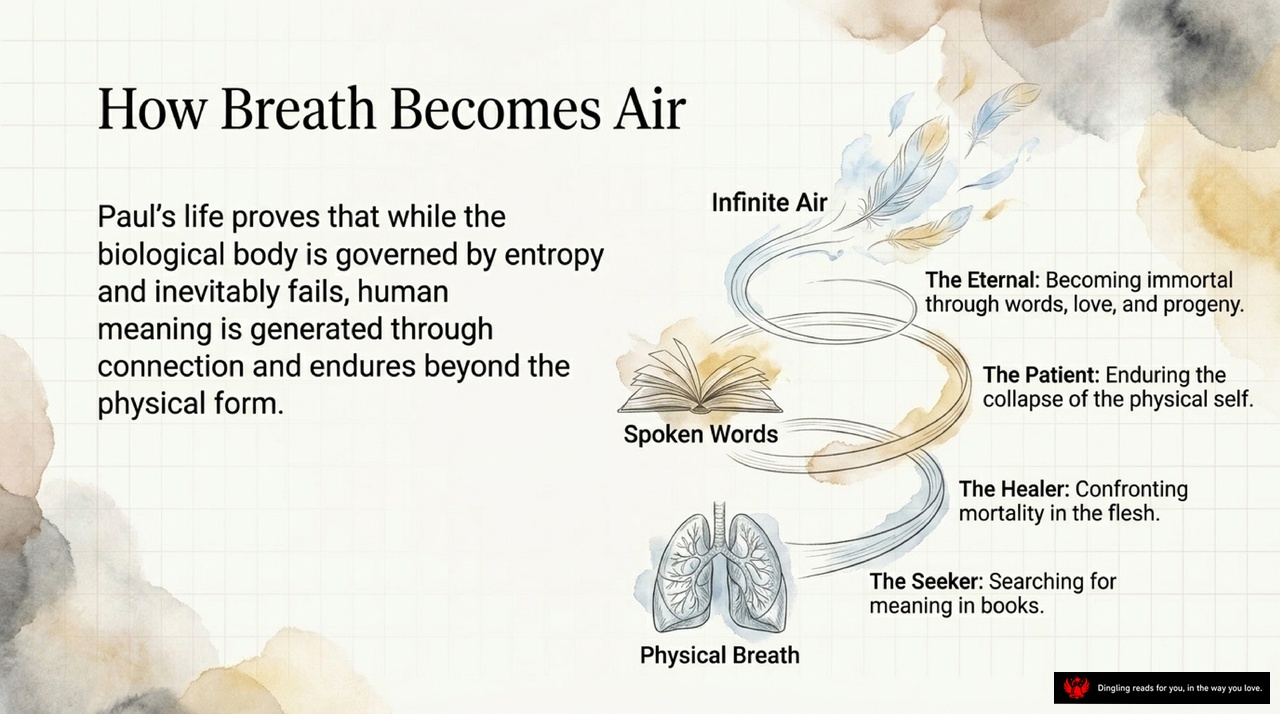
How Breath Becomes Air. On this slide, we see the journey of a life transformed. It starts with Physical Breath—the lungs at the bottom—representing the biological body governed by entropy, which inevitably fails. As the spiral rises, we move through stages of identity: The Seeker finding meaning in books, The Healer confronting mortality in the flesh, and The Patient enduring the collapse of the physical self. But the ultimate transformation is into Infinite Air. This is The Eternal: becoming immortal not through flesh, but through spoken words, love, and progeny. Paul's life proves that while the body dies, human meaning is generated through connection and endures beyond the physical form. That is how breath becomes air.
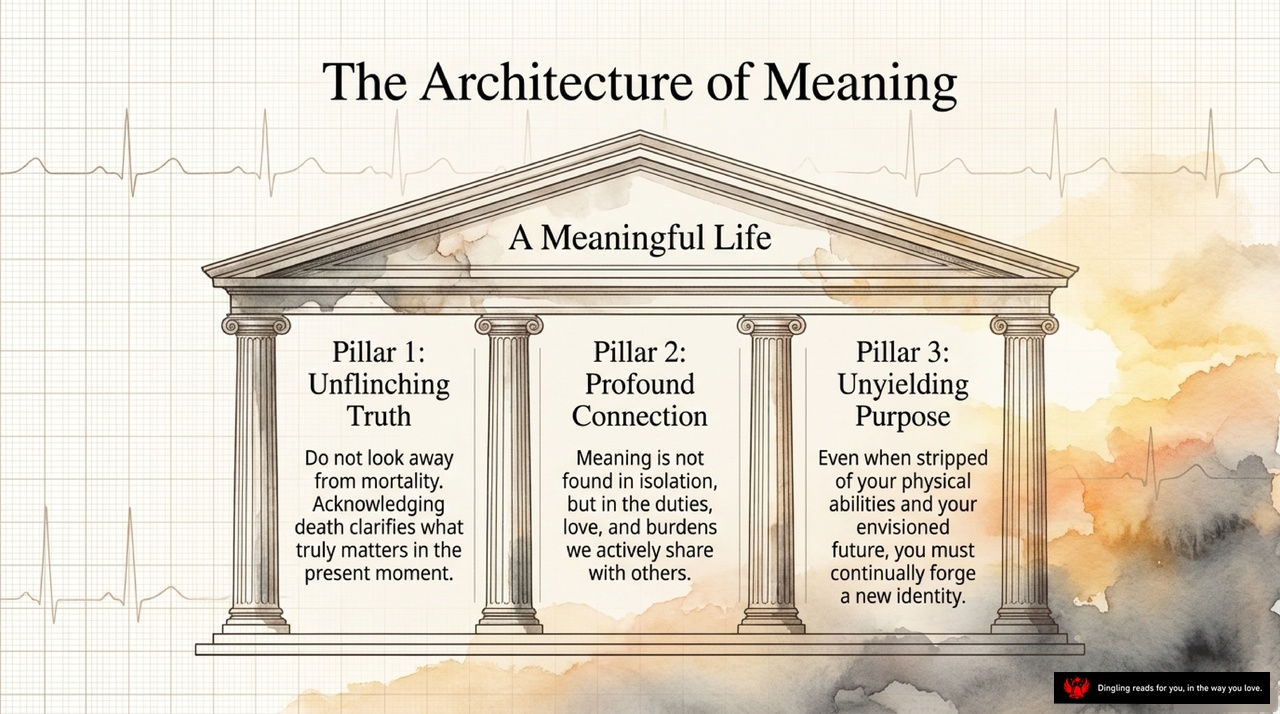
So, we're building the Architecture of Meaning, and it rests on three pillars. First, Unflinching Truth. This isn't about being grim; it's about refusing to look away from mortality. As I realized when facing my own diagnosis, acknowledging death is actually the only way to clarify what truly matters in the present moment. Without that hard truth, we're just drifting.
The second pillar is Profound Connection. Meaning isn't found in isolation or even in grand achievements. It lives in the duties, the love, and the burdens we actively share with others. I learned this the hard way, watching my colleagues struggle and eventually losing one of my own. We are not meant to be alone; we are meant to be with each other, supporting one another through the chaos.
And finally, the third pillar: Unyielding Purpose. This is the most crucial one. Even when stripped of your physical abilities or your envisioned future, you must continually forge a new identity. My career as a neurosurgeon ended, but my life didn't. By embracing my new reality as a father and a patient, I found a deeper purpose than I ever did in the operating room. These three pillars—Truth, Connection, and Purpose—are the foundation of a meaningful life.

The image captures a profound moment of transition: the end of a seven-year journey as a neurosurgeon and the beginning of a new chapter as a patient. The background features an EKG line, a universal symbol of life's rhythm, which here marks the point where that rhythm changes forever for Paul.
The text highlights Paul's journey from a literature student to a world-renowned neurosurgeon, and finally to a terminal patient. It reveals a core truth: the true measure of life isn't found in the length of our days, but in the depth of our connections and the courage with which we face our inevitable end. While the physical body fails, the meaning we forge endures.
This leads us to the powerful question at the bottom: If the certainty of your own death were revealed to you today, what is the one thing you would still choose to create, endure, or love before your breath becomes air?
For Paul, the answer wasn found in grand achievements or career milestones. Instead, it was found in the small, human moments that suddenly gained immense weight when facing mortality. It was in the decision to have a child, to embrace the uncertainty of life, and to cherish the time he had left with his wife, Lucy, and his newborn daughter, Lydia. He realized that when you stand at the edge of death, the only thing that truly matters is the love you've shared and the life you've lived deeply, rather than the time you've spent. This shift in perspective transforms the fear of ending into a celebration of the connections we've built.