
Whoever Tells the Best Story Wins: Complete Chapter-by-Chapter Summary
Welcome to today's session on "Whoever Tells the Best Story Wins" by Annette Simmons. We're here to explore a vital truth: in our data-driven world, the missing link between cold logic and genuine human connection is a powerful story.
Think of it this way: people don't just need information; they need meaning. When we replace a wall of facts with a warm narrative, we stop shouting and start connecting. This is the essence of story thinking—bridging the gap between what we know and what we feel. It's about moving from being a lecturer to becoming a guide who touches hearts.
As we dive in, remember that facts alone are often forgotten, but facts wrapped in emotion are remembered forever. Whether you're leading a team, selling an idea, or simply sharing a moment, the best storyteller wins not because they have the most data, but because they make others feel seen and understood. Let's unlock the power of this missing link together.
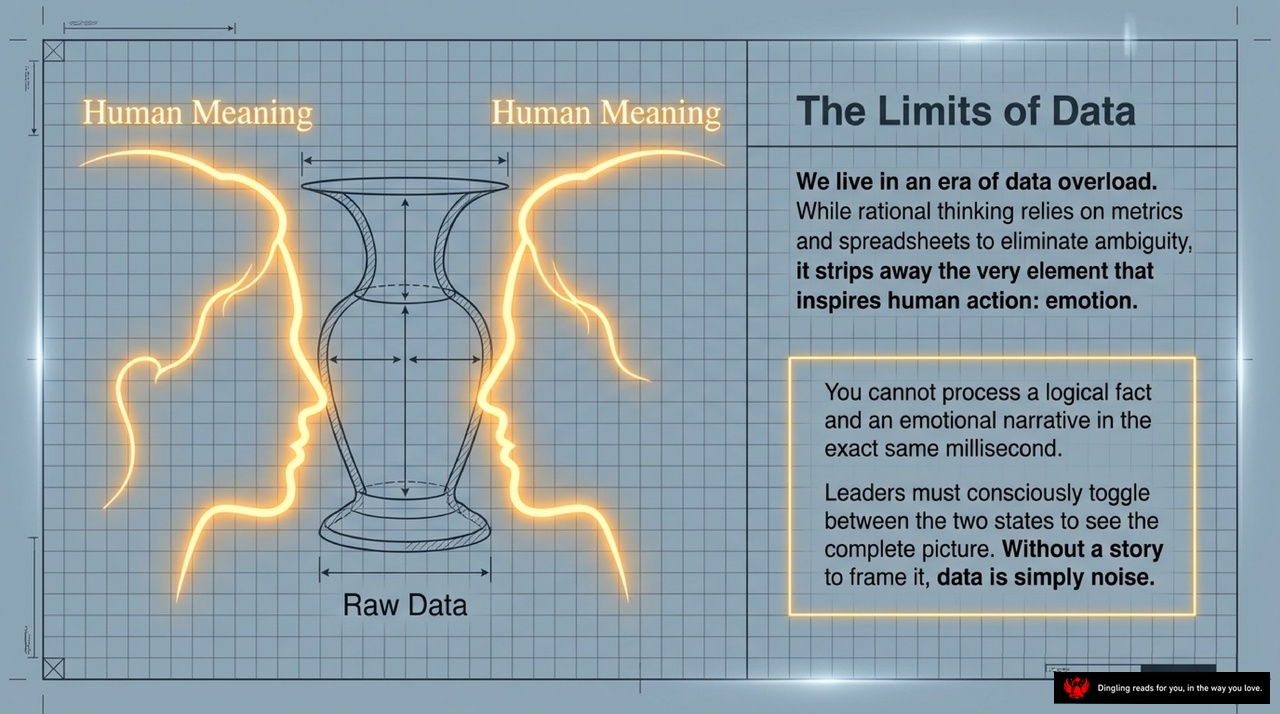
We live in an era of data overload, where we are drowning in metrics and spreadsheets. But here's the hard truth: while rational thinking relies on these tools to eliminate ambiguity, it actually strips away the very element that inspires human action—emotion. Look at this image. In the center, we have raw data, cold and rigid. Flanking it are two faces, glowing with human meaning. The point is, you cannot process a logical fact and an emotional narrative in the exact same millisecond.
This is the limit of data. Leaders must consciously toggle between these two states to see the complete picture. If you only focus on the numbers in the middle, you miss the connection. Without a story to frame it, data is simply noise. It doesn't move people; it just confuses them. To truly lead, you have to bridge that gap, turning cold facts into a warm narrative that touches the heart.
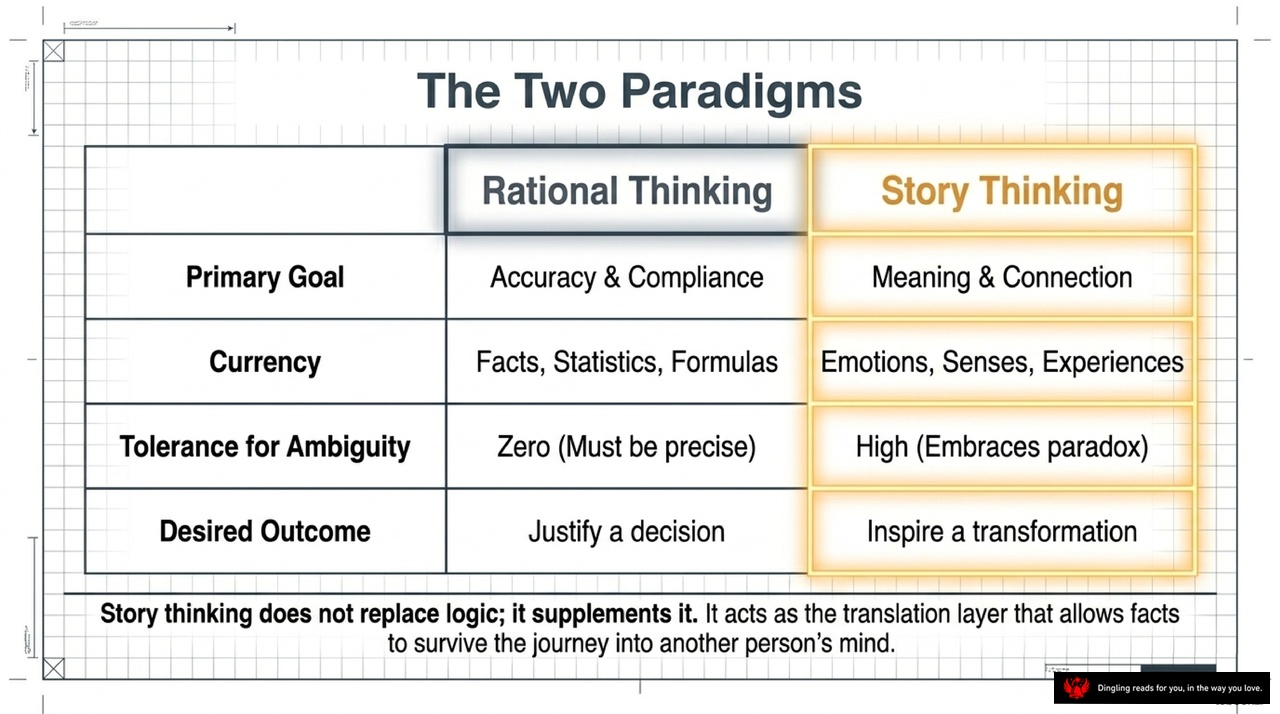
Today's slide breaks down the two distinct ways we process the world: Rational Thinking versus Story Thinking. Look at the table here. On the left, you have Rational Thinking. Its primary goal is accuracy and compliance. It speaks the language of facts, statistics, and formulas, and it demands zero tolerance for ambiguity. It exists to justify a decision.
On the right, highlighted in gold, is Story Thinking. Its goal isn't compliance; it's meaning and connection. Its currency isn't data; it's emotions, senses, and shared experiences. Crucially, it has a high tolerance for ambiguity because it embraces paradox. While rational thinking justifies a decision, story thinking is designed to inspire a transformation.
Notice the note at the bottom? This is vital. Story thinking does not replace logic; it supplements it. Think of it as a translation layer. Logic gives us the facts, but story is the vehicle that allows those facts to survive the journey into another person's mind. Without story, even the most accurate data often fails to land. We need both tools to truly influence and connect.
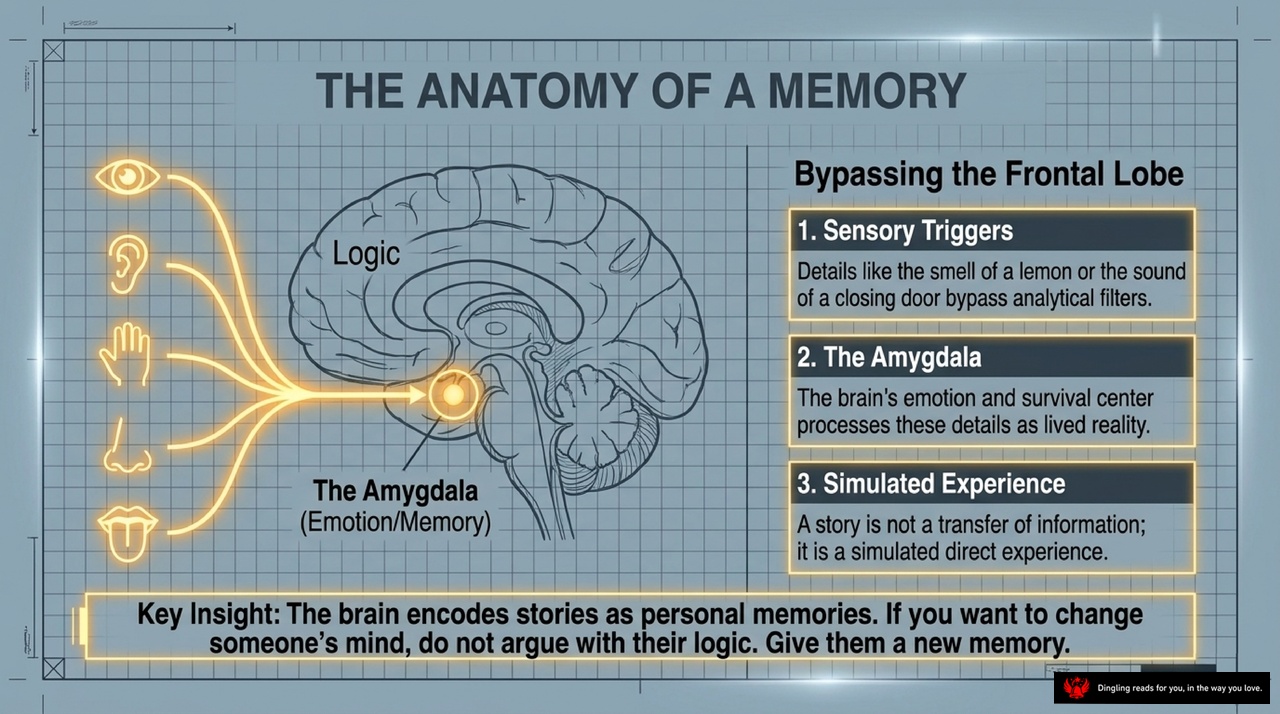
Look at this diagram titled "The Anatomy of a Memory." It illustrates a fascinating truth: to truly change someone's mind, you can't just argue with their logic. You have to bypass the frontal lobe and target the amygdala—the brain's center for emotion and survival.
Think about it. When you try to convince someone using dry facts or complex data, you are essentially speaking to their "Logic" center. But that rarely works. Instead, you need to engage their senses. That's what these "Sensory Triggers" are all about. Imagine the smell of a lemon or the sound of a closing door. These aren't just details; they are shortcuts that bypass our analytical filters and hit us directly.
Once those sensory details land, they go to the amygdala. This is where the magic happens. The brain stops treating the story as just "information" and starts treating it as a "Simulated Experience." It feels like you are actually living through the moment. This is why a powerful story isn't about transferring data; it's about creating a direct, emotional experience for the listener.
So, remember this key insight at the bottom: if you want to influence someone, don't fight their logic. Arguing with facts only triggers their defenses. Instead, give them a new memory. Create a story so vivid and emotionally resonant that they don't just understand your point—they feel it as their own truth. That is the only way to truly shift a perspective.
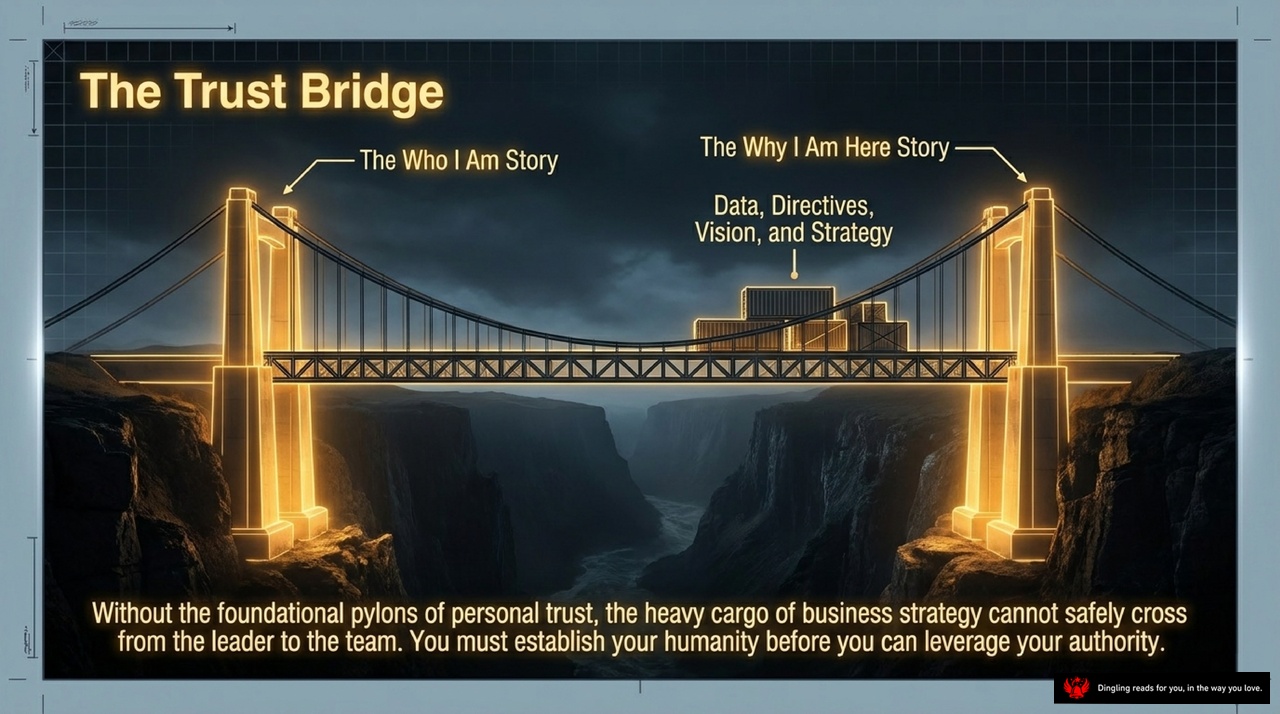
Imagine a bridge spanning a deep, dark canyon. On the left bank stands the "Who I Am" story—your personal history, your humanity, the very foundation that supports everything. On the right bank lies the "Why I Am Here" story, carrying the heavy cargo of data, directives, vision, and strategy.
Here is the critical insight: without the foundational pylons of personal trust built on that "Who I Am" side, the heavy load of business strategy simply cannot cross safely from you to your team. You cannot just lead with authority; you must first establish your humanity. If you skip the connection of who you are, your vision and your strategy will feel cold, distant, and untrustworthy.
Think of it this way: people don't follow data alone; they follow people they believe in. You must build that bridge of trust first. Only when your team feels they know you, understand your journey, and trust your character can they safely carry the weight of your vision forward. Establish your humanity before you try to leverage your authority, or you'll find yourself stranded on one side of the canyon, shouting into the void.
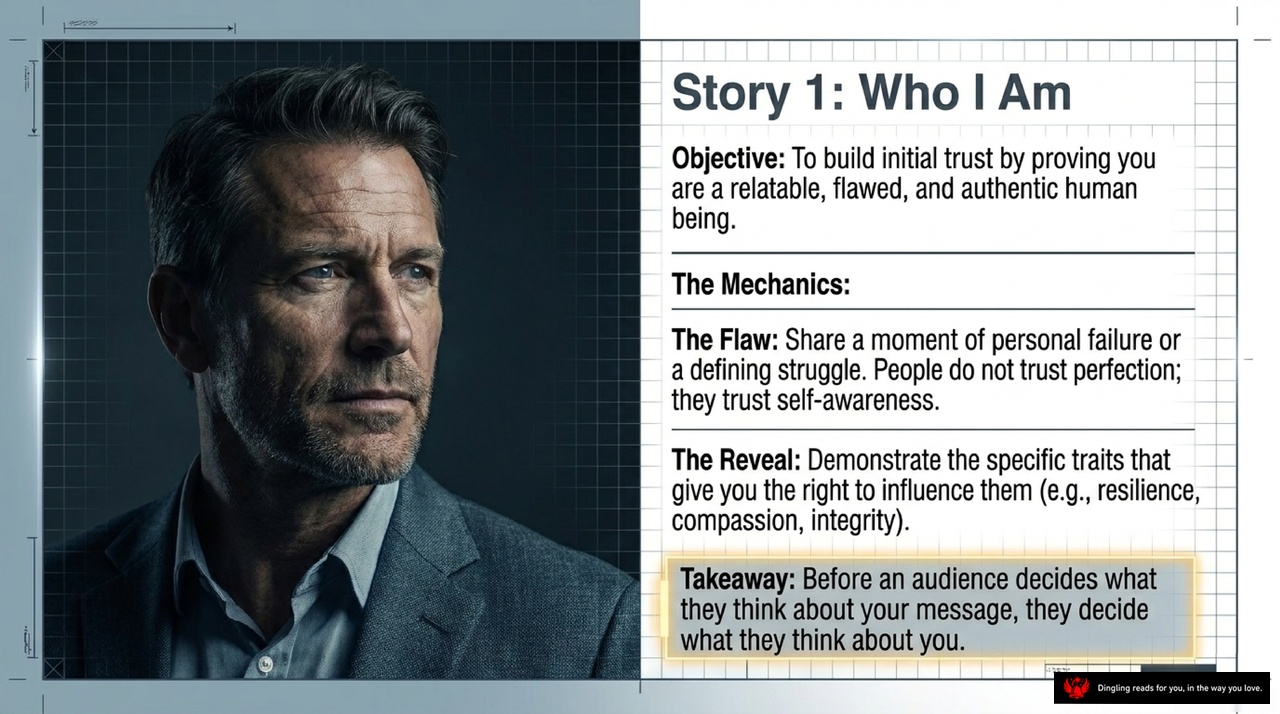
Look at this slide, "Story 1: Who I Am." It's all about building that initial spark of trust. Here's the deal: people don't connect with perfection; they connect with reality. Your objective is to prove you're a relatable, flawed, and authentic human being.
To do that, you need to share a moment of personal failure or a defining struggle. Think about it—nobody trusts a flawless robot, but everyone respects self-awareness. So, don't hide your cracks; let them be the bridge. Then, show the reveal. Demonstrate the specific traits that give you the right to influence them, like resilience, compassion, or integrity.
Here's the takeaway that really hits home: Before an audience decides what they think about your message, they decide what they think about you. If they don't trust who you are, they won't believe what you're saying. So, start with your story. Be real, be vulnerable, and let them see the human behind the professional title. That's how you build trust from the very first second.

Imagine you are walking into a room where everyone is already on guard. They aren't just skeptical; they are actively scanning you for a hidden agenda. They assume you are there to take their time, their money, or their autonomy. This is the unspoken fear that blocks every meaningful connection.
That is exactly why we need "Story 2: Why I Am Here." The objective isn't to hide your motives, but to dismantle that suspicion before it takes root. You have to be brave enough to disarm them openly. Say it clearly: "Yes, I am here to increase revenue." Don't flinch. But immediately follow that with the deeper, authentic mission that actually drives you.
Think of it like a radar screen. If you stay silent, the audience projects their own "hidden agendas" onto you. But when you speak your truth with transparency, you neutralize their skepticism. You show them that you aren't trying to trick them. When you tell people exactly what you stand to gain, they stop looking for a secret reason. They see a human being. That is the power of being honest about your intent—it turns a potential barrier into a bridge of trust.

Let's talk about how we actually teach people to change. Look at the two paths on the screen. Path A starts with a Directive, which naturally triggers Defensiveness and leads to Non-Compliance. It's a dead end because it fights the listener's ego. But Path B takes a different route. It begins with a Shared Experience, which leads to Self-Discovery, and ultimately Inspires Action. The objective here is clear: bypass the defensive ego and let the listener discover the lesson for themselves.
Think about the Scrooge Effect. People only change when they mentally simulate the consequences of their actions. Instead of lecturing an employee about patience, tell a three-minute story about a time you learned the hard cost of impatience. This is the power of "Show, Don't Scold." A lesson delivered as a story invites the listener to step into the narrative and draw the conclusion themselves, preserving their autonomy. When we use this Teaching Story, we aren't just transferring information; we are creating a safe space where real transformation can happen.
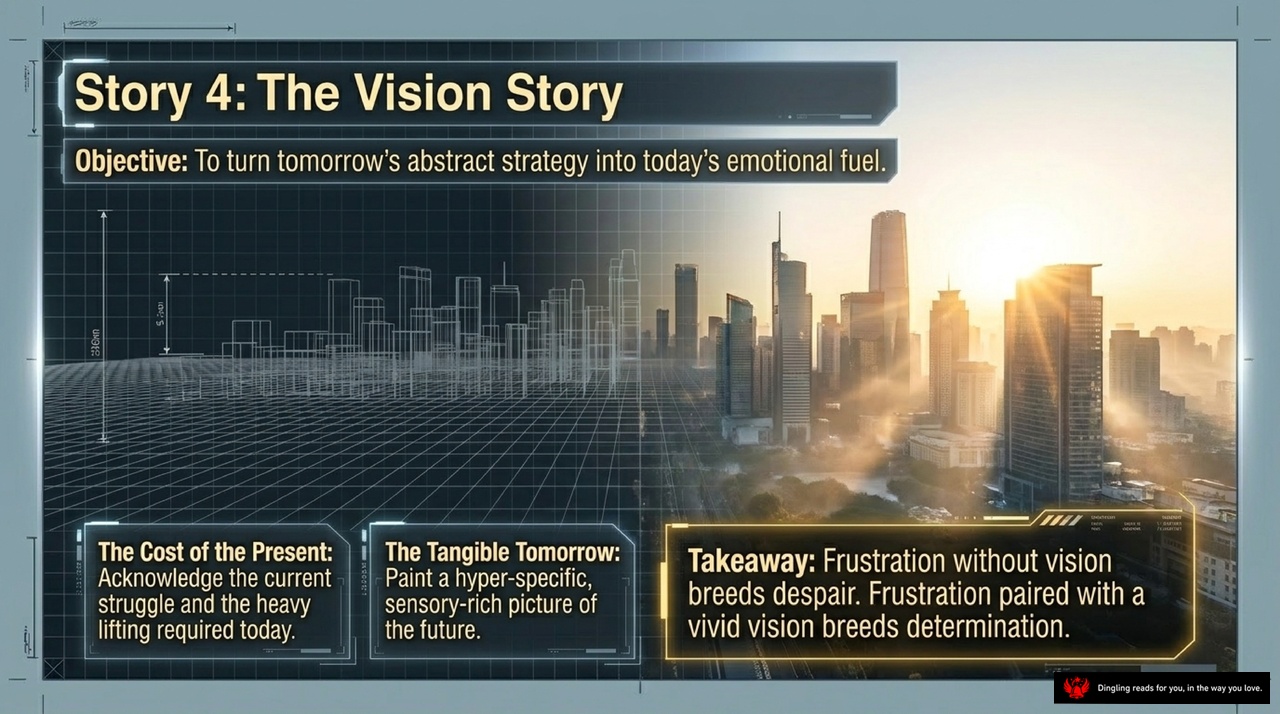
Look at this split image. On the left, we see a cold, rigid wireframe grid representing the heavy lifting of the present. On the right, the sun breaks through the skyline, painting a warm, tangible future. This is the heart of Story 4: The Vision Story. Its objective is simple yet powerful: to turn tomorrow's abstract strategy into today's emotional fuel.
The slide breaks this down into two opposing forces. On the left, "The Cost of the Present." It asks us to acknowledge the current struggle and the heavy lifting required right now. Without this honesty, we are just spinning our wheels. But on the right, we have "The Tangible Tomorrow." This isn't about vague promises; it's about painting a hyper-specific, sensory-rich picture of the future. It's the difference between saying "we will succeed" and making the audience feel the victory before it happens.
The takeaway here is critical. Frustration without vision breeds despair. It leaves people stuck in the grid on the left. But frustration paired with a vivid vision breeds determination. When you combine the reality of today's pain with the clarity of tomorrow's reward, you don't just motivate people; you transform their struggle into fuel. A clear vision makes the heavy lifting feel purposeful, turning a daunting climb into an inevitable ascent.

Imagine a grid where the vertical axis represents how deeply a leader is committed to a value, and the horizontal axis shows the personal cost it takes to uphold it. Most of us cluster in the bottom left—low commitment, low cost. We say the right things when it's easy. But true integrity lives in the top right corner: high commitment, high cost.
This is the heart of "Values-in-Action." A corporate value isn't real until it's tested. Think of it as a conflict story where doing the right thing is difficult, expensive, or unpopular. The mechanics are simple but powerful. You need a demonstration—a moment where a leader enforces that value even when no one is watching, or when it hurts the bottom line.
That's why hypotheses breed cynicism. Telling people what you believe is easy; showing them what you're willing to sacrifice for it is transformative. Instead of putting a poster on the wall, tell the story of the employee who lost a sale to protect a client. When you make the cost visible, you prove that the value isn't just a slogan, but a lived reality. That's how you instill integrity.

Let's dive into Story 6: "I Know What You Are Thinking."
Have you ever walked into a high-stakes meeting and felt that invisible wall? You're presenting your best work, but deep down, the audience is harboring secret doubts they're terrified to say out loud. They're thinking, "Is this really necessary?" or "This is just more corporate red tape," but they stay silent.
That's what we call "The Silent Objection." It's that unspoken fear that creates a massive empathy gap between you and your listeners.
Here's the game-changer: instead of ignoring it, we use a "Preemptive Strike." You simply voice their exact objection for them. You say, "I know you're thinking this new process is just more corporate red tape..."
When you acknowledge an opposing viewpoint, you aren't weakening your argument. On the contrary, it proves you are actually listening. It shows respect and instantly bridges that gap. You're no longer an adversary trying to convince them; you've become a collaborator who understands their perspective.
By acknowledging the hidden fears and unstated objections, you validate the audience's experience. You turn their internal resistance into an external conversation, making it safe for them to engage. This is the key to unlocking trust and turning silent skeptics into active partners.
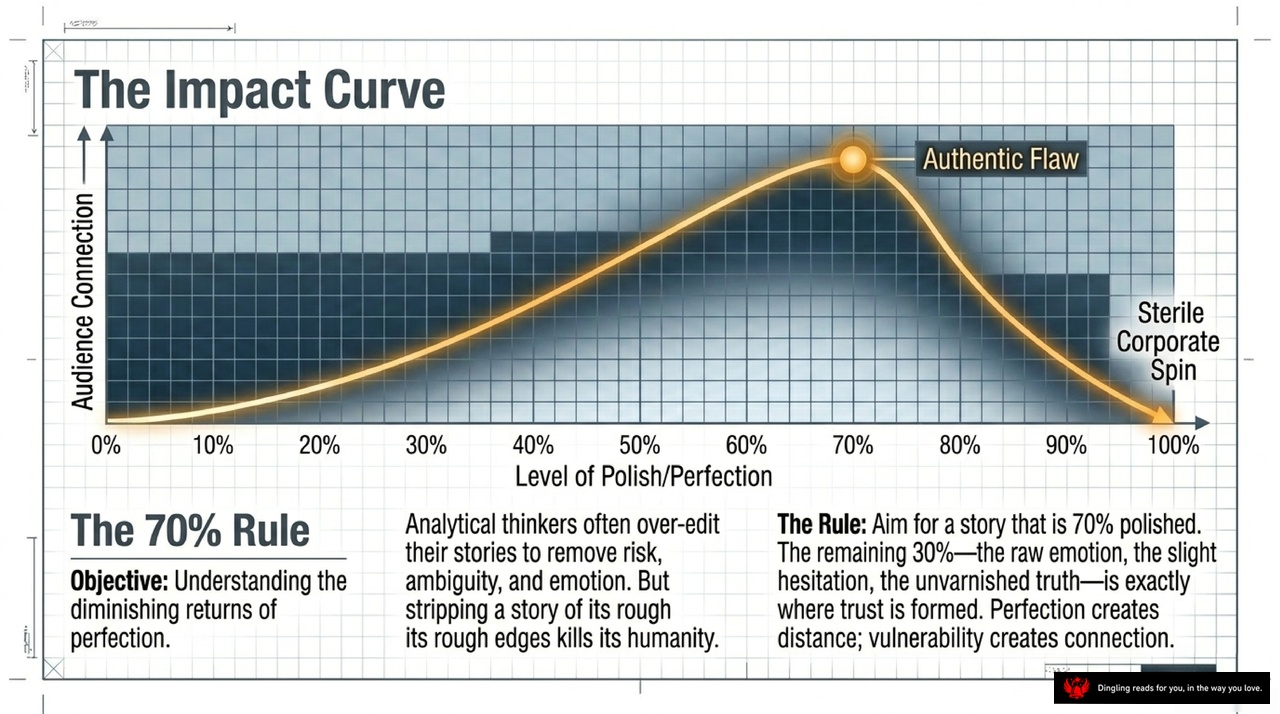
Imagine a curve that maps the very soul of connection. On the horizontal axis, we have the "Level of Polish or Perfection," climbing from zero to a hundred. On the vertical axis sits "Audience Connection." If you look closely, you'll see a golden arc peaking right around the 70% mark. This is the "Impact Curve."
Notice what happens as we push past that 70% point. As we chase that final 30% of perfection, trying to strip away every rough edge, every ambiguity, and every hint of risk, the curve doesn't rise. It crashes. We hit a plateau labeled "Sterile Corporate Spin." We've polished the story so much that it has lost its humanity, creating distance instead of intimacy.
But look at the peak. Right at that 70% mark, we find "Authentic Flaw." This is the sweet spot. The text below explains this as "The 70% Rule." It argues that analytical thinkers often over-edit their stories, terrified of imperfection. But here's the truth: stripping a story of its rough edges kills its humanity.
The rule is simple: aim for a story that is 70% polished. The remaining 30%—that raw emotion, the slight hesitation, the unvarnished truth—is exactly where trust is formed. Perfection creates distance; vulnerability creates connection. So, don't fear the flaw. Don't fear the unfinished feeling. That is precisely where your audience feels seen, understood, and willing to listen.

Imagine the room you're about to enter not as empty space, but as a living, breathing ecosystem already buzzing with its own narrative. Your audience is telling a story about you, your project, and your company right now, often before you even speak a word. You cannot overwrite a bad story if you don't first understand the one they are already holding. This is the hidden half of communication: active listening.
Before you ever open your mouth, you need to map the landscape. What metaphors are they using? What war stories are repeated in their breakrooms? Are they viewing challenges as battles to be won or problems to be solved? You must diagnose the room to find the cultural myths and unspoken fears that shape their reality. True listening means absorbing their narrative without immediately formulating your counter-argument. You must hear their story completely before you introduce yours. Only by understanding the existing cultural myths and employee anecdotes that drive their behavior can you hope to shift the story. It's about listening without reloading, allowing their perspective to settle before you offer your own, ensuring your message lands not as an interruption, but as a continuation of the conversation they are already having.
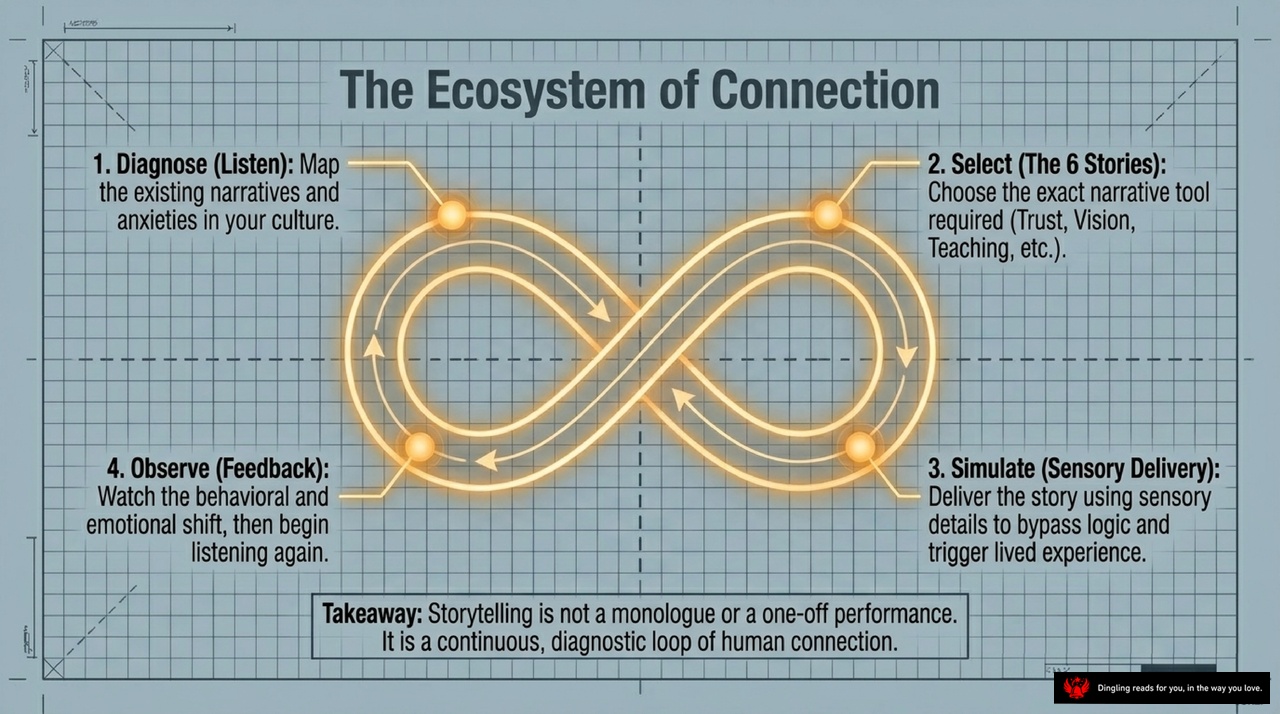
Look at this infinity loop on the screen. This is what I call "The Ecosystem of Connection." It flips the traditional idea of storytelling on its head. We often think of storytelling as a one-way monologue—a speech you give and then walk away. But this diagram shows us that true connection is a continuous, diagnostic loop.
It starts on the left with **Diagnose**. Before you ever speak, you have to listen. You need to map the existing narratives and anxieties already floating in your audience's culture. You can't just project your own story onto them; you have to understand their reality first.
Once you've diagnosed the landscape, you move to the top right: **Select**. Now you choose the exact narrative tool you need. Do you need to build trust? Paint a vision? Or offer a lesson? You pick the specific story that fits the gap you identified.
Next, we go down to **Simulate**. This is where you deliver the story using sensory details. You aren't just listing facts; you are bypassing logic to trigger lived experience. You want them to feel the story, not just hear it.
Finally, the loop closes at the bottom with **Observe**. You watch for behavioral and emotional shifts. Did they lean in? Did they look confused? Then, crucially, you begin listening again. You feed that feedback back into the start of the cycle.
The takeaway here is simple but profound: Storytelling is not a performance. It is a living, breathing conversation. It's a cycle where every interaction refines the next one, ensuring that your message actually lands and connects on a human level.
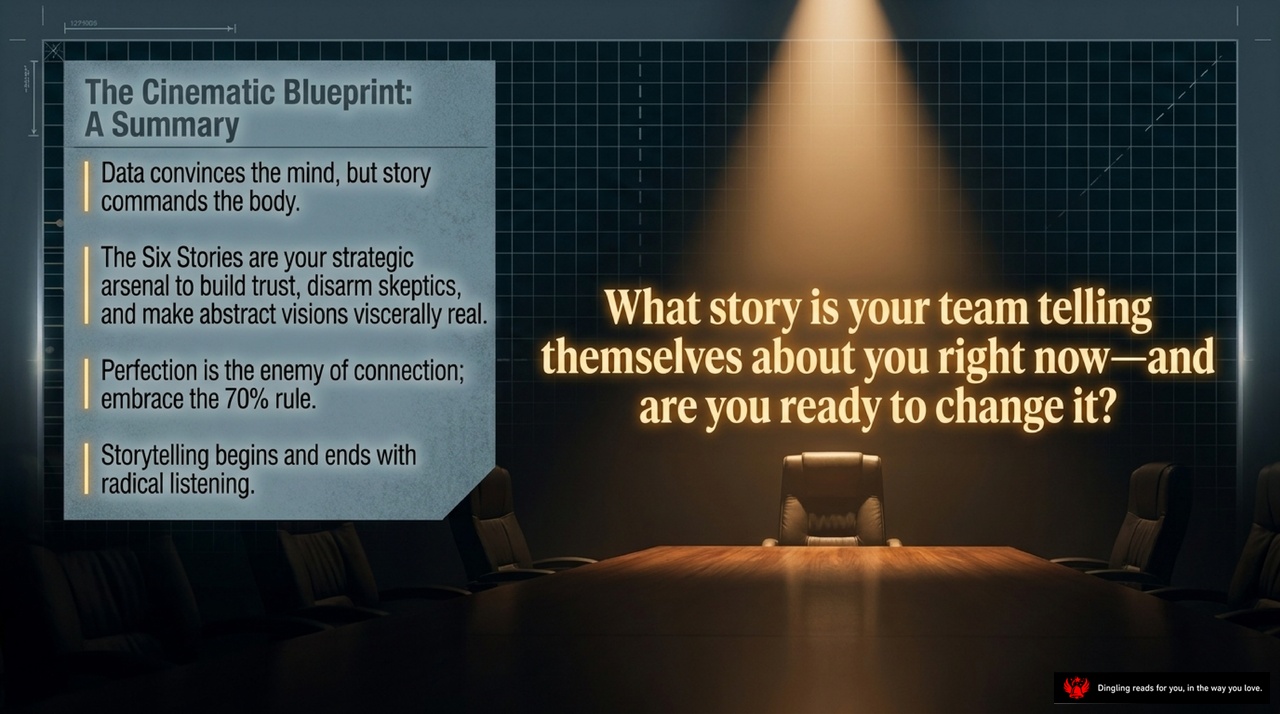
Imagine walking into a high-stakes meeting where the only thing on the table is a cold spreadsheet. We all know data convinces the mind, but here's the hard truth: story commands the body. If your team is telling you a story right now, what is it? And are you ready to change it?
The summary on this slide breaks down the cinematic blueprint for transformation. First, remember that the six stories we've discussed are your strategic arsenal. They aren't just fluff; they are tools to build trust, disarm skeptics, and make abstract visions feel viscerally real. Second, stop chasing perfection. Perfection is actually the enemy of connection. Embrace the 70% rule—good enough is often the most authentic and powerful version of the truth.
But the most critical point is this: storytelling begins and ends with radical listening. You cannot craft a compelling narrative if you don't first understand the stories already living in your audience's minds. By shifting from a data-driven mindset to a story-driven one, you stop pushing information and start inviting people into a shared reality. So, ask yourself: are you ready to stop talking and start listening?