
Why Evolution Is True: Complete Chapter-by-Chapter Summary

Welcome to today's session on *Why Evolution Is True* by Jerry A. Coyne. Imagine the Earth as a grand, ancient library where the pages are written in rock. The title of our book, *Why Evolution Is True*, promises to open this library and show us the irrefutable evidence behind Darwinian evolution.
The core message is simple yet profound: life on Earth is not a static creation but a dynamic story of change over time. As Coyne explains, evolution is the genetic change in species across generations. It started billions of years ago with simple self-replicating molecules and has led to the incredible diversity we see today. This process is driven by natural selection, where traits that help survival are passed down, while those that don't fade away.
But why do we believe this? The book presents a definitive scientific dossier. It's not just a guess; it's a theory supported by overwhelming evidence from fossils, genetics, and the very structure of our bodies. From the layers of rock telling a history of life from simple bacteria to complex humans, to the "imperfect" designs in nature that prove we were built by a tinkerer rather than a perfect engineer—this book lays out the case clearly.
Whether you're curious about your own origins or the journey of whales returning to the sea, Coyne guides us through the logic that makes evolution one of the most robust facts in all of science. Let's dive in and explore the evidence that has reshaped our understanding of life itself.

Evolution is often misunderstood as a chaotic lottery of pure luck, but the reality is far more structured and purposeful. As we see here, the process is actually a powerful equation: take **Random Mutation**, which provides the genetic variance, and combine it with **Non-Random Selection**, driven by environmental pressures. When you mix these two forces, you get **Directional Adaptation**—a clear, anti-entropic evolution that pushes life toward better survival strategies.
This framework helps us **deconstruct the random chance fallacy**. Many people believe evolution is purely accidental or that it always leads to higher complexity. But the reality is different. While mutations are indeed random, the selection process is a strict, rule-based filter that keeps only what works. Furthermore, evolution doesn't always move toward complexity; sometimes, simplicity is the superior survival strategy, as we see in bacteria. By understanding that evolution is an established scientific fact rather than a theory in crisis, we can see how life adapts not by design, but through the relentless, directional pressure of the environment acting on random variations.

Imagine evolution not as a grand, finished masterpiece, but as a constantly rewritten draft, where every organism carries the messy, beautiful history of its ancestors. Think of a body as a library of clues, where "vestigial organs" are the footnotes we've forgotten how to read. Take the ostrich: it retains tiny, useless wings that can't lift its massive body, yet they serve as a reminder of its ancestors who once soared through the skies. Similarly, humans carry an appendix and a tailbone—remnants of a time when our ancestors relied on fermentation and long tails for survival.
But the evidence goes deeper than just physical structures. Look at your DNA. You carry "pseudogenes"—broken, inactive genes that were once vital. For instance, our ancestors lost the ability to make Vitamin C because their diet was rich in fruit, leaving us with a genetic "ghost" of that function. Even our embryos tell a story; early in development, we sprout gill arches and a prominent tail, echoing our aquatic and tailed past before these features disappear.
Perhaps the most striking proof of evolution is nature's lack of perfection. If life were designed from scratch by an all-powerful engineer, we wouldn't have "suboptimal" designs. Consider the flounder: born with two symmetrical eyes, it eventually drags one across its skull to lie flat on the ocean floor. Or think of the giraffe's vagus nerve, which takes a ridiculous detour down its long neck just to get to its throat—a path inherited from its fish-like ancestors that simply couldn't be rewired. These aren't mistakes; they are the fingerprints of a "tinkerer," not an architect. Evolution works by patching what exists, not creating the perfect solution from nothing. These quirks and imperfections are the ultimate evidence that life is a product of gradual adaptation, not deliberate design.

Imagine a world where nature isn't a master architect designing perfect machines, but rather a skilled repairman working with whatever materials are already on hand. This slide perfectly captures that idea by showing us two incredible examples of nature's "imperfect" work: Tiktaalik and Archaeopteryx.
Look at Tiktaalik, the fish-amphibian node. Discovered exactly where evolution predicted, in 370-million-year-old freshwater sediment, this creature features fish gills but flat heads and primitive limb-like fins. It's the missing link between swimming and walking, a transitional fossil that proves life was gradually moving from water to land.
Then we see the reptile-bird node with Archaeopteryx and feathered dinosaurs. This common ancestor possessed both reptilian skeletal structures and fully formed flight feathers. It bridges the gap between the scaly dinosaurs of the past and the feathered birds we see today.
Notice the key insight at the bottom: transitional fossils do not perfectly blend two modern animals. They capture the historical branching point where a single ancestral lineage split to form entirely new trajectories. These aren't compromises or failures; they are the direct evidence that evolution works by modifying existing structures over time, rather than creating something from scratch.

The slide presents two striking evolutionary journeys: the descent of land mammals into the sea and the ascent of land creatures into the sky. On the left, we see the dramatic transformation of a four-legged ancestor into a streamlined whale. Notice how the nostrils migrate to the top of the skull, creating the blowhole, while the forelimbs compress into powerful paddles for swimming. This isn't a fresh design; it's a repurposing of old structures.
On the right, the story of flight unfolds. We see fingers fusing and diminishing as skin filaments evolve into complex, aerodynamic feathers. Just like the whale, the bird didn't start with a perfect wing; it modified the skeletal structure of its arm.
This visual perfectly illustrates the core rule at the bottom: natural selection is a tinkerer, not a perfect engineer. A supernatural creator could have designed these organisms from scratch, but evolution works by modifying what already exists. It takes the bones of a land animal and adapts them for the ocean or the air, leaving behind traces of its past in every new form.

Imagine your body as a historical palimpsest, a manuscript constantly overwritten but still bearing the ghostly traces of its ancestors. Today's slide brings this concept to life by showing us two powerful examples: the flightless wings of a bird and the human coccyx, or tailbone.
On the left, we see those vestigial wings. They no longer serve their original purpose of flight, yet they haven't disappeared. Instead, evolution has repurposed them for balance during a run or as a display during courtship. They are a clue, whispering that this bird's ancestors once soared through the skies. On the right, the X-ray reveals our own coccyx. This is a classic case of atavism—a rare reawakening of dormant ancestral genes. While it's often a small bump, it represents the tail of our primate ancestors. Occasionally, these genes activate in infants, resulting in un-fused, protruding tail vertebrae, a direct link to our evolutionary past.
The core message here is profound: organisms are filled with clues of their ancestors that only make sense in the light of evolution. These aren't mistakes or failed designs; they are evidence. They prove that we are not perfectly engineered from scratch, but rather historical products, carrying the legacy of billions of years of change within our very bones and feathers.

Have you ever looked at a peacock and wondered why it carries such a cumbersome, eye-catching tail? It seems like a terrible design for survival, right? But that's exactly where evolution shines.
This slide breaks down the concept of **Sexual Selection**, a powerful engine that drives evolution alongside natural selection. While natural selection cares about survival, sexual selection cares about reproduction.
Look at the top section: **Male-Male Competition**. Think of the elephant seal. The males are twice the size of females and weigh nearly three tons. They fight brutally for the right to mate, with the winner taking up to 100 females. This intense competition pushes males to evolve massive size and weapons like the antlers of a moose. It's a physical battle for dominance.
Now, look at the second section: **Female Choice**. This is often more subtle but equally powerful. Female peacocks prefer males with more eye-spots on their tails. Even if that tail makes the male harder to fly or more visible to predators, as long as the reproductive benefit outweighs the survival cost, evolution favors it. This leads to **Sexual Dimorphism**, where males and females look completely different, like the flashy male peacock versus the plain female.
But here's the mind-bending part: **Why do we have genders at all?** It seems inefficient. Asexual reproduction passes 100% of genes to offspring, while sexual reproduction only passes 50%. So why does sex dominate? The answer lies in adaptation. Sex shuffles the genetic deck, creating new combinations that help a population survive changing environments and parasites.
And it's not always "male fights, female chooses." Nature loves to flip the script. In seahorses, the male carries the pregnancy in a pouch, so females compete for the right to mate. In jacanas, the females are the aggressive ones, fighting for males who then do all the parenting.
Ultimately, this all comes down to investment. The sex that invests less in reproduction competes for mates, while the sex that invests more—whether through gestation, egg production, or parenting—gets to be the picky one. Whether it's a peacock's tail or a seahorse's pouch, these traits aren't about "perfect design." They are the result of billions of years of trade-offs, proving that evolution isn't a master engineer, but a creative force driven by the simple goal of passing genes to the next generation.

Look at this slide titled "The Evidence of Bad Design." It poses a fascinating question: if our bodies were intelligently designed, why do we have structures that seem so inefficient? The image highlights three perfect examples of this evolutionary "baggage."
First, consider the appendix. It's described here as a shrunken remnant of a larger ancestral digestive sac. While it can help with immunity, it's also highly susceptible to lethal inflammation—a clear sign it's not a perfect, necessary organ.
Next, look at the recurrent laryngeal nerve. The text explains that instead of taking a direct route from the brain to the throat, this nerve loops unnecessarily under the aorta. In giraffes, this creates a detour of several feet. This happened because the nerve evolved from fish anatomy, where the heart and gills were adjacent. As we evolved into mammals with long necks, we couldn't just "rewire" the system; we were stuck with this inefficient path.
Finally, there's the kiwi's wings. These are tiny, completely useless wings hidden under feathers, providing zero aerodynamic or balance benefits. They are pure evolutionary baggage.
These aren't mistakes by a designer; they are evidence of evolution. Natural selection is more of a "tinkerer" than a master engineer. It can only work with the materials already available, making compromises rather than creating perfect solutions. These imperfections are the most powerful proof that life has been shaped by gradual change over time, not by a blueprint.

Look at this map. It's not just a picture of Earth; it's a snapshot of a planet that was once whole. Notice how the fossilized ferns, *Glossopteris*, are scattered across Antarctica, South America, and Africa. They didn't jump across oceans. Instead, the continents carrying these native species drifted apart over millions of years, splitting a single ancient ecosystem into isolated pieces.
Now, look at the other side of the map: the Marsupial Migration. Marsupial fossils perfectly match the populations we see in Australia today. But here's the twist. In other parts of the world, mammals that look and act just like them—placental equivalents—evolved separately. This is convergent evolution. Nature didn't design two different perfect solutions; it took one lineage, isolated it on a massive island continent, and let it diverge.
The core message here is simple but powerful: God didn't create similar species in disparate locations. If that were true, we'd expect perfect, unrelated designs everywhere. Instead, we see ancient ecosystems fractured by shifting tectonic plates. The similarities we see today aren't evidence of a designer starting over; they are the echoes of a shared past, stretched thin across a broken world.

The slide you're looking at breaks down a crucial concept in biogeography: the "Island Test." It compares how life evolves on two very different types of islands—Continental Islands versus Oceanic Islands—and reveals something fascinating about the role of human interference.
Let's start with the left side: Continental Islands. Think of places like Great Britain or Japan. These islands were once physically connected to a mainland landmass. Because they started as part of the continent, they inherited a balanced ecosystem. You find everything there you would expect on a mainland: land mammals, amphibians, and freshwater fish. Their origin is simple; they just drifted apart from the continent.
Now, look at the right side: Oceanic Islands. These are the ones that rose directly from the ocean floor via volcanism, like the Galapagos, Hawaii, or St. Helena. Because they never touched a continent, they have a very different story. They are entirely devoid of native land mammals, amphibians, and freshwater fish. Why? Because those creatures simply cannot swim across vast oceans to get there. Instead, these islands are dominated exclusively by species capable of long-distance oceanic travel—birds, insects, and wind-borne plant seeds.
But here is the most important part, highlighted at the bottom: The Human Introduction Variable. When humans arrive and introduce pigs, toads, or rats to these Oceanic Islands, the result is often catastrophic. These mammals and amphibians thrive and devastate the native species that evolved without them. This proves a critical point: Oceanic islands are highly suitable for mammals and amphibians, but they are simply unreachable without human intervention. The fact that humans can so easily disrupt these fragile, isolated ecosystems highlights just how unique and vulnerable these island environments truly are.
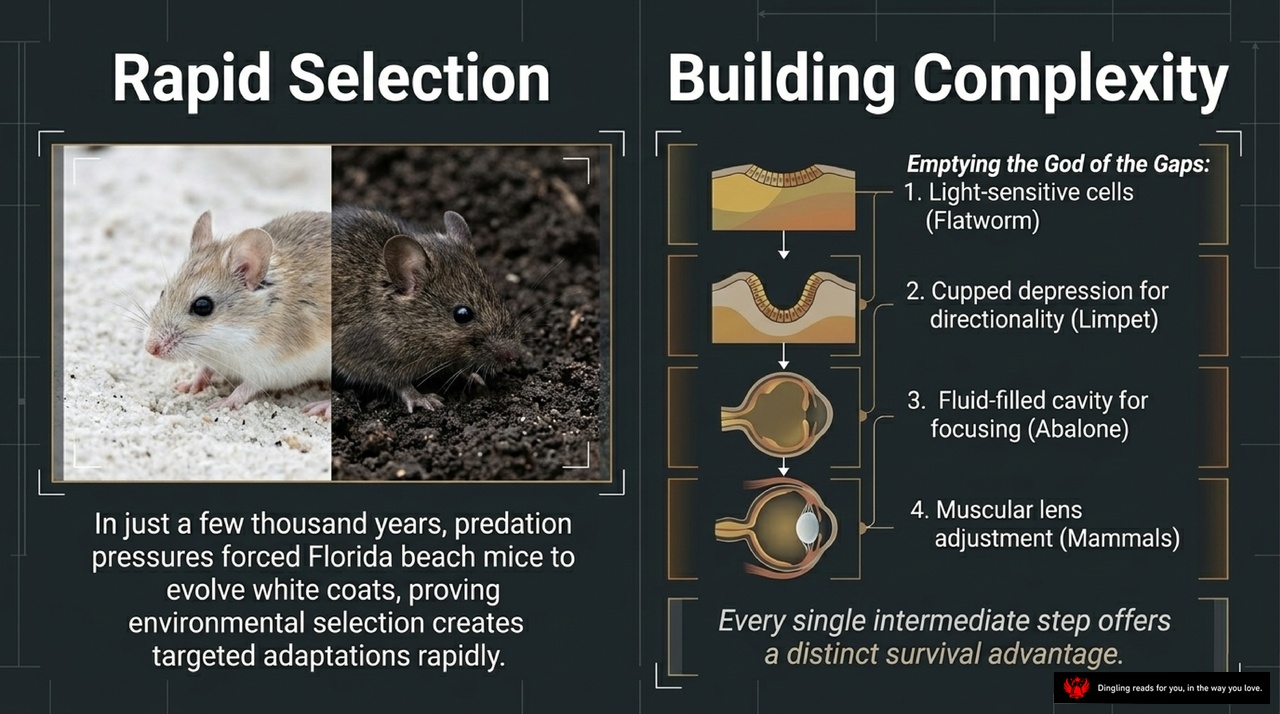
Look at this slide, and you'll see two powerful stories side by side that prove evolution isn't just a slow, distant theory—it's happening right now, and it builds complexity step by step.
On the left, under "Rapid Selection," we see Florida beach mice. Notice the stark contrast: the mouse on the left is pale, blending perfectly with the white sand, while the one on the right is dark, making it stand out against the dark soil. The text explains that in just a few thousand years, predation pressure forced these mice to evolve white coats to match their environment. This is a perfect example of targeted adaptation. Nature didn't wait millions of years; it simply selected the individuals that survived best in their specific setting.
Now, look at the right side, titled "Building Complexity." This section, which the slide calls "Emptying the God of the Gaps," shows how complex structures like the eye didn't appear all at once. Instead, evolution filled the gaps with useful intermediate steps. We start with light-sensitive cells in a flatworm, then move to a cupped depression for directionality in a limpet, then a fluid-filled cavity for focusing in an abalone, and finally, the muscular lens adjustment seen in mammals. The key takeaway at the bottom is clear: every single intermediate step offers a distinct survival advantage. Nature didn't need to build the perfect eye from scratch; it just kept refining what worked, layer by layer.
Together, these two concepts show the power of natural selection: it can drive rapid changes when the pressure is high, and it can construct incredibly complex systems through a series of small, beneficial steps.

Have you ever wondered why nature seems to create things that make no sense? Like a peacock's tail, which is so heavy and flashy that it hinders flight, drains energy, and actually attracts predators. It looks like a terrible design for survival.
But this slide reveals the "Paradox of Beauty." It asks a crucial question: Why does evolution produce traits that are so costly to an individual's life?
The answer lies in the conflict between two forces. First, natural selection tries to maximize survival, keeping you safe from predators and hungry. But sexual selection has a different goal: it maximizes reproduction. And in the animal kingdom, reproduction often wins.
Look at the cycle on the right. Because of "Overwhelming Mating Success," specifically driven by female choice, males with these expensive ornaments—like that giant tail—get to pass their genes to the next generation. Even though they pay a high price in terms of energy and predation risk, their reproductive success is so high that it completely offsets those costs. Their genes propagate despite the physical toll.
So, remember this key takeaway: when the drive to survive clashes with the drive to reproduce, evolution always chooses the latter. Reproduction wins. That is why we see these "imperfect" but stunningly beautiful traits everywhere in nature.

The African Origin. It all starts here, seven million years ago, when our lineage finally split from our closest living relatives, the chimpanzees. For decades, this was just a bold prediction by Darwin, a prophecy based purely on anatomy. He knew that if we had an ape-like ancestor, it had to be found in Africa. Then, in 1924, the world got its answer. Raymond Dart discovered the Taung Child, *Australopithecus africanus*, in South Africa. That skull right there? It was the smoking gun. It proved we aren't some separate, perfect creation standing apart from nature. We are a modified ape, bearing the indelible stamp of our lowly origin. We didn't just appear; we evolved. We are part of the same tree, connected by the same DNA, sharing a common past with the great apes. This isn't just about bones; it's about our place in the universe. We are the story of Africa, written in stone and flesh.

Let's talk about the Environment of Evolutionary Adaptedness, or the EEA. Our brains didn't evolve to navigate modern skyscrapers or digital screens; they were sculpted over 300,000 generations to survive in small hunter-gatherer bands. Think of our entire modern civilization as just the icing on the cake—a mere 250 generations of history compared to the deep time of our genetic programming.
This mismatch creates two very different realities. On one side, we have legitimate adaptations. These are proven survival mechanics like our innate craving for high-calorie sweets and fats, or our drive for parent-child bonding. These traits made perfect sense when food was scarce and social cohesion was life-or-death.
On the other side, we face the danger of "Just-So Stories." This is the trap of over-extrapolating our ancient past to explain modern social behaviors. Just because we crave sugar doesn't mean our depression is a strict genetic imperative, nor does it mean male infidelity is an unchangeable biological command. We often invent evolutionary excuses for things that are actually products of our current environment.
Crucially, remember this: genes are not destiny. While our inherited programming provides a starting point, environmental intervention can override it. Just as glasses correct poor vision or societal laws shape behavior, our modern world can rewrite our ancient instincts. We are not slaves to our evolutionary past; we have the power to adapt our environment to us.

The Verdict: Evolution is a fact etched in stone, written in our DNA, and observable in the world around us. From the geographic isolation of islands to the embryonic echoes of our fish-like ancestors, the evidence converges on a single, undeniable truth: the infinite diversity of life is the product of random mutation filtered by non-random selection over deep time.
If the blind forces of nature can sculpt the cosmos and engineer the infinite diversity of life from a single replicating molecule, do we really need a supernatural architect to find meaning, morality, and purpose in our existence? The answer lies not in a divine blueprint, but in the relentless, creative power of natural selection itself.