
Why We Sleep: Complete Chapter-by-Chapter Summary
Welcome to "Why We Sleep," the hidden science of the most powerful, life-saving biological mechanism on Earth. As we dive in, ask yourself: can you remember the last time you woke up naturally, without an alarm and without coffee? If not, you're part of a global crisis. In developed nations, two-thirds of adults aren't getting the recommended eight hours of rest, and the World Health Organization has officially labeled sleep deprivation an epidemic.
The cost of this neglect is staggering. Countries that have seen a sharp drop in sleep over the last century are now the epicenters for physical and mental health crises. We are the only species intentionally robbing ourselves of sleep, pushing humanity toward a health cliff. The consequences go far beyond just feeling tired; sleep loss directly attacks our body's core defenses. Less than six to seven hours a night can double your risk of cancer and Alzheimer's, spike your blood sugar into diabetes territory, and skyrocket your chances of heart disease, stroke, and anxiety. It's a vicious cycle where lack of sleep creates the very stress that keeps you awake.
Sleep is also a matter of life and death. Rare genetic conditions can lead to fatal insomnia, while fatigue-related car accidents claim more lives than drunk driving does every single hour in the U.S. For too long, we've ignored sleep because we didn't understand its purpose. But today, we are finally waking up to the truth: sleep isn't a luxury or a sign of laziness. It is the foundation of our survival, our intelligence, and our future.

Sleep isn't just about resting; it's a daily battle between two powerful biological forces. Imagine your day as a tug-of-war. On one side, you have Process C, your internal 24-hour clock. This is your Circadian Rhythm, a natural rhythm reset by sunlight that dictates your alertness regardless of how tired you feel. On the other side is Process S, or The Pressure. This is the relentless buildup of a chemical called Adenosine. Every minute you stay awake, you add a drop to a reservoir of sleep pressure.
Look at the graph here. You can see the blue line representing your Circadian Rhythm peaking around midday, while the orange line, your Adenosine Pressure, climbs steadily throughout the day. As evening approaches, these two forces finally collide. Sleep begins only when the pressure from Process S becomes strong enough to overcome the alertness signal from Process C. That intersection point is your Sleep Onset Trigger. Without this balance, without that buildup of pressure meeting the rhythm of your clock, you simply won't fall asleep. Understanding this collision is the key to mastering your sleep.
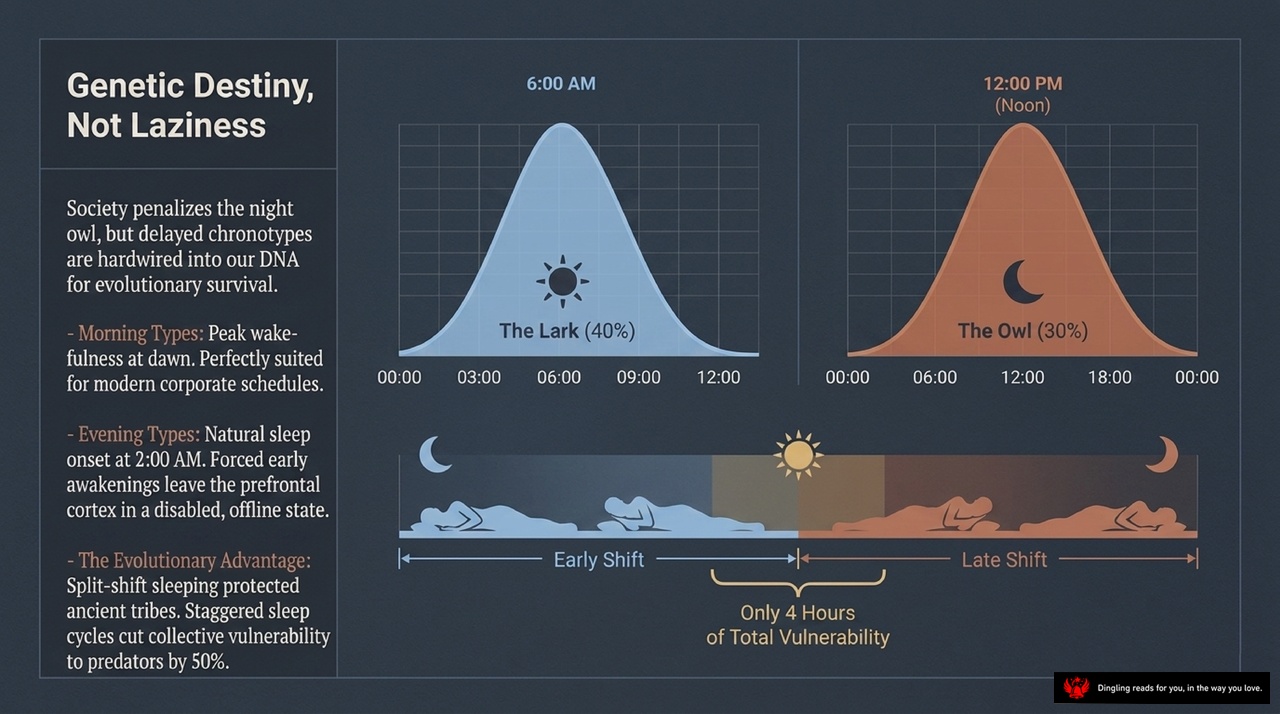
Society often blames night owls for being lazy, but the science tells a different story: your sleep schedule is written in your DNA. As the slide illustrates, we aren't all the same. About 40% of us are "Larks," peaking in wakefulness at dawn like the sun icon shows, perfectly wired for traditional corporate schedules. But the other 30% are "Owls," whose energy peaks at noon, just like that moon icon. Forcing these natural night types to wake up early disrupts their prefrontal cortex, leaving them in a disabled, offline state all day.
This isn't just about personal preference; it's an evolutionary advantage. Our ancestors didn't sleep in unison. Instead, they adopted a split-shift pattern, with some sleeping early and others staying up late. This staggered schedule meant that at any given time, only a small fraction of the tribe was vulnerable to predators. As the bottom graphic shows, this strategy reduced their collective vulnerability by 50%. So, when you feel tired because you're an owl, remember: you're not lazy. You're following an ancient survival strategy that modern society simply hasn't adapted to yet.

The Dual Architecture of Sleep: A Diagnostic Comparison.
Think of your sleep not as a single block of rest, but as a dynamic, two-stage renovation project happening inside your brain. Tonight, we're breaking down the blueprint.
First, we have NREM, or Non-Rapid Eye Movement, which we can call "The Deep Sculptor." As shown in the graphic, this stage dominates the early part of the night, from midnight until roughly 3:00 AM. You'll see those slow, rolling brainwave patterns here. This is your brain's editorial matrix. It's when you generate powerful, slow brainwaves to prune unnecessary neural connections, restore your physical systems, and lock in the facts you learned today. It's the heavy lifting for your body and memory.
Then, the script flips. Enter REM, or Rapid Eye Movement, "The Active Architect." This stage takes over the late morning hours, from 3:00 AM until around 6:00 AM. Notice how the brainwave line becomes jagged and chaotic, mimicking wakefulness? This is where your brain strengthens connections and processes emotions. However, there's a safety lock on this stage. Your body is completely paralyzed to prevent you from acting out your dreams. That's why you don't fall out of bed while running through a jungle in your sleep.
The bottom timeline illustrates the critical shift. You spend the first half of the night in NREM dominance, and the second half in REM dominance. Here is the hard truth: Truncating sleep at 6:00 AM disproportionately destroys up to 90% of your REM sleep. If you are an early riser who cuts your sleep short, you aren't just losing rest; you are deleting the very part of your night that handles your emotions and creativity. To truly heal, you need the full cycle.
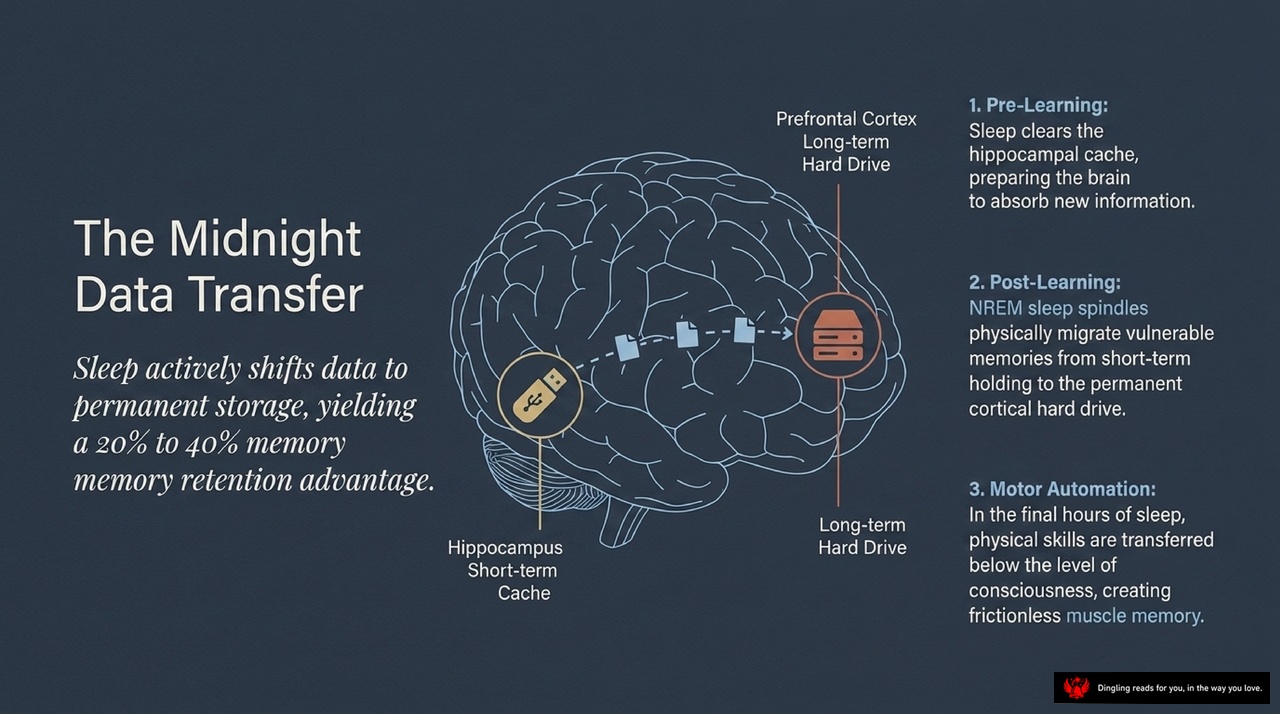
Sleep isn't just about resting your eyes; it's a high-stakes data transfer operation happening while you're unconscious. Think of your brain as a computer with limited RAM. During the day, your hippocampus acts as a temporary hard drive, holding onto new facts and skills. But this cache has a limit. If you don't sleep, that temporary storage gets overwhelmed, and you lose the ability to retain what you've learned.
The magic happens at night. As the slide illustrates, sleep actively shifts data from this short-term hippocampal cache to the prefrontal cortex, which serves as your permanent long-term hard drive. This process yields a massive 20% to 40% advantage in memory retention. It's not passive; it's an active migration of information.
This transfer happens in three distinct phases. First, pre-learning sleep clears out the clutter in your hippocampal cache, making space for fresh information the next day. Then, during post-learning sleep, specifically in NREM stages, your brain physically migrates vulnerable memories from that temporary holding area into your permanent cortical storage. Finally, in the final hours of sleep, your brain automates physical skills. Complex movements, like typing or playing an instrument, are transferred below the level of conscious thought, creating frictionless muscle memory.
Without this midnight data transfer, you aren't just tired; you're losing the ability to learn and grow. Prioritizing sleep is literally prioritizing your future intelligence.
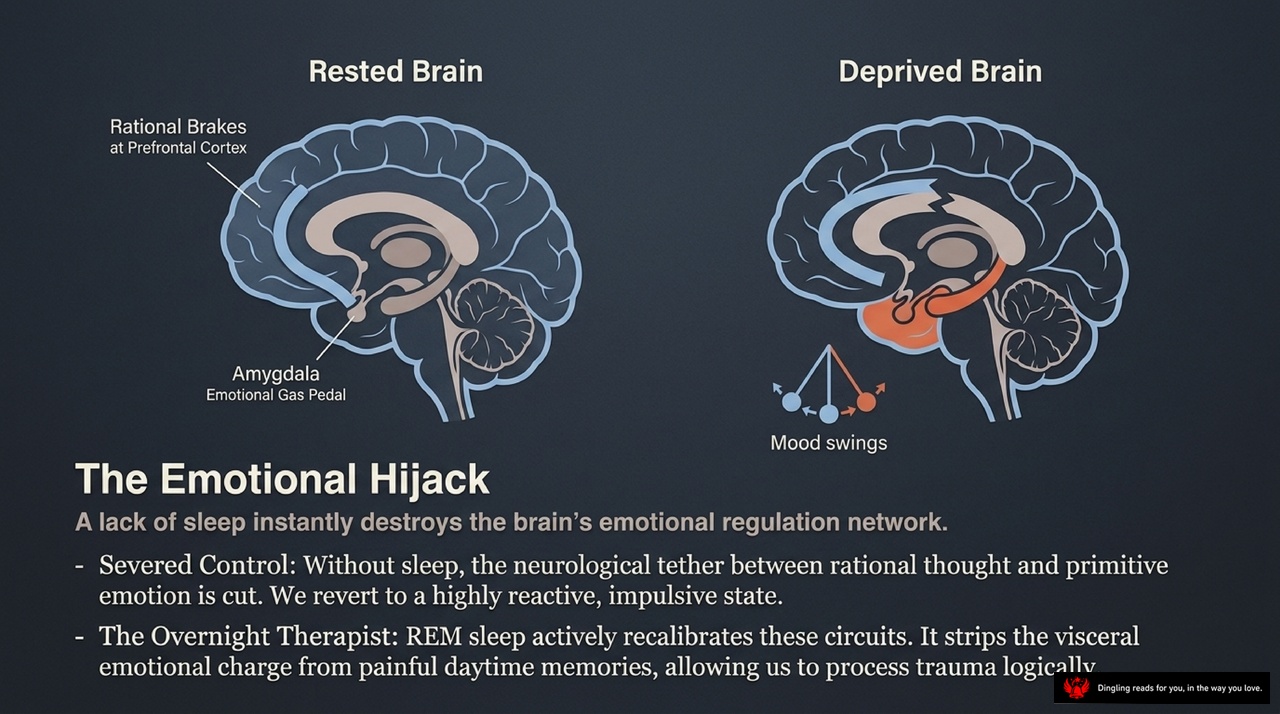
Every night, we actually slip into a temporary psychotic state. We hallucinate, experience delusions, feel confused about time and space, and our emotions swing wildly. The only difference is that when we wake up, we forget most of it. This isn't a disorder; it's the normal physiology of REM sleep.
While the deep non-REM stages are for quiet repair, REM is where the magic happens. It's the primary source of our dreams. During this phase, your visual cortex, motor cortex, and the amygdala—the brain's emotional center—are firing at 30% higher levels than when you're awake. Yet, ironically, the prefrontal cortex, your rational CEO, goes completely offline. You are essentially running on pure emotion and memory, with no logic to check it.
This is why REM sleep acts as your brain's overnight therapist. During the day, stress and anxiety keep your brain flooded with norepinephrine, a chemical that amplifies fear and keeps you in a state of high alert. But during REM, your brain stops releasing norepinephrine entirely. It creates a low-pressure environment where it can safely revisit painful memories. It allows you to retain the factual details of a traumatic event while stripping away the overwhelming emotional charge.
Think of it this way: if you don't get this nightly reset, those emotional wounds never heal. This is why people with PTSD often have disrupted REM sleep; their brains are stuck in a loop of high anxiety, unable to process the trauma. That's why treating the sleep cycle is so critical for mental health. Without this nightly emotional defragging, we carry our burdens forever, never getting the chance to let go.

Every night, we drift into a state that feels dangerously close to psychosis. We hallucinate, lose track of time, and our emotions swing wildly, only to forget it all the moment we wake up. But this isn't a sign of mental illness; it's the normal, essential physiology of REM sleep.
This is where the magic happens. While your body is paralyzed to prevent you from acting out your dreams, your brain is firing on all cylinders. The regions responsible for vision, memory, and—crucially—emotion are hyperactive. In fact, the parts of your brain that process feelings are 30% more active during REM than they are when you're fully awake. Meanwhile, the logical, rational part of your brain, the prefrontal cortex, essentially goes offline. It's like the CEO of your mind has been temporarily fired, leaving your emotions and memories to run the show.
This unique state is the engine of our creativity and emotional resilience. It's the reason why breakthroughs often happen in the shower or upon waking. During REM, your brain strips away the emotional "sting" from your memories. It allows you to keep the facts of a traumatic event but removes the fear and anxiety attached to it. This is why people who process their trauma through dreaming often heal faster than those who don't.
It's also the source of our most brilliant ideas. History is filled with moments of insight born from this state: Mendeleev dreaming up the periodic table, Beethoven composing symphonies, and countless others finding solutions to complex problems while asleep. REM sleep breaks the rigid boundaries of logic, allowing your brain to make wild, distant connections that lead to innovation.
And here's the most fascinating part: you can learn to control it. Through techniques like "reality checks" while awake and specific alarms that gently wake you during light sleep, you can enter a "Lucid Dream"—a state where you know you're dreaming and can actively steer the narrative. You can fly, solve puzzles, or face your fears in a safe, controlled environment. While this isn't a universal human trait yet, it proves that our dreams aren't just random noise. They are a powerful, malleable tool for healing, creating, and mastering our own minds.
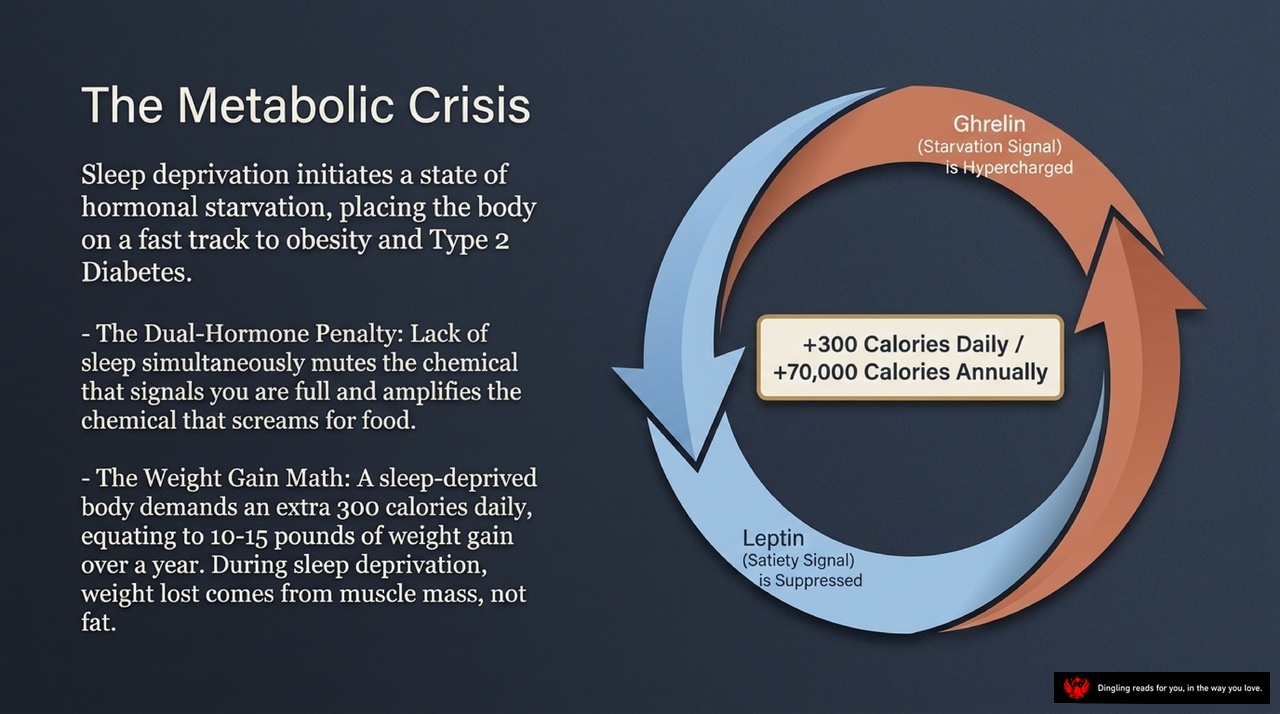
Imagine your body is trapped in a biological prison, not because of bars, but because of a hormonal glitch triggered by too little sleep. This slide, titled "The Metabolic Crisis," reveals the terrifying cycle that turns a tired night into a lifetime of health problems.
Look at this circular diagram. It illustrates what experts call the "Dual-Hormone Penalty." When you cut short your sleep, your body sends out two conflicting signals. The orange arrow represents Ghrelin, your hunger signal, which gets hypercharged and screams for food. Simultaneously, the blue arrow shows Leptin, the chemical that tells your brain you're full, which gets completely suppressed. You are biologically starving even when you're not.
This isn't just about feeling hungry; it's about your body demanding extra energy. The graphic highlights a staggering statistic: sleep deprivation forces your body to burn an extra 300 calories daily just to function. Over a year, that adds up to 70,000 extra calories. That is the equivalent of gaining 10 to 15 pounds of weight without ever stepping on a scale or changing your diet.
The text on the left explains the long-term cost. This state of "hormonal starvation" places you on a fast track to obesity and Type 2 Diabetes. It's a vicious cycle where your brain, confused by lack of sleep, craves high-calorie comfort foods, while your body loses muscle mass instead of fat. The result is a metabolic crisis that starts with a bad night's rest and ends with a lifetime of chronic disease. The solution isn't willpower; it's prioritizing sleep to reset these hormonal signals.

Every night, we dive into a state that feels dangerously close to psychosis: hallucinations, delusions, and wild emotional swings. But here's the relief—when we wake up, we forget most of it. These aren't symptoms of illness; they are the normal, vital workings of REM sleep, the stage where our most vivid dreams happen.
While our rational, logical prefrontal cortex goes offline, our brain's emotional centers light up 30% brighter than when we are awake. This is our nightly therapy session. During REM, the brain stops releasing norepinephrine, the chemical fuel for anxiety. It then reprocesses our day's painful memories, stripping away the emotional sting while keeping the lessons intact. Studies show that people who dream of their trauma can actually heal from it, whereas those who don't dream of it remain stuck in the pain.
But REM sleep does more than heal us; it fuels our creativity. History's greatest breakthroughs—from Mendeleev's periodic table to Beethoven's symphonies—often emerged from these dream states. REM allows our brain to make wild, remote connections that logic would block, turning scattered ideas into genius.
Perhaps the most fascinating aspect is lucid dreaming, where we become aware we are dreaming and can even steer the narrative. While still rare for most, this state proves that our minds hold immense untapped potential. By understanding these mechanisms, we realize that sleep isn't just a pause button; it's the engine driving our emotional stability and our greatest innovations.
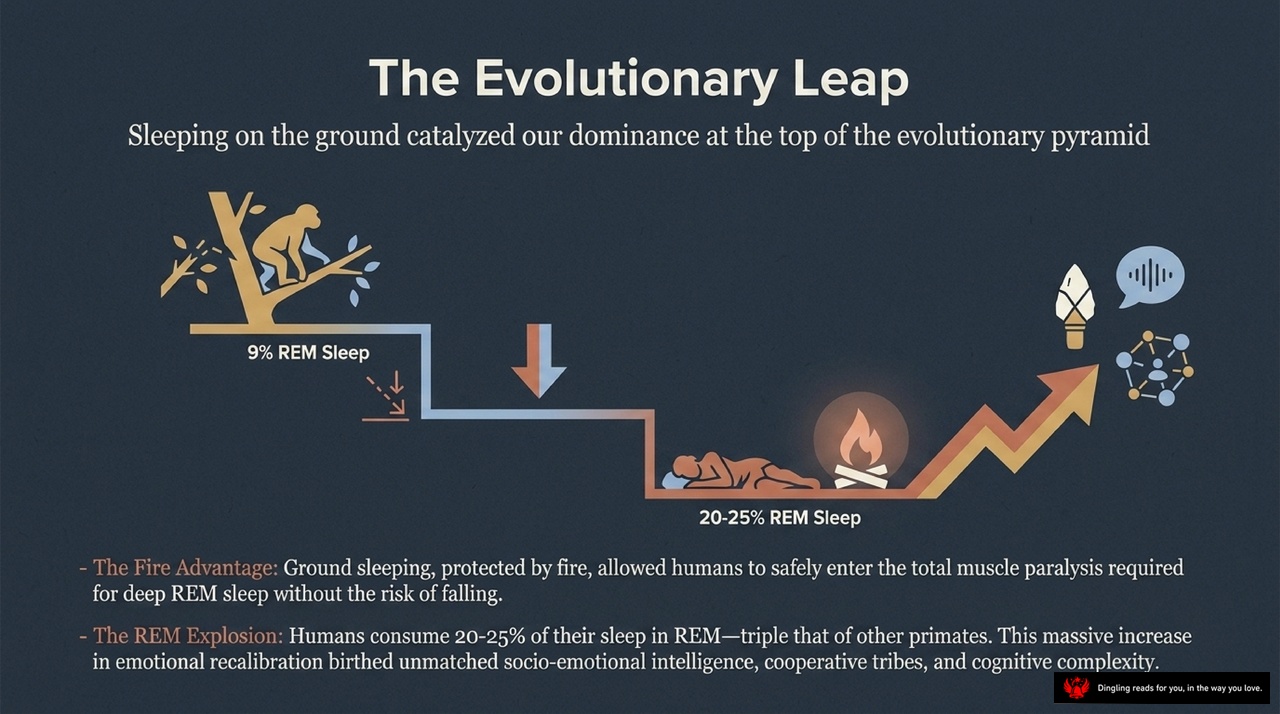
The Evolutionary Leap: How Sleeping on the Ground Made Us Human.
Imagine a time when our ancestors slept high in the trees, only to wake up with a jolt, terrified of falling. That was the old reality. But a massive shift happened when humans started sleeping on the ground, right next to the fire. This single change didn't just make us warmer; it triggered a biological explosion that placed us at the top of the evolutionary pyramid.
Look at the graphic. On the left, our primate cousins still get about 9% of their sleep in REM. But humans? We skyrocketed to 20-25%. Why? Because the ground, protected by fire, gave us the safety we needed to enter total muscle paralysis during deep REM sleep without the risk of falling. This is what we call "The Fire Advantage."
But the real magic lies in "The REM Explosion." By consuming triple the amount of REM sleep compared to other primates, we rewired our brains. This massive increase allowed for unmatched socio-emotional intelligence, the birth of cooperative tribes, and the cognitive complexity that defines us. While other animals sleep to rest, humans sleep to dream, to process emotions, and to build the very intelligence that allows us to conquer the world. We didn't just evolve; we leaped.
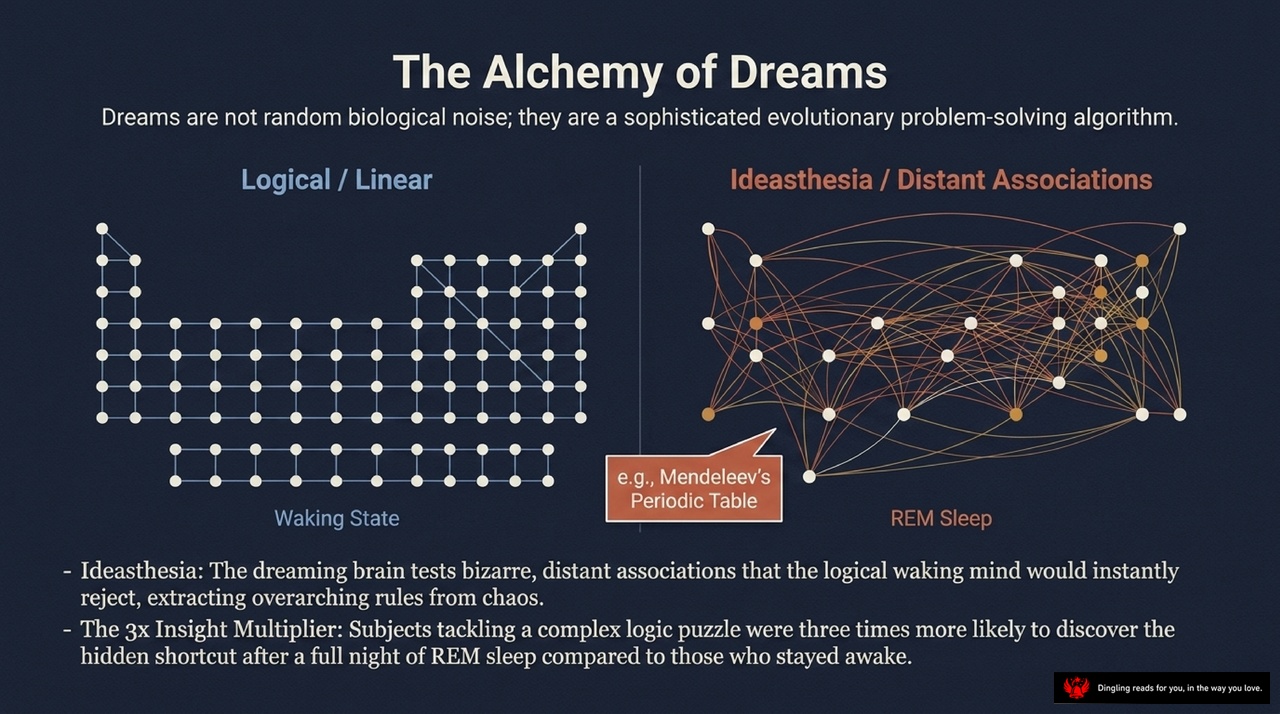
Dreams are often dismissed as random biological noise, but the truth is far more fascinating: they are actually a sophisticated evolutionary problem-solving algorithm. Think of your waking state as a logical, linear thinker—like the orderly grid of the Periodic Table, where everything has a fixed place and follows strict rules. But when you enter REM sleep, your brain switches gears entirely. It enters a state of "ideasthesia," creating a chaotic web of distant associations that your logical mind would instantly reject while awake.
This isn't just nonsense; it's a superpower. During this phase, your brain tests bizarre connections to extract overarching rules from chaos. In fact, research shows that subjects tackling complex logic puzzles are three times more likely to discover hidden shortcuts after a full night of REM sleep compared to those who stayed awake. It's the exact mechanism that allowed Mendeleev to see the Periodic Table in a dream or gave composers their greatest melodies. So, don't just sleep to rest your body—your brain is working overtime to solve the problems you can't tackle while you're awake.
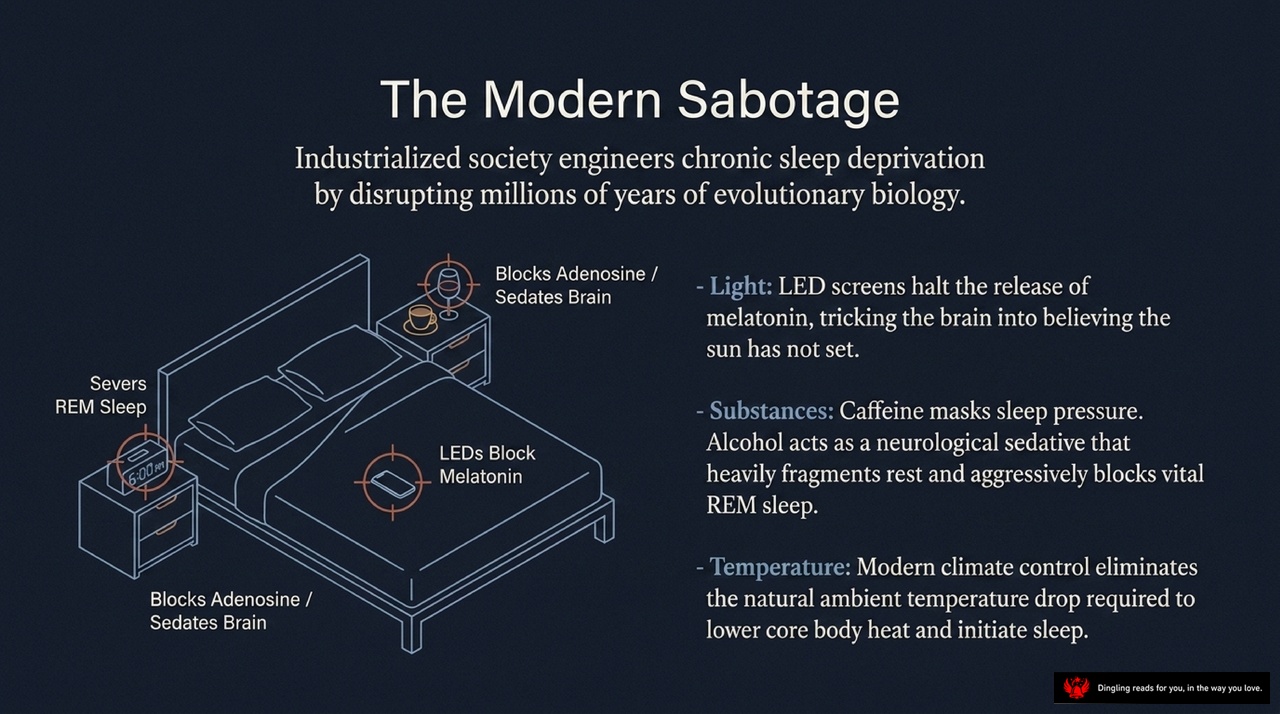
The Modern Sabotage. In our industrialized world, we've accidentally engineered a crisis: chronic sleep deprivation. We are disrupting millions of years of evolutionary biology with just a few modern habits.
Look at the diagram on the screen. It breaks down exactly how we are fighting our own biology every single night. First, consider Light. Our LED screens trick our brains into thinking the sun hasn't set, halting the release of melatonin and keeping us awake when we should be resting.
Then, look at what we consume. We use caffeine to mask our sleep pressure, and we turn to alcohol as a sedative. But while alcohol might help you fall asleep, it aggressively fragments your rest and blocks vital REM sleep, leaving you exhausted the next day.
Finally, consider our environment. Modern climate control keeps our rooms too warm. We've eliminated the natural drop in ambient temperature required to lower our core body heat and initiate sleep.
From the blue light in our phones to the caffeine in our coffee, and from the alcohol on our nightstands to the heat in our bedrooms, we have built a system of modern sabotage. We are the only species intentionally depriving ourselves of sleep, and the cost is being paid in our health, our safety, and our very lives.
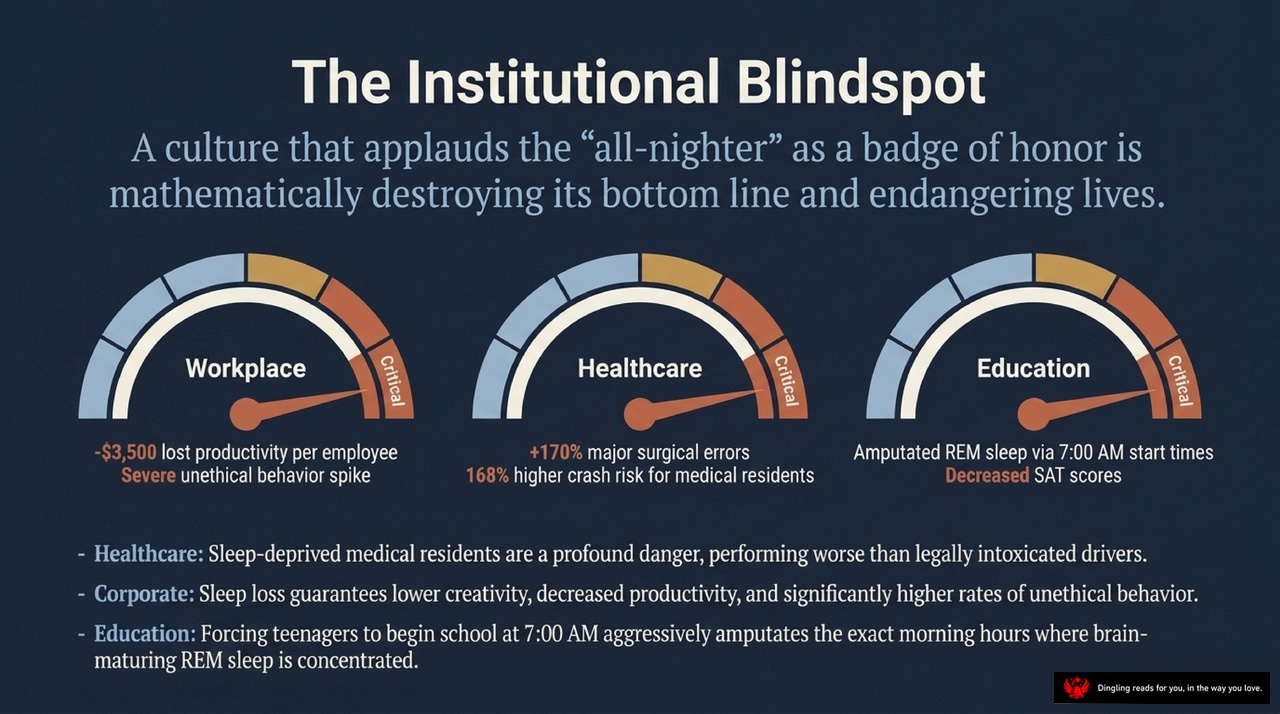
The slide highlights a terrifying reality: our institutions are operating with a massive blind spot. By glorifying the "all-nighter" as a badge of honor, we are mathematically destroying our bottom line and, more critically, endangering lives.
Look at the three gauges here. In the workplace, the cost is clear: we lose $3,500 in productivity per employee, and unethical behavior spikes to severe levels. In healthcare, the stakes are life-or-death. Sleep-deprived medical residents are 170% more likely to make major surgical errors and face a 168% higher crash risk—performing worse than legally intoxicated drivers. And in education, forcing teenagers to start school at 7:00 AM aggressively cuts off the REM sleep essential for brain maturing, leading to decreased SAT scores.
The data below confirms this crisis. In healthcare, exhaustion makes residents a profound danger. In corporate settings, sleep loss guarantees lower creativity and significantly higher rates of unethical behavior. In education, we are essentially forcing children to miss the exact morning hours where their brains do their most important developmental work. We are paying a steep price for a culture that values being awake over being rested.
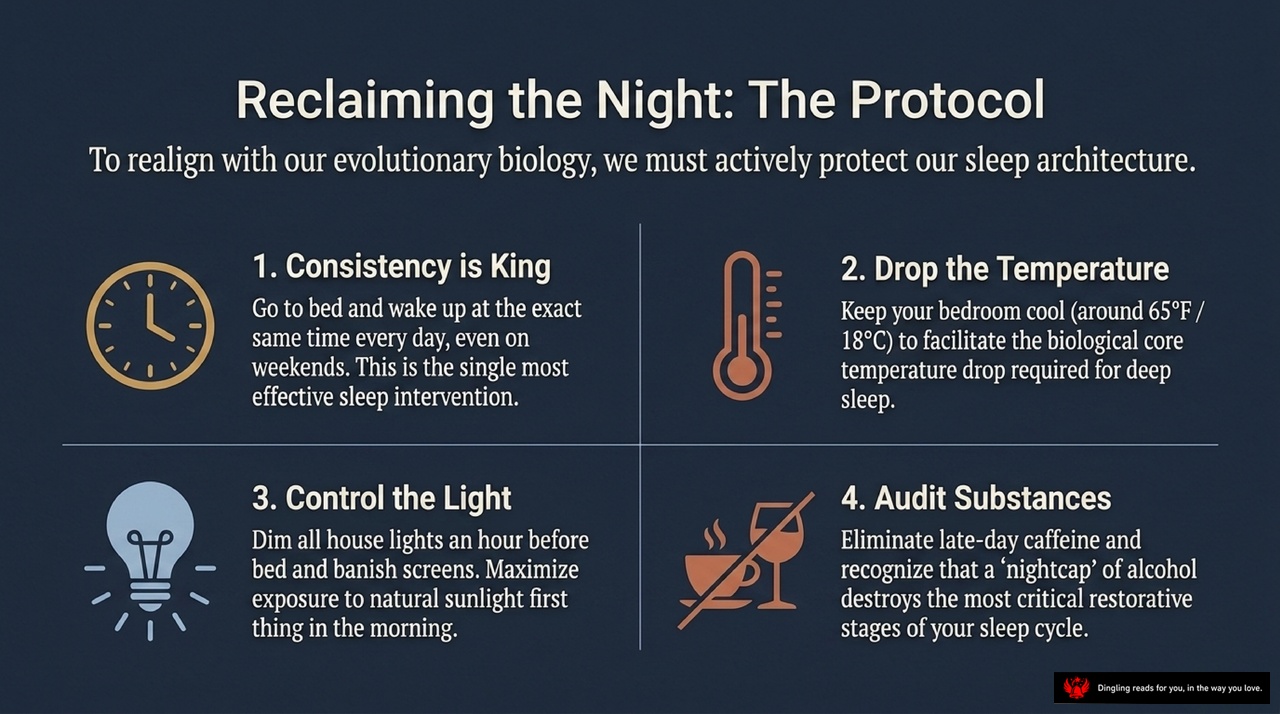
To reclaim the night and realign with our evolutionary biology, we need to actively protect our sleep architecture. Think of this as a four-part protocol for better rest.
First, consistency is king. You must go to bed and wake up at the exact same time every single day, even on weekends. This is the single most effective intervention you can make to stabilize your body's internal clock.
Second, drop the temperature. Keep your bedroom cool, around 65 degrees Fahrenheit or 18 degrees Celsius. A cooler environment facilitates that crucial drop in your biological core temperature, which is required to slip into deep, restorative sleep.
Third, control the light. Dim all house lights an hour before bed and banish screens. Instead, maximize your exposure to natural sunlight first thing in the morning. This resets your circadian rhythm and signals to your brain that the day has truly begun.
Finally, audit substances. Eliminate late-day caffeine and recognize that a 'nightcap' of alcohol destroys the most critical restorative stages of your sleep cycle. By following these four steps, you stop fighting your biology and start working with it.

Sleep isn't just a pause button; it is the most powerful life-support system nature ever designed. The clock on your screen shows DNA strands winding through time, symbolizing that sleep is the foundational pillar of our health, memory, and emotional stability. We are not evolutionarily built to endlessly borrow from a biological bank; instead, we are slowly engineering our own cognitive and physical demise by stripping away rest in the pursuit of productivity.
So, why do we wear exhaustion as a badge of honor? The answer lies in how we operate. When we sleep, our brain doesn't just rest; it actively repairs itself. It clears out toxic waste, strengthens your immune system, and processes the emotions of the day. Without this nightly reset, we face a steep decline in everything from heart health to mental clarity. We are essentially running our bodies on empty, trading long-term vitality for short-term gains. It's time to stop viewing sleep as a luxury and start treating it as the non-negotiable foundation of a healthy, thriving life.