
Winter Pasture: Complete Chapter-by-Chapter Summary

Welcome to the world of *The Winter Pasture*, a profound exploration of survival in the harshest corners of our planet. This isn't just a story about a family moving herds; it is an ethnographic breakdown of life in the -40°C deep desert of Xinjiang, based on the literary journalism of Li Juan.
Imagine a landscape where the air is so cold it can freeze your breath into solid ice before you even exhale. The image we see here—a square hole in the snow with smoke rising from the depths—represents the "winter pasture," a temporary home carved directly into the frozen earth. It is a place of extreme isolation, where survival depends on the simple, yet powerful rhythms of labor and endurance.
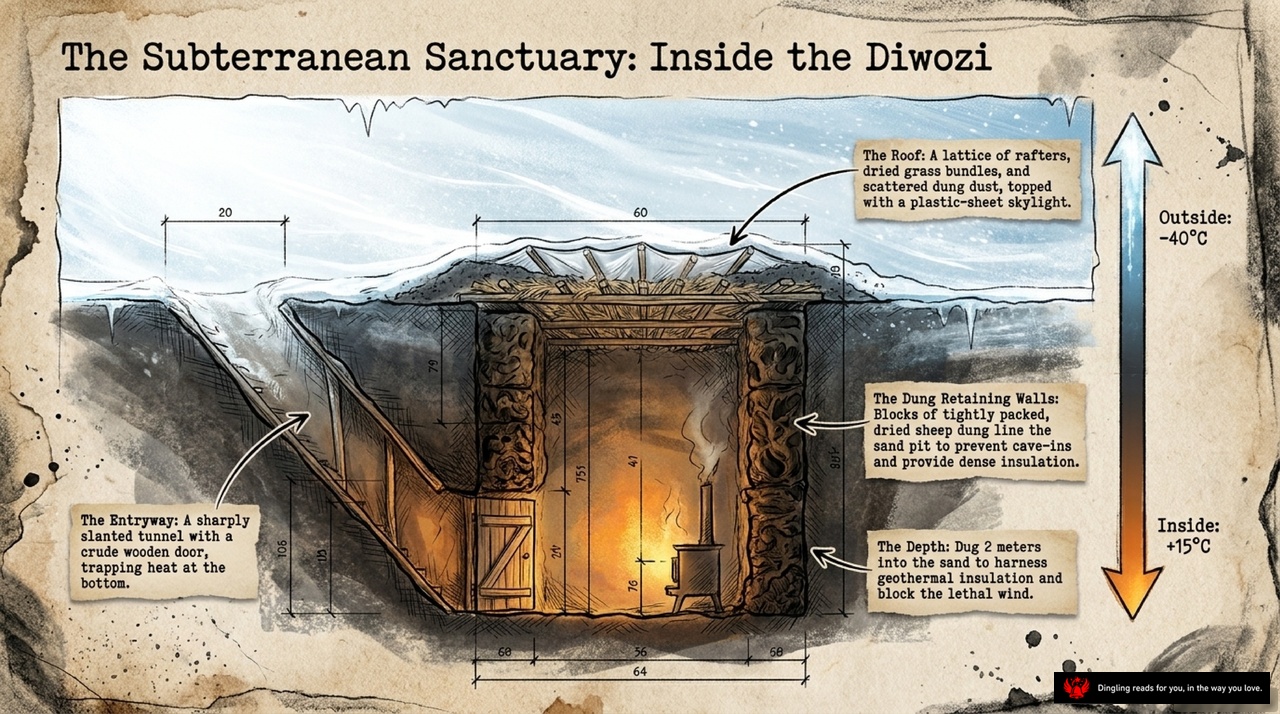
In this book, Li Juan steps out of her comfortable life as a "writer" in the village and follows a nomadic family into this unforgiving wilderness. They leave behind the warmth of their summer pastures to face the brutal winter, seeking shelter in underground pits made of sheep dung, which acts as both insulation and fuel. Here, every action is a battle against the elements: gathering snow for water, protecting pregnant ewes from the freezing wind, and caring for animals that have lost much of their strength.
This is a story about how humans find dignity and connection even when stripped of everything else. It is about the quiet resilience of a mother and daughter, the humor that keeps spirits alive in the face of despair, and the deep bond between people and the land they call home. As we turn the page, we will step into their world, where the silence of the desert speaks louder than any words, and where the cold is not just a temperature, but a test of the human soul.

Imagine a place so empty, it feels like the world has forgotten to exist. This is the winter pasture, a landscape defined by absolute emptiness. Located 200 kilometers south of the Ulungur River, it's a grueling three-to-four-day trek by camel and horseback just to reach it. Here, the density is less than 0.25 people per square kilometer—a true test of isolation.
The topography is harsh and unforgiving: treeless, stoneless, and dirtless. You'll find only sand, sparse withered grass, and patchy snow. The temperature plummets past -42°C in deep winter, cold enough to freeze your breath instantly. There is no shelter to find here; shelter must be built from the animals' own waste. This is the reality of the nomadic life, where survival depends on turning the barren land into a home, brick by brick, using nothing but sheep dung and sheer will.
Welcome to the heart of the winter pasture, where life isn't just about surviving the cold, but about caring for the very animals that keep us alive. In this subterranean sanctuary, the shepherd Juma treats his flock with a tenderness that rivals human family bonds. Every morning, he checks every sheep, scraping away yellow sores from their mouths and treating their colds, knowing that their survival is tied to his own.
But the winter brings its own tragedies. When a weak lamb arrives, Juma builds a special "sick room" for it, feeding it corn through a handmade mask to protect its food from the herd. Even when the lamb recovers, Juma's heart remains with it, secretly giving it extra meals. It's a quiet act of mercy in a harsh world.
And then there are the dogs. The black-and-white shepherd dog, known as the "panda dog," becomes a father in the middle of the freezing season. Despite temperatures dropping to minus 42 degrees, he refuses to leave his six newborn puppies huddled in the snow, his body half-exposed to the wind just to keep them warm. He doesn't eat, he doesn't drink, but he stays, a silent guardian against the howling storm. These moments remind us that in this vast, indifferent wilderness, love is the only thing that truly warms the soul.

Picture: The Ultimate Nomadic Technology: The Dung Economy
The image illustrates a self-sustaining cycle where sheep's waste becomes the foundation for survival in the harsh winter pasture. It shows how sheep forage for sparse grass under the snow, producing dense dung in their pens. Humans then harvest this frozen dung, using it as fuel for cooking and heating, and as insulation to keep livestock warm. The leftover dung is also used to build thick, black blocks for walls and retaining structures.
In our story, this "dung economy" is the lifeline of the winter pasture. The deep layers of frozen dung, hardened like concrete by the cold, serve multiple critical purposes. First, they are burned as fuel in the stove, providing the essential heat needed to survive the extreme cold. Second, soft surface-level dung is used to line the floors of the pens, insulating the animals' bellies from the freezing ground. Third, the dried dung is compressed into blocks to construct the walls of the underground dwellings, known as "diwozi." These thick, black walls act as thermal batteries, retaining warmth throughout the night and protecting the family from the biting wind.
This resource is incredibly valuable. The dung layer thickens by half a foot every month, making it the most precious material in the winter camp. Without this cycle—where sheep produce the fuel and building materials that humans then use to protect the sheep—the entire nomadic life would collapse. It's a perfect example of how the nomads have turned a byproduct into a complete survival system, creating a closed loop where nothing is wasted, and every element supports the next.
Welcome to the daily rhythm of the wilderness. Here, time isn't measured by the clock, but by the endless horizon and the simple act of surviving.
Look at this scene: it's not about luxury, but about the sheer will to keep going. In this vast, frozen landscape, the "idle" moments are actually the most precious. While the men ride out to herd the sheep or the horses, the narrator finds freedom in wandering the dunes. There are no traffic lights, no crowded buses, and no fear of thieves. Just the cold, bright air that feels safer than any city street.
She spends her days collecting colorful stones that look like polished sugar, observing the distinct footprints of cattle and wild mice, and naming the strange grasses she encounters. It's a life of deep observation. Even when she feels lost on an overcast day, climbing a nearby hill gives her the confidence to find her way home.
This isn't just about being bored; it's about finding joy in the infinite space. As she walks back and forth across the endless desert, she realizes that in this vast wilderness, the simple act of moving forward is its own kind of liberation. The silence here isn't empty; it's filled with the quiet dignity of life continuing against all odds.

Look at this illustration titled "Fueling the Human Engine." It depicts a stark, yet strangely intimate winter scene: slabs of dried meat hanging on a rack, bowls of steaming spiced milk tea, and hard, rock-like dried cheese being soaked in hot liquid. This isn't just a meal; it's a calculated survival strategy.
As the text explains, the winter diet is not about culinary pleasure. It is a "calculated caloric defense system against a freezing death." In the harsh winter, survival demands massive fat and protein intake to combat the cold. That's why you see the "Winter Slaughter"—slabs of air-dried, heavily salted horse and sheep meat. These aren't just snacks; they are dense energy blocks required to keep the body warm when temperatures plummet.
Then there are the "Hard Carbs." You see the Baursak, a fried dough, and the rock-hard Kurut, or dried cheese. In the winter, these aren't eaten raw. They are soaked in hot tea for hours until they soften enough to be bitten. This slow process extracts the last bits of nutrition from these tough ingredients.
Finally, we have the "Heat Conduits." These are bowls of boiling milk tea, heavily spiced with black pepper and cloves. The spices don't just add flavor; they force the body to sweat and generate internal heat, acting as a furnace from the inside out.
This entire setup—the meat, the soaked cheese, the spiced tea—is a precise engineering of food designed for one purpose: to fuel the human engine against the crushing weight of a frozen world. It's a reminder that in the wilderness, every bite is a battle for life.
The Human Anchor: Divisions of Labor
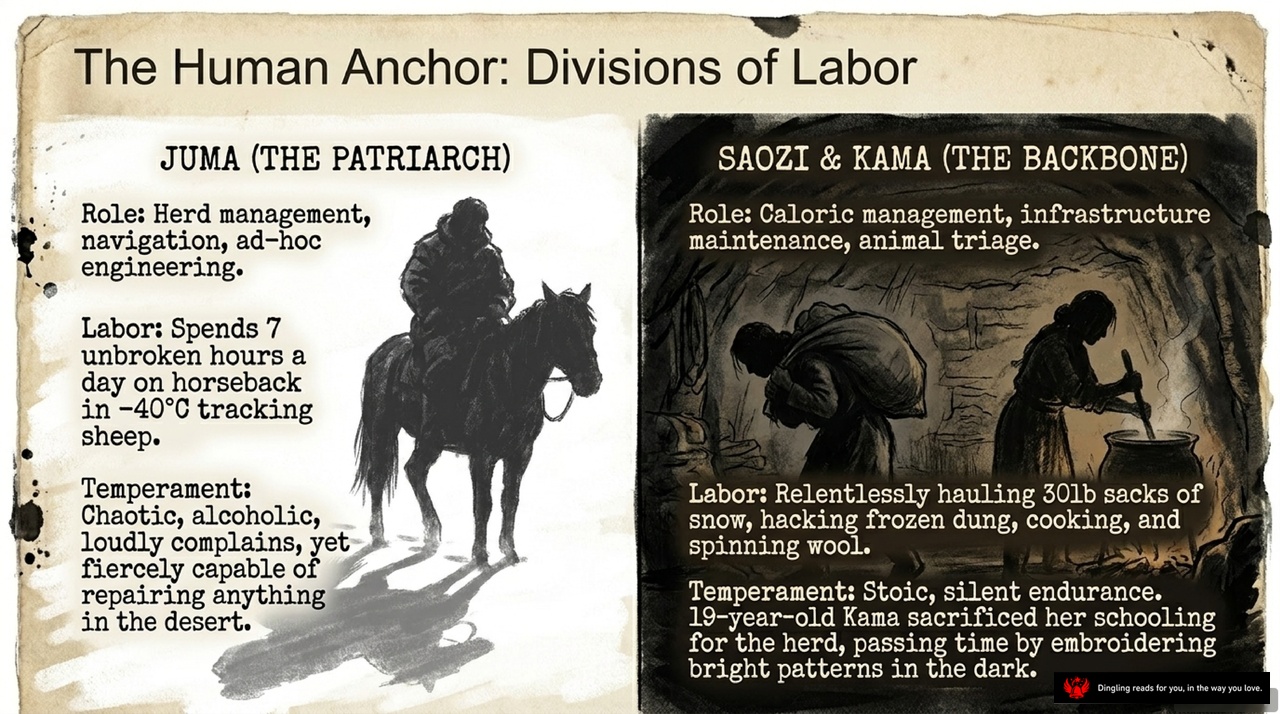
On this slide, we see the two pillars holding up life in the winter pasture. On the left is Juma, the patriarch. His role is high-level management: herding, navigation, and ad-hoc engineering. He spends seven unbroken hours a day on horseback in minus 40-degree Celsius, tracking sheep across the frozen desert. His temperament is chaotic, alcoholic, and loud, yet he possesses a fierce capability to repair anything in the wilderness. He is the chaotic brain of the operation.
On the right are Saozi and Kama, the backbone of the family. Their role is the essential, silent infrastructure: caloric management, maintaining the living space, and animal triage. Kama, a nineteen-year-old girl, is the heart of this labor. She relentlessly hauls thirty-pound sacks of snow, hacks frozen dung for fuel, cooks, and spins wool. Her temperament is defined by stoic, silent endurance. While Juma roams the open sky, Kama works in the dark, even sacrificing her schooling to keep the family warm and fed. She passes time by embroidering bright patterns in the dark, finding dignity in the shadows.
This image captures the true division of labor: one man managing the vast, unpredictable world outside, and the women managing the fragile, life-sustaining world inside. It is a partnership of chaos and calm, of the wild and the domestic, that keeps them alive in the harshest winter on earth.
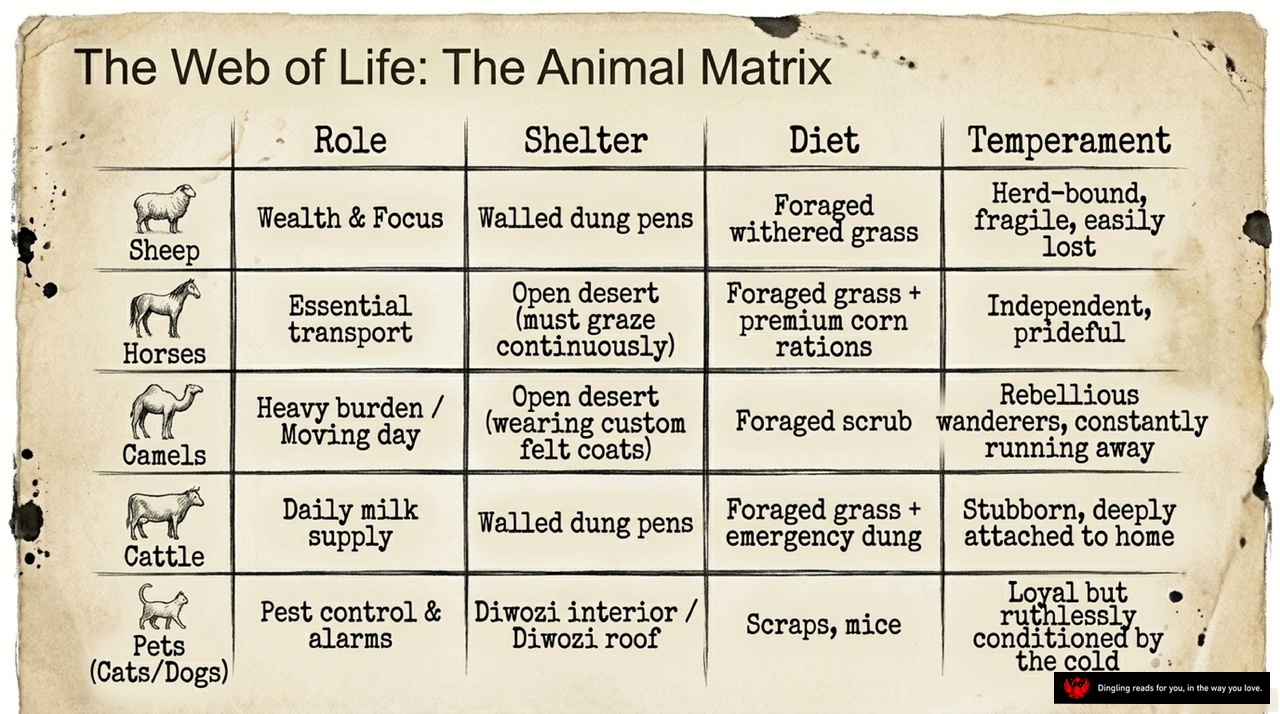
Imagine a living tapestry woven from the very animals that call this vast desert home. This isn't just a list of livestock; it's the "Animal Matrix," the essential web of life that keeps our nomadic family alive. Look at the roles: sheep aren't just sheep; they represent wealth and focus, their fragile, herd-bound nature requiring careful protection in walled dung pens. Horses are our lifelines, the essential transport that demands independence and pride, grazing continuously in the open desert.
Then there are the camels, the rebellious wanderers carrying our heavy burdens and moving us through the day. They wear custom felt coats to survive the cold, yet they are constantly trying to run away, needing a firm but fair hand. Cattle provide our daily milk supply, stubborn and deeply attached to home, often sharing the walled pens with the sheep. And finally, our pets—cats and dogs. They serve as pest control and alarms, living in the Diwozi interior or roof, surviving on scraps and mice, yet remaining loyal, ruthlessly conditioned by the cold. Every animal has a specific shelter, diet, and temperament. From the foraged withered grass for sheep to the premium corn rations for horses, each creature plays a unique part. Together, they form the matrix. Without this web, our life in the wilderness would simply unravel.

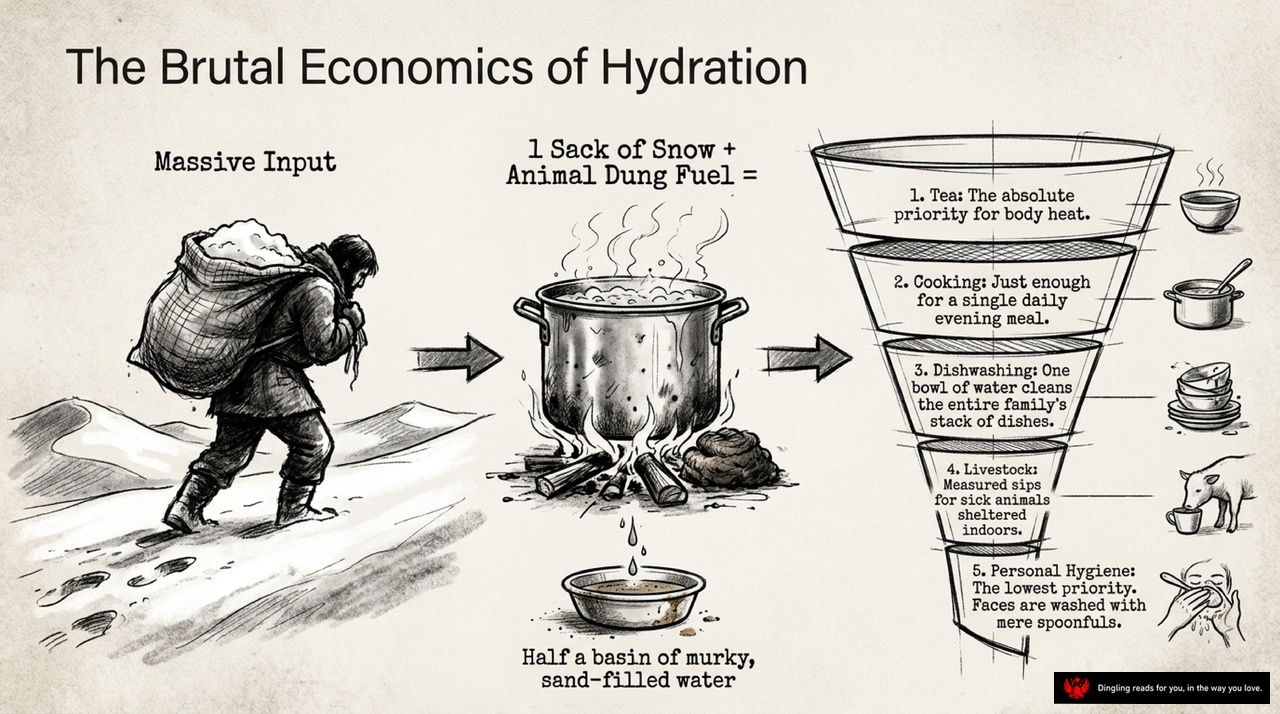
Look at this diagram. It's not just a picture of a winter camp; it's a map of survival, a strict hierarchy of shelter where warmth is the most strictly budgeted currency.
Imagine the outer ring: -40 degrees Celsius. This is the open desert. Here, life is a gamble. You see horses and camels constantly moving, trying to generate their own heat, while dogs and camels wear patched blankets just to survive the freezing wind.
Move inward to the middle ring, the windbreak or "the pen." This is the buffer zone. Healthy sheep are tightly packed together here, huddling for shared body heat, while milk cows stay close. It's a community effort to hold back the cold.
But then, we reach the innermost circle, the core. This is the "Diwozi," the underground shelter, where the temperature is a life-saving +15 degrees Celsius. This is the "sick ward." Here, you find the most vital and the most fragile: humans, newborn calves, the Plum Blossom Cat, and sick sheep that are forced indoors.
This visual tells a harsh truth about life in the deep winter. Only the most vital, or the most fragile, are permitted inside. Warmth is a currency that cannot be spent lightly. Everyone else stays on the edge, fighting the cold every single day.
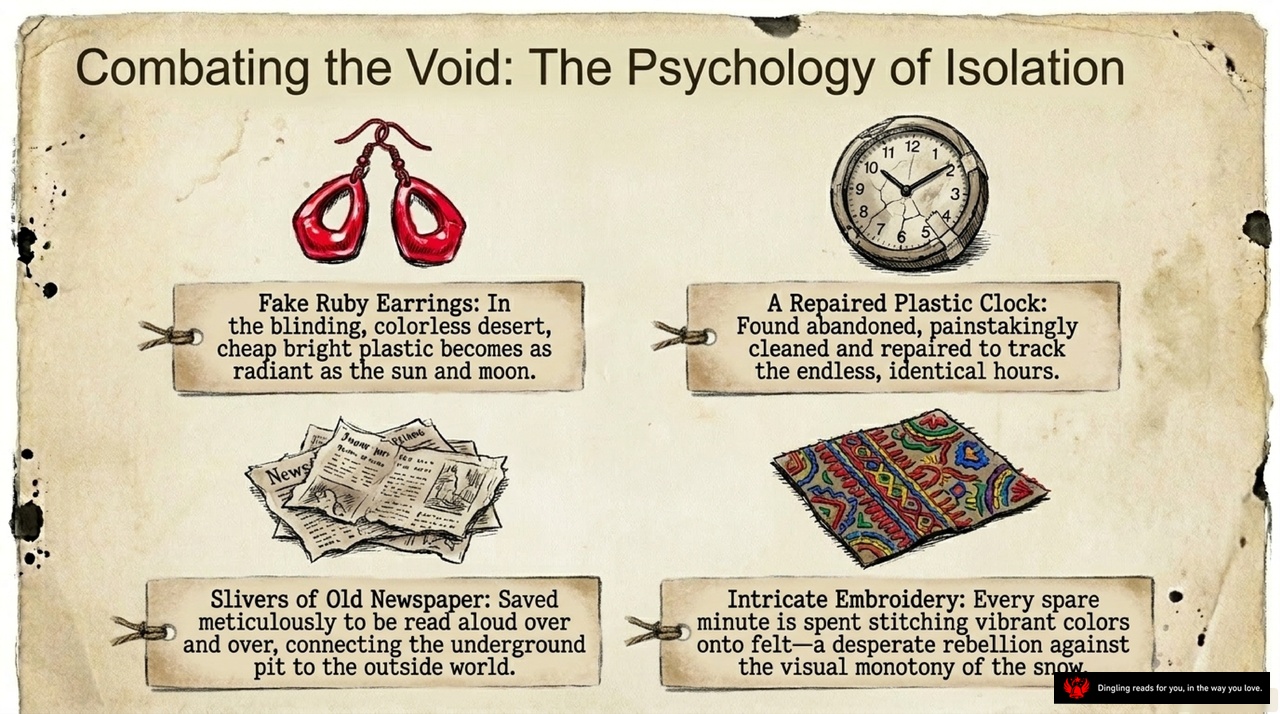
In this desolate winter camp, the only things that truly matter are the animals and the quiet endurance of life. You see, the sheep are the heart of this nomadic existence, yet they often act like silent background characters, patiently enduring the cold and following the herd without question. The goats, however, are different; they are the brave pioneers, always leading the way at the front of the flock.
But it isn't just the sheep that keep us company. There are the cats and dogs—our constant, furry companions who fill the gaps in our lonely days. The black-and-white dog, for instance, is a glutton when it comes to offal, but a loyal protector of the puppies born in the snow. And then there's the "Plum Blossom" cat, a mischievous little creature that gets painted red by mistake, only to survive with a mix of indignation and resilience.
Life here is a rhythm of survival and simple joys. We watch the herds move like dark waves across the sand, waiting for them to return as if they were a silent promise. We share tea, we laugh at jokes, and we find comfort in the company of strangers who pass through, turning our quiet camp into a temporary, warm community. It's a life where every breath is precious, and every moment with these animals feels like a victory against the vast, indifferent wilderness.

Welcome to the final chapter of our journey into the heart of the steppe. Today, we look back at the end of winter—the moment the silence breaks, and life rushes back toward the human world.
As the days grew longer and the biting cold finally receded, the family prepared to leave their underground shelter, the "di-wo-zi." It was time to say goodbye to the isolation of the deep winter and return to the bustling life of the summer pastures. This departure wasn't just a change of location; it was a celebration of survival. The neighbors, who had shared their food, tools, and stories during the darkest days, came out to see them off. The small settlement, once a quiet bubble of survival, became a hub of activity as families gathered to share dried meat, hand-grabbed rice, and potatoes. It was a feast that tasted of gratitude and relief.
But the most poignant moment came when the children had to leave. Zada and Rehaimaidihan, who had grown so accustomed to the rhythm of the winter camp, were bound for school. They had to pack their belongings, leaving behind the warmth of the fire and the companionship of their new friends. As the car arrived, a Beijing Jeep ready to carry them north, there was a mix of sadness and hope in the air. They promised to wait for the drivers, honoring the unspoken rules of the wilderness, but their hearts were already turning toward the future they had dreamed of for so long.
The journey back was a blur of snow and sand, a stark contrast to the stillness of the winter camp. As the vehicle rolled over the asphalt, passing villages and fields, the family realized that the harsh winter was truly over. The cold, the loneliness, and the struggle had all been left behind. Yet, the memories of those months—the laughter around the fire, the shared meals, and the deep bond with the land—would never fade. They had survived the inevitable enclosure, and now, they were ready to embrace the open sky once again.
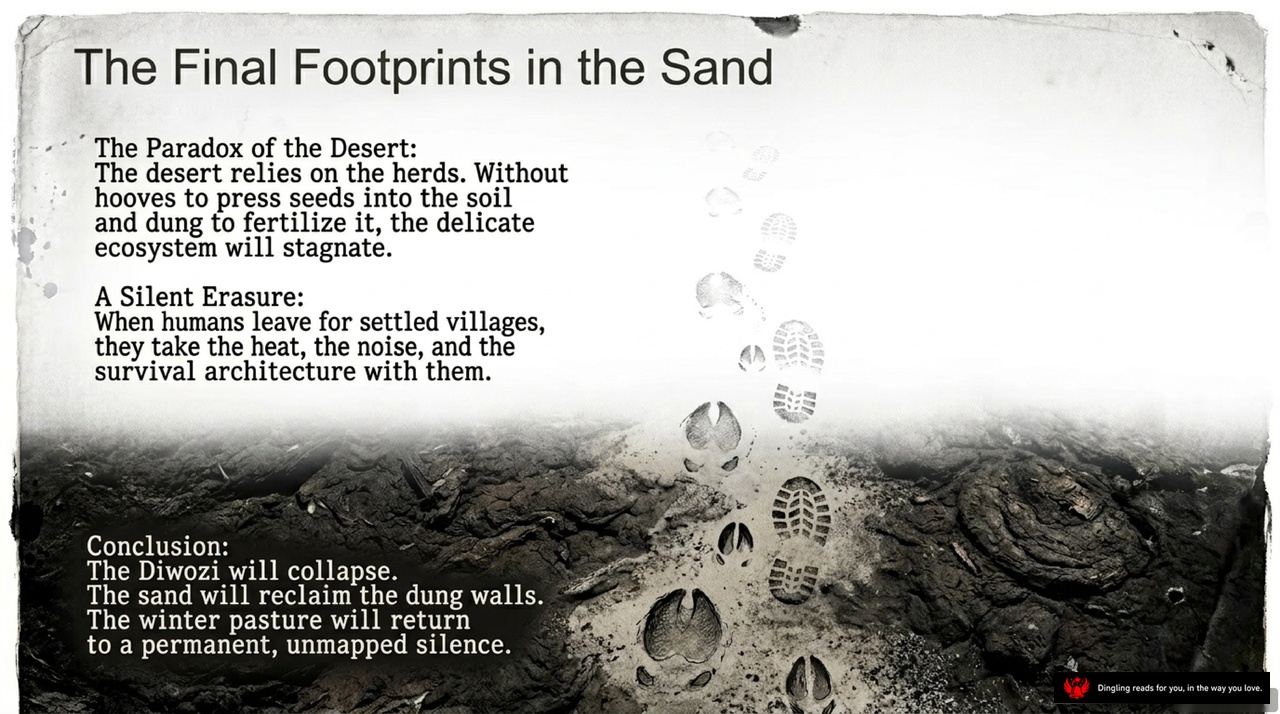
The final footprints in the sand. This isn't just a poetic title; it's the harsh reality of the Diwozi, the winter pasture, as it faces its inevitable end.
Look at the image. We see two distinct sets of tracks merging and then fading. First, there are the hoof prints—deep, deliberate, and essential. The desert relies on these herds. Without hooves to press seeds into the soil and dung to fertilize it, this delicate ecosystem would simply stagnate. The dung walls we built, the fuel we burned, the very foundation of our survival, depends entirely on the presence of these animals.
But then, look at the second set of prints. These are human footprints. They represent a silent erasure. When humans leave for settled villages, they take the heat, the noise, and the entire survival architecture with them. They leave behind the warmth that kept the ecosystem alive.
The conclusion is unavoidable. The Diwozi will collapse. The sand will reclaim the dung walls we so carefully built. The winter pasture will return to a permanent, unmapped silence. It's a paradox: the desert needs us to survive, yet our departure is what kills it. These footprints in the sand are the final testament to a way of life that is quietly vanishing, leaving nothing but empty tracks in the wind.