



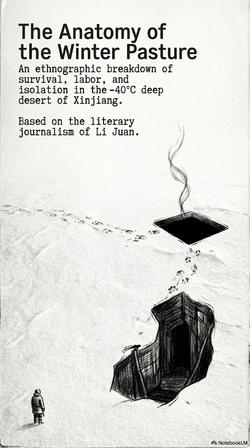
Li Juan honestly describes the brutal cold and scarcity without romanticizing it, making the struggle of nomadic life feel terrifyingly real.
Your Review
Li Juan honestly describes the brutal cold and scarcity without romanticizing it, making the struggle of nomadic life feel terrifyingly real.

Li Juan's immersion with the Kazakh family reveals the brutal reality of nomadic life, where survival depends on turning every resource, even waste like sheep dung, into a tool for warmth and cooking, while the constant threat of losing half their flock to a sudden snowstorm creates a tension that modern city dwellers rarely understand, forcing us to confront our own disconnect from the land and each other as we witness how government fencing and youth migration are slowly eroding centuries of tradition without offering a clear alternative for these resilient people who simply want to keep their families fed and safe.
The description of collecting snow for water and melting it in a pot really showed me how hard the nomads actually work to survive every single day.

Reading about the family's struggle with grazing fences and the daughter leaving made me feel the deep pressure on their traditions.

Li Juan's account of the family's struggle against fencing and climate change shows how modernity quietly erodes nomadic traditions. The story isn't just about survival; it highlights the loss of community bonds when young people leave for cities. Watching Jiamu dream of escaping the pasture while herding sheep creates a heartbreaking conflict. The book reveals that traditions are not just memories but vital tools for resilience. Even as policies restrict land and consumerism pulls them away, the herders maintain mutual aid by sharing meat and fuel. This balance between preserving culture and adapting to harsh realities is the core lesson. We lose our own connection to the land when we forget these simple, shared practices.

Reading this felt like trading my phone for a frozen camel, a stark and urgent shift from my hollow city life.

The story of the red-painted cat and the shared meals shows how community and humor keep these people alive despite the brutal cold.

The detailed description of the family's struggle to collect snow and melt it for drinking water really showed me how hard survival is in that frozen landscape.

I was moved by how the author shows that even in extreme poverty, the family finds joy and meaning through their deep bonds and daily rituals.
The description of collecting snow for water and melting it in a rusted pot to make tea truly captured my sense of the harsh reality.
This book makes me realize how disconnected we are from the land and each other.

The description of collecting snow for water hits hard.

The story of the Kazakh herders shows how tradition and community help people survive harsh winters and find purpose even when modern forces push them away. Li Juan captures the bone-deep cold and the joy of shared tea without romanticizing their struggle. Reading about Jiamu leaving for the city made me think about how fast we lose local skills and bonds. The book doesn't just describe a dying way of life; it asks us to consider what we are losing in our own busy, disconnected cities. When the herders share meat and help neighbors dig out snow-blocked pens, it feels like a lesson in mutual aid that we desperately need. Li Juan's perspective as an outsider who became part of the family gives us a unique view of both the beauty and the pain of this transition. The details about using sheep dung for fuel and collecting snow for water highlight how they live in harmony with nature, something we have largely forgotten. This book is not just a travelogue; it is a mirror reflecting our own anxiety and search for meaning in a chaotic world.

The family's struggle with government fences blocking their traditional routes made me realize how quickly modern policies can destroy a way of life.

The description of collecting snow and melting it for tea made me realize how much effort we take for granted in our daily lives.

The detailed description of the family's harsh winter survival feels exhausting, yet I struggled to put it down despite the heavy sadness of their fading culture.

The analysis of government fencing policies explains why the herders can no longer move freely, making their struggle feel political and real.

Li Juan does not romanticize the nomadic life but honestly describes the bone-deep cold and scarcity of clean water while also capturing the resilience and joy the family finds in singing together around the fire, the quiet bond between herder and sheep, and the pride in a job well done, making the struggle feel real rather than distant or exotic for anyone living in our hyper-connected modern age where we are increasingly disconnected from the land and the work that sustains us, forcing us to ask what we lose when we abandon lives rooted in nature and mutual dependence as the nomads fight to hold onto a way of life that gives them identity and purpose.

The description of collecting snow and melting it for tea highlighted how every single drop mattered for survival in the freezing cold, showing that even in such harsh conditions, the family found a deep sense of purpose and unity by turning a daily chore into a vital ritual that kept them alive together against the overwhelming wind and silence of the vast steppe.

This book is a mirror reflecting our own loss of connection to land and community in the modern world.