
Wisdom External Brain: Complete Chapter-by-Chapter Summary
Welcome to the first session of our book sharing series. Today, we're diving into a book that promises to solve the chaos of our modern information overload. The title is "The Smart External Brain" by Shiruo.
As you see on the slide, the core mission is clear: to transform chaotic information into an interconnected architecture of wisdom using the Knowledge Grid Management Model. Think of your brain not just as a storage drive, but as a dynamic processor that needs a smart external system to function at its peak.
In our fast-paced world, we often collect endless data, articles, and ideas, only to find ourselves unable to recall or apply them when it matters most. This book offers the blueprint to break free from that trap. It guides you on how to build a personal knowledge network that doesn't just store facts, but actively generates new insights and solutions. Whether you are a student, a professional, or a lifelong learner, mastering this model will help you turn scattered fragments of information into a powerful, cohesive engine for your growth and success.
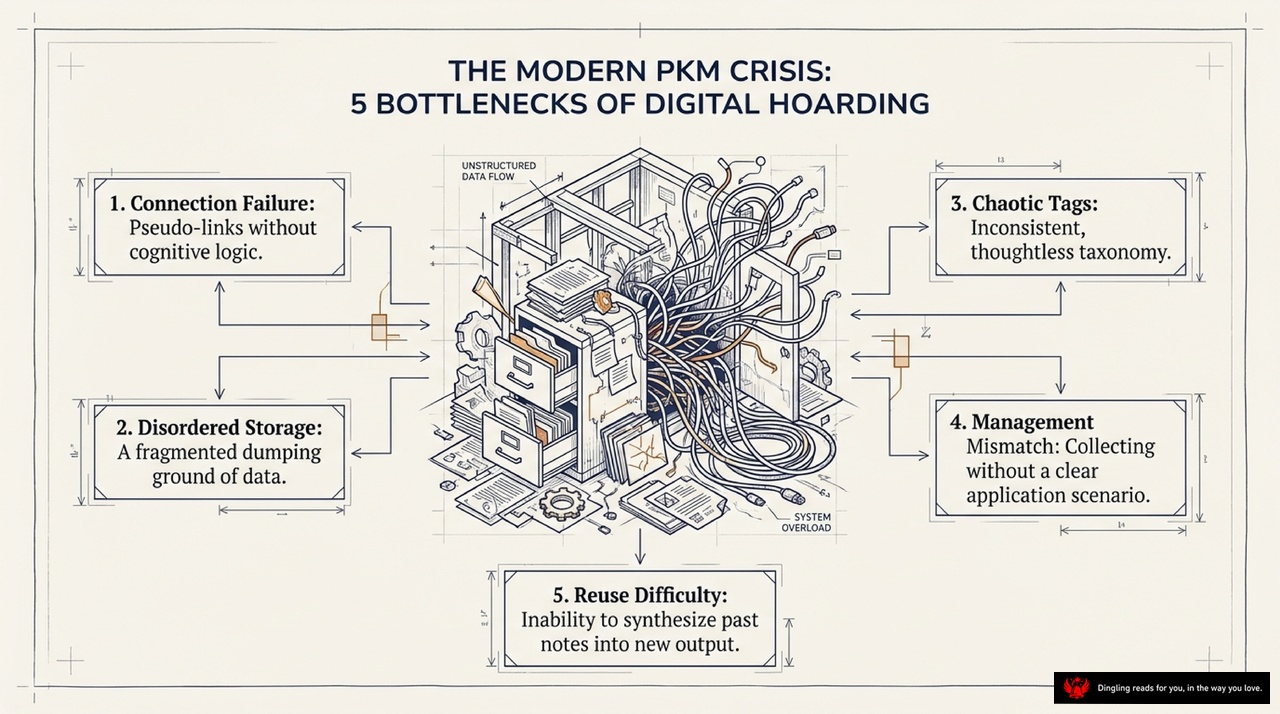
The modern PKM crisis isn't about running out of storage space; it's about the five bottlenecks of digital hoarding that turn your knowledge base into a chaotic mess. Imagine a server room where cables are tangled into a knot, drawers are overflowing with random files, and nothing makes sense. That's exactly what happens when we collect data without a system.
First, we face Connection Failure. Software lets us create links instantly, but often these are just pseudo-links—fake connections that don't follow any real cognitive logic. They look like a network, but they're useless when you need to think.
Second, Disordered Storage. We dump text, images, and videos everywhere like a cluttered attic. When you need something, you can't find it. You're stuck in that painful "delete or keep" loop, terrified of losing something useful.
Third, Chaotic Tags. We use tags carelessly, creating an inconsistent taxonomy that makes searching harder than the original problem.
Fourth, Management Mismatch. We collect thousands of notes but never know *when* or *where* to use them. We have the data, but no clear application scenario, leaving us staring at a blank screen when inspiration is needed.
Finally, Reuse Difficulty. Because our knowledge is scattered and disconnected, we can't synthesize past notes into new output. We waste brilliant ideas because we can't connect them to solve today's problems.
The solution? Stop hoarding and start managing. You need a model that handles connections, storage, and reuse all at once. This is where the Knowledge Grid Management Model comes in. It treats your knowledge not as a static warehouse, but as a dynamic, interconnected grid where every piece of information has a specific place and purpose.
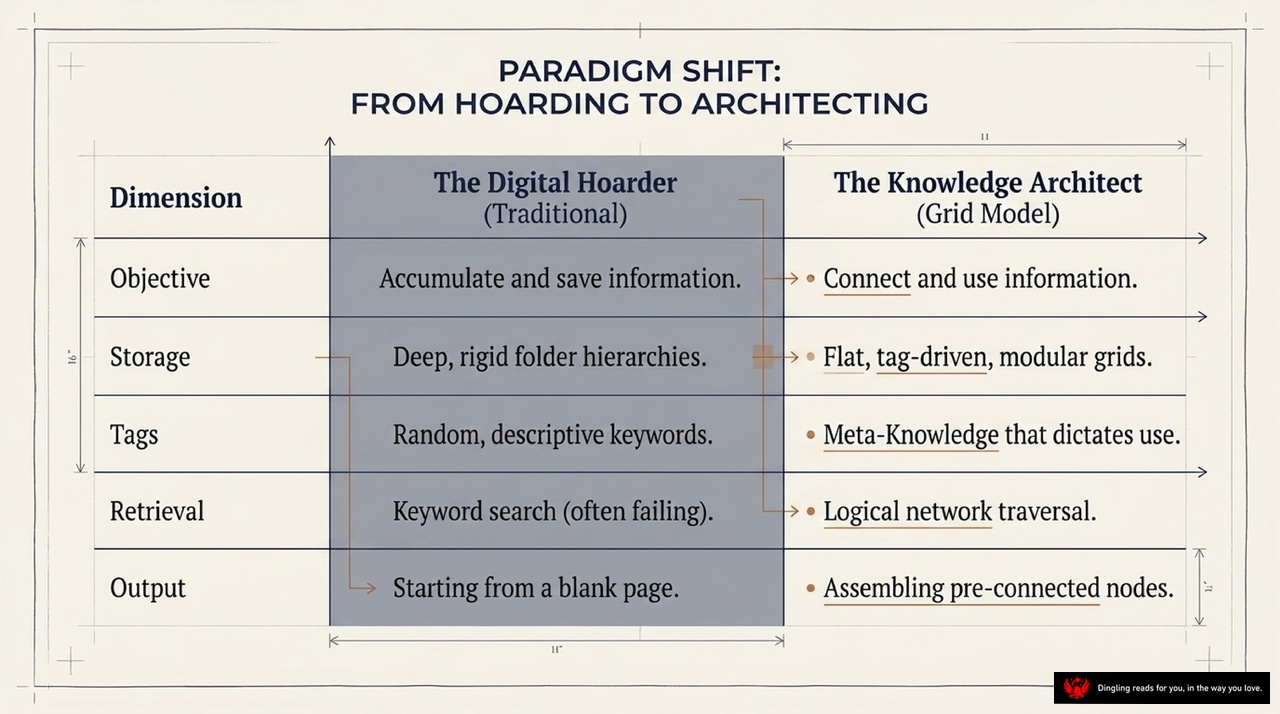
Imagine your brain as a vast, chaotic warehouse where clothes are piled haphazardly—no matter how many you own, you can't find what you need. This is the trap of traditional knowledge management: hoarding information without architecture. But what if you shifted from being a "Digital Hoarder" to a "Knowledge Architect"?
Today's slide maps out this critical paradigm shift across five key dimensions. First, look at the **Objective**. Instead of merely accumulating and saving information, the goal becomes connecting and using it. Second, consider **Storage**. Move away from deep, rigid folder hierarchies that trap your data, and embrace flat, tag-driven modular grids that make retrieval intuitive.
Third, rethink your **Tags**. Stop using random, descriptive keywords that often fail you. Instead, adopt "Meta-Knowledge"—a layer of management knowledge that dictates exactly how your information should be used. Fourth, upgrade your **Retrieval** method. Ditch keyword search, which often leads to dead ends, and rely on logical network traversal to find insights instantly. Finally, transform your **Output**. Rather than staring at a blank page, start assembling pre-connected nodes.
This shift isn't just about better tools; it's about building a system where every piece of knowledge is designed for action, turning your scattered thoughts into a powerful, interconnected engine for growth.
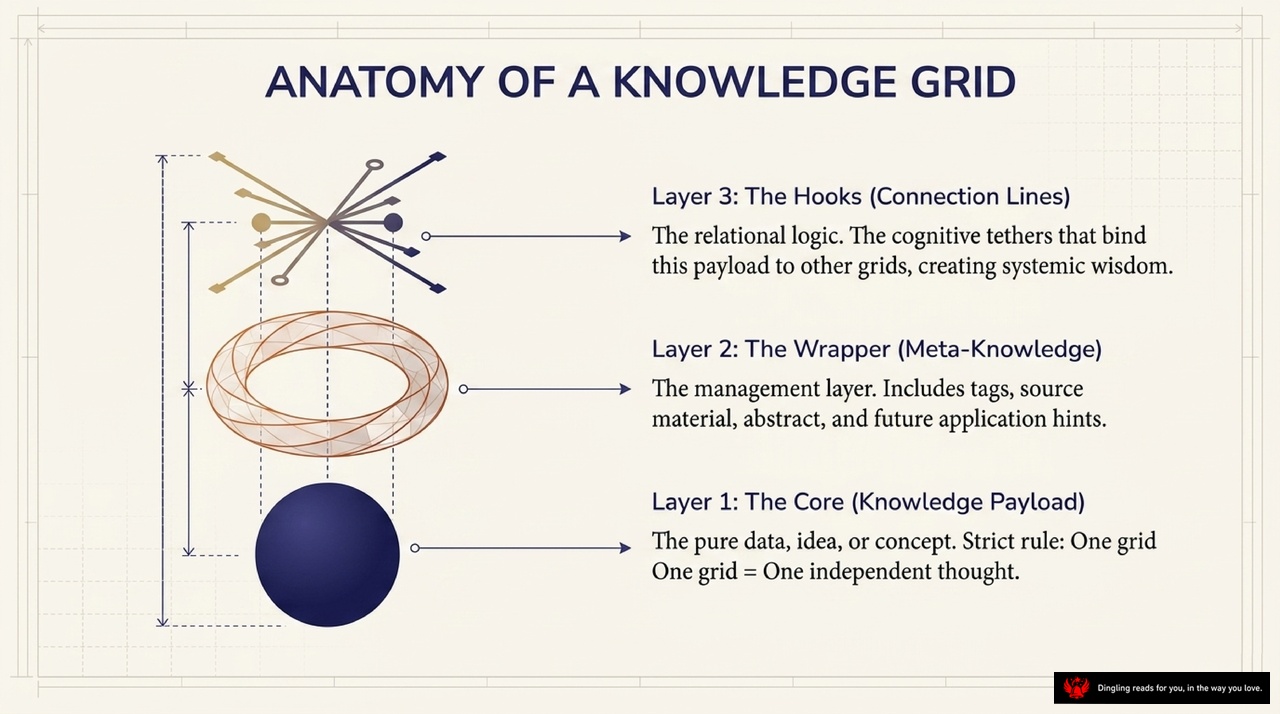
Think of your personal knowledge not as a chaotic closet stuffed with clothes you can't find, but as a smart, organized warehouse where every item has a specific place and a clear label. This slide breaks down the anatomy of that "Knowledge Grid," showing exactly how we build a system that actually works for you.
At the very bottom is Layer 1, The Core. Think of this as the pure payload—the single, independent thought, idea, or piece of data. It's the brick in our building. The golden rule here is simple: one grid equals one independent thought. By keeping each concept separate, we make it incredibly easy to find and use later.
Wrapped around that core is Layer 2, The Wrapper. This is your meta-knowledge, the management layer. It includes tags, sources, and hints about how to apply this idea. It's like the label on the storage box; without it, even the best item is useless. This layer connects the raw data to your broader goals.
Finally, at the top, we have Layer 3, The Hooks. These are the connection lines—the relational logic that binds your ideas together. Just like cells in a body need to connect to function, your isolated thoughts need these cognitive tethers to create systemic wisdom. Without these hooks, you just have a pile of facts; with them, you have a living, breathing knowledge network that can solve complex problems.

Welcome back. Today, we're diving into the practical architecture of wisdom. Look at this diagram: "The Architecture of Wisdom: Scaling Up." It maps out exactly how we move from isolated ideas to a powerful, interconnected mind.
At the very center is **The Grid**, or the Atomic level. This is your base unit—a single, independent concept with its metadata. Think of it as the individual brick in your intellectual wall.
Moving outward, we connect these grids into **The System**, which is Vertical. This happens when you link grids together under a unified theme, like notes from a specific book or a single skill. It's your specialized domain.
Beyond that lies **The Subnet**, or the Block. Here, multiple systems weave together. Imagine cross-disciplinary knowledge required for a specific job role. This is where you become a T-shaped or Pi-shaped talent, combining your core expertise with adjacent skills.
Finally, at the outermost layer, is **The Network**, which is Holistic. This is your ultimate external brain—a macroscopic web connecting all your subnets. It enables true polymathic thinking, allowing you to solve complex problems by drawing from diverse fields.
The key takeaway? Wisdom isn't just about collecting information. It's about scaling up. By structuring your knowledge from atomic grids into a holistic network, you transform scattered data into a dynamic, living system that fuels your growth and innovation.

Imagine your knowledge not as a chaotic closet of clothes, but as a perfectly organized system where every item has its place. Today, we're looking at the blueprint for that system: the four-layer architecture of Knowledge Grid Management. Think of it as building a city, brick by brick.
At the very foundation, we have **The Grid**. This is your smallest unit—a single, independent knowledge point, like a single brick in a wall. It's the basic building block where you store one clear idea.
Next, we connect these bricks to form **The System**. When you group several grids around a specific theme—like "Writing Methodologies" or "Marketing Strategies"—you create a dedicated module. This is your specialized building, focused on one distinct area of expertise.
Then, we expand outward to **The Subnet**. This is where different systems collaborate. Imagine a complete residential community where the library, school, and park all work together. In our knowledge world, a subnet connects related systems to handle complex, multi-faceted topics, giving you a broader functional area.
Finally, at the top, we have **The Network**. This is your entire knowledge ecosystem. By interconnecting multiple subnets, you create a web that covers everything you care about. Just like a city's utility grid, this network allows you to draw resources from any corner instantly.
The magic happens in the connection. By moving from individual grids to a full network, you transform isolated facts into a powerful, living intelligence that can solve any problem you face.

In the world of knowledge management, we often get lost in the details of tools, forgetting the bigger picture. Today, let's zoom out and look at the architecture that makes it all work. Think of your personal knowledge network not as a messy closet, but as a well-organized city.
At the very foundation, you have the **Knowledge Grid**. Imagine these as individual bricks or storage boxes. Each grid holds a single, independent piece of information—a specific fact, a quote, or an idea. It's the smallest unit where your thinking lives.
When you gather many of these grids that share a common theme, they form a **Knowledge System**. This is like a dedicated building or a specific department within your city, focused on one domain, such as marketing or history.
Now, take several of these systems and connect them based on logical relationships. You create a **Knowledge Subnet**. Think of this as a functional district or a neighborhood where different buildings collaborate to solve complex problems. It's where your diverse skills start to talk to each other.
Finally, when you link multiple subnets together, you build the **Knowledge Network**. This is the entire city itself—a vast, interconnected ecosystem. Just like a city allows you to travel from any point to any other, a knowledge network lets you jump from a concept in marketing to a principle in psychology instantly.
The magic happens because every level connects to the one above it. The grids build the systems, the systems form the subnets, and the subnets create the network. By mastering this four-layer structure, you move from simply collecting information to building a living, breathing intelligence that adapts and grows with you.

Welcome to the final chapter where we move from theory to action. If you've been following along, you now understand the WRITE Thinking Framework—a gear-like system where every part drives the next. But knowing the model is only half the battle; the real work begins when you pick up your digital tools.
Today, we're diving into the practical tools that bring your knowledge network to life. Think of these not just as software, but as the physical gears of your brain.
First, let's look at Obsidian. This tool is built on a powerful concept: linking. It allows you to create bidirectional links between your notes, meaning one idea can instantly pull up another. Its best feature? Local storage. Your data lives on your hard drive, not in a cloud server, giving you total control and peace of mind. Whether you're writing a book or organizing research, Obsidian's ability to split windows and link content blocks makes it a powerhouse for deep thinkers.
Next, consider Flomo. If Obsidian is a library, Flomo is your pocket notebook. It's lightweight, focusing purely on capturing fleeting thoughts without the pressure of formatting. It uses a unique tagging system—Inbox, Area, Project, Resource—to help you organize chaos. The secret here is consistency. By recording just a few words a day, you build a massive reservoir of insights that can later be connected into full ideas.
For those who love structure,思源笔记 offers a flexible block-based system. It mirrors the grid management model perfectly, letting you organize notes into content blocks that can be linked and visualized. It's ideal for researchers who need to see the relationships between their data points clearly.
Finally, we have Anki. This isn't for organizing notes, but for locking knowledge into your long-term memory. Using spaced repetition, Anki shows you cards right before you're about to forget them. It's the ultimate tool for mastering facts, languages, or complex concepts, ensuring that what you learn today stays with you tomorrow.
The beauty of this toolkit is that you don't need all of them. Choose the one that matches your workflow. Whether you prioritize deep linking, quick capture, visual structure, or memory retention, there is a tool here to support your growth. Now, it's time to stop just collecting information and start building a system that works for you.
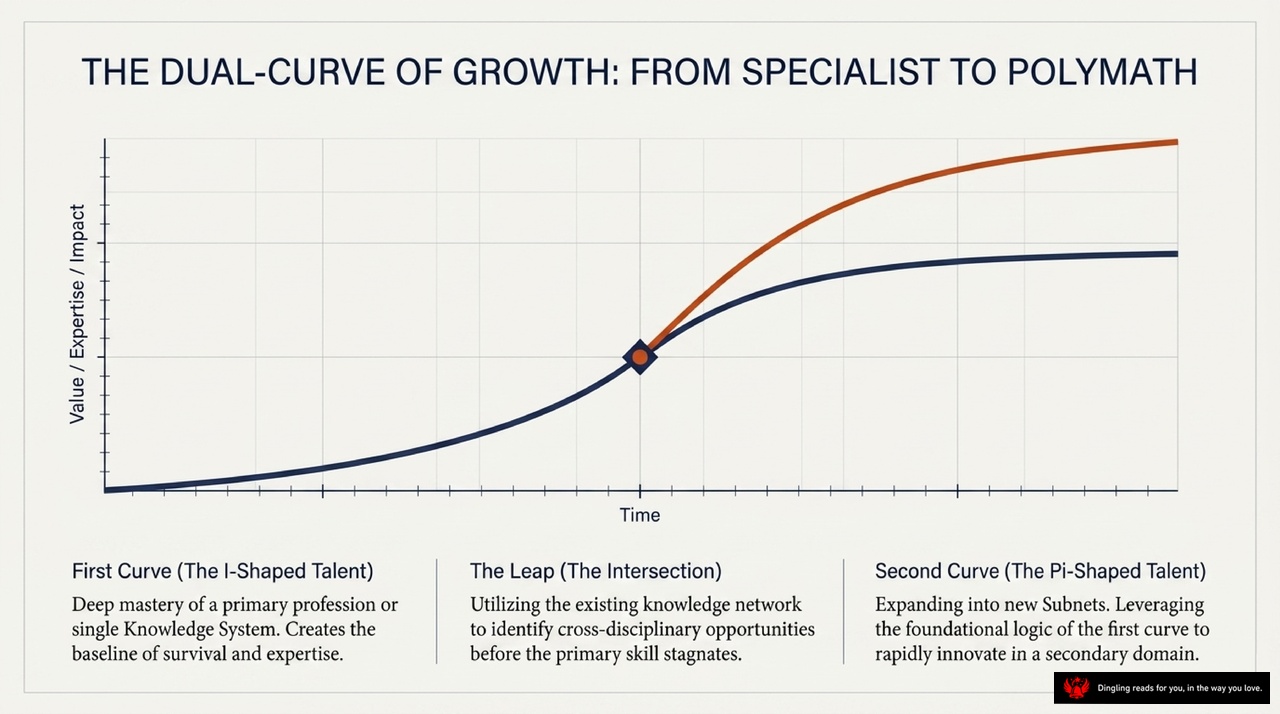
Today's slide visualizes the ultimate goal of our knowledge journey: transforming from a narrow specialist into a versatile polymath through what we call the "Dual-Curve of Growth." Look at the two lines here. The dark blue curve represents your "First Curve," or the I-Shaped talent. This is your deep mastery of one primary profession. It's the baseline that ensures your survival and gives you initial expertise. However, notice how this curve eventually flattens. If you stay here too long, your growth stagnates.
But watch the orange line—the Second Curve, or the Pi-Shaped talent. This represents expanding into new subnets. It starts with a "Leap," right at that intersection point where your existing knowledge meets a new domain. This is where you leverage the logic of your first curve to innovate rapidly in a secondary field.
Think about it this way: an I-shaped person is like a deep well, valuable but limited. A Pi-shaped person is like a bridge, connecting two shores. By utilizing your foundational logic to pivot into a new area—whether it's a new skill, a different industry, or a fresh perspective—you unlock exponential growth. The key isn't just accumulating more facts in your first lane; it's about using that expertise as a springboard to build your second curve before the first one even hits its ceiling. This shift from single-domain mastery to multi-domain innovation is exactly what defines true professional longevity and leadership in today's complex world.
Imagine your knowledge not as a chaotic pile of clothes, but as a fully organized wardrobe where every item has its perfect place. That's exactly what the "Knowledge Grid Management" model does—it turns scattered information into a structured, wearable asset.
Think of it in four layers. At the base, you have the **Knowledge Grid**, the single brick holding one specific point of knowledge. Stack these bricks together, and you build a **Knowledge System**, a dedicated room for a specific skill or topic. Connect several systems logically, and you create a **Knowledge Subnet**, like a functional neighborhood. Finally, link all your subnets together to form a **Knowledge Network**, a complete ecosystem that covers your entire life and career.
This structure isn't just about storage; it's about flow. By organizing your knowledge from the smallest grid to the vast network, you ensure that when you face a challenge, you don't just have random facts—you have a ready-made solution. You can instantly pull the right system, the right subnet, and the right grid to solve the problem at hand. It transforms you from someone who hoards information into someone who wields wisdom.
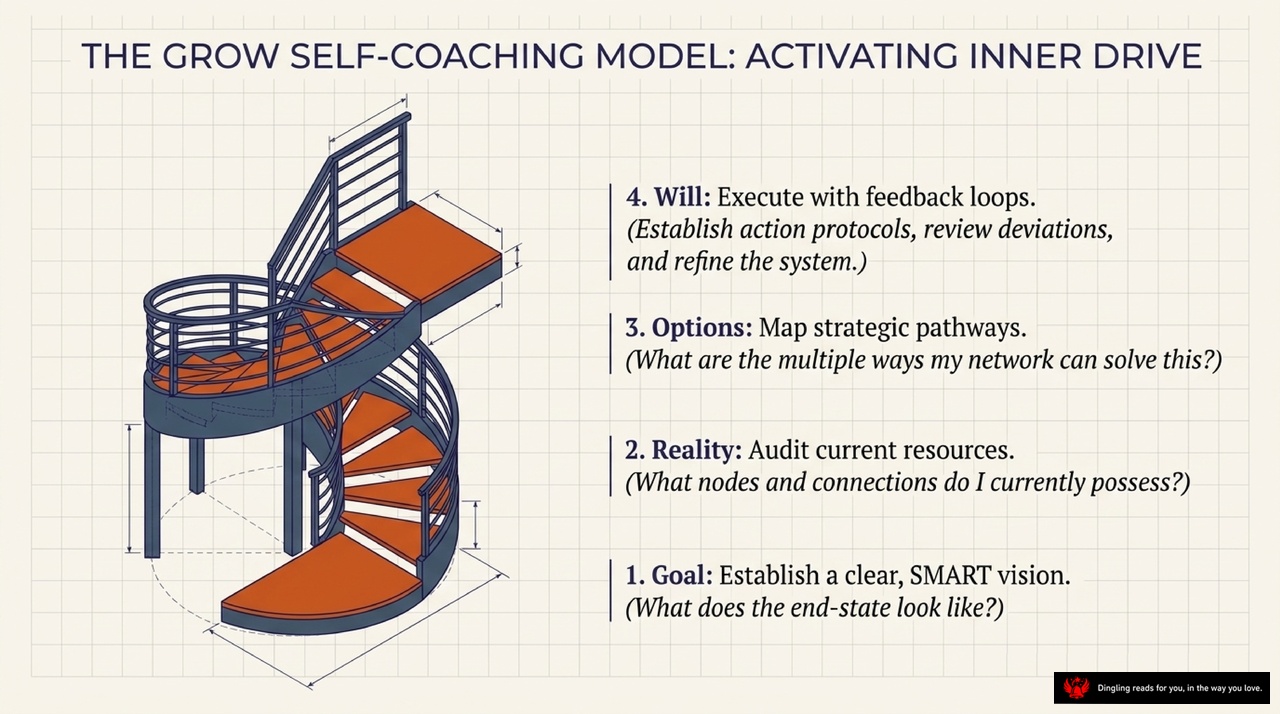
Imagine your mind as a vast, interconnected library where every idea is not just stored, but actively linked to spark new insights. Today, we're diving into the "GROW Self-Coaching Model," a powerful framework designed to activate your inner drive and turn scattered thoughts into actionable strategies.
Visualize the spiral staircase on the left as your personal growth journey. It starts at the bottom with **Goal**: establishing a clear, SMART vision. Ask yourself, "What does the end-state look like?" Without a defined destination, your efforts lack direction.
As you ascend, the next step is **Reality**. Here, you audit your current resources. Consider the question: "What nodes and connections do I currently possess?" You need to honestly assess your existing skills, tools, and network before planning your next move.
Once you understand your reality, move to **Options**. This is where you map strategic pathways. Challenge yourself: "What are the multiple ways my network can solve this?" Don't settle for a single solution; explore diverse paths to find the most effective route forward.
Finally, reach the top with **Will**. This is about execution with feedback loops. Establish action protocols, review deviations, and refine your system continuously. Remember, success isn't a one-time event; it's a cycle of doing, checking, and improving.
By integrating these four elements—Goal, Reality, Options, and Will—you create a dynamic system that keeps you aligned with your vision while adapting to the realities of today. This model transforms passive thinking into active leadership, empowering you to navigate challenges with confidence and clarity.
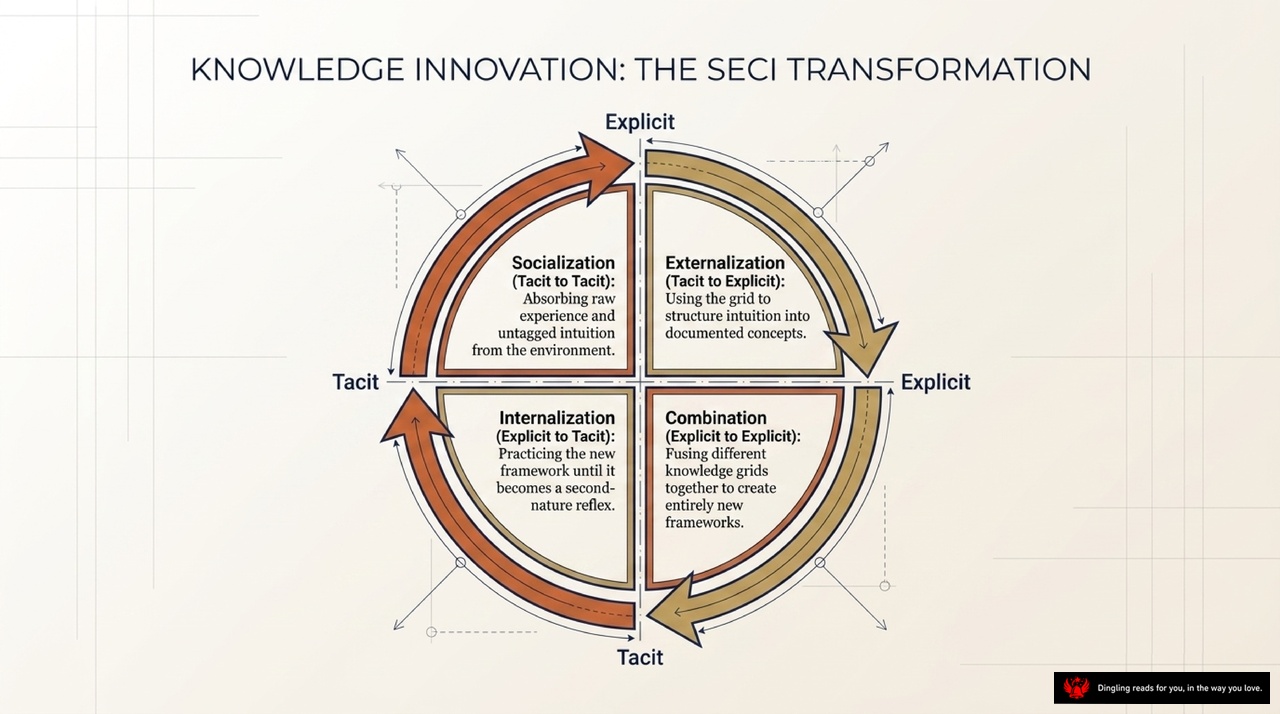
Welcome back to our deep dive into knowledge management. Today, we're looking at the heart of the SECI transformation model—a dynamic cycle that turns your scattered thoughts into powerful, actionable wisdom.
As you see on the screen, this isn't just a static chart; it's a living ecosystem of innovation. Let's break down how this loop actually works in your daily life.
It all starts with **Socialization**, moving from **Tacit to Tacit**. Think of this as the moment you absorb raw experience and untagged intuition from your environment. It's that "gut feeling" you get after years of working in an industry, or the vibe you pick up from a team meeting. You aren't writing anything down yet; you're just soaking it in.
Next, we move to **Externalization**, shifting from **Tacit to Explicit**. This is where the magic happens. You take those vague intuitions and use a mental grid to structure them into documented concepts. You're essentially giving a name to your intuition, turning a feeling into a clear idea you can share with others.
Then, we combine those ideas through **Combination**, moving from **Explicit to Explicit**. Here, you fuse different knowledge grids together. Maybe you're blending a marketing strategy with a new technology trend to create an entirely new framework. This is how you generate fresh insights by connecting existing data.
Finally, the cycle closes with **Internalization**, going from **Explicit to Tacit**. You practice these new frameworks until they become a second-nature reflex. The documented concepts you created earlier are now back inside you as deep, instinctual expertise.
This continuous loop—Socialization, Externalization, Combination, and Internalization—is the engine of knowledge innovation. It ensures that your personal experience never stays stuck in your head; instead, it evolves into shared knowledge, creates new systems, and eventually, becomes your next level of expertise.

Think of your brain not as a hard drive, but as a volatile RAM system. Without constant maintenance, it naturally dumps data to save space. This is the Ebbinghaus Forgetting Curve in action. If you don't intervene, your memory retention plummets within minutes, then drops drastically after an hour, and is almost gone by the end of a week.
But there is a protocol to stop this decay. The solution is Spaced Repetition. By strategically rebooting your memory at critical intervals—checking in at 5 minutes, 30 minutes, 12 hours, 1 day, and 7 days—you force your brain to move information from temporary RAM into permanent storage. Tools like Anki automate this process, ensuring that what was once fleeting becomes a permanent part of your internal grid. This simple shift transforms how you learn, turning fragile memories into a reliable, enduring asset.

Let's dive into the final piece of the puzzle: how we actually build this system. The slide breaks down the "Master Synthesis" into four clear stages: Intake, Processing, Storage & Linking, and Output. Think of this as your personal knowledge pipeline.
First, we have **Intake**. Raw data flows into an "Acquisition Quadrant Filter." This is your first line of defense against information overload. You aren't just hoarding everything; you are curating. You decide what truly belongs in your system based on its relevance and necessity, ensuring that only high-value content enters your workflow.
Next is **Processing**. Here, your input passes through the **WRITE Framework**. This is where the magic happens. Instead of dumping raw text, you split information into "atomic Knowledge Grids." You're breaking down complex ideas into their smallest, most digestible units. This step transforms chaotic data into structured, manageable knowledge blocks that your brain can actually work with.
Once processed, these grids move to **Storage & Linking**. This is where you tag your grids with **Meta-Knowledge** and establish connections. You aren't just filing documents; you are creating a web of relationships. By linking these grids via **Permanent, Exchange, or Soft-Permanent connections**, you ensure that ideas from different domains can talk to each other. This turns isolated facts into a dynamic, interconnected network where context matters.
Finally, we reach **Output**. Your network gets processed through the **SECI Model**—Socialization, Externalization, Combination, and Internalization—to produce real-world wisdom. The result? Tangible value in the form of published books, strategic decisions, courses, or even breakthrough innovations. You've moved from passive consumption to active creation.
By mastering this pipeline, you stop being a collector of information and start becoming a creator of wisdom. Every step, from filtering raw data to generating new insights, ensures your knowledge is not just stored, but actively working for you.
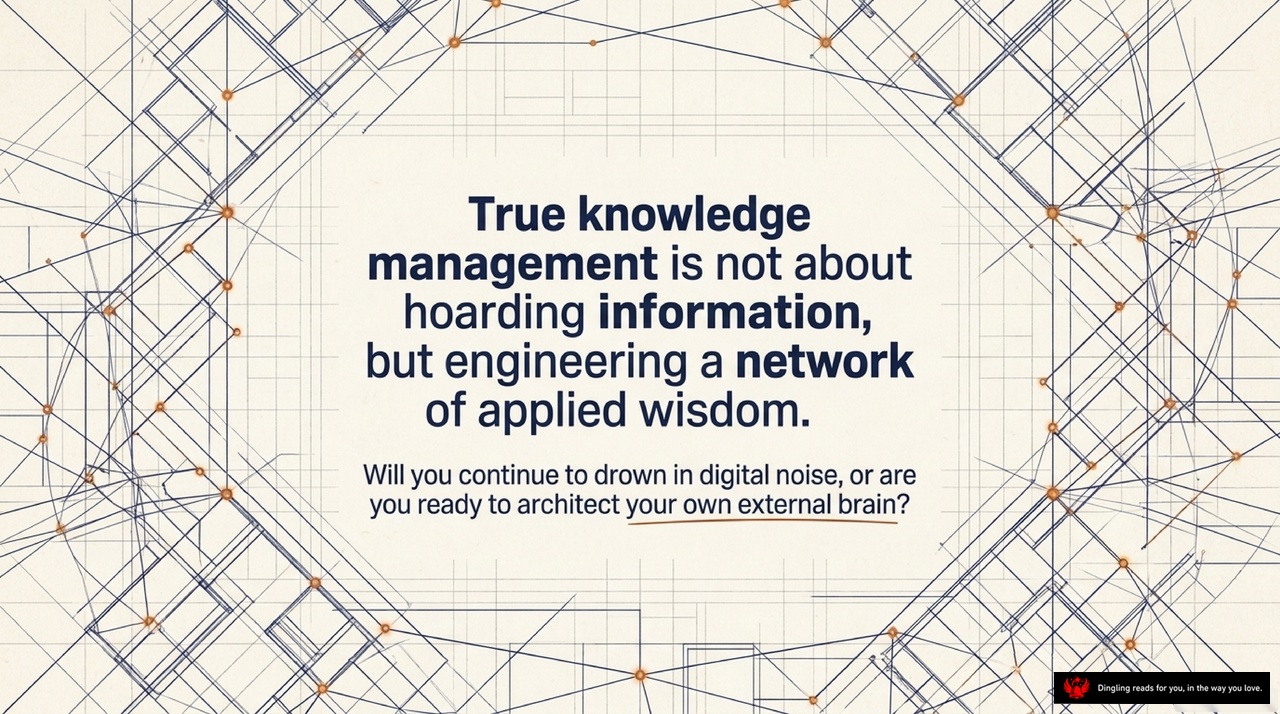
True knowledge management isn't about hoarding information; it's about engineering a network of applied wisdom. Instead of drowning in the endless digital noise that surrounds us, are you ready to architect your own external brain?
The core of this transformation lies in moving from passive storage to active connection. Traditional methods often trap us in a chaotic storage room of fragmented notes, where retrieving wisdom feels like searching for a needle in a haystack. But with a grid-based approach, we shift the focus. We stop treating knowledge as static files and start treating it as living nodes in a dynamic network.
Think of your mind as an ecosystem. Every piece of information you capture—a concept, a quote, a observation—becomes a grid. These grids aren't isolated; they are connected by logic, not just software links. When you connect a marketing strategy to a psychological principle, or a historical event to a modern business case, you create new value that didn't exist before. This is the power of the "knowledge network." It allows you to access diverse perspectives instantly, turning scattered data into actionable insight.
The goal is simple yet profound: to make your knowledge work for you. By building these connections, you create a system where one idea triggers another, fueling creativity and problem-solving. You stop being a collector of information and become an engineer of wisdom. So, the question remains: will you continue to let algorithms dictate your thoughts, or will you take the initiative to design a personal knowledge system that empowers your growth and unlocks your potential?