
Writing is a Craft: Complete Chapter-by-Chapter Summary
Writing is a Craft, by Liu Junqiang. This isn't just about being a good student; it's about mastering the art of academic writing through structured thinking and clear storytelling. Think of writing not as a magical talent reserved for a few, but as a skill you can learn and refine—much like cooking or driving a car.
The book promises to guide you from the anxiety of the blank page to the confidence of a clear argument. It covers everything from understanding the difference between high school essays and university papers, to shaping a style that acts like clear glass rather than colorful stained glass—letting your ideas shine without distraction. You'll learn how to ask the right questions, find your sources, build a logical argument, and even weave a compelling story into your research.
But remember, knowing the rules is only half the battle. True mastery comes from practice and feedback. Just as you can't learn to swim by reading a manual, you can't become a great writer without doing the work. This book is your map, but you have to walk the path yourself. Let's get started.

Entering academia is a cognitive coming-of-age. You are no longer memorizing the world; you are analyzing it. This slide captures that pivotal shift: transitioning from a consumer to a producer.
On the left, we see "The Essay" from the past. Think of it as a closed-book, quick output exercise. The goal is simply to express yourself and your emotions. You're working with standardized, known answers, often aiming for around 800 words. It's about finding the right answer in a known system.
On the right, we have "The Thesis" for the present. This is where the real work begins. The goal shifts to proving a claim with evidence. The process becomes open-book and iterative, requiring deep research rather than quick recall. There are no standard answers here; your answers must be novel and capable of withstanding active defense. The scale expands from hundreds of words to thousands.
This isn't just a change in writing style; it's a fundamental upgrade in thinking. As the bottom note suggests, you are moving from passive memorization to active analysis. Mastering this transition is the key to unlocking the full potential of higher education and your future career.

Have you ever wondered why some books feel like a conversation with a friend, while others read like climbing a wall of jargon? It all comes down to the "Transparent Glass Principle."
Imagine two windows. On the left, you have "Stained Glass." It's beautiful, intricate, and full of color, but it focuses on the glass itself. It's driven by complex jargon, an artificial academic tone, and ego. The result? It obscures the actual subject, making it hard to see the view beyond. On the right, you have "Transparent Glass." It seems invisible. It's driven by clarity, simplicity, and precision. When you look through it, you get an unobstructed view of the data and logic.
This is the paradox of craft: writing simply is vastly harder than writing complexly. True transparency requires painstaking refinement. Just like modern glass took centuries to master, achieving this "invisible" style means stripping away the fluff—removing the student-like clichés, the overly dense academic speak, and the bureaucratic fluff. The goal isn't to hide your work, but to let the reader focus entirely on your ideas, not your words. As the book puts it, good writing should be like a window, not a stained-glass masterpiece.
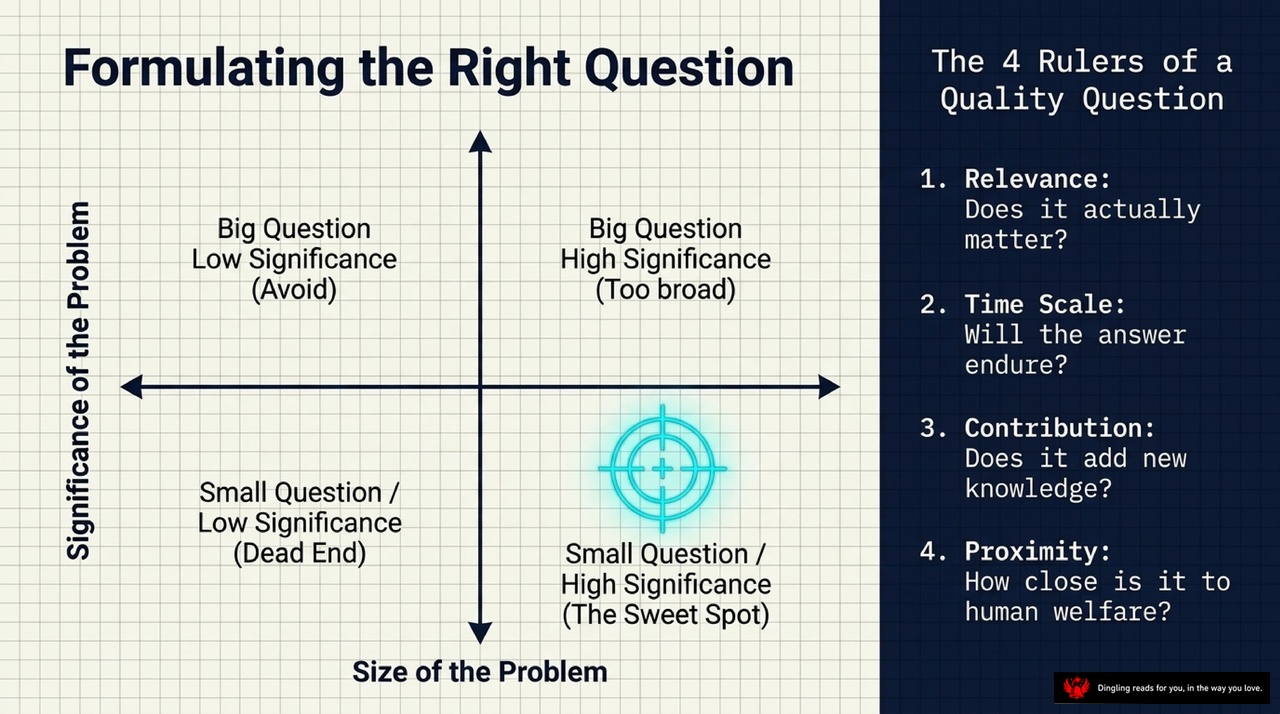
Imagine you are trying to find a research topic, but you feel stuck. You might be overwhelmed by a "Big Question" that is too broad to answer, or you might be trapped in a "Small Question" that leads to a dead end with no real significance. The slide on your screen shows exactly how to navigate this maze. It presents a four-quadrant map based on the size of the problem versus its significance.
Ideally, you want to land in the bottom-right quadrant: the "Sweet Spot." This is where a small, manageable question meets high significance. It is the perfect balance for a breakthrough study. Conversely, the top-left quadrant warns us to avoid "Big Questions with Low Significance"—these are often abstract ideas that don't matter to anyone. The top-right quadrant represents questions that are too broad, making them impossible to solve within a reasonable timeframe. And finally, the bottom-left quadrant is the "Dead End," where small, trivial questions offer no value.
But how do we actually find that sweet spot? The slide lists four essential rulers to guide us. First is **Relevance**: Does this question actually matter to people or society? Second is **Time Scale**: Will the answer endure, or is it just a fleeting trend? Third is **Contribution**: Does this research add new knowledge that we didn't know before? And fourth is **Proximity**: How close is this question to human welfare and daily life?
By applying these four rulers, you can filter out the noise and focus your energy on questions that are not only interesting but also impactful. This is the art of formulating the right question, turning a vague idea into a powerful research engine.

Imagine you've spent years writing essays, where the goal was simply to express yourself or follow a template. But now, you're in university, and suddenly, your professors aren't asking, "Did you remember the facts?" They're asking, "What do you think?" and "How do you know?" This shift is the core of our next topic: the difference between an essay and a paper.
On the left of this slide, we see the common mistake. Many students treat a literature review like a linear list of books. They just say, "Author A said X, Author B said Y." It feels disconnected and passive, like reading a book report. But that's not enough for academic work.
The solution, shown on the right, is to structure your literature as an active debate. Think of it as a structured conversation where different ideas clash and connect. First, you need to find the nucleus—anchor your review on a core variable that everyone is discussing. Next, sort the authors into camps: who are the defenders of a certain idea, and who are the challengers? Finally, enter the chat by pinpointing the exact gap your research fills.
Remember this key takeaway at the bottom: A literature review is not a book report. It is your entry into an ongoing, historical debate. You aren't just summarizing what others have written; you are joining a conversation that has been going on for decades and adding your own voice to it.
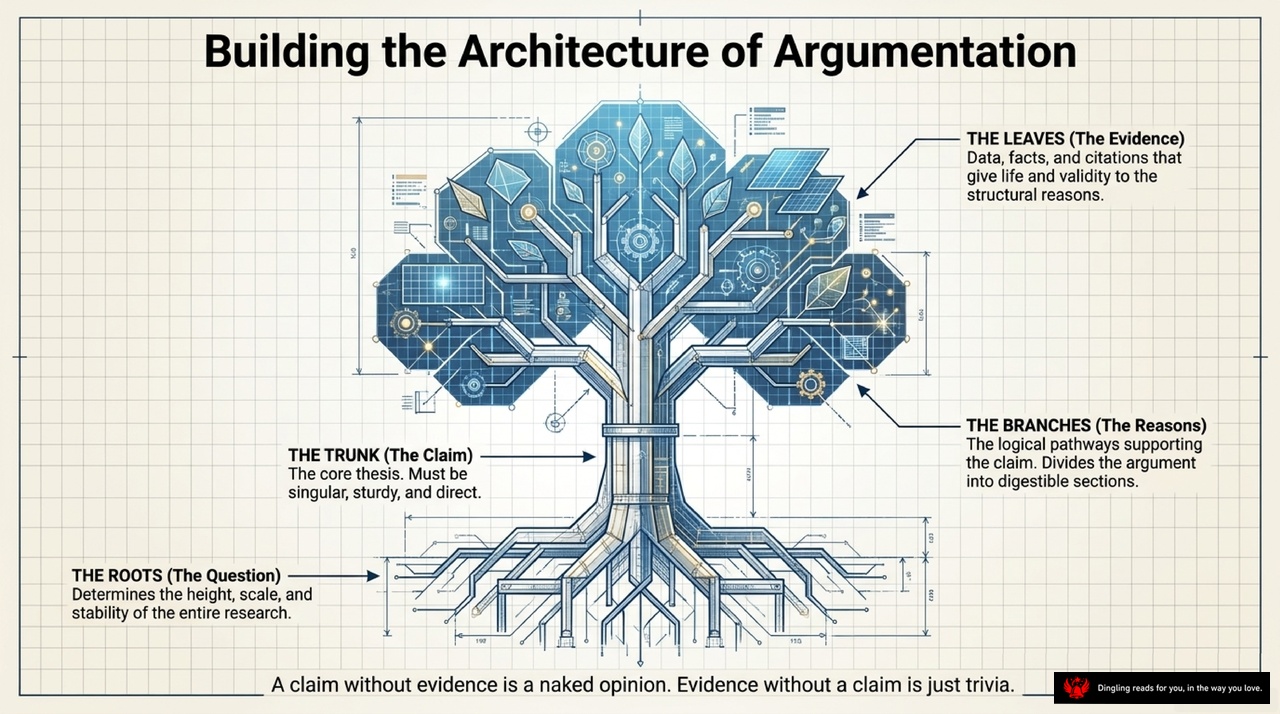
The core of any strong argument lies in the evidence that supports it. As the slide illustrates, this evidence acts as the leaves of our argumentative tree, giving life and validity to the structural reasons beneath. Without these leaves, a claim is just a naked opinion floating in the air.
But we often struggle with a critical distinction that makes or breaks our arguments: the difference between fact and opinion. A fact is an objective statement about reality—something verifiable that doesn't change based on your feelings. For example, "The temperature is 35 degrees" is a fact. However, saying "It feels unbearably hot" is an opinion, rooted in subjective experience. Similarly, stating "Student A fell asleep in class" is a fact, while claiming "Student A wasn't paying attention" is an interpretation or opinion, perhaps ignoring that the student might be suffering from dry eyes.
Confusing these two is the root of many failed debates and weak writing. It allows people to dodge real arguments by shifting to emotional appeals or irrelevant cultural justifications—a cycle often summarized as: when you speak reason, they respond with chaos; when you speak chaos, they bring law; when you speak law, they cite politics. This loop avoids the actual point entirely.
To build a solid case, you must construct a clear logical chain. Think of it as a tree: your research question is the root, your main claim is the sturdy trunk, your reasons are the branches, and your evidence is the leaves. Each part supports the others. Your reasons act as the bridge connecting your claim to the evidence. And when evaluating that evidence, whether it's quantitative data, qualitative interviews, or expert testimony, always check its accuracy, precision, and reliability.
Remember, a claim without evidence is meaningless, and evidence without a claim is just trivia. By rigorously distinguishing facts from opinions and building this tree-like structure, you transform a simple statement into a powerful, undeniable argument.

Imagine your argument as a tree. The research question is the deep root, the main claim is the sturdy trunk, the reasons are the branching limbs, and the evidence is the lush leaves. Without this tree structure, your writing is just a pile of disconnected branches, easy for readers to lose in.
But building this tree isn't just about drawing lines; it's about mastering the difference between facts and opinions. A fact is something verifiable, like "the temperature is 35 degrees." An opinion is subjective, like "it's too hot." Confusing the two is the root cause of many weak arguments, where people argue from emotion rather than logic.
Once you have your facts and opinions clear, you need to construct your logical chain. Your reasons act as the bridge connecting your claim to your evidence. Think about how you arrange them: do you list them side-by-side for equal weight, or do you stack them to build a deeper conclusion? And crucially, your evidence must be solid. Whether it's numbers from a survey, a detailed interview, or an expert's authority, every piece of evidence must directly support your reason.
However, a strong argument isn't just about what you say; it's about what you leave unsaid. Every argument relies on hidden assumptions—implicit premises that must be true for your logic to hold. If those assumptions are shaky, your entire tree collapses. That's why you must also actively hunt for counter-arguments. By anticipating what a skeptic would say and addressing it head-on, you don't just defend your point; you make your argument unshakeable.
So, the next time you write, stop throwing random points at the page. Instead, plant your root, build your trunk, and carefully arrange your branches and leaves. Create a logical structure that stands tall on its own, supported by undeniable facts and honest engagement with opposing views. That is how you turn a simple idea into a powerful, convincing argument.

Great flow. Smooth paragraphs. Think of your writing like a river flowing through a landscape—every sentence should guide the reader effortlessly from one point to the next. But how do you actually achieve that? It all comes down to mastering two levels of structure: the micro and the macro.
At the micro level, we are talking about the mechanics of your sentences and words. Your word choices matter immensely. You need to balance abstract concepts with concrete details. If you go too abstract with words like "modernity" or "intersubjectivity," you lose your reader. But if you are too specific, you might limit your argument. The key is clarity. Your sentences must have a clear subject and a strong verb. Avoid vague phrases like "is the case." Instead, use active, direct language. And watch your sentence length. Don't write one giant, breathless paragraph that overwhelms the reader. Mix short, punchy sentences with longer, more complex ones to create a natural rhythm, like a well-composed piece of music.
Now, let's zoom out to the macro level: the paragraph itself. This is where many writers stumble. A good paragraph should follow a specific rule: one idea per paragraph. No more, no less. Think of it like a single infantry unit on a battlefield; if you try to make it do too many tasks at once, it gets confused and loses its effectiveness. The first sentence of every paragraph must be your topic sentence. This is the most important rule in academic writing. Place your core argument right at the top, like an inverted triangle. Give the reader a handle to grasp immediately so they know exactly where you are going before you even start listing your evidence. Once you have that strong opening, use the subject of that sentence to carry the rest of the paragraph forward. Keep every subsequent sentence focused on that same subject, building your argument step by step, like soldiers advancing in formation.
Finally, remember that your entire piece needs a clear motivation. Every single sentence and every paragraph must serve your central thesis. If a sentence doesn't help prove your main point, cut it. Don't let your writing wander off on a tangent just because it feels interesting. Keep your focus tight, and your argument will flow with the smoothness of chocolate, leaving your reader satisfied and convinced.

Good morning, everyone. Today, let's talk about the art of flow—specifically, how to make your writing feel like a smooth ride rather than a bumpy trek.
Think of a great article as a piece of organic armor, much like the ceramic plates in a bulletproof vest. Each plate represents a specific point, and the resin binding them is your logic. If the structure is weak, the whole thing falls apart. The key to this lies in mastering the "micro" and "meso" structures of your writing.
Let's start with the micro level: the sentence. Clarity is king here. You want your subject and verb to be close together, like best friends. Avoid vague abstractions; instead, use concrete nouns and active verbs. For example, instead of saying "There is a discussion about the issue," say "We are discussing the issue." Keep it direct. Also, mix up your sentence lengths. A string of long, winding sentences can overwhelm your reader, while a series of short, choppy ones can feel like a child's rant. Aim for a natural rhythm, like stones scattered on a path.
Now, zoom out to the meso level: the paragraph. This is where many writers struggle. A strong paragraph must follow three golden rules. First, one paragraph, one idea. Don't try to fight two battles at once. Second, start with a topic sentence. Think of it as an inverted pyramid: put your main point at the very top, then support it with details. This respects your reader's limited attention span. Third, keep your subject consistent throughout the paragraph, like a soldier marching in formation. Don't let your ideas wander off into the bushes.
Finally, remember the "Lazy Reader" principle. Most of your audience won't read every single word; they will scan. So, design your writing to be easy to digest. Use clear transitions, bold key terms, and keep your paragraphs short—no longer than a third of a page. If you can hold their attention with a clear, logical flow, you've successfully turned your words into a powerful tool for communication.
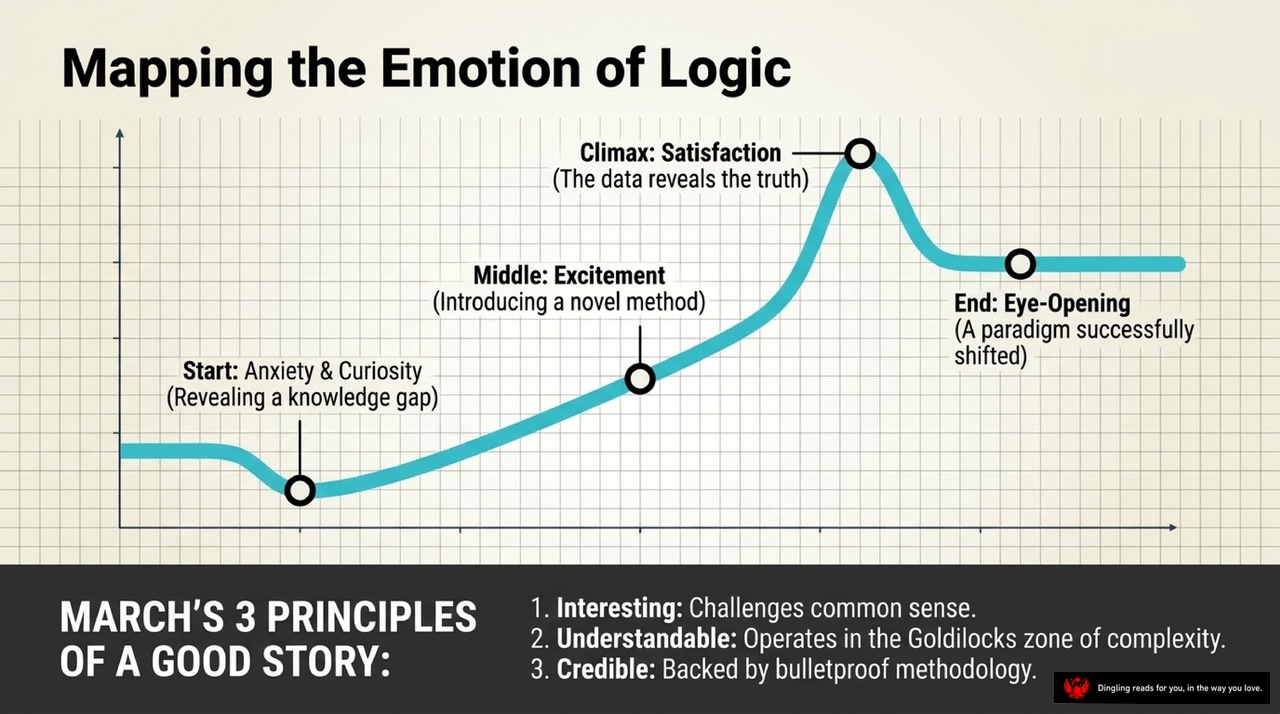
Good morning, everyone. Today, we're diving into the emotional architecture of logic, a concept that bridges the gap between dry data and human connection. As you see on the screen, this curve maps the "Emotion of Logic," transforming a standard argument into a compelling narrative.
It starts with **Anxiety & Curiosity**. Think of this as the moment you reveal a knowledge gap. Just like spotting a puzzle piece that doesn't fit, this initial friction creates the tension necessary to hold an audience's attention. Without this spark, your logic feels flat and unimportant.
Next, we move to the **Middle: Excitement**. This is where you introduce a novel method or a fresh perspective. It's the turning point where the story gains momentum, showing the reader not just *what* you think, but *how* you think.
Then comes the **Climax: Satisfaction**. Here, the data finally reveals the truth. It's that "aha!" moment where all the pieces click together, resolving the anxiety from the start. This is the payoff your audience has been waiting for.
Finally, we reach the **End: Eye-Opening**. This isn't just a conclusion; it's a successful paradigm shift. The reader leaves with a new way of seeing the world, feeling a sense of clarity and relief.
All of this relies on March's three principles for a good story: it must be **Interesting** by challenging common sense, **Understandable** by staying in the "Goldilocks zone" of complexity, and **Credible** by backing up your claims with bulletproof methodology. When you map your logic this way, you stop presenting facts and start telling a story that resonates.
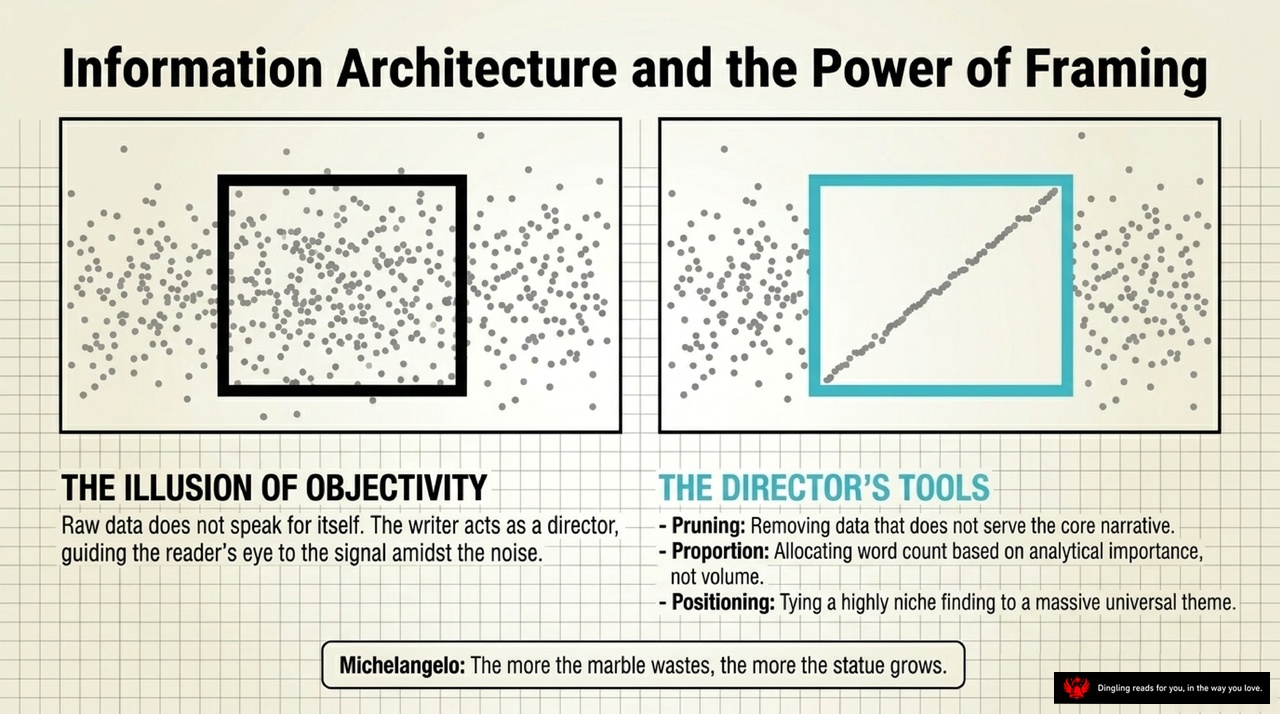
Imagine looking at a cloud of random dots. On the left, a black box captures the chaos; on the right, a blue box isolates a clear diagonal line. This visual perfectly illustrates the core lesson of today's slide: the power of framing in information architecture.
Raw data never speaks for itself. It is just noise until a writer acts as a director, guiding the reader's eye from the confusion to the signal. This is the illusion of objectivity we often fall into, thinking the data is telling us the truth without any human intervention. But as the slide reminds us, the writer is the one choosing what to keep and what to cut.
Think of this as Michelangelo's famous principle: "The more the marble wastes, the more the statue grows." In writing, we must aggressively prune irrelevant details. We allocate our word count not based on volume, but on analytical importance. And we position niche findings to connect with massive, universal themes.
By mastering these director's tools—pruning, proportion, and positioning—you transform a messy collection of facts into a compelling narrative. You stop being a passive reporter of data and become an active architect of understanding, turning noise into a clear, undeniable story.

Imagine you are handing a gift to someone. If you just grab the most expensive item you can find and shove it into their hands, you might end up with an awkward, unopened box. That is exactly the trap many writers fall into. They write as if they are the gift-giver, pouring all their research, jargon, and complex ideas into a package, assuming the reader will magically appreciate the effort. But writing is not about what *you* gave; it is entirely about what the *recipient* receives.
Look at the contrast on this slide. On the left, we have the "Author-Centric" approach. It's like sitting in a dark room under a single spotlight, lost in your own thoughts. This style is inductive, building up slowly just to surprise the reader at the end. It focuses heavily on the author's grueling research process and relies on jargon to sound smart. It's self-indulgent.
On the right, we see the "Reader-Centric" approach. Here, the writer holds the flashlight, illuminating the path for the reader. This is deductive: point first, then provide the evidence. It respects the reader's limited time and cognitive energy. It uses clear formatting like road signs to guide them through the text.
The core message at the bottom is simple but profound: Writing is a gift. You must design it for the recipient, not the giver. When you shift from author-centric to reader-centric, you stop trying to impress and start trying to communicate. You stop writing for yourself and start writing for the person on the other side of the screen. That is the true empathy shift.

Managing the Four Personas of Workflow is a dynamic cycle where creativity meets discipline. It starts with **The Madman**, who writes freely, ignoring all rules to generate pure volume—think of that messy scribble in the diagram. Next comes **The Architect**, who takes that raw chaos and organizes it into a rigid structural blueprint, much like using a compass to draw order from confusion. Then, **The Carpenter** steps in to build the paragraphs and connect the logic chains, hammering the pieces together into a coherent whole. Finally, **The Judge** cuts, polishes, and brutally enforces the "Transparent Glass" principle, ensuring the final text is clear and unobstructed. But here is the critical warning: never let the Judge into the room while the Madman is working. You must keep these roles distinct and sequential to transform raw ideas into polished, powerful arguments.

Exceptional academic writing isn't magic; it's an engineered ecosystem built on clear questions, structural blueprints, reader empathy, and disciplined refinement. Think of it less like painting and more like architecture—you're not just decorating a blank page; you're constructing a masterpiece from the ground up.
As you look at this pen resting on the grid, remember that you now hold the blueprints. The transition from essay to thesis is your intellectual coming-of-age, moving you from a consumer of knowledge to a creator of it. But how do you actually build?
Start with the question. A vague topic is a dead end; you need a precise, puzzle-like inquiry that demands an answer. Next, lay out your structure. Whether it's the standard TAIMRDR framework or a custom logic tree, your argument needs a solid skeleton where every claim is supported by evidence. But structure alone isn't enough. You must write with the "transparent glass" style—clear, direct, and unadorned so the reader sees your ideas without distraction.
Crucially, never write for yourself alone. Shift your mindset from "author-centered" to "reader-centered." Ask yourself: Does this make sense to someone who isn't an expert? Are you speaking to them as an equal, or are you lecturing? Finally, embrace the process. Writing is a craft honed by practice and feedback, not a one-time burst of genius. So, what will you construct on your next blank page? The tools are in your hands; the building starts now.