
Wuthering Heights: Complete Chapter-by-Chapter Summary
Welcome to *Wuthering Heights*. This is a tale of untamed passion, systemic revenge, and the ultimate resurrection of humanity, set against the unforgiving moors of 19th-century England. Imagine a world where the wind doesn't just blow—it sculpts your soul. Here, the landscape isn't just a backdrop; it's a living, breathing character that mirrors the chaos within.
We are entering a story where love is not a gentle embrace but a force of nature, capable of destroying and rebuilding lives in equal measure. It's a narrative where the boundaries between the living and the dead blur, and where the desire for vengeance consumes everything in its path. As we turn the page, we step into a world where the moors whisper secrets that have been buried for generations, and where the only way to find peace is to first understand the depth of the pain that created it.
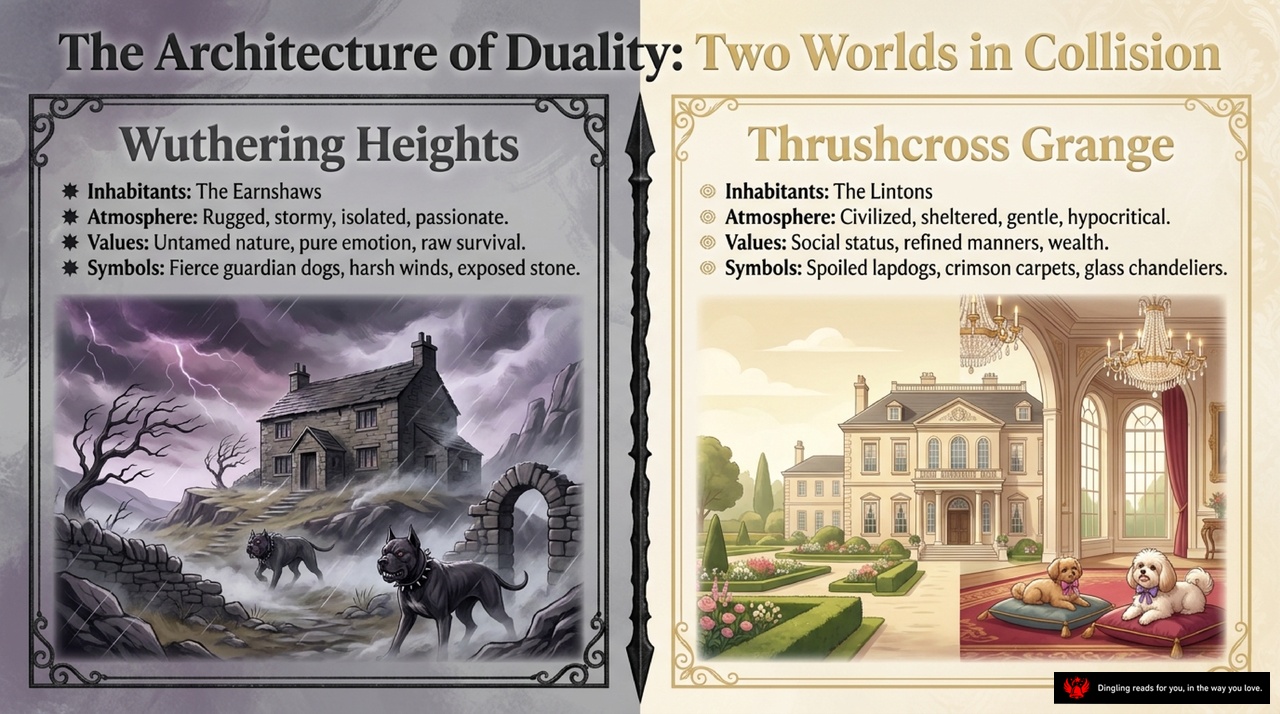
Picture this: two worlds colliding, locked in an eternal architectural battle. On the left, Wuthering Heights. It's rugged, stormy, and isolated—a place where passion runs wild and survival is raw. Here, nature is untamed, values are driven by pure emotion, and symbols like fierce guardian dogs and harsh winds remind us that life is a struggle against the elements.
On the right, Thrushcross Grange. It's the opposite: civilized, sheltered, and deeply hypocritical. This is a realm of social status, refined manners, and wealth, where spoiled lapdogs and crimson carpets symbolize a life of comfort built on fragile pretenses.
These aren't just two houses; they are two opposing forces. The Earnshaws of the Heights live by their instincts, while the Lintons of the Grange live by their rules. This clash defines the entire story, creating a tension that will tear the characters apart and eventually bring them together in ways they never expected.
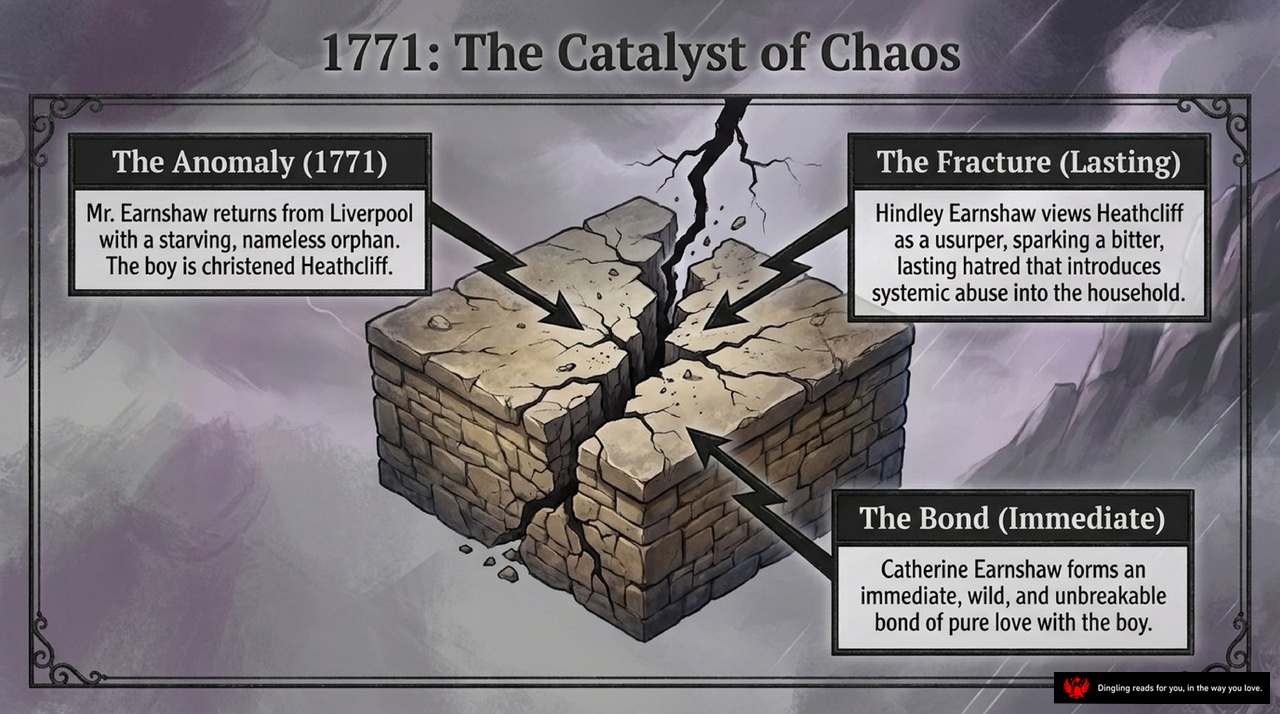
In 1771, the foundation of our story's chaos was laid when Mr. Earnshaw returned from Liverpool with a starving, nameless orphan he christened Heathcliff. This arrival created an immediate, wild, and unbreakable bond of pure love between the boy and Catherine Earnshaw, a connection that would define their lives forever. However, this love sparked a deep fracture within the household. Heathcliff's younger brother, Hindley, viewed him as a usurper, sparking a bitter, lasting hatred that introduced systemic abuse into the home. As the years passed, this cruelty only deepened the divide, turning the Earnshaw house into a place of suffering where innocence was crushed by resentment.
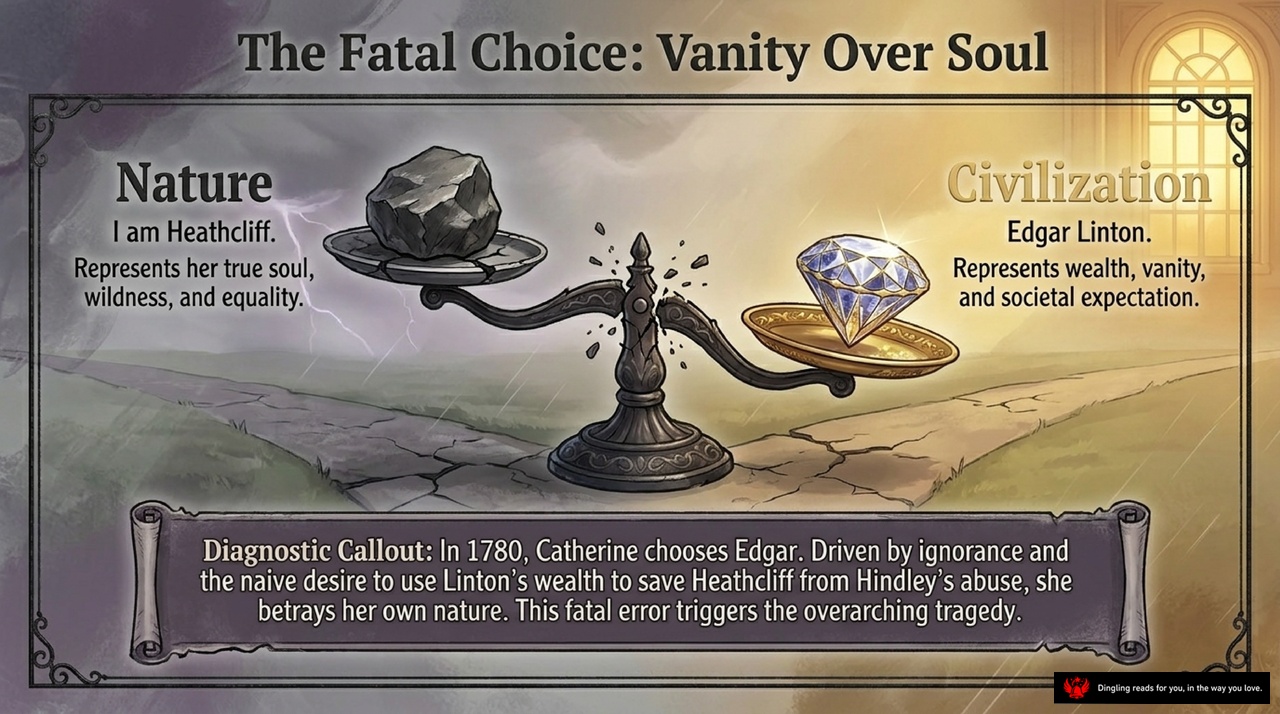
The Fatal Choice: Vanity Over Soul. Look at this scale. On one side, we have Nature—represented by the rough stone, which is Heathcliff. On the other, Civilization—represented by the sparkling diamond, which is Edgar Linton. Catherine is torn between these two worlds. Nature stands for her true soul, her wildness, and her sense of equality. Civilization represents wealth, vanity, and the rigid expectations of society. In 1780, driven by a naive desire to use Linton's wealth to save Heathcliff from Hindley's abuse, she tragically chooses the diamond over the stone. She betrays her own nature. This fatal error, choosing social status over her true self, triggers the overarching tragedy that destroys everyone she loves. It's a heartbreaking reminder that when we sacrifice our soul for vanity, the cost is everything.

The spark of vengeance ignited three years ago, and today we see the full transformation of Heathcliff. In 1780, driven by Catherine's betrayal and years of degradation, he flees the moors into the unknown, a broken man running toward an uncertain future. But by 1783, when he returns, he is fundamentally transformed. He is now wealthy, educated in manner, and dressed in the finest attire, yet beneath this polished exterior burns a hardened, volcanic hatred. His sole purpose has shifted entirely from love to systematic revenge against those who degraded him and stole his soulmate. He has spent those three years mastering the art of destruction, returning not as a victim, but as the architect of the very ruin he suffered.
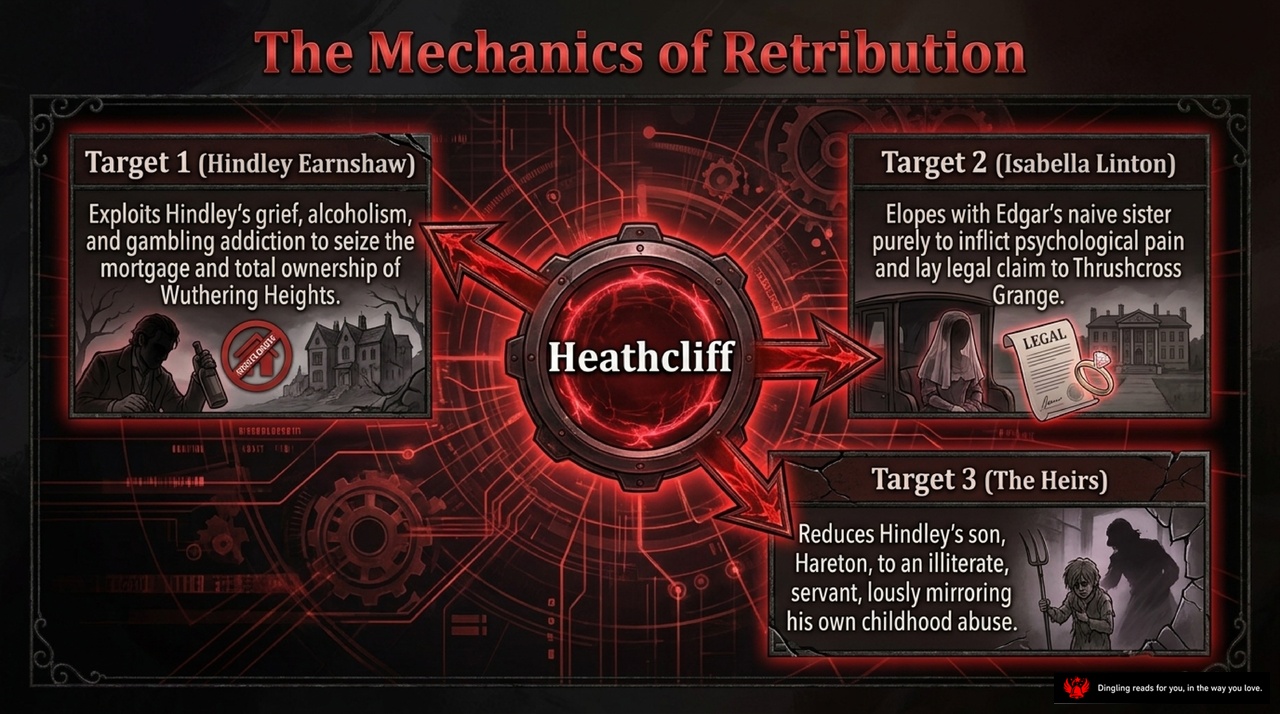
Target 1, Target 2, and Target 3. These aren't just names; they are the precise instruments in Heathcliff's master plan for total retribution. Look closely at how he weaponizes every single person in his path. First, Target 1: Hindley Earnshaw. Heathcliff doesn't just fight him; he systematically destroys him. He exploits Hindley's grief, his alcoholism, and his gambling addiction to seize the mortgage and total ownership of Wuthering Heights, effectively turning his enemy into a servant. Then, Target 2: Isabella Linton. Heathcliff elopes with Edgar's naive sister purely to inflict psychological pain and lay a legal claim to Thrushcross Grange. He uses her as a pawn, dragging her into a hell of abuse and isolation. Finally, Target 3, the heirs. He reduces Hindley's son, Hareton, to an illiterate servant, lously mirroring his own childhood abuse to ensure the cycle of hatred continues. This is the mechanics of retribution: a cold, calculated strategy where every soul is sacrificed to build a legacy of suffering.

1784: The Pivot of Tragedy. This single year acts as the fulcrum on which the entire story tips into darkness. Look at the event on the left: Catherine breaks down psychologically and dies after giving birth to Cathy Linton. Her death is the catalyst that removes Heathcliff's last tether to morality. As the slide explains, his sorrow instantly metabolizes into a volcanic, unyielding hatred. Without her, he is free to destroy everything he loves.
Now look at the curse on the right. He famously demands that she not rest, begging her ghost to haunt him and drive him mad for the rest of his life. This isn't just grief; it's a self-imposed damnation. He chooses eternal torment over peace, ensuring that his love for her becomes the very instrument of his own destruction. The tragedy isn't that she died; it's that he refused to let her go, trapping himself in a cycle of pain that would consume his soul forever.

Look at this complex family tree. It's not just a chart of names; it's a map of a war that raged across two generations. At the very center, driving the entire tragedy, is Heathcliff. He is the "Echoed Generation," the pawn of a new era, but ultimately, the master of his own destruction.
Above him, we see the "Deceased First Generation": Catherine Earnshaw, Edgar Linton, Isabella Linton, and Hindley Earnshaw. These are the ghosts who shaped everything. Catherine and Edgar built Thrushcross Grange, a place of refined comfort, while Hindley and Isabella represent the darker, more volatile side of the family. But their choices created the chaos below.
Below them, we see the three tragic children: Hareton Earnshaw, Cathy Linton, and Linton Heathcliff. Hareton is the son of Hindley, raised in degradation, stripped of his education, yet retaining a naturally strong constitution. He is the physical echo of his grandfather, but his spirit is broken by neglect.
Then there is Cathy Linton. She is the daughter of Catherine and Edgar. Sheltered and initially arrogant, she possesses her mother's fierce spirit and her father's gentle heart. She becomes the bridge between the two warring families, trying to heal the divide that her parents' death left behind.
Finally, on the right, we have Linton Heathcliff. He is the son of Heathcliff and Isabella. Sickly, spoiled, cowardly, and universally despised by his own father. He is the ultimate casualty of revenge—a child used as a tool to inherit property, never allowed to grow into his own person.
This diagram shows the full circle of suffering. Heathcliff's revenge didn't just destroy the first generation; it corrupted the next. He raised Hareton to be ignorant and cruel, he broke Linton's body and spirit, and he manipulated Cathy's life until she died young. The title says they are "pawns," and looking at their descriptions, it is painfully clear. Every single one of them was sacrificed on the altar of Heathcliff's hatred. But as the story ends, we see a glimmer of hope. Despite all this manipulation, Hareton and Cathy find their way back to each other. They are the only ones who can finally break the cycle, proving that even the deepest scars can heal if we choose love over revenge.
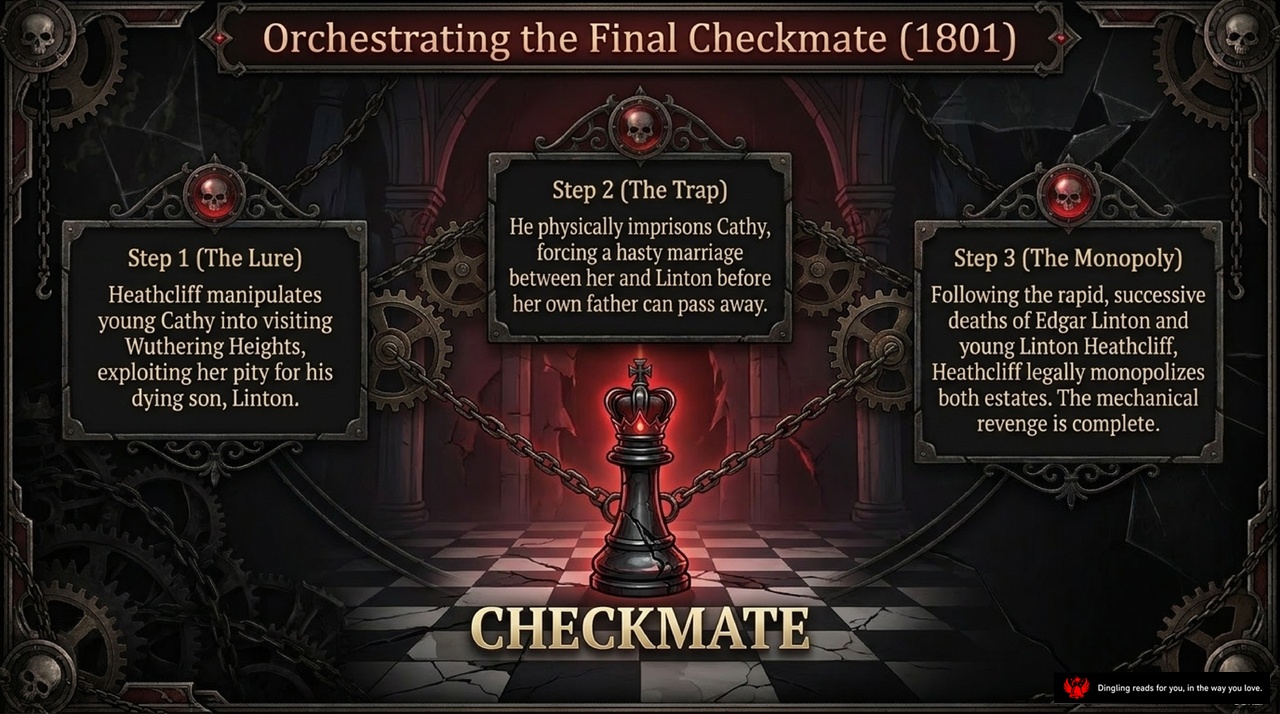
Look at this chessboard. We are now in 1801, and Heathcliff has finally orchestrated the final checkmate. This isn't just a game; it's a brutal, calculated execution of revenge that spans generations. The image breaks down his master plan into three deadly steps.
First, we have "The Lure." Heathcliff manipulates young Cathy into visiting Wuthering Heights, exploiting her pity for his dying son, Linton. He knows she loves him, and he knows she cares for her father, Edgar Linton. He turns her compassion against her.
Next is "The Trap." This is where the real cruelty begins. He physically imprisons Cathy, forcing a hasty marriage between her and Linton right before her own father can pass away. By locking her in the very house that once belonged to her family, he ensures she is bound to him legally and emotionally.
Finally, we reach "The Monopoly." Following the rapid, successive deaths of Edgar Linton and young Linton Heathcliff, Heathcliff legally monopolizes both estates. The mechanical revenge is complete. He has taken everything from the Linton family, leaving them with nothing but ghosts.
This final move seals the fate of the entire family, proving that in Heathcliff's world, love is nothing but a tool for destruction.

Look at this dramatic curve rising against the backdrop of time. It visualizes the ultimate arc of *Wuthering Heights*: the story of how two broken souls, Cathy and Hareton, break the cycle of abuse that has haunted their family for generations.
In the beginning, we see the baseline. Despite a lifetime of cruelty, Hareton stubbornly retains a loyal, gentle heart. Meanwhile, Cathy initially meets him with arrogance and scorn, viewing him as beneath her. But as time passes, we hit the turning point. Stripped of her wealth and status, Cathy eventually recognizes Hareton's innate goodness. She stops mocking him and begins teaching him to read, bridging the gap between them.
This shift leads to the result shown at the peak of the graph: their blossoming love and mutual empathy introduce a foreign element into Wuthering Heights, effectively breaking the generational curse of abuse. Their connection isn't just romance; it's redemption. By loving each other, they heal the wounds inflicted by Heathcliff and the past, proving that even in the darkest place, humanity can be resurrected through compassion.

Welcome to the final chapter of our journey through *Wuthering Heights*. Today, we arrive at the moment of transformation, where the ghosts of the past finally find their rest.
Look at the visual before us. We see a split reality: on the left, "The Young Lovers," representing Hareton and Cathy, bathed in a cool, blue light; and on the right, "The Phantoms of the Past," symbolizing Heathcliff and Catherine, swirling in a dark, red vortex. Between them lies a cracked mirror, the very symbol of our protagonist's journey.
In the story, this mirror moment is profound. When Heathcliff looks into it, he sees a perfect reflection of his own degraded youth, but more importantly, he sees the young Hareton and Cathy. He recognizes Catherine's exact eyes in them. This realization is the catalyst for everything that follows. It is the moment where the cycle of revenge breaks.
Heathcliff's descent into madness was fueled by starvation and the haunting visions of Catherine's ghost. He believed he was detached from the mortal world, driven by an ecstatic, destructive love. But seeing these two young lovers—his own children, in a way—changes him instantly. He realizes that his revenge against this reflection is meaningless. The hatred that built his empire spontaneously dissipates. He loses the will to destroy.
This is the collapse of will. The Phantoms of the Past do not vanish because they are exorcised, but because they are finally understood and integrated. The young lovers represent the future, the possibility of peace, and the restoration of humanity that Heathcliff had long abandoned.
So, as we close this book, we see that the true victory isn't in defeating the past, but in allowing it to transform into something new. The hatred ends not with a bang, but with a quiet, heartbreaking acceptance. And that is the power of Emily Brontë's masterpiece.

The final chapter of Wuthering Heights arrives with a strange, almost surreal harmony. It is the year 1802 to 1803, and the storm that has raged over these two houses for generations is finally, tragically, quieting down.
In April 1802, the story reaches its most haunting moment. Heathcliff is found dead in Catherine's old oak-paneled bed, soaked by the rain but with a fierce, ecstatic smile on his face, finally reunited with her spirit. It is a death that feels less like an end and more like a homecoming, a release from the torment he endured for so long.
With Heathcliff gone, the nightmare ends. The properties legally revert to their rightful heirs. The Gothic horror of the past is over, and the cycle of revenge is broken.
Now, the sun begins to rise on a new day. On New Year's Day 1803, Hareton and Cathy plan to marry and move down to Thrushcross Grange, leaving Wuthering Heights to the ghosts of the past. For the first time, love is not a weapon, but a sanctuary. They are building a future together, free from the shadows that once defined their lives.

Literary Synthesis: A Shock to the Era. Today, we're looking at the collision of two worlds: the polished, restrained Victorian Sentimentalism and the raw, untamed fire of Brontë's masterpiece. On the left, you see the polite society of the time—moralistic boundaries, low-spirited melancholy, and gentle romanticism. It was the era's ideal. But on the right, Brontë shatters that illusion with fierce love, violent hatred, ruthless revenge, and the untamed moors. This isn't just a clash of styles; it's a fundamental rebellion against the very fabric of the age. The core insight here is profound: this is not a traditional romance. It is a deep social tragedy depicting how a deformed, rigid society twists and distorts innate human nature into something terrifying. While the world demanded gentleness, Brontë showed us that true passion requires no boundaries, and sometimes, that freedom comes at a devastating cost.

Look at this "Thematic Architecture: The Red Line." It's not just a plot summary; it's the DNA of *Wuthering Heights*. This slide maps the entire emotional journey of Heathcliff and Catherine through four distinct phases, showing how their love transforms from a pure force into an instrument of destruction, and finally, into a path for redemption.
It starts in **Phase 1: Pure Love & Rebellion**. The image shows two figures intertwined in fire. This represents their childhood isolation. As the text reveals, they were outcasts in a cruel world, bonded by a soul-deep connection that defied their society. Their love wasn't just romantic; it was a rebellion against the very world that tried to separate them.
Then we move to **Phase 2: Vanity & Betrayal**. The image shifts to a dark house with a broken heart. This is the moment their love fractures. Catherine chooses security and social status over her soulmate, marrying Edgar Linton. She tries to suppress her feelings for Heathcliff, thinking she can have both worlds. But in doing so, she betrays the very essence of who she is, and in her vanity, she sets the stage for tragedy.
**Phase 3: Despair & Vengeance** brings the darkness. The image here is a hooded figure surrounded by lightning. This is Heathcliff after his heart is shattered. He doesn't just grieve; he weaponizes his pain. He returns not to reclaim love, but to destroy the lives that stole Catherine from him. He torments her new husband and her sister, turning his broken heart into a weapon that tears the Linton family apart.
Finally, we reach **Phase 4: The Awakening of Humanity**. The image shows hands reaching toward a light, breaking a chain. This is the resolution. The cycle of generational trauma ends when the younger generation, Catherine and Hareton, find the strength to break free from the past. Through their empathy and forgiveness, they heal the wounds of the previous generation. They don't repeat the mistakes of their parents; instead, they choose love over hate, finally bringing peace to Wuthering Heights.
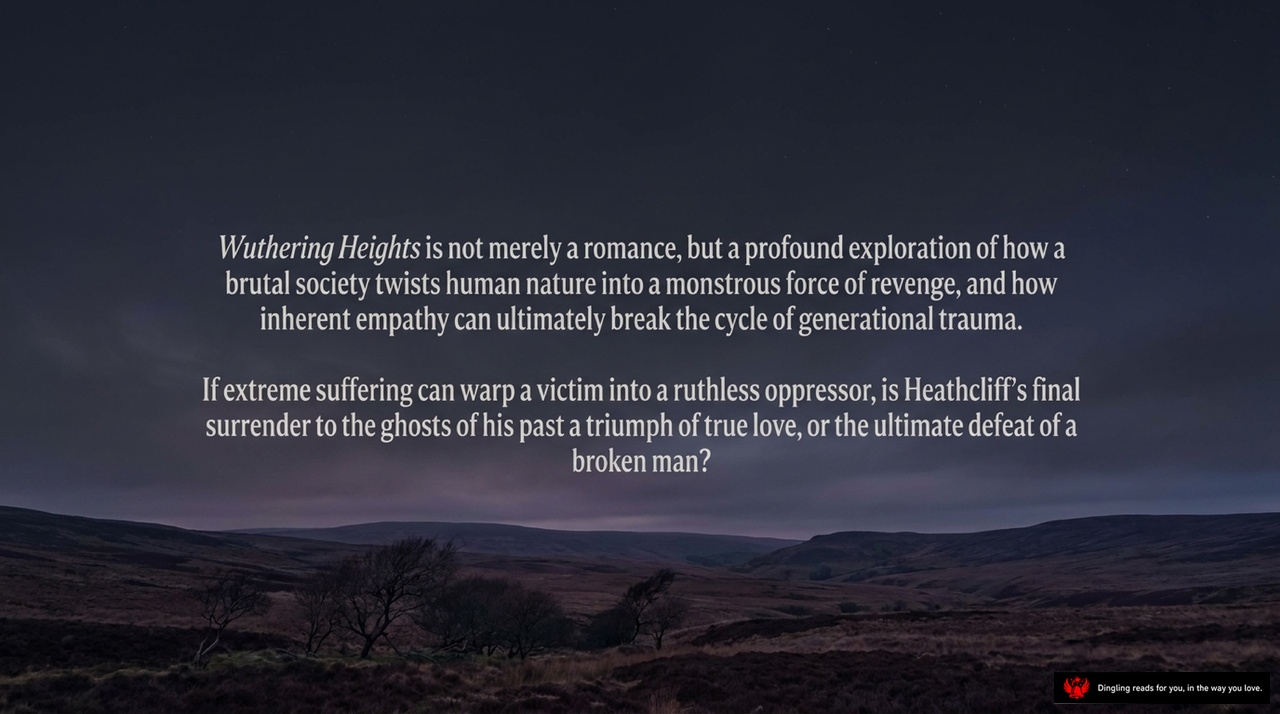
Wuthering Heights is not merely a romance, but a profound exploration of how a brutal society twists human nature into a monstrous force of revenge, and how inherent empathy can ultimately break the cycle of generational trauma. We see this transformation clearly in Heathcliff's final surrender to the ghosts of his past. Is it a triumph of true love, or the ultimate defeat of a broken man?
Consider the journey of young Catherine and Hareton. Once, they were strangers bound by hatred, with Catherine mocking Hareton's ignorance and he retreating in shame. But as they grew, their shared suffering and the quiet moments of learning together began to heal old wounds. Catherine taught Hareton to read, while he helped her care for the garden, slowly replacing resentment with understanding. Their love didn't just save them; it liberated the entire estate from the shadow of vengeance.
Even in death, this redemptive power remains. When Heathcliff finally dies, he doesn't seek revenge anymore. Instead, he asks to be buried right next to Catherine, his ghostly presence wandering the moors until he finds peace. His suicide and his final request to be interred beside her signify that the cycle has ended. The hatred that once consumed him is replaced by a desperate, loving need to be reunited with the one he lost.
So, when we look at the end of Wuthering Heights, we see that while suffering can warp a victim into an oppressor, love has the unique ability to break that chain. Heathcliff's story reminds us that even the deepest scars can be healed, and that true love is the only force strong enough to conquer the darkness of a broken world.