
Zero Second Thinking: Complete Chapter-by-Chapter Summary

Welcome to "Zero Second Thinking" by Yuji Akaba. This book offers a powerful promise: transform your mind from chaotic to crystal-clear in just one minute per page. Imagine taking control of your thoughts instantly, turning confusion into clarity with a simple, practical method. It's about mastering the art of thinking fast and acting decisively, without getting lost in endless overthinking or emotional loops. Whether you're facing a complex work challenge or personal uncertainty, this approach gives you the tools to find answers quickly. Let's dive into how you can achieve this mental clarity and start making better decisions today.

Imagine a tangled mess of scribbles on the left—that's the trap we all fall into. We spend hours spinning our wheels, looping over the same anxieties, confusing "spending time" with actually "thinking." It's exhausting and leads nowhere. But look at the right side: a straight arrow pointing to a clear target. That's the reality. Without a way to get our thoughts out of our heads, our brains just recycle the same fragmented worries, causing decision fatigue. True deep thinking isn't about staring into the void; it's about breaking that loop.
The secret lies in externalizing your thoughts. When you feel that knot of confusion, don't just sit with it. Grab a piece of paper and write down whatever is swirling in your mind—your doubts, your frustrations, even the messy details you'd rather ignore. Whether it's wondering why a boss passed on a project or grappling with guilt after an argument, put it all on the page. You don't need to worry about grammar or logic; just let the raw feelings flow. This simple act transforms invisible, chaotic emotions into something concrete and manageable. By breaking the cycle of internal looping and giving your thoughts a physical form, you stop wasting energy on mental gymnastics and start moving toward clear, decisive action.

Imagine a spectrum of human thought. On one end, you have days of deliberation, hours of debate, minutes of hesitation. But on the other end lies a powerful, almost forgotten state: Zero Seconds Thinking. This isn't about moving faster; it's about eliminating the friction between seeing a problem and solving it.
Look at the diagram here. It illustrates the journey from a slow, wavering mind to that explosive red star of instant clarity. What is this ability? It is the capacity to instantly grasp a situation, organize your thoughts, and decide on a course of action without a single second of hesitation.
Think about our ancestors. We evolved in the wild to make split-second survival decisions based on instinct and immediate data. A lion appears, you run or fight—no time for pros and cons. That was our ancestral mind. But today, we've created a "modern blur." Societal rules, over-education, and the paralyzing fear of failure have dulled this natural instinct. We overthink everything, turning simple choices into complex puzzles.
Zero Second Thinking is the training required to get it back. It's not magic; it's a skill you can rebuild. By learning to write down your thoughts immediately—capturing those fleeting ideas before they vanish—you stop the mental loop that wastes your energy. You move from days of worry to zero seconds of action.

Here is the spoken-word script for Slide 3, tailored for an American audience:
"Let's talk about how to actually deepen your thinking using these notes. Instead of just writing once, take the ideas you just captured and turn them into new titles for fresh pages. This is the secret to moving from surface-level worrying to real problem-solving.
For example, if you wrote, 'Why won't my boss talk to me?', don't stop there. Break that down. Create new titles for each guess: 'Did I offend him in the last meeting?' or 'Is he just having a bad day because of his wife?' By writing out each possibility as a separate page, you stop spiraling in your head and start analyzing the facts. You might realize, 'Oh, his silence has nothing to do with me; he's just busy.' Suddenly, the weight lifts.
This technique also helps you think from multiple angles. If you're frustrated that a colleague won't share data, ask yourself: 'When *do* they share info?' or 'Who *do* they share it with?' You're stepping out of your own ego and seeing the bigger picture. This isn't just about clearing your head; it's about building a logical tree of thought without the stress of forcing a structure.
Finally, once you master this, you can tackle complex projects like business plans. Dump all your raw ideas onto separate pages first, then sort them by theme. It's like building a house with bricks before you lay the foundation. This method makes your thinking structured, visual, and incredibly efficient, turning chaotic anxiety into a clear path forward."

Today's slide introduces the "Ultimate Tool": the A4 Method. This isn't just about writing; it's about engineering your brain for instant clarity. Look at the diagram: we start with scrap paper, zero-friction ink, and a strict one-minute timer. The goal? To produce ten pages a day. Why? Because the path to "Zero Second Thinking" doesn't rely on expensive software or pristine journals. It requires raw speed. The formula is simple: one horizontal A4 sheet, one minute, and one theme equals absolute clarity. By dumping your raw thoughts onto cheap paper without overthinking, you bypass the mental friction that slows you down. This practice transforms vague anxiety into concrete data, allowing you to see solutions instantly rather than getting stuck in endless loops. It's the ultimate hack for turning chaos into a decisive action plan.

Think of your mind as a high-speed processor, but without an external hard drive, it constantly overloads with fleeting ideas and chaotic emotions. That's why the "Anatomy of the Perfect Note" is your ultimate upgrade tool. As shown on this slide, a truly effective note isn't just random scribbles; it's a structured framework designed to capture clarity instantly.
Start at the top left with your Title. This isn't just a label; it's the anchor for your thought. Write down your key question in the moment, and crucially, underline it. This simple act signals to your brain that this is the core issue you are tackling right now. On the top right, lock in your date using the YYYY-MM-DD format. It's a quick way to save time and create a clear timeline for your ideas.
Now, look at the body. This is where the magic happens. Keep it strictly between four to six lines, preceded by a dash. Each line should be a direct point—no fluff, no long-winded explanations. Line one is your clear, concise thought; line two is your specific observation or action. You want to be brutally honest and specific here. For instance, instead of writing "Boss is unhappy," write "Boss interrupted me three times during the report and questioned the data accuracy."
The length of each line matters too. Aim for 20 to 30 characters per line. This forces you to be precise without being overly verbose. Long enough to be specific, short enough to be read in seconds. Finally, maintain a strictly horizontal orientation. This layout allows for wider peripheral vision, helping your brain see the natural flow of logic from left to right without getting lost.
By following this anatomy—Title, Date, a focused Body, and the right Length—you transform your scattered thoughts into a clear, actionable plan. It's not just about writing; it's about engineering your thinking so you can move from confusion to clarity in zero seconds.

Welcome back. Today, we're diving into the engine that drives your productivity: The Rule of Momentum.
Imagine your brain as a car. If you keep the foot off the gas, you stop. But if you keep pressing it, you gain speed and power. This slide outlines exactly how to keep your mental engine running.
First, look at that speedometer on the right. It tracks "Words per Minute." The core rule here is simple but non-negotiable: You must write while looking at the second hand. We are talking about a strict one-minute limit per page. Why? Because speed prevents self-censorship. When you rush, you bypass the inner critic that usually stops you from being honest or creative. Don't worry about grammar, structure, or even handwriting. Just write the raw, unfiltered truth exactly as it appears in your mind.
This leads us to the second point: Bypass the Critic. Most of us hold back because we fear judgment or perfection. But here, you are writing for yourself only. Whether it's frustration with a boss, confusion about a project, or personal doubts, get it all out. The goal isn't to produce a perfect essay; it's to clear the mental clutter so you can think clearly.
Finally, we have The Daily Quota. The magic number is ten pages a day. That's it. Ten pages equals roughly ten minutes of total investment. It sounds small, but the cognitive return is exponential. By consistently hitting this daily target, you train your brain to stay in flow. You stop overthinking and start solving. So, grab your pen, set a timer for one minute, and start writing. That's how you build unstoppable momentum.

Why A4 scrap paper is the ultimate tool for your brain.
Look at this comparison matrix. We're pitting scrap A4 paper against a bound notebook and a digital app like Word or Evernote. The verdict? Analog scrap paper wins every time as the ultimate low-friction cognitive tool.
Think about startup speed. With scrap paper, you have an instant start. You grab a sheet and write immediately. In contrast, a bound notebook feels slower, and digital apps create high friction just to open and type.
Then consider spatial freedom. Scrap paper gives you total drawing freedom. You can draw diagrams anywhere on the page. A notebook constrains you with margins, while digital apps are terrible for quick spatial diagrams.
Sorting flexibility is another winner for scrap paper. You can easily sort loose sheets into folders by topic. Notebooks trap you in a chronological order, and digital apps create an endless scrolling trap that makes finding things difficult.
Finally, look at cognitive friction. With scrap paper, there is zero guilt for "wasting" paper. You feel free to write anything. A notebook makes you fear ruining the pristine pages, while digital apps bring screen distractions and the stress of endless editing.
The result is clear: analog scrap paper removes all the mental barriers holding you back. It's the simplest, most effective way to capture your thoughts without hesitation.

Emotional Detoxification isn't just a buzzword; it's a practical reset button for your brain. Imagine your mind as a tangled mess of scribbles—suppressed anger, jealousy, and anxiety clogging up your cognitive function. These hidden emotions don't just disappear; they consume the very processing power you need to solve problems. The solution? Stop hiding them and let them out.
This slide breaks down the process into three clear steps. First, **The Blockage**. Acknowledge that your suppressed feelings are the reason you feel stuck. You can't think clearly while carrying this baggage. Second, **The Purge**. This is the action phase. Take a pen and write down the names of the people you resent. Be brutally honest about why you're angry. Don't self-censor. Just pour it all onto the page without worrying about grammar or judgment. Finally, **The Result**. After writing for about 10 to 15 pages, something magical happens. The emotional charge naturally dissipates. Your brain effortlessly shifts from subjective rage to objective problem-solving. You go from being overwhelmed by feelings to being ready to tackle solutions. It's the ultimate way to clear your head and get back to work.

Stop staring at the ceiling and waiting for inspiration to magically appear. The real power lies in taking your existing notes and using them to build a living logic tree. Instead of getting stuck on one big problem, take a single line from your current note and make it the exact title for your next one-minute note. This simple act of branching out allows you to dive deeper without feeling overwhelmed. By breaking massive, paralyzing problems down into microscopic, highly actionable components, you transform abstract anxiety into clear steps. This method effortlessly shifts you from empty worrying to structured thinking, giving you the confidence to tackle any challenge with precision and clarity.

Imagine you're stuck in a loop, frustrated that your boss simply ignores you. You're trapped in that single, painful reality. But what if you could instantly step out of your own head and see the full picture? That's exactly what a 360-degree perspective does. Instead of getting stuck on one question like "Why doesn't my boss talk to me?", you expand your view to four distinct angles. You ask yourself: Why is he ignoring me? What is he actually stressed about right now? When does he finally open up? And crucially, how would other people handle this exact situation? By rapidly writing from these multiple angles, you force your brain to generate immediate empathy. You shatter your personal bias and stop taking things so personally. The result? You tackle stubborn interpersonal problems not by waiting for a breakthrough, but by attacking them from every direction at once. This simple shift from a narrow tunnel vision to a wide, open circle transforms how you understand conflict and communicate.
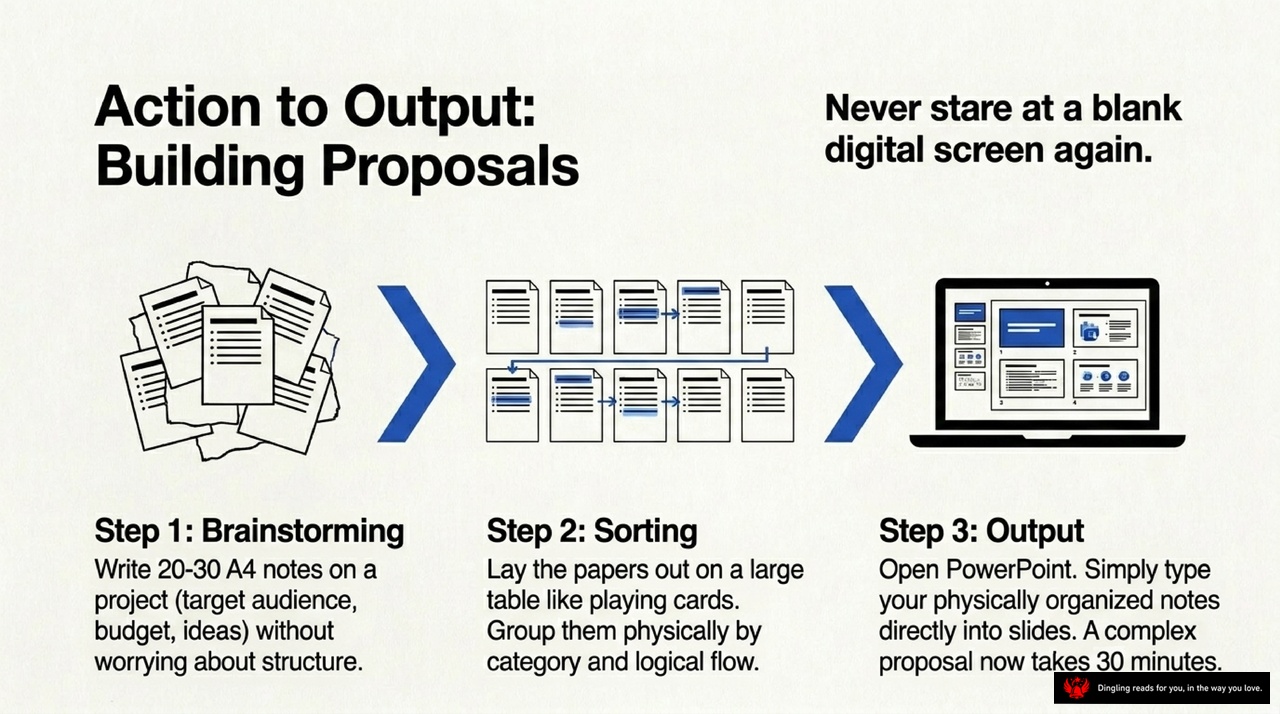
Let's talk about how to turn that messy pile of ideas into a polished proposal without staring at a blank screen for hours. The key is a simple three-step process: Brainstorming, Sorting, and Output.
First, grab some paper and do a wild brainstorming session. Write down 20 to 30 notes about your project—think about your target audience, the budget, and your ideas. Don't worry about structure or logic at all; just get everything out of your head.
Next, move to the sorting phase. Lay those papers out on a large table, treating them like playing cards. Physically group them by category and logical flow. This visual arrangement helps you see the big picture and organize your thoughts naturally.
Finally, it's time for output. Open your PowerPoint and simply type the notes you've already organized directly into your slides. Because you've done the heavy lifting on paper, building a complex proposal now takes just 30 minutes. Never stare at a blank digital screen again; let your physical notes guide you to a finished product in no time.
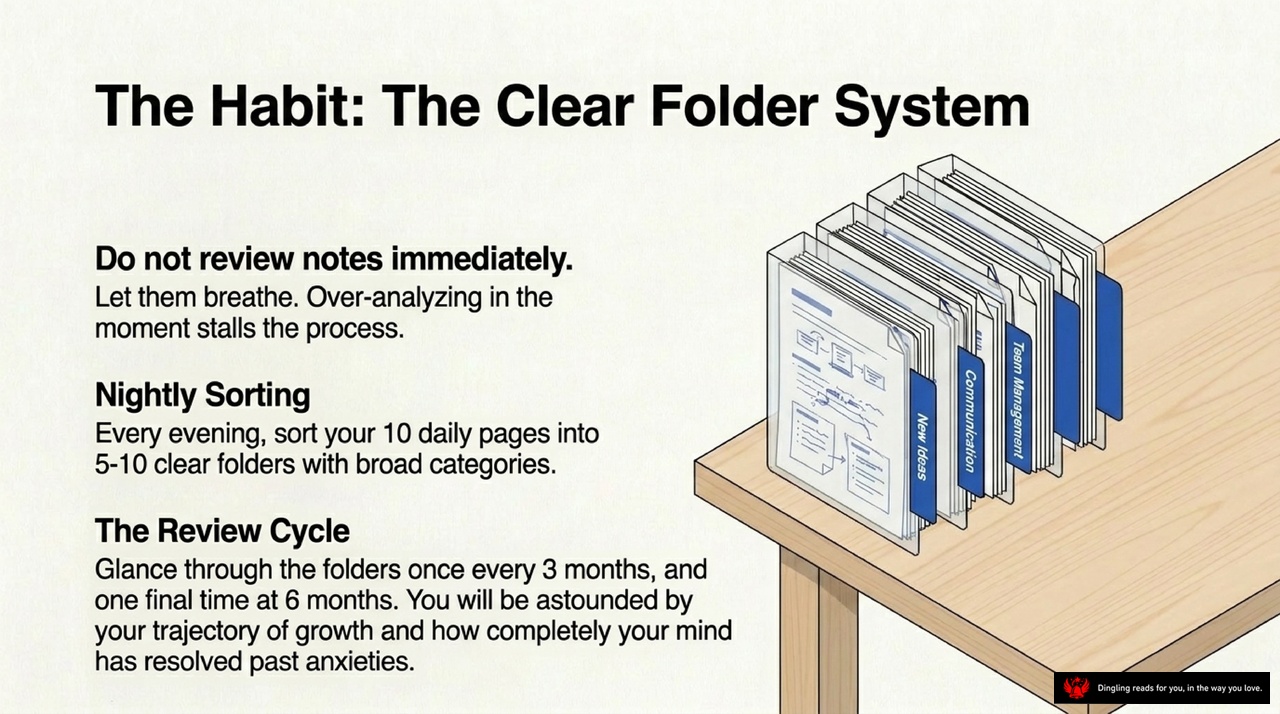
So, let's talk about how to actually keep all this thinking from disappearing into thin air. The book introduces a specific habit called "The Clear Folder System," and honestly, it's a game-changer for anyone who feels overwhelmed by their own mind.
The core idea is simple but powerful: do not review your notes immediately after writing them. Let them breathe. If you try to over-analyze everything the moment it happens, you stall the entire process. Instead, the book suggests a "Nightly Sorting" routine. Every single evening, take those ten pages of raw thoughts you wrote and sort them into five to ten clear folders based on broad categories. You can label them things like "New Ideas," "Communication," or "Team Management," just like you see on this slide.
But here's the magic part, the part that really surprised me: "The Review Cycle." You don't need to dig into these folders every day. In fact, you shouldn't. Instead, glance through them once every three months, and do one final deep dive at the six-month mark. Trust me, when you do that, you will be astounded by your trajectory of growth. You'll see exactly how your mind has resolved past anxieties that felt huge back then but are now just small chapters in your story. It's about organizing your chaos so your brain can finally catch up.

Zero-second thinking isn't about staring into space until an answer magically appears. It's about doing the opposite: dumping your raw, chaotic thoughts onto a piece of A4 paper immediately. By externalizing your mental clutter within just one minute, you clear the mental fog and create space for instant clarity and decisive action.
Think about it: if absolute mental clarity costs you nothing more than ten scraps of paper and ten minutes a day, what is truly stopping you from starting right now? The barrier isn't a lack of time or intelligence; it's the fear of thinking without structure. By writing down your doubts, frustrations, or even your wildest ideas without judgment, you transform invisible anxiety into visible data. You stop spinning your wheels in your head and start moving forward with purpose.