
Zhuangzi: Complete Chapter-by-Chapter Summary
Welcome to our deep dive into *Zhuangzi*, a foundational masterpiece by Zhuang Zhou that guides humanity toward absolute spiritual freedom and harmony with the natural world. Imagine a vast fish named Kun swimming in the northern sea, transforming into a magnificent bird called Peng with wings like clouds. This creature soars nine thousand li high, riding the wind for six months just to rest. Yet, tiny cicadas and small birds mock it, asking why bother flying so far when they can just hop on a mulberry tree? This is the essence of Zhuangzi's philosophy: true freedom isn't about how far you fly, but about letting go of the need to compare yourself to others. It's about transcending the limits of your own perspective and embracing a state of "absolute spiritual freedom" where you are no longer bound by the opinions of the world or the constraints of your own ego.
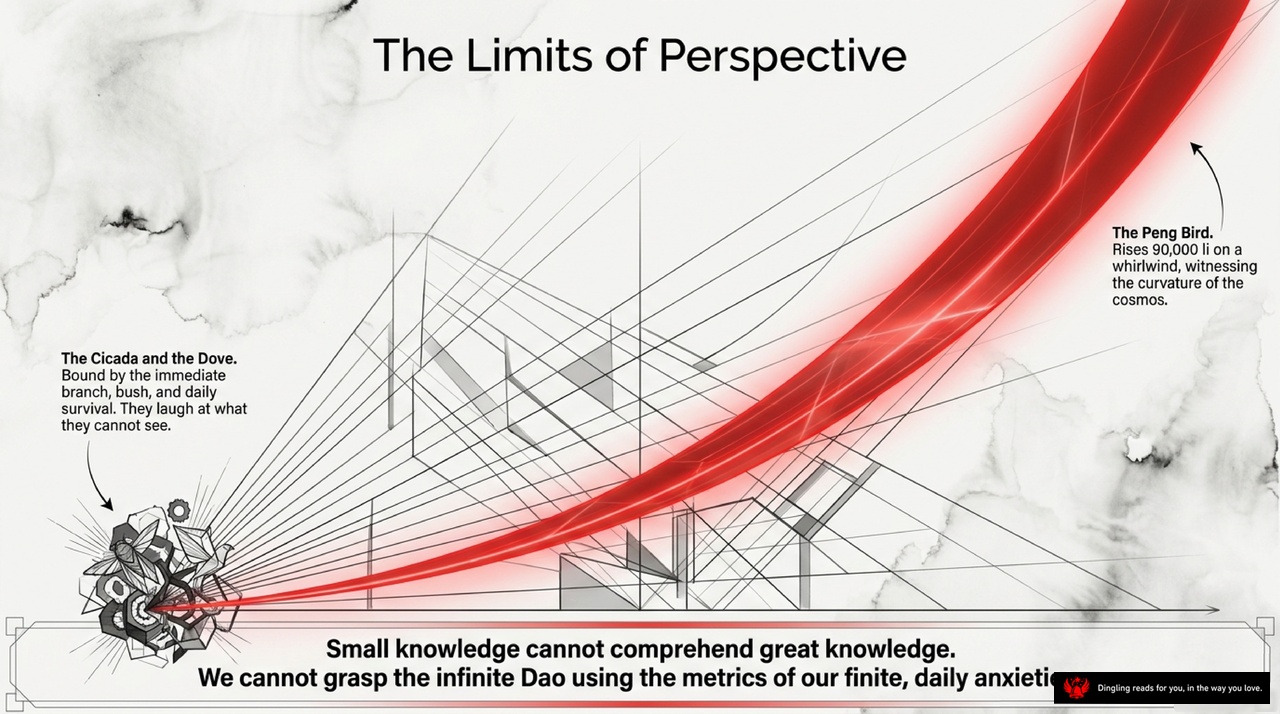
Look at this striking visual: "The Limits of Perspective." Notice how the diagram contrasts two worlds. On the left, we have the Cicada and the Dove, trapped by the immediate branch, bush, and daily survival. They laugh at what they cannot see, bound by a narrow, finite view. On the right, soaring high above the red curve, is the legendary Peng Bird. It rises 90,000 li on a whirlwind, witnessing the curvature of the cosmos itself.
This image perfectly captures the core tension in Zhuangzi's philosophy. As the text reminds us, "Small knowledge cannot comprehend great knowledge." We are often trying to grasp the infinite Dao using the metrics of our finite, daily anxieties. It's a humbling realization that our limited perspective creates a blind spot we can't even see.
Think about your own life. How often do we judge the vast possibilities of the world based on our immediate circumstances? We laugh at the "Peng Bird" because our wings can't reach that height. But true wisdom, as Zhuangzi teaches, isn't about forcing yourself to fit into a bigger world; it's about realizing that your current view is just one angle of a much larger truth. The red curve in this graphic isn't just a line; it's an invitation to expand your horizon, to stop laughing at what you can't see, and start seeing the vast, curved reality that lies beyond your immediate branch.

Deconstructing Duality: Why Right and Wrong Don't Exist
Look at this diagram. It visualizes a radical shift in how we see the world. We usually live in a binary mindset, constantly arguing between opposites: right versus wrong, big versus small, beautiful versus ugly, even life versus death. But this image, titled "Deconstructing Duality," suggests that all these distinctions are artificial constructs of language and human bias.
From the perspective of the Dao, these opposites are interdependent and ultimately one. They all converge into a central point called "The Heavenly Equalization," or Tian Ni. The text explains that to argue about right and wrong is merely to show one's own prejudice. When we get caught up in labeling things, we lose sight of the natural flow.
The sage doesn't fight against these distinctions; instead, they rest in the natural flow. Imagine trying to force a square peg into a round hole or insisting that one side of a spectrum is the only truth. That is the trap of duality. By stepping back and seeing how these opposites are woven together, we realize that the true nature of reality is a unified whole, far beyond our limited labels. This isn't about ignoring differences, but about transcending the rigid boundaries we create, allowing us to move with the universe rather than against it.
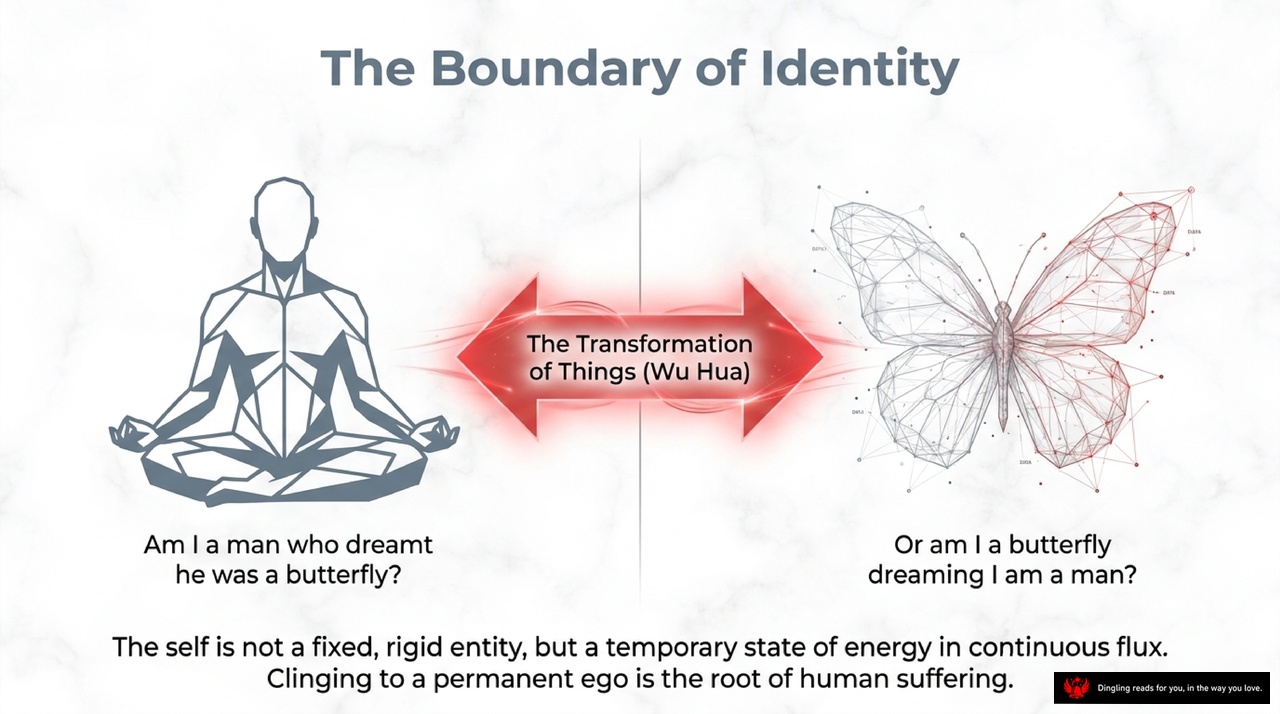
Look at this slide, "The Boundary of Identity." It poses a question that has haunted philosophers for centuries: Am I a man who dreamed I was a butterfly, or am I a butterfly dreaming I am a man? This is Zhuangzi's famous "Butterfly Dream." The image beautifully illustrates "Wu Hua," the transformation of things. On the left, we see a meditating figure representing the human self, and on the right, a butterfly made of data points, symbolizing the fluid nature of reality.
Zhuangzi challenges our fixed idea of who we are. He argues that the self is not a rigid, permanent entity, but rather a temporary state of energy in continuous flux. When we wake up from the dream, we might think we are back in our human bodies, but how do we truly know we weren't the butterfly all along? The boundary between the two is blurry, and the distinction is meaningless.
This concept is the root of human suffering. We cling to a permanent ego, believing we are separate and unchanging, but nature shows us that everything transforms. By accepting that the self is fluid and that boundaries are illusions, we can stop fighting against the flow of life. Instead of worrying about losing our identity, we can embrace the freedom of transformation. This is the true "Xiao Yao"—to wander freely without being trapped by the labels we give ourselves.

Imagine a world where being "useless" is actually your greatest superpower. This slide captures the core paradox of utility that Zhuangzi teaches us: the difference between a twisted, gnarled tree and a straight, perfect timber. Society often chases the "Straight Timber"—the straight wood that gets chopped down immediately by carpenters to build boats or pillars. We are the straight timber, constantly being harvested for our productivity, our utility, and our immediate value. But look at the other side of the chart: "The Gnarled Tree." Its branches are twisted, its wood is deemed useless by the market, yet because it has no value, no one tries to cut it down. Left alone to grow for centuries, it becomes a giant, ancient oak that provides shade and shelter for generations.
This visual perfectly illustrates Zhuangzi's famous lesson on the "uselessness of being useless." What the world deems as a flaw or a lack of function is precisely what protects you. When you stop trying to fit into the mold of what society thinks is useful, you stop being consumed by others. You are allowed to grow to your full, natural potential without being chopped down for someone else's gain. True freedom isn't found in being the most efficient tool; it's found in having the courage to be the gnarled tree, growing wild and free, because you are too valuable to be used.
The Anatomy of Non-Action (Wu-Wei)
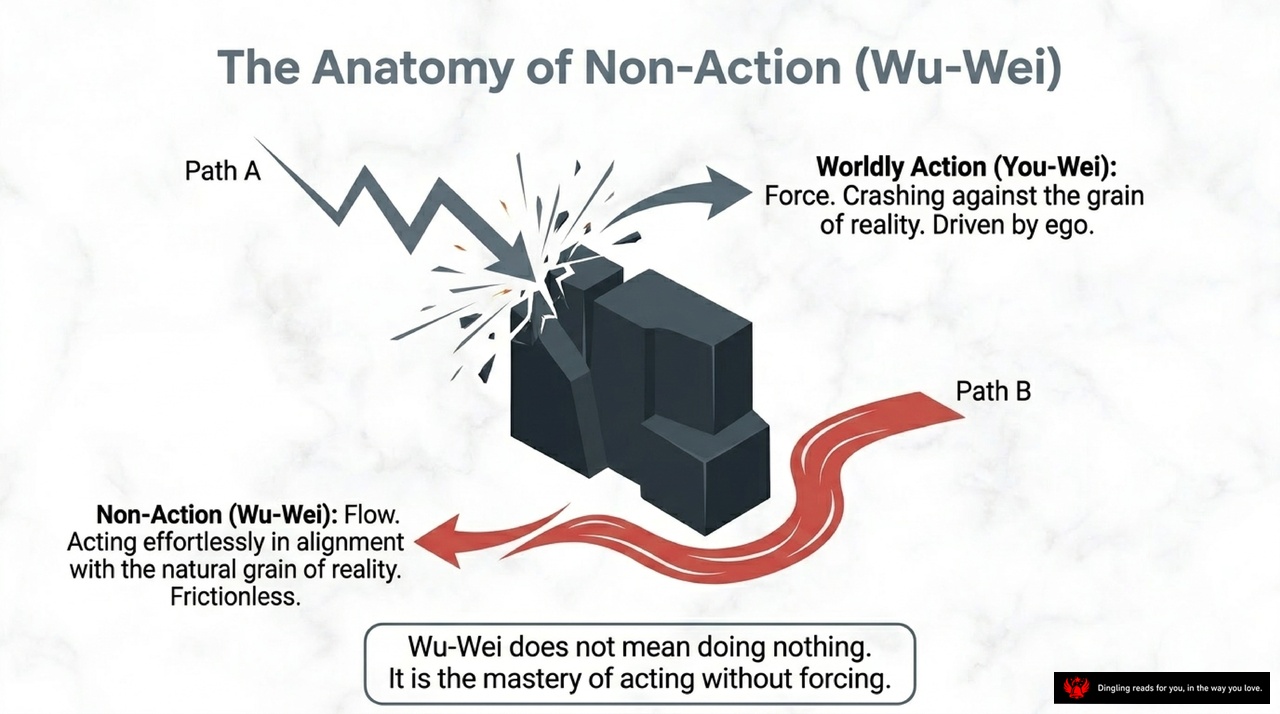
Look at this slide. We are breaking down the core concept of Wu-Wei, often mistranslated as "non-action," but which is actually the mastery of acting without forcing. The image presents two distinct paths. Path A represents Worldly Action, or You-Wei. Here, you see a jagged, violent arrow crashing against a solid block of reality. This is forceful, ego-driven action that tries to push against the natural grain of things, resulting in friction and destruction.
In contrast, Path B illustrates Non-Action. Notice the smooth, red, flowing arrow that effortlessly curves around the obstacle. This isn't about doing nothing; it's about flow. It is acting in perfect alignment with the natural grain of reality, making the journey frictionless. As the text at the bottom reminds us, Wu-Wei is the art of moving with the current rather than fighting it. Think of it like swimming downstream versus swimming upstream. The former requires immense energy and leads to exhaustion, while the latter allows you to cover vast distances with minimal effort. True power lies not in how hard you push, but in how perfectly you align with the world around you.
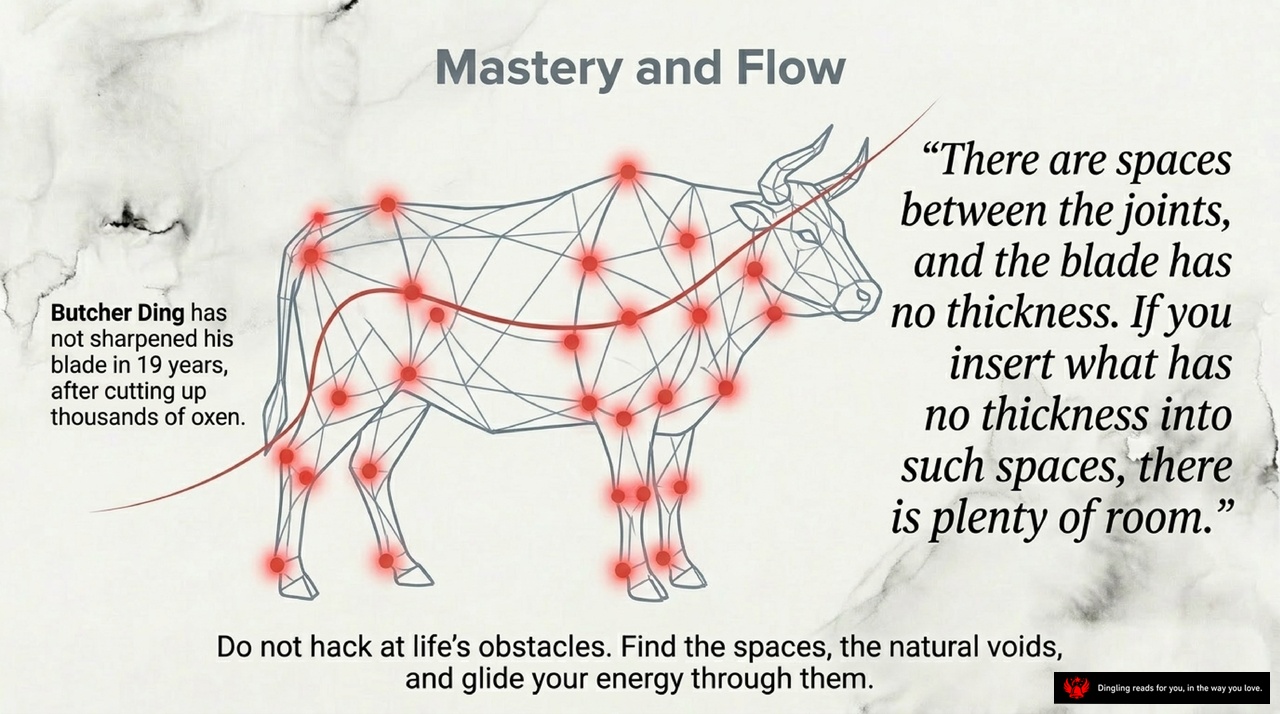
Look at this striking image of Butcher Ding. The graphic shows a cow with its joints highlighted, and a thin red line tracing the path of the blade through the natural gaps between them. This visual perfectly captures the essence of mastery and flow.
The text on the left reminds us of an incredible fact: Butcher Ding has not sharpened his blade in 19 years, even after cutting up thousands of oxen. How is that possible? The answer lies in the quote on the right. He explains, "There are spaces between the joints, and the blade has no thickness. If you insert what has no thickness into such spaces, there is plenty of room."
This is the core of his philosophy. He teaches us that we shouldn't hack at life's obstacles with force. Instead, we need to find the spaces, the natural voids, and glide our energy through them. By aligning our actions with the natural structure of the task, we move with effortless grace. When we stop fighting against reality and start flowing with it, we achieve a state where our tools never dull and our work becomes a form of art.

The Fasting of the Mind, or *Xin Zhai*, is about more than just skipping food; it's a radical reset for your perception. Look at the top of this slide: "Hearing with the Ears." This is how we usually operate—catching only surface noise, getting lost in the chaotic static of the world. But when we move to "Hearing with the Mind," represented by this complex neural network, we're still trapped. We're clouded by calculation, bias, and the urge to categorize everything we see. We try to solve every problem with logic, but that just creates more noise.
True clarity comes from the third level: "Hearing with the Spirit," or Qi. This is the core of *Xin Zhai*. It means emptying the vessel of your mind. As the slide states, "Empty, receptive, waiting for things to themselves without judgment." You stop forcing answers and let the truth reveal itself naturally. Remember the closing line: "Emptiness is the vessel that the Dao fills." You can't hold the wisdom of the universe if your mind is overflowing with your own opinions. By fasting your mind, you create the space where true understanding can finally land.
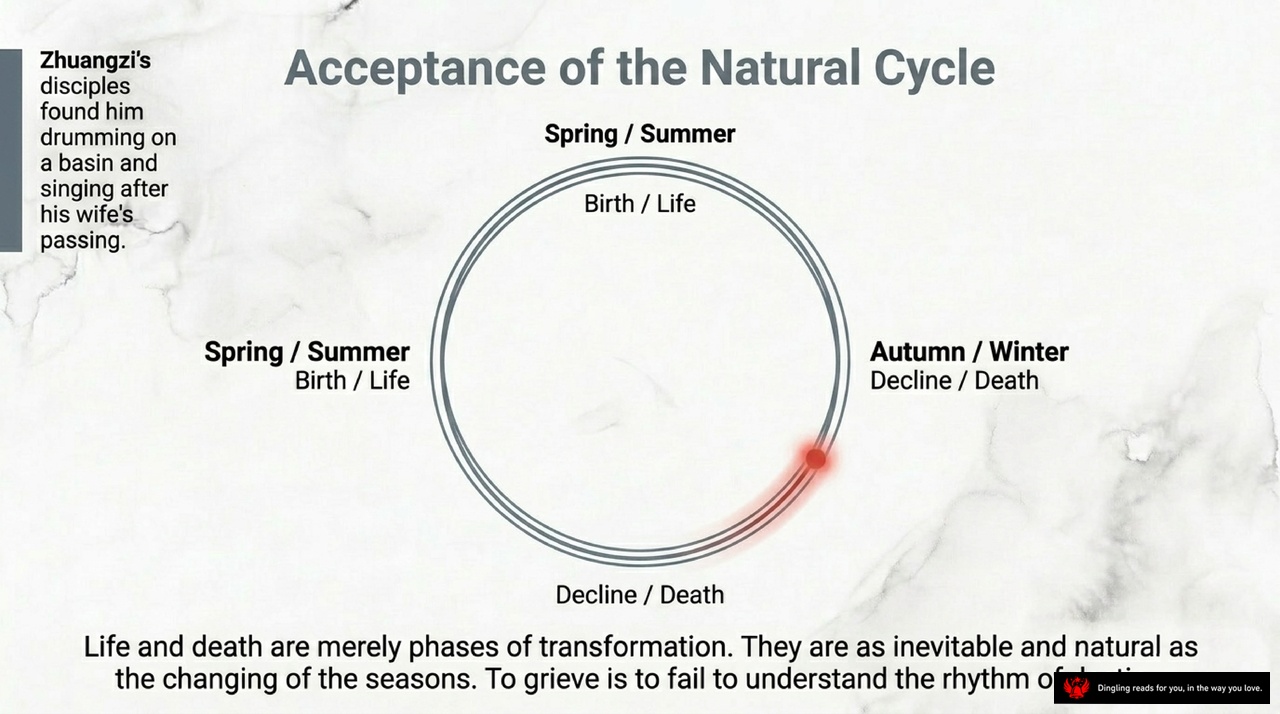
Have you ever felt that grief is a sign of weakness, a failure to move on? Today's slide challenges that very notion with the powerful image of Zhuangzi's cycle of life. Notice the circle labeled "Acceptance of the Natural Cycle," where birth and life bloom like spring and summer, while decline and death fade into autumn and winter. This isn't just a diagram; it's the core of Zhuangzi's wisdom. When his wife passed away, instead of weeping, Zhuangzi was found drumming on a basin and singing. His disciples were shocked, but he explained that life and death are merely phases of transformation, as inevitable and natural as the changing seasons. To grieve is to fail to understand this rhythm. Just as we accept the warmth of summer, we must embrace the quiet of winter. True freedom lies not in fighting the flow of nature, but in riding it. By seeing death not as an end, but as a necessary part of the great cycle, we find peace in the very inevitability of change.

Look at this diagram: the Architecture of the Perfected Person. It's not just a spiritual map; it's a blueprint for total freedom. At the very core, we have Emptiness. Think of it as the fasting of the mind. It's about creating a space of pure receptivity, a void that can hold everything without being filled by it. This inner stillness is the foundation for everything else.
Moving outward, we encounter Wu-Wei, or Non-action. This doesn't mean doing nothing; it means navigating the spaces of life by abandoning the rigid duality of good and bad, right and wrong. It's about flowing with the current rather than fighting against it. Surrounding this is the concept of Xiao Yao, which translates to free and easy wandering. This is where you find absolute spiritual autonomy. It's the ability to roam the infinite realms of existence without relying on any external object or status.
The text reminds us that the Perfected Person, the Zhi Ren, has no self. When you strip away the ego, you unlock this architecture. You stop being a slave to your own desires and the opinions of others. Instead, you become like the wind, moving through the world effortlessly. You realize that true power isn't about controlling things, but about having the freedom to let them be. This is the ultimate state of liberation, where you are completely at one with the flow of the universe.
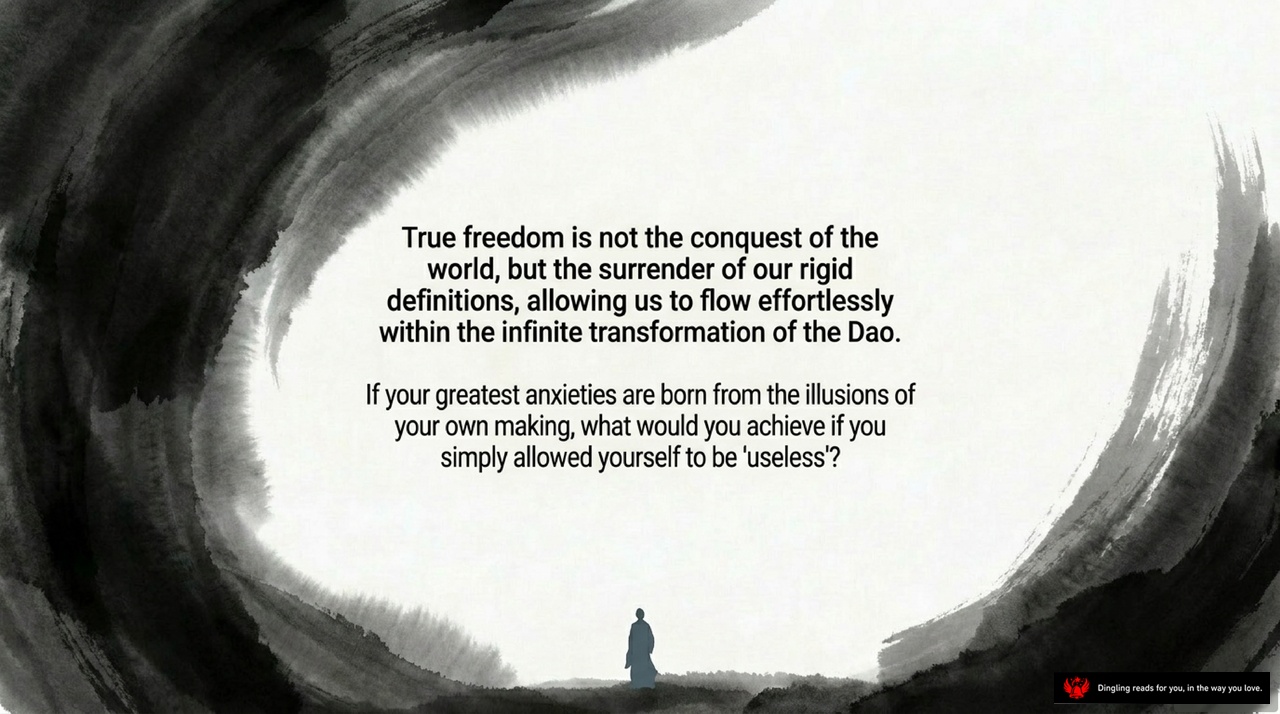
True freedom isn't about conquering the world; it's about surrendering our rigid definitions. When we let go of the boxes we've built for ourselves, we finally allow the effortless flow of the Dao. Think about your biggest anxieties right now. How many of them are actually illusions you created in your own mind? What would happen if you simply allowed yourself to be "useless"? In our high-pressure American culture, we are constantly told that our value depends on our productivity. We are terrified of being a burden or having no tangible output. But the ancient wisdom here suggests that true power often lies in letting go of that need to be useful. By embracing your "uselessness," you stop fighting against the natural rhythm of life. You stop trying to force outcomes and start trusting the infinite transformation around you. When you stop clinging to your rigid self-image, you find a freedom that no one can ever take away.