Small Data
Loading…

Small Data

Martin Lindstrom

4.61298 learners

Martin Lindstrom’s *Small Data* redefines how businesses connect with consumers by zeroing in on the tiny, overlooked details of daily life—from the way Russians arrange fridge magnets to how American grocery shoppers respond to square cakes. Across case studies spanning the U.S., Russia, India, Brazil, and China, Lindstrom reveals why big data fails to capture the emotional drivers behind behavior, while small data (observations of home spaces, social rituals, and unspoken cultural norms) unlocks hidden, unmet desires. He introduces the 7C Framework, a step-by-step method to collect, connect, and convert these micro-clues into actionable brand strategies. Whether revamping a grocery store’s community vibe, repositioning a beer brand in Brazil, or designing a car for Chinese families, Lindstrom proves that the most powerful consumer insights aren’t in spreadsheets—they’re in the unscripted moments that reveal who people truly are.
Small Data7C FrameworkConsumer InsightsCultural ObservationsBrand Strategy
The Age of Intelligence
Loading…

The Age of Intelligence

Wu Jun

41263 learners

In 'The Age of Intelligence', Wu Jun breaks down the transformative power of big data driving the global shift into an era of machine intelligence. Moving past the deterministic mechanical thinking that defined the industrial age, he introduces a data-driven mindset—prioritizing strong correlations over rigid cause-and-effect to solve complex, previously intractable problems. Through iconic examples like IBM’s Deep Blue defeating chess legend Garry Kasparov, Google’s game-changing search algorithms, and Target’s pregnancy-prediction marketing strategy, he illustrates how raw data evolves into actionable intelligence. He also explores real-world applications across industries: precision agriculture in Israel, data-driven basketball tactics with the Golden State Warriors, and smart manufacturing at Tesla. Wu doesn’t gloss over challenges, diving into storage limits, parallel computing bottlenecks, and the critical issue of privacy protection. Finally, he paints a vivid picture of the future smart society, where human-machine collaboration becomes the norm, and we must adapt to new work paradigms while safeguarding individual rights.

Machine IntelligenceBig DataPrivacy ProtectionSmart ManufacturingData-Driven Approach
Great Country, Great People
Loading…

Great Country, Great People

Wang Zhigang

3.41184 learners

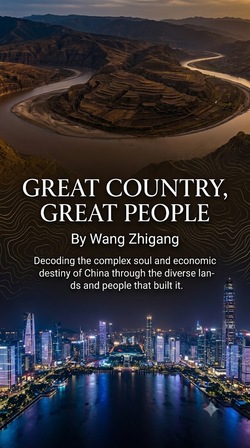
From the ancient cultural bedrock of Shaanxi to the tech-driven transformation of Guizhou, *Great Country, Great People* by Wang Zhigang delivers a vivid, on-the-ground exploration of China’s diverse regions and the people who define its identity. Drawing on decades as a journalist and strategic planner, Wang takes readers on a cross-province journey, unpacking how geography, history, and local traditions forged distinct regional personalities—from the stoic resilience of Shaanxi’s "old soup" civilization to the entrepreneurial grit of Zhejiang’s merchants. He confronts Western misconceptions, arguing China is far from a monolith; it’s a complex tapestry of overlapping cultures, each with unique struggles and triumphs. By examining historical legacies and modern challenges—like Northeast China’s industrial decline and Shanxi’s shift from coal to tourism—Wang provides a nuanced key to understanding China’s past, present, and future, making this book essential for anyone seeking a deeper, more accurate view of one of the world’s most dynamic nations.

Regional CultureChinese CivilizationJin MerchantsHunanese EliteGreater Bay Area
Big Data
Loading…

Big Data

Viktor Mayer-Schönberger;Kenneth Cukier

41087 learners

In *Big Data*, Kenneth Cukier breaks down the seismic shift from small-data thinking to the era of massive, unfiltered information. He argues that the centuries-old reliance on random sampling—once a necessity due to limited tools—has become a barrier, as modern technology lets us analyze full datasets instead of just subsets. Cukier outlines four core principles: embracing data volume over strict precision, prioritizing correlation (predictive patterns) over rigid causal explanations, digitizing every aspect of life to unlock hidden value, and leveraging data’s secondary uses for unprecedented insights. Using relatable examples—from Google’s real-time flu tracking to Walmart’s hurricane-season product correlations, and UPS’s predictive vehicle maintenance—he shows how big data transforms industries from healthcare to retail. He also confronts critical challenges: privacy risks in an era of permanent digital footprints, the danger of "data dictatorship," and the need for new ethical frameworks to balance innovation and responsibility.

Full-data modeCorrelation analysisData digitizationData reutilizationDifferential privacy
The Pinnacle of Data
Loading…

The Pinnacle of Data

Tu Zipei

01083 learners

From the U.S. founding fathers tying population data to republican governance to the rise of smart cities, *The Pinnacle of Data* traces data’s extraordinary journey as a transformative force in politics, business, and society. Starting with the 1787 Constitutional Convention’s Great Compromise and the controversial 3/5 Clause, the book unpacks how census data balanced state power and shaped early American democracy. It moves through pivotal eras: the Civil War, where data fueled debates over slavery and guided Lincoln’s military strategies; the Gilded Age, where Herman Hollerith’s punch-card tabulator birthed IBM; the Progressive Era, where cost-benefit analysis sparked ethical debates over life valuation; and the sampling revolution that propelled Gallup’s polls and Deming’s quality management, which revitalized Japan’s economy. The book also explores data openness movements, the explosion of big data, and smart city initiatives in both the U.S. and China, revealing how data evolved from a political tool to a core driver of modern governance, innovation, and equitable progress.

Cost-benefit analysisIBMOpen DataBig DataPopulation Census
Method

Bloom Filter Workflow

1. Initialize all bits of a long binary vector to 0 2. Map each element to 8 different positions and set those bits to 1 3. Check if all 8 mapped bits of a new element are 1 to judge membership.

OperationBig DataData Structure
Concept

Data Hybridity

It means accepting moderate inaccuracy and messy unstructured data instead of chasing absolute precision, to unlock the value of 95% non-standard data in the digital world.

Big DataData QualityUnstructured Data
Insight

Sampling is Outdated

Random sampling was a helpless shortcut in small data era, but now it filters out valuable micro details. Full data mode has become the mainstream of information analysis.

AnalysisSamplingBig Data
Golden Sentence

We Prevent, Not Judge Future

We can use big data to prevent potential risks, but we can never judge or punish people for the possible crimes that have not happened yet.

EthicsJusticeBig Data
Scenario

Guizhou Big Data Success

Guizhou successfully built a national big data industrial cluster, attracting top tech firms like Apple, Microsoft and BAT to set up their data centers here.

Digital EconomyTech IndustryGuizhou
Concept

Bloom Filter

It uses a long binary vector and several mapping functions to judge if an element belongs to a huge set. It only takes 1/8 to 1/4 storage space of a standard hash table, with very low false positive rate.

EfficiencyBig DataData Structure
Insight

Distributed Training Advantage

Distributed training is the only feasible way to train super large deep learning models. Splitting model or data across multiple machines lets teams scale up training speed for big datasets.

ScalingDL EngineeringDistributed Training
Concept

Full-Data Mode

It refers to analyzing all data related to a specific phenomenon instead of using random samples, achieving the effect of "sample equals population" to capture full details.

Data AnalysisSamplingBig Data
Concept

Differential Privacy

A privacy protection technology that deliberately blurs data details to output approximate results, so the processed data can not be linked to any specific individual.

TechBig DataPrivacy Protection
Insight

Old Privacy Rules Fail

The old "notice and consent" rule does not work anymore, since enterprises can never tell users all unknown secondary uses of data in advance.

regulationPrivacyBig Data
Insight

New Rules Are Needed

We need a whole new regulatory framework for big data, shifting privacy responsibility from ordinary users to data users, to balance innovation and individual rights.

InnovationregulationRight
Golden Sentence

Sample Equals Population

In the big data era, we no longer need to infer the whole from samples, we can analyze all related data to see the full picture of the fact.

InsightCore IdeaBig Data
Golden Sentence

Chaos Becomes Standard Path

To get the huge bonus brought by large scale data, accepting moderate mess and inaccuracy has become the standard way to unlock hidden value.

InsightBig DataData Value
Insight

Big Data Has Blind Spots

Big data can only show you statistical correlations, not the real emotional motivation behind behaviors. A financial firm’s big data retention model failed, because it missed clients left after divorce.

ResearchLimitationBig Data