
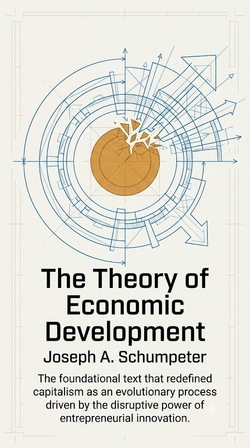
The Theory of Economic Development
Joseph A. Schumpeter’s *The Theory of Economic Development* redefines how we understand growth by rejecting static “circular flow” economic models. Schumpeter argues that true economic progress doesn’t come from incremental adjustments to existing systems, but from entrepreneurial innovation that disrupts equilibrium. He introduces the core concept of “new combinations”: five transformative acts—launching untested products, adopting novel production methods, opening untapped markets, securing new raw material sources, and restructuring industries—that drive economic change. The book explains how credit creation enables entrepreneurs to redirect existing resources toward these innovations, frames entrepreneurial profit as a temporary reward for breaking economic inertia, and positions interest as a derivative of these profits. Finally, Schumpeter ties economic cycles to clustered waves of innovation, showing how bursts of entrepreneurial activity spark booms, followed by recessions as the economy adapts to new structures. This foundational work elevates the entrepreneur as the critical engine of economic transformation.