
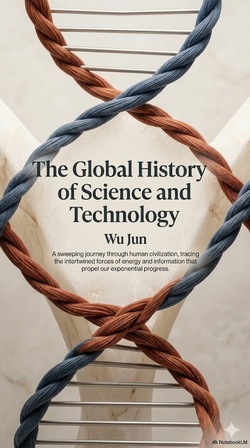
The Global History of Science and Technology
Loading…

The Global History of Science and Technology

Jun Wu

3.41039 learners

Spanning from humanity’s first stone tools to cutting-edge gene editing and quantum communication, *The Global History of Science and Technology* traces how technological breakthroughs have shaped every era of human civilization. Starting with the 1.76-million-year-old Acheulean handaxe and controlled fire use that let early humans expand beyond Africa, it moves through agricultural revolutions, the rise of metallurgy, and the birth of systematic scientific methods in ancient Greece and the Islamic Golden Age. The book highlights pivotal moments like the Industrial Revolution’s steam engines, Einstein’s relativity, the atomic age, and the digital revolution’s computers and internet. It also explores emerging technologies—CRISPR, quantum communication, artificial photosynthesis—and their ethical implications. More than a timeline, it connects tech advancements to social shifts, from early settlement to modern globalization, showing how science has always been intertwined with human survival, progress, and ambition.
Industrial RevolutionNuclear EnergyQuantum mechanicsAgricultural RevolutionQuantum Communication
The Evolution of Physics
Loading…

The Evolution of Physics

Albert Einstein;Leopold Infeld

4.31025 learners

Co-authored by Albert Einstein and Leopold Infeld, *The Evolution of Physics* takes readers on a captivating, accessible journey through the most transformative shifts in physical thought. Starting with Aristotle’s intuitive, long-dominant views on motion, it traces how Galileo’s experimental rigor laid the groundwork for Newton’s classical mechanics—establishing laws that governed our understanding of the macro world for centuries. The book then explores the cracks in this "mechanical view": the rise of thermodynamics and electromagnetic theory, which challenged the idea that all phenomena could be reduced to particle interactions. It delves into the revolutionary concepts of fields, Einstein’s special and general relativity (redefining space, time, and gravity as curved spacetime), and the birth of quantum mechanics, which upended deterministic views with wave-particle duality and probability waves. More than a textbook, it focuses on the evolution of ideas, making complex physics approachable for anyone curious about how we’ve unlocked the universe’s secrets.

General Relativitywave-particle dualityClassical MechanicsQuantum TheoryField Concept
Insight

Newton Started Mechanical Thinking

Newton’s classical mechanics brought the mechanical thinking revolution, which regarded the universe as a precision clock running by fixed rules, broke medieval theological superstition and guided later industrial inventions.

Scientific RevolutionNewtonClassical Mechanics
Concept

Galileo's Inertia Law

Refined by Newton later, this rule states an object keeps static or uniform linear motion if no external force acts on it. It breaks the old wrong idea that force is needed to sustain motion.

MotionClassical MechanicsInertia
No more