

The Aesthetics of Chinese Life
Loading…

The Aesthetics of Chinese Life

Liu Yuedi

3.8807 learners

Drawing from ten insightful lectures, *The Aesthetics of Chinese Life* reveals how beauty is not an elite, distant art form but a living, breathing practice woven into every corner of everyday Chinese existence. From the rhythmic reverence for seasonal weather shifts and poetic appreciation of nature’s creatures to refined rituals of tea, dining, and curating "superfluous" objects, this book unpacks the deep philosophical roots of Chinese aesthetic thought—rooted in Confucian moral harmony, Taoist unity with nature, and Zen mindful presence. It traces how ancient ideals, like the Confucian pursuit of "perfect beauty (jinshan jinmei)" and the Taoist vision of "unity of man and nature," have shaped traditions from garden design to letter-writing, and how these practices endure in modern life. More than a cultural survey, it invites readers to rediscover quiet, intentional beauty in routine, offering a timeless blueprint for mindful living amid modern chaos.
Chinese Life AestheticsQi CosmologyConfucian Junzi IdealTaoist Unity with NatureZen Mindfulness
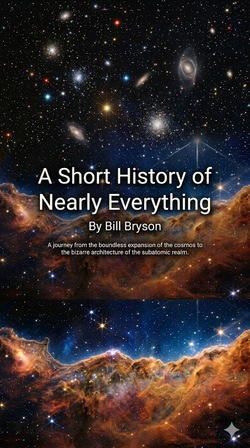
A Short History of Nearly Everything
Loading…

A Short History of Nearly Everything

Bill Bryson

4.1614 learners

Bill Bryson’s *A Short History of Nearly Everything* transforms intimidating scientific concepts into a witty, approachable journey for every curious reader. Ditching dry textbook jargon, Bryson weaves together tales of cosmic origins, planetary formation, the rise of life on Earth, and the quirky, often overlooked stories of the scientists who unlocked these secrets. From the mind-bending physics of the Big Bang to the messy, miraculous process of evolution, he breaks down complex ideas—like quantum mechanics or plate tectonics—into relatable anecdotes and plainspoken explanations. Whether you’re a science novice or casual enthusiast, this book demystifies everything from subatomic particles to the vastness of the universe, proving science is a story of curiosity, failure, and awe that connects us all to the history of nearly everything.

EvolutionQuantum PhysicsCosmologyPlanetary ScienceBig Bang
View

Universe Self-Creates

Hawking says the universe can create itself from nothing. Quantum laws allow particles to pop into existence, and gravity’s negative energy balances matter’s positive energy.

CosmologyQuantumGod
Scenario

Cosmic Background Radiation

1965 discovery of 2.7K microwave radiation—Big Bang leftover heat—confirmed the Big Bang theory.

ExperimentCosmologyBig Bang
View

Science And Myth No Conflict

The real conflict is between outdated ancient cosmology and modern science, not science and religion. Myths should absorb modern science to stay meaningful for contemporary people.

ReligionScienceModern Life
Insight

Pre-Big Bang Scenario

String theory suggests the universe started as cold, expanded space before contracting into the hot Big Bang.

CosmologyString theoryPre-Big Bang
Concept

Spearman's Law Definition

Max Spearman's core idea: individual growth (ontogeny) repeats the universe's development (cosmogeny). It shapes George's upbringing.

GrowthCosmologySpearman's Law
Concept

Inflation Theory

Early universe expanded exponentially (10^30 times in 10^-35 seconds). Solves uniformity and flatness problems of the Big Bang.

ExpansionCosmologyBig Bang
Quote

Universe Creates Itself

Hawking: 'The universe can and will create itself from nothing. Spontaneous creation is the reason there is something rather than nothing.'

CosmologyOriginQuantum
Scenario

Hubble’s Expansion

Hubble observed galaxies moving away from us. The farther they are, the faster they move—proving the universe is expanding.

ExpansionCosmologyHubble
Concept

Omega Point Theory

The theory that at the final collapse of the universe, infinite space oscillation will provide unlimited computing resources, allowing intelligent life to complete infinite calculation and gain infinite subjective experience.

FutureCosmologyOmega Point