
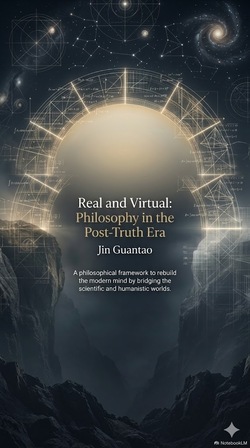
Reality and Virtuality
Jin Guantao’s *Reality and Virtuality*—the second volume of his Authenticity Philosophy project—chronicles a decades-long intellectual evolution from systems theory to a groundbreaking framework for tackling today’s truth crisis. Born from 1980s Chinese philosophical debates and a later realization that systems evolution theory failed to account for the unique dynamics of life, society, and thought, this book redefines truth not as objective reality, but as a dynamic relationship between subject, control methods, and object. Guantao introduces the "arch model" to explain how scientific truth bridges empirical experience and mathematical symbols, with repeatable controlled experiments as the critical keystone. He breaks truth into three distinct domains—scientific, social, and personal—each governed by its own repeatability standards. The work confronts virtual worlds, arguing their experiences hold validity if rooted in repeatable control, and dissects AI’s inherent limits, showing it can never achieve true consciousness as it lacks subjective agency. As a methodological bridge in his trilogy, this book blends Chinese philosophical traditions with modern science, offering a path to rebuild a coherent sense of truth amid digital disruption and the growing rift between science and humanity.