
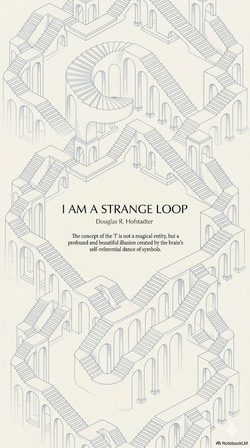
I Am a Strange Loop
Douglas Hofstadter’s *I Am a Strange Loop* masterfully bridges Gödel’s mathematical incompleteness theorem with the mystery of human self-awareness. Through intimate personal stories—from his teenage distress over lab guinea pigs to the profound grief of losing his wife—Hofstadter argues that the 'I' we cherish isn’t a physical thing, but an abstract 'strange loop': a self-referential feedback loop of brain symbols that creates the illusion of a unified self. He introduces the 'Hennekes' scale to quantify soul 'size', framing consciousness as a spectrum tied to empathy and cognitive complexity, not an all-or-nothing trait. Exploring downward causation, he shows how high-level abstract patterns (like mathematical truths or personal desires) drive physical actions, pushing back against reductionist views. Hofstadter also dives into identity entanglement, explaining how close relationships merge our self-loops, and debunks myths of free will and dualistic consciousness, offering a radical, science-backed vision of what it means to be 'you'.