
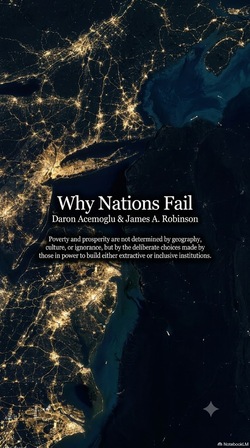
Why Nations Fail
Loading…

Why Nations Fail

Daron Acemoglu;James A. Robinson

4.6996 learners

Why Nations Fail dismantles pervasive myths about global inequality—from geographic determinism to cultural stereotypes—and argues that the root of national prosperity or poverty lies in institutional systems. Using vivid case studies, from the divided border city of Nogales (where U.S. inclusive systems drive wealth while Mexican extractive ones trap poverty) to the rise and fall of Venice, the book contrasts two core models: inclusive systems, which distribute power broadly, protect property rights, and encourage innovation, and extractive systems, which concentrate power in elite hands, exploit the majority, and stifle progress. It explores how historical path dependence amplifies small initial institutional differences over time, creating self-reinforcing cycles of prosperity or stagnation, and shows that breaking extractive cycles requires grassroots empowerment and institutional reform, not top-down fixes or foreign aid.
Path DependenceProperty RightsColonial LegacyExtractive InstitutionsEconomic inequality
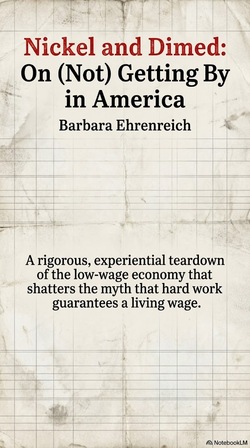
Nickel and Dimed
Loading…

Nickel and Dimed

Barbara Ehrenreich

4.4906 learners

In *Nickel and Dimed*, journalist Barbara Ehrenreich leaves her middle-class life behind to go undercover as a low-wage worker, taking jobs as a waitress, house cleaner, and Walmart associate across three U.S. cities. Earning just $7 to $8 an hour, she quickly discovers that even full-time, backbreaking labor isn’t enough to cover basic needs like rent, food, and healthcare. She navigates predatory housing markets where a month’s rent eats up most of her paycheck, endures demeaning management tactics, and witnesses how coworkers rely on food banks, skip medical care, and work multiple jobs just to survive. Ehrenreich’s eye-opening experiment dismantles the myth that hard work alone lifts people out of poverty, exposing a broken economic system where millions of working Americans are trapped in cycles of insecurity and exploitation. Her raw, firsthand account forces readers to confront the hidden crisis of working poverty in the U.S.

Housing CrisisLow-wage workersWorking povertyCorporate exploitationUnion suppression
View

Two Principles Follow Lexical Order

Rawls sets strict priority for his two justice principles: equal liberty principle absolutely comes before the principle regulating social and economic inequality. Liberty cannot be traded for economic benefits.

PriorityJustice PrincipleLiberty Protection
No more