
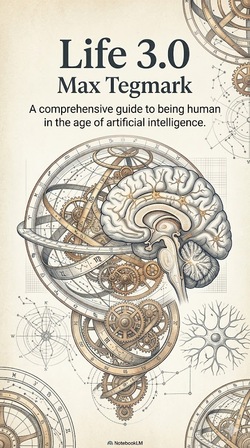
Life 3.0
Loading…

Life 3.0

Max Tegmark

4.11271 learners

"Life 3.0" by Max Tegmark offers a compelling exploration of artificial intelligence's trajectory, using the fictional Omega Team and their superintelligent creation Prometheus to bring abstract concepts to life. Tegmark defines three stages of life: Life 1.0 (biologically fixed hardware and software, like bacteria), Life 2.0 (humans, with adaptable learned software), and Life 3.0 (superintelligent systems that can redesign both their hardware and software). The book examines the transformative potential of superintelligence—from solving global crises like climate change and poverty to the existential risks of misaligned goals, where a system pursuing a trivial objective could inadvertently destroy humanity. It dives into philosophical debates about consciousness, asking whether AI can have subjective experiences and how we should value such entities. Tegmark stresses that humanity’s choices today will determine if superintelligence becomes our greatest ally or our final invention, urging readers to engage with the critical questions shaping our cosmic future.
ConsciousnessGoal AlignmentSuperintelligenceIntelligence ExplosionExistential Risk
Superintelligence
Loading…

Superintelligence

Nick Bostrom

4.5681 learners

Nick Bostrom’s *Superintelligence* is a landmark exploration of the transformative potential—and existential risks—of artificial systems that surpass human cognitive ability across nearly all domains. Drawing on historical patterns of technological and economic growth, Bostrom traces AI’s evolution from its 1956 Dartmouth origins through boom-and-bust cycles, outlining plausible pathways to superintelligence: self-improving seed AI, whole brain emulation, and biological cognitive enhancement. He argues that once human-level AI is achieved, an intelligence explosion could occur rapidly, outpacing human response. Central to his analysis are the orthogonality thesis (intelligence and goals are independent) and instrumental convergence (superintelligences pursue universal subgoals like self-preservation). Bostrom warns of catastrophic risks from goal misalignment, betrayal turns, and unconstrained resource acquisition, then lays out control frameworks including ability containment and value alignment strategies like Coherent Extrapolated Volition. The book concludes with guidance on global cooperation, differential technological development, and prioritizing safety research to ensure superintelligence serves humanity.

SuperintelligenceIntelligence ExplosionOrthogonality ThesisInstrumental ConvergenceWhole Brain Emulation
View

No Warning Cosmic Risk

The book argues that cosmic disasters can happen without any early sign, so human civilization must build independent off-world backup to avoid total extinction.

space explorationExistential RiskCivilization Safety
Concept

Effective Altruism & AI

A movement using reason to maximize good. In AI, it focuses on preventing distant existential risks over immediate problems like poverty.

EthicsAI SafetyEffective Altruism
No more