
Ludwig Wittgenstein
Loading…

Ludwig Wittgenstein

Ray Monk

4.21060 learners

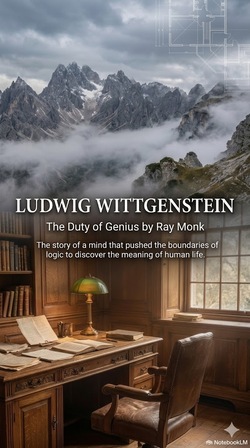
Ray Monk’s definitive biography traces Ludwig Wittgenstein’s extraordinary life—from his privileged yet tormented Viennese childhood, marked by family tragedy and a lifelong obsession with moral truth, to his ascent as one of the 20th century’s greatest philosophers. We follow his journey from engineering student to Bertrand Russell’s protégé at Cambridge, the creation of his groundbreaking *Tractatus Logico-Philosophicus* amid WWI trenches, his post-war rejection of vast wealth to teach rural Austrian children, and his dramatic late-career shift to the pragmatic, language-centered philosophy of *Philosophical Investigations*. Monk vividly captures Wittgenstein’s volatile spirit: his relentless self-scrutiny, religious awakening, struggles with loneliness and identity, and uncompromising commitment to resolving the deepest philosophical puzzles. This biography isn’t just a chronicle of ideas—it’s a portrait of a man whose life and thought were inextricably woven, driven by a desperate quest to live honestly and make sense of the world.
Family ResemblanceAspect PerceptionTractatus Logico-PhilosophicusPhilosophical InvestigationsLanguage Games
Philosophical Investigations
Loading…

Philosophical Investigations

Ludwig Wittgenstein

4.5677 learners

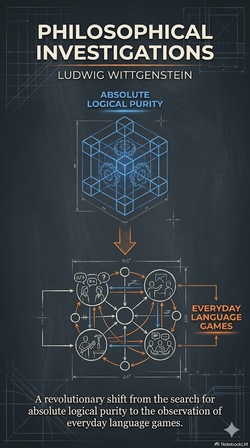
Ludwig Wittgenstein’s *Philosophical Investigations* upends traditional theories of language and meaning, rejecting his own earlier "picture theory" to argue that words gain significance not by corresponding to abstract entities, but through their use in everyday "language games"—interwoven acts of speech and action tied to specific life forms. Using vivid examples like Augustine’s account of language learning, the builder-assistant dialogue, and the duck-rabbit illusion, Wittgenstein dismantles the myth of a universal language essence. He introduces "family resemblance" to explain how concepts like "game" lack a shared core, linking instead through overlapping similarities. The work debunks private language, showing meaning depends on shared rules and public context. Ultimately, Wittgenstein frames philosophy not as a theory-building discipline, but as a "therapy" to dissolve confusion caused by linguistic misuse, guiding readers back to concrete, everyday word uses that give language its true purpose.

Language GameFamily ResemblancePrivate Language ArgumentPhilosophical TherapyAspect Perception
Concept

Family Resemblance

For concepts like 'game', no shared essence—only overlapping similarities (like family members). Rejects traditional essentialism.

EssenceConceptLater Philosophy
Concept

Family Resemblance

Games don’t share a single essence—they have overlapping similarities like family members (some eyes, some nose, no common trait).

SimilarityConceptGames
No more