
Capitalism and Freedom
Loading…

Capitalism and Freedom

Milton Friedman

4.21127 learners

In *Capitalism and Freedom*, Nobel Prize-winning economist Milton Friedman dismantles the myth that politics and economics operate independently, arguing that economic freedom is not just a path to prosperity—it’s the bedrock of political liberty. He critiques decades of government overreach, from the New Deal’s interventionist policies to occupational licensing, mandatory Social Security, and progressive taxation, showing how these measures erode individual choice and stifle innovation. Friedman reframes the Great Depression as a failure of Federal Reserve policy, not inherent flaws in capitalism, and outlines a vision of limited government: acting as a rule-maker and referee, addressing only market failures like externalities or natural monopolies, while leaving most economic activity to voluntary exchange. He proposes concrete reforms—school vouchers to expand educational choice, a negative income tax to replace inefficient welfare programs, floating exchange rates for global trade—to restore freedom and equity, proving that free markets protect minorities, check concentrated power, and deliver greater prosperity than centralized control.
Free Market CapitalismEconomic FreedomPolitical LibertyLimited GovernmentSchool Vouchers
A Monetary History of the United States
Loading…

A Monetary History of the United States

Milton Friedman;Anna Jacobson Schwartz

4.51098 learners

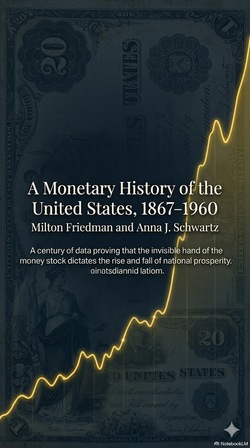
Co-authored by Milton Friedman and Anna J. Schwartz, *A Monetary History of the United States* is a landmark work spanning 93 years of U.S. economic and financial history (1867–1960). Through rigorous empirical analysis, the book traces fluctuations in the money supply and their profound, often underrecognized, impact on pivotal events—from the paradoxical Greenback Era where deflation coincided with rapid economic growth to bitter gold-silver debates, the creation of the Federal Reserve, the catastrophic policy failures of the Great Depression, and post-WWII monetary policy evolution. Challenging conventional wisdom, Friedman and Schwartz argue that changes in the money stock are independent drivers of economic booms and busts, not just passive responses to shifts. This seminal text redefined monetary policy’s role, offering timeless insights into how monetary decisions shape national prosperity and crisis.

Monetary PolicyGreat DepressionGold standardMonetary StockFederal Reserve System
The Great Game
Loading…

The Great Game

John Steele Gordon

3.81075 learners

John Steele Gordon’s *The Great Game* delivers an electrifying, page-turning account of Wall Street’s evolution—from its gritty beginnings as a Dutch defensive wall in 17th-century New Amsterdam to its ascent as the world’s dominant financial hub. Gordon brings to life the larger-than-life figures who shaped its destiny: Alexander Hamilton, whose bold fiscal framework turned a fledgling nation into an economic powerhouse; Cornelius Vanderbilt, the tough-as-nails shipping tycoon who outmaneuvered Wall Street’s shadiest speculators to control railroads; and J.P. Morgan, the legendary banker who rescued America from catastrophic financial panics. He doesn’t sugarcoat the chaos: the tulip bubble’s lasting legacy, the 1929 stock market crash, the 2008 subprime crisis, and the endless battle between regulation and unbridled greed. More than a history of a street, this book is a chronicle of America itself—how financial innovation, ambition, and resilience forged the nation’s identity and global influence.

J.P. MorganWall StreetFederal ReserveGreat DepressionSpeculation
Insight

Federal Reserve's Origin

The book implies the 1907 panic (saved by Pierpont) showed need for a central bank, leading to Federal Reserve's 1913 creation.

Federal Reserve1907 PanicCentral Bank
Golden Sentence

Fed's Great Depression Mistake

"The Great Depression was not an inevitable outcome of economic decline but largely an independent factor exacerbated by Federal Reserve's policy errors."

Great DepressionFed PolicyError
Concept

Federal Reserve Act1913

Created US central bank (Fed) to address 'inelastic' money supply. Designed to provide liquidity during crises, replacing 1908 Aldrich-Vreeland Act.

banking reformFed Creation1913 Act
Scenario

1907 Panic: Pierpont as Central Bank

In 1907, 70yo Pierpont rushed back to NYC to save Wall Street. He locked trust execs to force rescue funds, working 19h/day with a cold. This led to Federal Reserve's creation.

Pierpont Morgan1907 PanicFed Origin
Concept

Bank Holding Company

A regulated financial structure that gives firms access to the Federal Reserve’s low-cost discount window for stable emergency funding during market panics.

regulationMorgan StanleyGoldman Sachs
Scenario

1907 Banking Crisis Impact

Trust company runs in NY spread nationwide. NY banks limited cash withdrawals. Crisis exposed 'inelastic' money supply, pushing Congress to create Federal Reserve System.

1907 CrisisFed CreationBanking
Insight

Great Depression Was Man-Made

The Great Depression was not caused by free market flaws. The Federal Reserve made a huge mistake, letting total money supply drop by 1/3 between 1929 and 1933, and turned a mild recession into a national disaster.

Great DepressionFed Policymonetary history
Scenario

Bear Stearns $2 Fire Sale

In March 2008, JPMorgan bought collapsing Bear Stearns for just $2 per share, with the Federal Reserve taking on $30 billion of its toxic bad assets, the first major crisis rescue.

RescueBear StearnsAcquisition
No more