
Cybernetics
Loading…

Cybernetics

Norbert Wiener

4.41045 learners

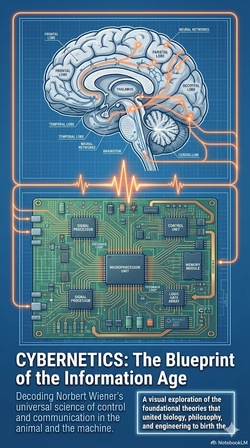
Norbert Wiener’s *Cybernetics*—the cornerstone of the information age—revolutionizes our understanding of control, communication, and order across machines, biological systems, and societies. First published in 1948 (with a revised 1961 edition), this seminal work breaks down disciplinary silos by identifying shared feedback-driven mechanisms governing everything from human motor functions to automated engineering systems. A polymath blending math, engineering, biology, and philosophy, Wiener introduces core concepts like negative entropy (information as a counterforce to disorder), black box analysis, and the statistical nature of control. The revised edition expands into cutting-edge territory, exploring learning machines (early AI prototypes that outperform their designers) and self-organizing systems, where order emerges spontaneously from nonlinear interactions. Beyond technical innovation, *Cybernetics* challenges mechanical determinism, laying the groundwork for fields like artificial intelligence, robotics, biocybernetics, and social systems theory, while prompting critical reflections on automation’s ethical and societal impacts.
CyberneticsFeedback MechanismInformation TheoryNegative EntropyLearning Machine
Gamification Marketing
Loading…

Gamification Marketing

Hu Huacheng

2.7958 learners

Gamification Marketing taps into humanity’s innate love of play to transform stale, pushy advertising into immersive, engaging experiences that drive customer action. Unlike traditional marketing that makes consumers feel pressured, this approach leverages core game mechanics—including instant feedback loops, flow states, achievement recognition, and social connection—to meet deep psychological needs. The book breaks down how to design effective gamified campaigns, from crafting compelling challenges to building layered incentive systems that balance extrinsic rewards (like discounts) and intrinsic motivation (like pride and belonging). It features real-world examples that resonate with U.S. audiences, from Barack Obama’s groundbreaking in-game campaign ads targeting young voters to McDonald’s and Tesla’s successful gamified strategies that boost brand loyalty and sales. Whether you’re a marketer, business owner, or entrepreneur, this guide shows you how to turn passive customers into active participants, foster emotional brand connections, and unlock measurable growth across industries.

Flow StateBehavioral PsychologyFeedback MechanismUser EngagementBrand Loyalty
Method

GROW Self-Coach

G (set SMART goals), R (analyze current status), O (choose paths), W (strengthen will). With feedback mechanisms to adjust.

Goal SettingGROW ModelSelf-Coach
Concept

Ponzi Process (Feedback Loop)

Past price rises boost investor confidence, leading them to buy more, push prices higher, attract others—creating a loop that amplifies initial factors.

Feedback MechanismSpeculative Bubble
Scenario

1929 Crash Not News-Driven

On crash day, Wall Street Journal reassured the public, but the crash was due to negative feedback: price drops triggered selling.

Feedback MechanismHistorical Crash
Scenario

1987 Crash Feedback

Investors saw prior price drops as key news. Portfolio insurance was essentially feedback selling to price declines.

Feedback Mechanismstock crash
Method

5 Steps For Effective Decision

1. Start with existing opinions instead of raw facts; 2. Collect different conflicting opinions; 3. Judge if action is necessary; 4. Assign clear execution responsibilities; 5. Track results with feedback mechanism.

EfficiencyDecision MakingManagement Skill
Concept

Negative Feedback Mechanism

A regulation loop that sends output deviation back to the input, to counteract current system movement and keep the system stable, like thermostats or human hand movements grabbing a cup.

StabilityFeedbackSystem Regulation
No more