
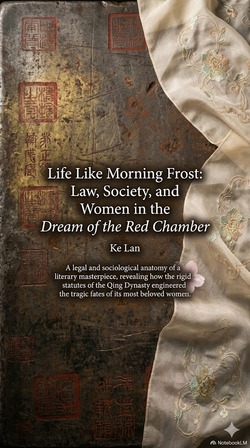
Life Like Morning Frost
Loading…

Life Like Morning Frost

Ke Lan

3.81233 learners

Life Like Morning Frost uses the unforgettable female characters from *Dream of the Red Chamber* as a lens to unpack the brutal realities of 18th-century Qing Dynasty China. From Zhen Yinglian (later Xiangling), a kidnapped girl sold into lifelong servitude, to Qin Keqing, a noble mistress trapped by scandal and patriarchal power, and the tragic You sisters, each woman’s story reveals how rigid social systems—unequal servant laws, forced marriage customs, collective punishment, and caste hierarchies—stripped women of autonomy, regardless of their class or talent. The book goes beyond literary analysis, diving into historical records and legal texts to show why even privileged women like Lin Daiyu and Xue Baochai couldn’t escape their fates, while marginalized figures like opera girls and servant wives faced even harsher cruelty. It’s a vivid, eye-opening exploration of how a deeply patriarchal society crushed countless lives, framing *Dream of the Red Chamber* as a searing critique of a broken system, not just a romance.

Qing DynastyDream of the Red ChamberFemale OppressionServant SystemPatriarchal Marriage
The Second Sex
Loading…

The Second Sex

Simone de Beauvoir

4.3876 learners

Simone de Beauvoir’s groundbreaking 1949 work *The Second Sex* upends the myth that women are “naturally” subordinate to men. Drawing on biology, history, psychology, and existential philosophy, de Beauvoir argues that “one is not born, but rather becomes, a woman”—gendered roles and the label of “the Other” are imposed by patriarchal societies, not innate traits. She traces how women have been reduced to reproductive tools, confined to domestic labor, and denied access to political, economic, and creative freedom across centuries. From ancient matriarchies to 20th-century feminist movements, de Beauvoir dissects the contradictions of male attitudes toward women—simultaneously idealizing and fearing them—and explores the psychological toll of societal conditioning on girls, wives, and mothers. More than a critique, this landmark text calls for women to claim their autonomy, reject passive “feminine” stereotypes, and forge equal, mutually respectful relationships with men. It remains a foundational voice in feminist theory, challenging readers to rethink the very fabric of gender inequality.

Female OppressionPatriarchySexual PoliticsGender ConstructionThe Other
No more