
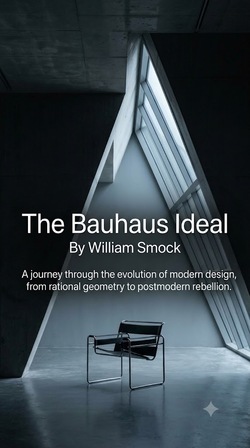
The Bauhaus Ideal
William Smock’s *The Bauhaus Ideal* explores the revolutionary German design school that redefined 20th-century art, architecture, and everyday objects. Founded by Walter Gropius post-WWI, the Bauhaus broke down long-standing walls between fine art and craft, merging artistic vision with industrial functionality. Smock introduces iconic faculty—from Wassily Kandinsky’s abstract art teachings to Mies van der Rohe’s "less is more" mantra—and tracks how many fled Nazi Germany to reshape American design at Harvard, the New Bauhaus, and beyond. The book unpacks core Bauhaus principles: form follows function, truth to materials, and democratic design for the masses. It also examines the movement’s legacy, from its mid-century American golden age to the 1970s postmodern backlash, and the gap between its egalitarian ideals and the commercialization of Bauhaus pieces as luxury collectibles in institutions like MoMA. A vivid look at how a radical school turned bold visions into the foundation of modern design we know today.