
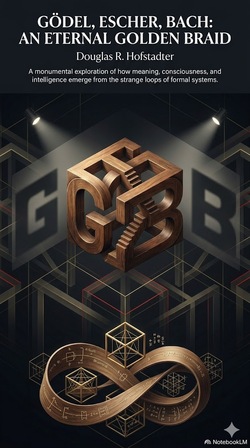
Gödel, Escher, Bach
Starting with Bach’s iconic *The Musical Offering*, Douglas Hofstadter’s *Gödel, Escher, Bach* weaves a groundbreaking cross-disciplinary narrative uniting logician Kurt Gödel, artist M.C. Escher, and composer Johann Sebastian Bach. At its core, the book explores “strange loops”—self-referential, tangled hierarchies that appear in logic, art, music, and human cognition. Hofstadter breaks down formal systems like the WJU and pq systems to explain how meaning emerges from abstract rules, then dives into Gödel’s incompleteness theorems, showing how self-reference undermines perfect logical consistency. He extends these ideas to the human brain, linking neural networks to symbolic thought and framing consciousness as a product of layered loops, while exploring implications for artificial intelligence, from the Church-Turing Thesis to early programs like SHRDLU. Blending rigorous logic, playful dialogues, and vivid examples, the book reveals how disparate fields converge on universal truths about understanding’s limits and possibilities.