
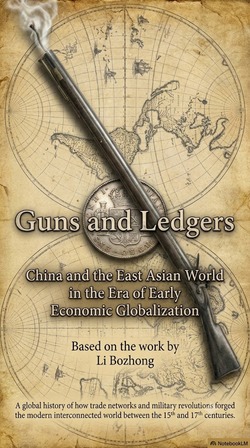
Muskets and Ledgers
Loading…

Muskets and Ledgers

Li Boyong

31303 learners

From the rise of global history as a field to the untold story of early economic globalization, *Muskets and Ledgers* redefines how we view pre-17th-century East Asia. Moving beyond traditional nation-state narratives, this book weaves together two powerful forces: the spread of firearm technology (the "muskets") and interconnected global trade networks built on silver and merchant enterprise (the "ledgers"). It debunks the myth of Ming-era Chinese isolationism, revealing China as the linchpin of early global commerce—by the 18th century, half the world’s silver flowed into its coffers. The text explores shifting East Asian cultural spheres, the crippling border crises facing the late Ming, and the mixed successes of its military reforms: innovations that later propelled the Qing Dynasty to dominance, only to stagnate and set the stage for 19th-century decline. Packed with vivid case studies, from the Manila Galleon trade to the Sino-Japanese Korean War, it offers a sharp, timely look at globalization’s dual nature of opportunity and conflict.
Qing DynastyEarly Economic GlobalizationFirearm TechnologySilver TradeLate Ming Dynasty
The Global History of Science and Technology
Loading…

The Global History of Science and Technology

Jun Wu

3.41039 learners

Spanning from humanity’s first stone tools to cutting-edge gene editing and quantum communication, *The Global History of Science and Technology* traces how technological breakthroughs have shaped every era of human civilization. Starting with the 1.76-million-year-old Acheulean handaxe and controlled fire use that let early humans expand beyond Africa, it moves through agricultural revolutions, the rise of metallurgy, and the birth of systematic scientific methods in ancient Greece and the Islamic Golden Age. The book highlights pivotal moments like the Industrial Revolution’s steam engines, Einstein’s relativity, the atomic age, and the digital revolution’s computers and internet. It also explores emerging technologies—CRISPR, quantum communication, artificial photosynthesis—and their ethical implications. More than a timeline, it connects tech advancements to social shifts, from early settlement to modern globalization, showing how science has always been intertwined with human survival, progress, and ambition.

Industrial RevolutionNuclear EnergyQuantum mechanicsAgricultural RevolutionQuantum Communication
Concept

What is Global History?

A 20th-century US historical school breaking national boundaries to view the world as interconnected networks, rejecting Eurocentrism and focusing on cross-cultural interactions.

Global HistoryHistorical SchoolInterconnectedness
Concept

Kondratiev Cycles

Long-term economic cycles (expansion/contraction) affecting global economies—e.g., the 17th-century silver crisis (B phase) led to Ming Dynasty collapse.

Global HistoryEconomic CyclesKondratiev
View

1260 Is World History Turning Point

Core claim: The year 1260 completely changed global history. After Ariq Boke and Kublai’s succession conflict, the unified Mongol empire turned into a loose Eurasian federation, and pushed Kublai to create a new maritime trade system.

Kublai KhanWorld History
View

Mongol System Is Not Stable

Core claim: The Mongol Eurasian system collapsed not just because of Black Death, but because it was too premature for the 14th century, without modern transport or communication to rule the 10,000km wide territory.

Mongol CollapseGlobal History
Golden Sentence

Mongol Linked Eurasia First

More than 2 centuries earlier than the Age of Discovery, the Mongol Era first connected the entire Eurasian world as one single integrated network.

Mongol EraGlobal History
Method

Global Holistic Approach

The book uses a global holistic framework to analyze history—focusing on cross-regional connections instead of Eurocentric regional studies.

Global HistoryResearch MethodHolism
No more