
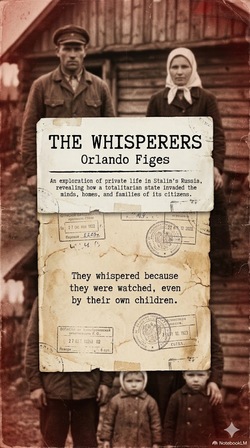
The Whisperers
Loading…

The Whisperers

Orlando Figes

4.7886 learners

Orlando Figes’ *The Whisperers* delivers an intimate, unflinching portrait of ordinary Soviet families navigating the brutal tides of totalitarian rule, from the 1917 Bolshevik Revolution to the post-Stalin thaw. Drawing on personal diaries, letters, and oral histories, Figes centers stories like poet Konstantin Simonov’s tangled loyalty to the regime, peasant families destroyed by forced collectivization, and “enemies of the people” survivors grappling with lifelong trauma. The book exposes how Stalin’s regime infiltrated every corner of private life—eroding family bonds, fostering a culture of betrayal and whispered secrecy, and forcing individuals to choose between survival and conscience. It humanizes the grand, brutal history of the Soviet Union, revealing the quiet resilience, guilt, and longing that defined daily life for millions under oppressive rule.
StalinismSoviet UnionGulagCollectivizationGreat Terror
Gulag: A History
Loading…

Gulag: A History

Anne Applebaum

4.2509 learners

Anne Applebaum’s *Gulag: A History* is a definitive, unflinching account of the Soviet Union’s sprawling forced labor camp system, tracing its origins from post-1917 revolutionary repressions to its collapse in the late 20th century. Starting with repurposed WWI POW camps and Lenin’s directives to detain "unreliable elements," the book chronicles the Gulag’s evolution from a political tool to a core pillar of Stalin’s industrialization drive—epitomized by the deadly White Sea Canal project, where over 2.5 prisoners died. It exposes the horrors of the Great Purge, where millions were arbitrarily arrested, tortured, and sent to remote camps, as well as the system’s expansion during WWII, when foreign POWs and occupied-region civilians were added to its ranks. Applebaum also details the Gulag’s decline after Stalin’s death, driven by reforms, prisoner uprisings, and international pressure, and explores its enduring legacy in Russian society’s fractured memory of totalitarianism.

Historical MemoryTotalitarianismPolitical PrisonersGulag SystemSoviet Forced Labor
Concept

Special Settlers

Special settlers were exiled to remote areas without trial—often ethnic minorities or 'enemies of the people'—facing harsh conditions similar to Gulag prisoners.

Soviet RepressionExileSpecial Settlers
Quote

Gulag as Economic Machine

In essence, the forced labor of the Gulag was an integral part of the Soviet economic system, a cheap tool for Stalin’s industrialization.

GulagForced LaborSoviet Industrialization
Concept

What is the Gulag?

The Gulag was a vast Soviet system of labor camps and prisons, serving as both a political tool to suppress dissent and an economic asset for industrialization, operating from the 1920s to the 1980s.

GulagSoviet HistoryForced Labor
Insight

Foreign Prisoners' Plight

Foreign prisoners (like German POWs) in the Gulag were denied international law protections, facing worse treatment than Soviet prisoners and being forgotten.

GulagInternational LawForeign Prisoners
Insight

Memory Prevents Recurrence

Applebaum emphasizes remembering the Gulag is crucial to prevent atrocities—silence allows repetition, so preserving stories is an act of resistance.

MemoryGulagAtrocity Prevention
Insight

Vulnerable Groups in Gulag

Women and children in the Gulag faced extra hardships—sexual violence, lack of care, higher mortality—showing the system’s cruelty to the most vulnerable.

WomenChildrenGulag Cruelty
Quote

Eggs for Revolution

"No eggs can be made without breaking eggs"—Simonov’s rationalization for the repression of his relatives during Stalin’s terror.

RepressionSimonovJustification
Scenario

Siberian Exile Survival

Evdokia and her kids survived Siberian exile by selling berries, growing potatoes, and enduring harsh winters. She even led others to grow food to survive.

SurvivalExileGulag
Insight

WWII & Gulag Expansion

WWII expanded the Gulag: prisoners were used for military production, but conditions worsened—food scarcity, disease, and high mortality showed system indifference to life.

WWIImortalityGulag Expansion
Insight

Gulag's Silent Legacy

Applebaum notes the Gulag left a culture of silence in post-Soviet society, suppressing victims' stories and hindering healing and reconciliation.

ReconciliationSilenceGulag Legacy
Quote

Lingering Gulag Shadow

Gulag's shadow lingers long after its dissolution. — The system’s impact on society, families, and culture continues to affect post-Soviet nations.

Post-SovietShadowGulag Legacy
Concept

Samizdat in Gulag Context

Samizdat refers to underground self-published literature (like Solzhenitsyn’s works) that exposed Gulag truths, bypassing Soviet censorship to spread information.

CensorshipsamizdatGulag Truths
Insight

Gulag's Dual Purpose

Applebaum argues the Gulag served two roles: eliminating political opponents and providing cheap labor for projects like the White Sea Canal, making it repressive and economic.

GulagPolitical RepressionEconomic Tool
Quote

Arrest Without Cause

This is an era where you can be arrested for no reason. — A line reflecting the arbitrary arrests during the Gulag period, with no evidence or clear charges.

GulagRepressionArbitrary Arrest