The Grand Chessboard
Loading…

The Grand Chessboard

Zbigniew Brzezinski

4.2973 learners

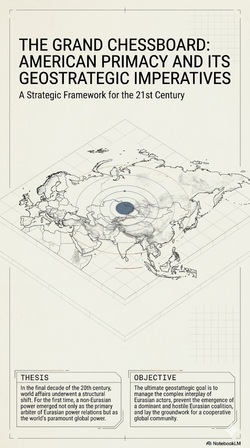
In Zbigniew Brzezinski’s seminal geopolitical work *The Grand Chessboard*, he frames Eurasia as the critical battleground for sustaining America’s status as the world’s first true global superpower. Brzezinski traces the evolution of U.S. hegemony, contrasting it with historical empires like Rome, China, and Mongolia to highlight its unique democratic, economic, and cultural foundations. He breaks down Eurasia into a strategic 'chessboard,' identifying core geostrategic players (France, Germany, Russia, China, India) and pivotal states (Ukraine, Azerbaijan, Turkey) that shape regional dynamics. The book dissects America’s key challenges: fostering a unified yet aligned Europe, guiding Russia toward integration rather than imperial revival, balancing power in Central Asia’s volatile 'Eurasian Balkans,' and managing the delicate U.S.-China-Japan triangle in East Asia. Brzezinski concludes that America must act as a stabilizing arbiter, building a cooperative framework to share global responsibility while preserving its leadership for at least a generation, noting it may be the last global superpower in history.
US-China RelationsSoviet CollapseEurasian geopoliticsglobal hegemonygeostrategic players
Hyperion
Loading…

Hyperion

Dan Simmons

4.7614 learners

Set against the backdrop of a crumbling interstellar Hegemony threatened by the aggressive Ousters, *Hyperion* follows seven disparate pilgrims bound for the forbidden world of Hyperion. Tasked with unraveling the mysteries of the Time Tombs—ancient structures moving backward through time—and the Shrike, a terrifying, blade-wielding entity that haunts the planet, each pilgrim shares their personal story during the journey. From a priest grappling with a parasitic cross that grants twisted immortality, to a soldier haunted by a mysterious lover tied to Hyperion’s secrets, a poet chasing his lost muse, and a former Consul with a tragic past on the world, their tales weave a tapestry of faith, loss, redemption, and existential dread. As they draw closer to their destination, the group faces an unseen spy among them and the looming threat of the Ousters, with the fate of the Hegemony hanging in the balance.

HegemonyThe ShrikeTime TombsCruciform ParasitePilgrims
Has China Won?
Loading…

Has China Won?

Kishore Mahbubani

4.3553 learners

Renowned Singaporean scholar Kishore Mahbubani’s *Has China Won?* dissects the high-stakes geopolitical rivalry between the U.S. and China, challenging pervasive Western myths while offering a nuanced look at both nations’ strategic missteps. Mahbubani argues the U.S. has already lost the first round of competition due to its lack of a coherent long-term China strategy, wasteful defense spending driven by lobbying, and domestic decay marked by soaring income inequality and money-dominated politics. He refutes claims of Chinese expansion, highlighting China’s historical non-imperialist roots and defensive military posture. The book also analyzes how key global players—Australia, Europe, Japan, India, and ASEAN—navigate their conflicting economic and security ties to both powers. Finally, Mahbubani identifies five critical areas of shared interest, from climate action to counterterrorism, urging both nations to prioritize cooperation over zero-sum confrontation to secure global stability and mutual prosperity.

Nuclear DeterrenceIncome InequalityBelt and Road InitiativeU.S.-China RivalryDollar Hegemony
Carthage Must Be Destroyed
Loading…

Carthage Must Be Destroyed

Richard Miles

4.6484 learners

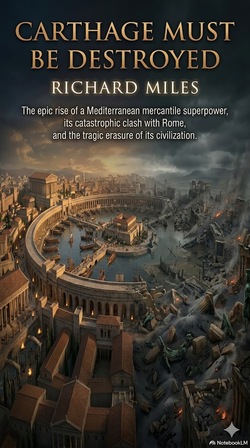
Richard Miles’ *Carthage Must Be Destroyed* traces the epic saga of Carthage, from its Phoenician roots as a dominant Mediterranean trading power to its brutal destruction at the hands of Rome. Drawing on archaeological evidence and debunking ancient Greek and Roman biases, Miles reveals Carthage’s sophisticated civilization—its oligarchic governance, innovative agricultural systems, and controversial religious practices like child sacrifice. The book chronicles the three Punic Wars, highlighting Hannibal’s daring Alpine invasion and Rome’s relentless quest for regional hegemony. Beyond warfare, it explores the cultural fusion between Carthage, Greece, and Rome, showing how Carthaginian traditions subtly shaped Roman identity long after the city’s fall. This definitive work reclaims Carthage’s rightful place in history, offering a nuanced look at a civilization that challenged Rome’s dominance and left an indelible mark on the Mediterranean world.

CarthagePhoeniciaPunic WarsHannibal BarcaRoman Hegemony
Quote

"Modernization ≠ Westernization"

"China will be the first great power to modernize on its own without Western hegemony—breaking the 'modernization = Westernization' myth."

ModernizationWesternizationChina's Path
Concept

Male Hegemony

Men maintain dominance via rules and cultural narratives, long suppressing women's ability to form opposing systems.

Hegemonygender power
View

Hegemony Is Collapsing

Core claim: The Hegemony’s rule is already rotten from inside. Logic: When Hyperion faces invasion, the rescue fleet is delayed by 3 years of time debt, and local forces openly disobey central orders.

HegemonyHyperionPolitical Theme
Concept

The Global Minotaur

A metaphor for the post-1971 US global system, where America’s twin deficits absorb global excess goods and capital, treating foreign profits as tributes to sustain its hegemony.

2008 CrisisUS HegemonyGlobal Economy
View

Minotaur Has 4 Core Attractions

The US drew global capital for 4 reasons: dollar’s reserve currency status, relative low energy costs, stagnant wages raising corporate profits, and unbeatable military geopolitical power.

Dollar HegemonyUS Economycapital flow
Scenario

Qin Duke’s Short-sighted Choice

Qin Xiao Gong chose short-term hegemony strategy instead of long-term benevolent governance. Qin Empire unified the country quickly, but only lasted 15 years before total collapse.

HistoryDecision Makinglong term
Concept

The Hegemony Consul

The former Hegemony representative on Hyperion, haunted by past trauma. He is selected as one of seven pilgrims to travel to the Time Tombs.

CharacterHegemonyHyperion
Scenario

Consul Receives Pilgrim Order

While playing piano on a remote unnamed planet, the Consul gets an emergency hypercomm call from CEO Meina Gladstone, ordering him to join the Shrike pilgrimage.

HegemonyHyperionPlot Scene
Golden Sentence

No Permanent Hegemony

The arrival of a multi-polar world is inevitable. Blocking the rise of a 1.4 billion population economy is too costly and already too late for Western countries.

GeopoliticsGlobal OrderChina Rise
Insight

China's Unique Modernization

China is the first great power to modernize without Western hegemony—breaking 'modernization = Westernization'.

ModernizationNon-WesternChinese Model