My Country and My People
Loading…

My Country and My People

Lin Yutang

4.41270 learners

Lin Yutang’s *My Country and My People* is a timeless, warm-eyed introduction to Chinese culture that has captivated Western readers for generations. Far from a dry academic treatise, this beloved work uses wit, personal anecdotes, and sharp observation to demystify the Chinese character, social structure, and way of life. Yutang explores the stark divides between northern and southern Chinese identities, the enduring influence of family systems and the civil service exam, and the philosophical underpinnings of Confucianism and Taoism that shape daily choices. He delves into the core traits of resilience, contentment, and quiet humor that define Chinese life, as well as the art of finding beauty in ordinary moments—from tea ceremonies to garden design. More than a cultural guide, it’s a celebration of the “autumn spirit” of Chinese civilization: a mature, pragmatic wisdom that prioritizes harmony, family, and present-moment joy over grand ambition. This book remains an essential read for anyone seeking to understand the depth and complexity of Chinese culture beyond stereotypes.
ConfucianismTaoismContentmentChinese AestheticsChinese humanism
The Futurological Congress
Loading…

The Futurological Congress

Stanislaw Lem

4.2897 learners

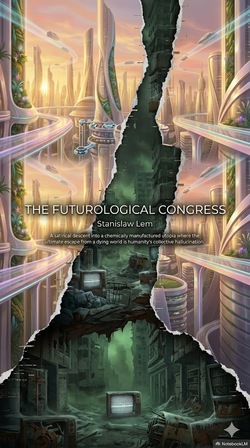
Step into the chaotic, satirical world of Stanislaw Lem’s *The Futurological Congress*, where a disillusioned future journalist attends the 8th World Futurological Congress in Costa Rica—only to be swept up in absurd riots, bomb scares, and a bizarre hotel stocked with survival gear. Decades later, he’s thawed into 2039’s “psychochemical society,” a world where emotions, memories, and even reality are controlled by a flood of drugs: joy-inducing “Goodwill,” memory-altering “Dantein,” and mood-manipulating pills that turn anger into compliance. As he navigates this surreal landscape—where newspapers dissolve overnight, custom dreams are sold like candy, and language evolves into unrecognizable jargon—he stumbles on a horrifying secret: the entire “perfect” world is a facade. A drug called Dream Decorator fogs the air, masking a grim reality of 200+ billion people starving in squalor, their minds tricked into believing in luxury and abundance. When he finally sees the truth, he’s forced to confront humanity’s desperate choice: embrace the comforting lie of the psychochemical world, or face a brutal reality that might break the human spirit.

Dream DecoratorPsychochemical SocietyFuturological CongressReal CollapseProsthetic Humanism
Enlightenment Now
Loading…

Enlightenment Now

Steven Pinker

4.3819 learners

In Enlightenment Now, Steven Pinker delivers a sharp, data-backed defense of the Enlightenment’s core values—reason, science, humanism, and progress—against rising pessimism and anti-Enlightenment backlash. Drawing on cross-disciplinary research, Pinker dismantles the myth of global decline, highlighting tangible improvements: eradicated diseases, plummeting extreme poverty, reduced war deaths, and expanded civil rights. He addresses critics from romanticists to religious conservatives, explaining how their rejection of rationality ignores decades of human progress. Pinker also confronts modern threats like nuclear war, populism, and climate change, arguing that doubling down on Enlightenment principles is the only way to navigate future challenges. This isn’t just a celebration of the past; it’s a blueprint for sustaining humanity’s upward trajectory by prioritizing evidence, empathy, and collective rationality.

ScienceHumanismProgressReasonEntropy
21 Lessons for the 21st Century
Loading…

21 Lessons for the 21st Century

Yuval Noah Harari

4.2516 learners

In *21 Lessons for the 21st Century*, Yuval Noah Harari cuts through the noise of modern chaos to unpack the defining crises and opportunities of our time. Starting with the collapse of liberalism’s once-dominant narrative—undermined by 2008’s financial crash, Brexit, and Trump’s rise—he explores how AI and biotech are reshaping work, widening inequality, and threatening to create a “useless class” left behind by automation. Harari dives into the battle for data sovereignty, warning that tech giants and governments alike are exploiting personal information to gain unprecedented power. He also addresses cultural clashes, terrorism’s psychological tactics, and the limits of nationalism in solving global threats like climate change. Finally, he offers actionable paths forward: reorienting education around critical thinking and adaptability, embracing secular humanism’s core values, and using mindfulness meditation to reclaim control of our minds from algorithmic manipulation. This book isn’t just a diagnosis of our era—it’s a guide to navigating uncertainty with clarity and resilience.

Liberalism CrisisArtificial IntelligenceUniversal Basic IncomeData SovereigntyPost-truth Era
Insight

Humanism's Historical Value

Humanism (Renaissance) had progress (against feudalism). We shouldn't reject it entirely—take its reasonable parts (respecting human dignity).

AestheticsHumanismRenaissance
Golden Sentence

Technology Must Serve Humans

"We did not make this new technology for the sake of technology itself. The ultimate goal of cybernetics is to let all machines work for the benefit of human beings."

Tech EthicsHumanismWiener
Concept

Chinese Humanism

Chinese humanism centers on living happily now—valuing family, nature, and simple joys over afterlife or grand ideals.

HumanismLife Philosophy
Concept

Humanism Core

Humanism focuses on human flourishing. It uses reason and science to reduce suffering, promote equality, and build a better world—no supernatural beliefs needed.

EthicsHumanismReason
Concept

Renaissance

The Renaissance (1400s) revived Greco-Roman ideas, focusing on human potential instead of just religion—starting Europe’s secularization.

HumanismRenaissanceSecularization
Golden Sentence

Life Is Love Not Hate

"Violence and hate solve nothing. The real force that keeps life going is love, not anger." Bloom’s line when arguing with the nationalist "Citizen" in the Dublin pub.

PeaceLoveHumanism
View

Humanity Spirit Needs Rebuilding

We cannot go back to old traditional moral rules, but we also should not be fully controlled by instrumental rationality, to rebuild humanistic value in modern times.

ValueHumanismmodernity
View

New Bodies Don’t Make You New

Even if you get a fully young, genetically enhanced body, your old memories, personality and love for the people you cared about on Earth never fade away.

IdentityHuman NatureTranshumanism
Golden Sentence

You Are Not Your New Body

"Your new green super body is just a vessel. The real you is the 75 years of memories you brought from Earth, not the strong muscles you got now."

IdentityselfTranshumanism
Concept

Prosthetism Plan

An extreme future plan that separates human brains from bodies and stores them in plastic jars, so people no longer need physical space or real food, and live entirely in simulated consciousness.

Sci-FiDystopiaTranshumanism
Quote

Humanism’s Purpose

"Humanism is the belief that human flourishing is the ultimate good." — Pinker (summarizing the core of humanist ethics).

EthicsHumanismFlourishing
No more