
Cybernetics
Loading…

Cybernetics

Norbert Wiener

4.41045 learners

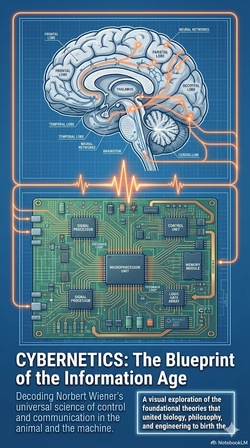
Norbert Wiener’s *Cybernetics*—the cornerstone of the information age—revolutionizes our understanding of control, communication, and order across machines, biological systems, and societies. First published in 1948 (with a revised 1961 edition), this seminal work breaks down disciplinary silos by identifying shared feedback-driven mechanisms governing everything from human motor functions to automated engineering systems. A polymath blending math, engineering, biology, and philosophy, Wiener introduces core concepts like negative entropy (information as a counterforce to disorder), black box analysis, and the statistical nature of control. The revised edition expands into cutting-edge territory, exploring learning machines (early AI prototypes that outperform their designers) and self-organizing systems, where order emerges spontaneously from nonlinear interactions. Beyond technical innovation, *Cybernetics* challenges mechanical determinism, laying the groundwork for fields like artificial intelligence, robotics, biocybernetics, and social systems theory, while prompting critical reflections on automation’s ethical and societal impacts.
CyberneticsFeedback MechanismInformation TheoryNegative EntropyLearning Machine
The Information
Loading…

The Information

James Gleick

4.5479 learners

James Gleick’s The Information is a sweeping, engaging exploration of how information has shaped human civilization from ancient times to the digital age. Starting with early information carriers—from African talking drums that used redundancy to beat ambiguity to the first alphabet systems that rewrote human thought—the book traces the evolution of how we encode, transmit, and store knowledge. It delves into the origins of English dictionaries, the mechanical computing dreams of Charles Babbage and Ada Lovelace, and the telegraph revolution that erased time and space barriers. At its core, the book celebrates Claude Shannon’s groundbreaking 1948 information theory, which introduced the 'bit' as the universal unit of information and laid the groundwork for modern computing, communications, and even molecular biology. Gleick then expands into far-reaching impacts: from Norbert Wiener’s cybernetics to DNA’s genetic code, Richard Dawkins’ 'meme' concept, and quantum information’s challenge to physical laws. Finally, it confronts modern information overload, asking how we can reclaim meaning in a world drowning in data.

Information OverloadInformation TheoryDNAMemeClaude Shannon
Concept

What Is Bit

Bit is the basic unit of information, referring to the exact amount of uncertainty eliminated when you pick one out of two equally possible outcomes, such as confirming a coin flip result.

Information TheoryMeasurementShannon
Concept

Information As Negative Entropy

Wiener defined information as the opposite of thermodynamic entropy: entropy measures system disorder, while information quantifies the organization degree and order level of a system.

EntropyInformation TheoryOrder
Concept

Information Entropy

A formal measure of uncertainty, where higher entropy means more unknown possible outcomes, and higher level of surprise when a result is revealed.

UncertaintyInformation TheoryMeasurement
Concept

Shannon Entropy

Shannon Entropy measures the uncertainty level of a message source. The more unexpected a message is, the higher its entropy, and the more information it carries.

UncertaintyMathInformation Theory
Insight

Info And Meaning Separate

Shannon separated information from its semantic meaning on purpose. The engineering of message transmission has nothing to do with what the message actually means, which makes quantifying information possible.

EngineeringInformation TheorySemantics
Golden Sentence

Information Is Negative Entropy

"Information is information, not matter or energy. The amount of information in a system is equal to its negative entropy."

Information TheoryCore IdeaClassic Quote
No more