Drive
Loading…

Drive

Daniel H. Pink

4.21136 learners

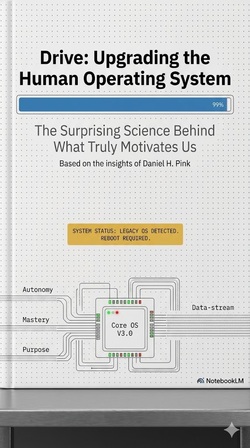
In *Drive*, Daniel H. Pink dismantles the outdated 'carrot-and-stick' model of motivation (Drive 2.0) that fueled the industrial age, arguing it falls flat in today’s creative, complex work environments. Drawing on decades of behavioral science research and real-world examples—from Google’s 20% time policy to TOMS Shoes’ 'one-for-one' model—Pink introduces Drive 3.0, a framework rooted in three core intrinsic motivators: autonomy (the desire to direct our own lives), mastery (the urge to get better at something that matters), and purpose (the yearning to serve something larger than ourselves). He demonstrates that when individuals and organizations prioritize these elements over external rewards, they unlock higher productivity, greater job satisfaction, and more sustainable success. Whether you’re a leader energizing a team or an individual seeking deeper fulfillment, *Drive* offers actionable strategies to shift from extrinsic to intrinsic motivation.


AutonomyFlow StatePurposeDeliberate PracticeDrive 3.0
Cognitive Surplus
Loading…

Cognitive Surplus

Clay Shirky

41020 learners

In *Cognitive Surplus*, Clay Shirky unpacks how the billions of hours we once spent passively consuming TV—dubbed "cognitive surplus"—are being reclaimed as a transformative social resource via digital and social media. Using vivid real-world examples, from the Ushahidi crisis-mapping platform that tracked Kenyan election violence to viral "Lolcat" memes and South Korea’s youth-led candlelight protests, Shirky explains why people are shifting from passive consumers to active creators, collaborators, and sharers. He dives into the intrinsic motivations fueling this shift: the human desire for autonomy, competence, belonging, and generosity. Shirky also outlines four tiers of value generated by cognitive surplus—personal, communal, public, and civic—and explores how intentional governance and cultural norms can turn scattered individual efforts into meaningful collective impact. This book is both a sharp analysis of media evolution and a practical guide to leveraging shared free time to solve problems, build communities, and reshape society.

Social MediaIntrinsic MotivationWikipediaCognitive SurplusCollective Collaboration
Tear Down the Walls in Your Mind
Loading…

Tear Down the Walls in Your Mind

Gu Dian

3.5981 learners

Tear Down the Walls in Your Mind is a transformative guide that helps readers break free from invisible mental barriers holding them back—from clinging to false security (like overvaluing homeownership or unfulfilling stable jobs) to buying into toxic success myths. Drawing on relatable stories (including Warren Buffett’s early choice between a house and investments, and John Wood’s pivot from Microsoft exec to nonprofit leader) and actionable strategies, the book unpacks how limiting mindsets shape choices: it explains why we confuse dependence with love, mistake fear for disinterest, and let victimhood rob us of agency. It offers practical tools to reframe success as progress toward personal goals, find fulfilling careers through intentional exploration, balance societal expectations with inner fulfillment, and embrace action over endless waiting. Whether stuck in a dead-end job, trapped by self-doubt, or chasing someone else’s version of happiness, this book equips you to reclaim control, grow into your authentic self, and build a life aligned with your true values.

Mental ModelsIntrinsic MotivationSelf-actualizationSuccess MythSecurity Mindset
Punished by Rewards
Loading…

Punished by Rewards

Alfie Kohn

4.5981 learners

Alfie Kohn’s *Punished by Rewards* dismantles the deeply ingrained American belief that rewards—from office bonuses and classroom stickers to parental praise—are reliable tools for motivating behavior. Rooted in B.F. Skinner’s behaviorist theory, which frames humans as controllable beings driven by external reinforcement, this pervasive "do this, get that" logic permeates schools, workplaces, and homes. Kohn exposes its hidden costs: while rewards may yield short-term compliance, they erode intrinsic motivation, stifle creativity, damage collaborative relationships, and reduce the quality of work or learning. Drawing on decades of psychological research and real-world examples—from corporate performance pay schemes to classroom token economies—he argues that rewards are fundamentally manipulative, treating people as passive objects rather than autonomous individuals. Kohn doesn’t just critique the status quo; he offers actionable alternatives: fostering autonomy, creating meaningful work and learning experiences, prioritizing collaboration over competition, and shifting focus from external incentives to internal joy and purpose. This book challenges readers to rethink how we motivate others and ourselves, advocating for a more humane, effective approach that honors human dignity and inherent curiosity.

AutonomyIntrinsic MotivationBehaviorismB.F. SkinnerExtrinsic Rewards
Anti-Burnout Energy Station
Loading…

Anti-Burnout Energy Station

Dao Xiong

3.8708 learners

Fed up with the myth that willpower is the fix for every life struggle? *Anti-Burnout Energy Station* flips the script, arguing that sustainable success doesn’t come from forcing yourself to be "disciplined"—it comes from building a personalized energy system that works with your natural strengths. Packed with actionable, science-backed strategies, this book shows you how to break free from mental drain, stop energy leaks caused by phone addiction, and beat procrastination with tricks like the 5-second rule and snowball task method. You’ll learn to close task loops to recharge energy, leverage small wins to rebuild self-efficacy, and use external feedback to stay motivated. It also teaches you to identify unique energy triggers, protect your influence circle from draining environments, and shift from passive consumption to active creation. Whether you’re stuck in burnout, overwhelmed by inner chaos, or craving consistent motivation, this guide turns exhaustion into sustained, joyful productivity.

Intrinsic MotivationTask Loop ClosureExternal Feedback5-Second RuleEnergy System
View

Incentive Replacement Risk

Replacing moral incentives with economic ones can backfire if the cost is too low. It erodes intrinsic motivation instead of reinforcing desired behavior.

IncentivesMotivationbehavior change
Concept

Drive 3.0 Core Elements

Drive 3.0 focuses on autonomy (choice), mastery (skill growth), and purpose (meaning) to fuel intrinsic motivation for complex, creative tasks.

AutonomyDrive 3.0Intrinsic Motivation
Method

Peer Recognition Rewards

Let employees give small rewards to peers (e.g., $50). This builds community and reinforces positive behavior without harming intrinsic motivation.

CommunityMotivationPeer Recognition
Insight

Avoid Punishment & Praise

Rewards or punishments damage self-esteem and intrinsic motivation—let kids learn from their own experiences.

EducationMotivationChild Psychology
Insight

External Rewards Harm Creativity

Daniel Pink argues external rewards (money) narrow focus and kill creativity. For innovative tasks, intrinsic motivation works better.

CreativityIntrinsic MotivationExternal Rewards
Scenario

Stanford Reward Experiment

Stanford researchers found that giving money rewards for hobbies (like reading) killed intrinsic motivation. Once rewards stopped, students stopped the activities they once loved.

PsychologyMotivationIntrinsic Drive
Insight

Ditch Praise & Criticism

Praise/criticism are manipulative—they make people act for others' approval, not their own. Instead, treat others as equals, focus on their efforts, and let them find intrinsic motivation.

EducationMotivationAdler
View

Flow Beats Forced Discipline

Flow is intrinsic motivation—you don’t need to 'stick to' it because you love the task. Discipline is external, but flow brings immediate joy and long-term growth.

DisciplineMotivationFlow Time
Concept

Intrinsic Motivation Definition

Intrinsic motivation is the natural drive to do an activity purely for the inherent joy, curiosity, or personal value of the task itself, with no external pressure or prize required.

Learningpersonal growthMotivation
Method

RND For Curiosity Driven AI

Step 1: Build two separate prediction models. Step 2: Give exploration bonus based on the gap between two models’ outputs. Step 3: The bigger the prediction gap, the more novel the state is to the AI.

Intrinsic MotivationRL
Concept

Intrinsic vs Extrinsic Drive

Intrinsic drive comes from internal joy (interest, helping others). Extrinsic drive is external (money, praise). Too much extrinsic drive can kill intrinsic motivation.

PsychologyMotivationEnergy
Quote

Intrinsic Motivation Building Blocks

Autonomy, mastery, purpose—these are the building blocks of intrinsic motivation, the type that drives people to do their best work.

AutonomyMasteryIntrinsic Motivation
No more