
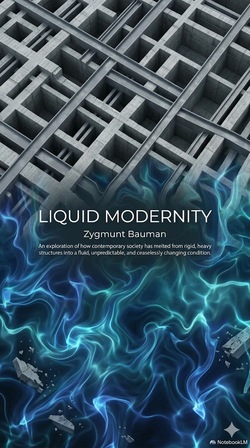
Liquid Modernity
Loading…

Liquid Modernity

Zygmunt Bauman

4.2896 learners

Zygmunt Bauman’s *Liquid Modernity* redefines late modern life by contrasting our era of constant flux with the rigid, rule-bound "solid modernity" of Fordist factories, lifelong careers, and fixed social identities. Bauman frames liquid modernity as a world where every structure—jobs, relationships, even self-concepts—has melted into temporary, shifting states. He breaks down its core traits: everything operates on short-term cycles, power functions through speed and escape rather than control, individuals are forced into "involuntary nomadism" without stable anchors, and consumerism dominates as a tool for identity-building and anxiety relief. The book explores how capital’s relentless pursuit of mobility, fueled by digital technology, dismantled solid modernity’s foundations, leaving individuals grappling with precarious work, fragile communities, and pervasive uncertainty. Bauman also examines the crisis of critical theory in this new era, arguing it must shift from challenging state oppression to addressing the erosion of public space and the false freedom of consumer culture, offering a sharp, accessible analysis of life in a world where nothing stays fixed.

ConsumerismCritical TheoryLiquid ModernitySolid ModernityFordism
Concept

Liquid vs Solid Modernity

Bauman contrasts solid modernity (Fordism: fixed jobs, stable identities, rigid rules) with liquid modernity—everything’s temporary: jobs, relationships, even identities shift nonstop.

modernitySocial TheoryBauman
Concept

Light Capitalism

In liquid modernity, capital is light: no fixed factories/territory, moves instantly globally, prioritizes short-term profits over long-term commitments.

EconomyCapitalismLiquid Modernity
Insight

Critical Theory Outdated

Traditional critical theory (focused on class struggle) can’t explain liquid modernity’s problems like individual insecurity—it needs to adapt.

modernityCritical TheorySocial Theory
Insight

Time Over Space

In liquid modernity, time matters more than space—everything moves fast, so being quick beats owning territory.

modernityMobilityTime-Space
Golden Sentence

All That Is Solid Melts

Bauman uses Marx’s line 'All that is solid melts into air' to describe liquid modernity—fixed structures vanish, replaced by constant change.

QuotemodernityBauman
Golden Sentence

Power Through Escape

Power operates through escape, not occupation—powerful entities avoid responsibility by moving away, not controlling a place.

PowerEscapeLiquid Modernity
Concept

Time-Space Reconfiguration

In liquid modernity, time and space disconnect—tech lets you reach any place instantly, so space loses its value.

TechnologymodernityTime-Space
Concept

Cloakroom Community

Temporary, single-purpose groups (event attendees, online fandoms) that dissolve after activity—no lasting bonds.

CommunitySocial BondsLiquid Modernity
Insight

Power as Escape

In liquid modernity, power isn’t about controlling territory—it’s about escaping (e.g., capital leaving a country to avoid taxes).

PowerControlLiquid Modernity
Insight

Trust Crisis

In liquid modernity, trust is hard to build—jobs/relationships are temporary, so people don’t invest in long-term bonds.

TrustSocial BondsInsecurity
Insight

Consumerism as Identity

People use consumption to build identities—buying brands to show who they are since traditional identities are gone.

IdentityConsumerismLiquid Modernity
Golden Sentence

Cloakroom Community

Community is now like a cloakroom—temporary, no lasting ties: people gather briefly then leave, no deep connections.

CommunitySocial BondsLiquid Modernity
No more