
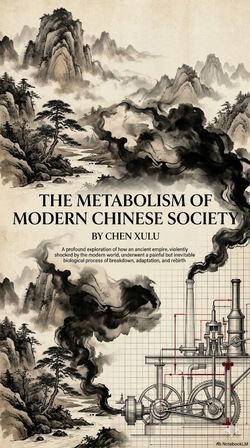
The Metabolism of Modern Chinese Society
Loading…

The Metabolism of Modern Chinese Society

Chen Xulu

3.8976 learners

This book dissects the profound 'metabolism' of Chinese society from the late feudal era through the turbulent 19th and early 20th centuries. Starting with a deep dive into the rigid yet resilient structure of China’s 2,000-year feudal system—its small-scale peasant economy, centralized bureaucracy, and Confucian ideology—it contrasts China’s stagnation with Western Europe’s rapid capitalist rise. It then traces how the Opium War shattered the old order, triggering a cascade of transformations: the Taiping Rebellion’s challenge to feudal norms, the Self-Strengthening Movement’s tentative modernization efforts, the Hundred Days’ Reform’s push for institutional change, and the Xinhai Revolution’s overthrow of the monarchy. The narrative culminates in the New Culture Movement’s intellectual awakening and the eventual rise of Marxism, explaining how each wave of change interacted with foreign pressures and internal uprisings to reshape China’s social fabric. Packed with vivid historical details and sharp analysis, it reveals the complex, often contradictory forces that drove China’s transition from a traditional empire to a modern nation.

Self-Strengthening MovementXinhai RevolutionTaiping RebellionQing DynastyOpium War
Scenario

Teaching Marxism to Pinochet

Sebastian is asked to teach Marxism to Pinochet and generals. They want to understand their enemies. Pinochet says he reads and writes, unlike Allende. Sebastian feels nervous but complies.

MarxismteachingPinochet
Concept

Alienated Labor

Alienated labor means workers lose control over their product, work process, and own human nature. Their labor becomes a forced chore, not a fulfilling activity, disconnecting them from everything—product, work, and self.

laborMarxismAlienation
View

Marx's Class Theory Flaw

Marx thought workers would unite for revolution, but they won't—each worker knows their effort won't matter, so they let others do it.

MarxismFree RiderClass Action
Insight

Ideology vs Superstructure

Ideology isn't superstructure—superstructure includes political institutions (army, courts), while ideology is part of it (philosophy, art).

IdeologySuperstructureMarxism
Method

Study Marxism Aesthetics

To learn Marxism aesthetics: read original works (not just quotes), master foreign languages to access materials, avoid dogma.

Marxism AestheticsStudy MethodOriginal Works
Quote

Grendel's Perspective Rewrite

Student Grace rewrote Beowulf from Grendel’s view: 'Kings and warriors are the real monsters—they plunder farmers’ gains while feasting themselves.' The author found this sharper than college Marxism professors’ comments.

Literary InsightStudent CreativityBeowulf
Insight

Socialism for China

After observing Europe's class struggles, Zhou Enlai concluded China must take the socialist path to save the nation.

MarxismRevolutionary Path
View

New Culture Movement Value

The movement’s promotion of “Democracy and Science” completely broke the feudal Confucian ideological shackles, liberated young people’s minds, and paved the way for the spread of Marxism in China.

New Culture MovementEnlightenment1915
View

May Fourth As New Revolution Start

In this movement, Chinese working class stepped on the political stage as an independent force. It connected Marxism with workers, laid foundation for the founding of the Chinese Communist Party later.

May Fourth1919New Democratic Revolution
View

Marx’s Crisis Argument

Capitalism is inherently unstable, not a natural system. It creates regular worsening crises as it replaces human labor, and turns people into pawns serving capital’s endless expansion.

MarxismCapitalismSystemic Risk
Golden Quote

Capital Treats Us As Pawns

"Capital is the dominant force shaping the world, treating human beings as mere pawns, while making us believe serving capital gives us value." — Yanis Varoufakis

MarxismCapitalismAlienation
Insight

Academic Freedom

Chen Yinke insisted academic research needs independent spirit and free thought. He refused to let Marxism guide his medieval history research when invited to Beijing in 1953.

MarxismAcademic FreedomChen Yinke
No more