
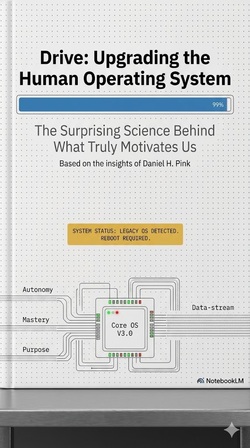
Drive
Loading…

Drive

Daniel H. Pink

4.21136 learners

In *Drive*, Daniel H. Pink dismantles the outdated 'carrot-and-stick' model of motivation (Drive 2.0) that fueled the industrial age, arguing it falls flat in today’s creative, complex work environments. Drawing on decades of behavioral science research and real-world examples—from Google’s 20% time policy to TOMS Shoes’ 'one-for-one' model—Pink introduces Drive 3.0, a framework rooted in three core intrinsic motivators: autonomy (the desire to direct our own lives), mastery (the urge to get better at something that matters), and purpose (the yearning to serve something larger than ourselves). He demonstrates that when individuals and organizations prioritize these elements over external rewards, they unlock higher productivity, greater job satisfaction, and more sustainable success. Whether you’re a leader energizing a team or an individual seeking deeper fulfillment, *Drive* offers actionable strategies to shift from extrinsic to intrinsic motivation.
AutonomyFlow StatePurposeDeliberate PracticeDrive 3.0
The Fifth Discipline
Loading…

The Fifth Discipline

Peter M. Senge

4.3804 learners

In The Fifth Discipline, Peter M. Senge lays out a groundbreaking framework for building learning organizations—dynamic, adaptive entities that thrive amid today’s volatile business landscape. At its core are five interconnected disciplines: Personal Mastery, where individuals push beyond self-imposed limits to pursue meaningful growth; Improving Mental Models, which challenges ingrained assumptions that skew decision-making; Building Shared Vision, aligning diverse teams around a collective, inspiring future; Team Learning, leveraging deep dialogue to unlock collective intelligence; and Systems Thinking, the integrating backbone that ties all disciplines together, teaching leaders to see interconnections instead of isolated problems. Senge also identifies seven hidden barriers to organizational learning—from siloed thinking to short-term focus—and provides actionable strategies to overcome them. Backed by real-world examples like the Beer Game and adaptive organizations such as Singapore’s police force, this book demonstrates how shifting from linear to systemic thinking can transform rigid hierarchies into resilient, self-renewing communities where people and performance grow in tandem.

Mental ModelsSystems ThinkingPersonal MasteryShared VisionTeam Learning
Scenario

Roger Craig’s Jeopardy Win

Roger Craig used SRS to memorize facts and won Jeopardy’s highest single-day prize. He proved that targeted memory techniques can turn ordinary people into experts.

JeopardySRSMemory Mastery
Golden Sentence

Less but Better

"True masters keep doing fewer but better things." (Emphasizing focus on high-value tasks.)

EfficiencyFocusMastery
Concept

Mastery as Asymptote

Mastery is like an asymptote—you get closer but never fully reach it. The journey of improvement is the reward.

GrowthMasteryAsymptote
Scenario

MIT CS Challenge Success

Scott Young finished MIT's 4-year CS program in 12 months. He used 2x video speed, practice problems, and quick error reviews to pass 32 courses—landing interviews at Microsoft and proving rapid mastery is possible.

MIT ChallengeRapid LearningCS Skills
Concept

Drive 3.0 Core Elements

Drive 3.0 focuses on autonomy (choice), mastery (skill growth), and purpose (meaning) to fuel intrinsic motivation for complex, creative tasks.

AutonomyDrive 3.0Intrinsic Motivation
Concept

Growth vs Fixed Mindset

Growth mindset: ability improves with effort. Fixed mindset: ability is innate. Growth mindset fuels mastery and resilience.

Growth MindsetMasteryFixed Mindset
Insight

Mistake as Learning

Rafe lets students rewrite grammar exercises until they get 90% right—no shame, just learning. This builds mastery and confidence.

Confidencegrammarlearning from mistakes
Golden Sentence

Master's Secret

"True masters don't just work hard alone—they use rules and tools to amplify their efforts." (A key insight into top performers' success.)

tool useEffortMastery
Concept

Flow State Explained

Flow is a state of full immersion where skill matches challenge. Time flies, and the activity itself becomes the reward.

FlowEngagementMastery
Concept

Motivation Drivers

Employees are motivated by autonomy (control over work), mastery (growing skills), and purpose (meaningful work). Focus on these three to keep teams engaged.

EngagementMotivation
View

Outer Power Makes You Weak

Even kings are trapped by fear, greed and paranoia, often overthrown or betrayed. Real power never comes from ruling others, it comes from mastering your own inner desires.

FreedomPowerself-mastery
Concept

Mental Representations

Mental structures built via repeated practice, that let you quickly recognize patterns, predict next moves, and make fast correct decisions in your field.

ExpertiseCognitionSkill Mastery
Insight

Familiarity Is Not Mastery

The fluency you feel after reading a paragraph multiple times is not proof that you understand or can apply the knowledge. It is just a surface level illusion that misleads most students to use ineffective study methods.

studyself assessmentLearning Illusion