
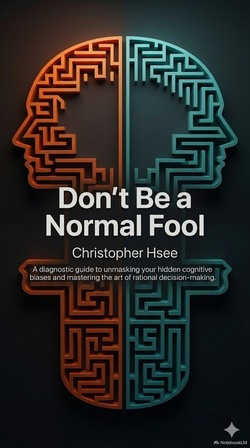
Don't Be a Normal Fool
Loading…

Don't Be a Normal Fool

Christopher Hsee

3.5722 learners

Drawing on behavioral economics and real-world case studies, *Don't Be a Normal Fool* exposes the hidden cognitive biases that drive irrational decisions in finance, career, and daily life. Author Christopher Hsee breaks down core mental traps: mental accounting (how we categorize and spend money differently based on its source), transaction bias (fixating on deals over utility or percentages over actual savings), sunk cost fallacy (chasing lost investments), overconfidence (overestimating our abilities), and adaptive bias (misjudging long-term emotional impacts of events). Through relatable examples—from splurging windfalls to clinging to failing projects—Hsee explains how these biases skew judgment, then offers practical strategies to overcome them. Readers learn to recognize these traps, shift to rational decision-making, and optimize their choices to avoid common pitfalls that hinder financial stability and intentional living.
Cognitive BiasBehavioral EconomicsSunk Cost FallacyRational Decision-MakingOverconfidence
Misbehaving
Loading…

Misbehaving

Richard H. Thaler

4.3397 learners

In *Misbehaving*, Nobel Prize-winning economist Richard H. Thaler dismantles the long-standing 'rational economic man' assumption of traditional economics. Starting with a quirky classroom experiment—where students cheered for a 96/137 exam score but raged at a 72/100 despite identical grade outcomes—Thaler reveals how real people’s decisions are driven by predictable irrationalities, not cold, calculated logic. He traces his decades-long journey collaborating with psychologists Daniel Kahneman and Amos Tversky, whose prospect theory laid the foundation for behavioral economics. Thaler breaks down core concepts like the endowment effect, mental accounting, and loss aversion using relatable examples: wine collectors refusing to sell or buy their own valued bottles, consumers prioritizing transaction utility over actual value, and businesses failing to grasp fairness perceptions. He also explores how these insights transformed finance (challenging the efficient market hypothesis) and public policy, with game-changing solutions like the 'Save More Tomorrow' retirement plan and the 'nudge' framework now adopted by global governments. This engaging blend of memoir and scholarship shows how studying human misbehavior turned a fringe idea into a mainstream discipline, reshaping our understanding of economics, business, and daily choices.

Loss AversionBehavioral EconomicsEndowment EffectEfficient Market HypothesisProspect Theory
Concept

Mental Accounting

A psychological bias where people categorize different sources of income into separate "accounts", and follow different spending and saving rules for each category.

PsychologySavingConsumer Behavior
Concept

Mental Accounting

People mentally divide their money into separate non-fungible accounts for specific uses, even though money is essentially interchangeable.

PsychologyPersonal Finance
No more