
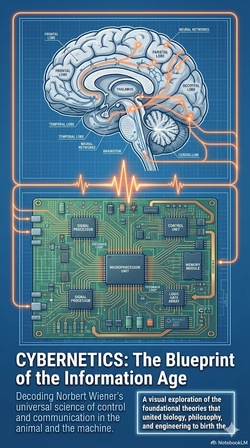
Cybernetics
Loading…

Cybernetics

Norbert Wiener

4.41045 learners

Norbert Wiener’s *Cybernetics*—the cornerstone of the information age—revolutionizes our understanding of control, communication, and order across machines, biological systems, and societies. First published in 1948 (with a revised 1961 edition), this seminal work breaks down disciplinary silos by identifying shared feedback-driven mechanisms governing everything from human motor functions to automated engineering systems. A polymath blending math, engineering, biology, and philosophy, Wiener introduces core concepts like negative entropy (information as a counterforce to disorder), black box analysis, and the statistical nature of control. The revised edition expands into cutting-edge territory, exploring learning machines (early AI prototypes that outperform their designers) and self-organizing systems, where order emerges spontaneously from nonlinear interactions. Beyond technical innovation, *Cybernetics* challenges mechanical determinism, laying the groundwork for fields like artificial intelligence, robotics, biocybernetics, and social systems theory, while prompting critical reflections on automation’s ethical and societal impacts.
CyberneticsFeedback MechanismInformation TheoryNegative EntropyLearning Machine
Upward Growth
Loading…

Upward Growth

Jiu Bian

3.7726 learners

Upward Growth is a down-to-earth, actionable guide to escaping stagnation and building lasting personal and financial progress. Grounded in principles like entropy increase from thermodynamics, it frames continuous learning as a non-negotiable survival tactic—without steady inputs of knowledge and skills, you’ll slide into decline, relying on outdated expertise. The book breaks down practical, doable learning hacks: start with tiny daily goals to beat procrastination, link new information to existing mental frameworks to retain it, and balance hands-on, immediate skills with long-term knowledge that sparks breakthroughs. It then shifts to upward mobility, debunking myths about innate talent and get-rich-quick shortcuts, and outlines how to break poverty traps by ditching mindless consumption and focusing on long-term value-building. You’ll learn to recognize and escape stagnant low-level cycles, build anti-fragility to thrive under stress, avoid "zombie culture" (passive scrolling and unproductive entertainment), choose high-potential career paths like coding with clear skill benchmarks, and understand economic cycles and wealth logic—including how leverage and global asset allocation work for the wealthy. Packed with relatable real-life stories and step-by-step advice, it’s a roadmap for anyone ready to move from passive living to active, sustainable growth.

Compound GrowthAnti-FragilityEntropy IncreaseNegative Entropy FlowZombie Culture
Concept

Entropy Increase

Any isolated system without constant energy input decays. For us, info/knowledge is 'negative entropy'—stop taking them in, and you'll stagnate with old knowledge and get left behind.

GrowthLearningEntropy
Golden Sentence

Life Feeds On Negative Entropy

"Living organisms feed on negative entropy, absorbing order from the environment to maintain their highly organized structure against entropy increase."

LifePhysicsSchrödinger
Concept

Information As Negative Entropy

Wiener defined information as the opposite of thermodynamic entropy: entropy measures system disorder, while information quantifies the organization degree and order level of a system.

EntropyInformation TheoryOrder
Concept

Negative Entropy

Negative entropy is the opposite of thermodynamic chaos. Living organisms absorb this ordered form of information from outside, to fight against natural entropy increase and stay alive.

LifeOrderThermodynamics
Golden Sentence

Information Is Negative Entropy

"Information is information, not matter or energy. The amount of information in a system is equal to its negative entropy."

Information TheoryCore IdeaClassic Quote
No more