
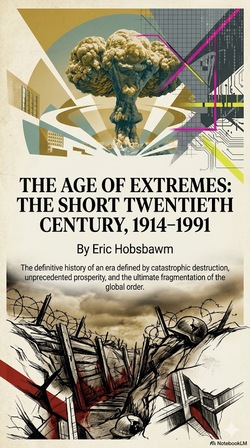
The Age of Extremes
Loading…

The Age of Extremes

Eric Hobsbawm

4.41177 learners

Eric Hobsbawm’s *The Age of Extremes* dissects the turbulent 'short 20th century'—a 77-year period spanning from the outbreak of World War I in 1914 to the collapse of the Soviet Union in 1991. This definitive historical work traces the era’s defining extremes: the catastrophic global wars that shattered 19th-century liberal order, the seismic revolutions that birthed socialist states, the Great Depression that upended capitalist systems, and the decades-long Cold War that divided the world into opposing camps. Hobsbawm also explores the era’s social and cultural upheavals—from decolonization and the rise of youth culture to the transformation of science and art. He analyzes how these interconnected crises reshaped global politics, economies, and societies, leaving a legacy of inequality, ideological fragmentation, and ecological challenges. A masterful synthesis of historical analysis, the book offers critical insights into the forces that defined modernity and warns of the risks of repeating the era’s violent mistakes.

Great DepressionCold WarSoviet CollapseShort 20th CenturyWorld War I
Has China Won?
Loading…

Has China Won?

Kishore Mahbubani

4.3553 learners

Renowned Singaporean scholar Kishore Mahbubani’s *Has China Won?* dissects the high-stakes geopolitical rivalry between the U.S. and China, challenging pervasive Western myths while offering a nuanced look at both nations’ strategic missteps. Mahbubani argues the U.S. has already lost the first round of competition due to its lack of a coherent long-term China strategy, wasteful defense spending driven by lobbying, and domestic decay marked by soaring income inequality and money-dominated politics. He refutes claims of Chinese expansion, highlighting China’s historical non-imperialist roots and defensive military posture. The book also analyzes how key global players—Australia, Europe, Japan, India, and ASEAN—navigate their conflicting economic and security ties to both powers. Finally, Mahbubani identifies five critical areas of shared interest, from climate action to counterterrorism, urging both nations to prioritize cooperation over zero-sum confrontation to secure global stability and mutual prosperity.

Nuclear DeterrenceIncome InequalityBelt and Road InitiativeU.S.-China RivalryDollar Hegemony
Concept

Cold War Definition

The Cold War (1945-1991) was a US-Soviet standoff. It avoided direct war due to nuclear deterrence.

Cold WarNuclear DeterrenceSuperpowers
Insight

Deterrence Reduces Violence

Clear retaliation signals (eye for an eye, nuclear deterrence) break the Hobbesian trap by making violence costly.

Conflict ResolutionHobbesian TrapDeterrence
No more