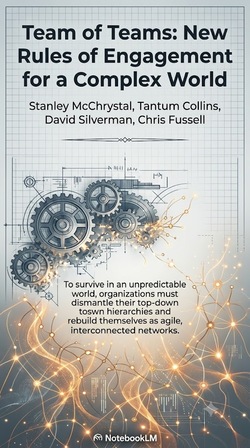
Team of Teams
Loading…

Team of Teams

Stanley McChrystal;Tantum Collins;David Silverman;Chris Fussell

4.21146 learners

In *Team of Teams*, retired General Stanley McChrystal reveals how America’s elite Joint Special Operations Task Force (JSOTF) overhauled its rigid, hierarchical structure to defeat Abu Musab al-Zarqawi’s decentralized al-Qaeda in Iraq. Facing an enemy that outmaneuvered them with rapid, autonomous attacks, McChrystal’s team realized their decades-old Taylorist management model—built for efficiency and predictability—was obsolete in a hyper-connected, chaotic 21st-century battlefield. Drawing lessons from NASA’s Apollo program, airline crew resource management, and even ant colonies, they broke down silos with radical information sharing, embedded cross-team members to build trust, and empowered frontline operators to make critical decisions without top-down approval. This isn’t just a military memoir; it’s a playbook for any organization struggling to thrive in uncertainty, proving shared awareness and decentralized leadership can turn unwieldy teams into a unified, unstoppable force.

Network OrganizationFrontline EmpowermentTeam of TeamsShared AwarenessHierarchical Management
Strangers at the Gate
Loading…

Strangers at the Gate

Frederic Wakeman Jr.

4.1854 learners

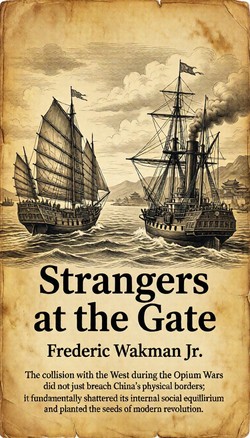
Frederic Wakeman Jr.'s *Strangers at the Gate* delves into the turbulent transformation of 19th-century Guangdong, starting with the 1841 Sanyuanli Uprising—often celebrated as a grassroots victory over British invaders, yet rooted in local gentry leadership. The book traces the complex interplay between imperial authorities, foreign powers, local elites, peasant militias, and secret societies amid the Opium Wars and subsequent rebellions. It unpacks how the Qing court’s failed efforts to curb opium trade and defend its territory shifted power to provincial gentry, who leveraged age-old militia systems to fill security vacuums. From the anti-British entry protests that dominated post-Opium War diplomacy to the chaos of the Red Turban and Taiping Rebellions, Wakeman reveals how these conflicts reshaped local governance, laid the groundwork for later nationalist movements, and exposed the fragility of imperial control in China’s southern frontier.

Taiping RebellionSecond Opium WarRed Turban RebellionLocal GentrySanyuanli Uprising
The Future of Management
Loading…

The Future of Management

Gary Hamel;Bill Breen

4.3853 learners

Outdated industrial-era management—rooted in 19th-century principles, optimized for 20th-century efficiency—has hit a wall in the fast-paced, unpredictable 21st century. In *The Future of Management*, Gary Hamel and Bill Breen argue that rigid hierarchies, top-down control, and efficiency-obsessed processes are stifling creativity and adaptability, leaving businesses vulnerable to disruption. Drawing on real-world case studies from trailblazers like Whole Foods, W.L. Gore, and Google, the book outlines a radical shift toward human-centered, adaptive management models. It explores how decentralized decision-making, trust in frontline employees, systematic creativity cultivation, and dynamic resource allocation can build resilient organizations. The authors introduce Management 2.0, a network-driven framework where power flows from contribution, not title, and every team member becomes an innovator. Packed with actionable strategies and eye-opening insights, this book is a blueprint for leaders ready to ditch outdated practices and build organizations built for long-term success in an era of constant change.

GoogleManagement InnovationDecentralized OrganizationsManagement 2.0Self-Managing Teams
Institutions, Institutional Change and Economic Performance
Loading…

Institutions, Institutional Change and Economic Performance

Douglass C. North

4.4741 learners

Douglass C. North’s seminal work redefines our understanding of economic success by centering institutions—the formal rules (laws, constitutions) and informal constraints (norms, cultural traditions) that structure human political, economic, and social interaction. Departing from neoclassical economics’ frictionless market assumptions, North argues transaction costs (which account for over 45% of U.S. national income) and institutional frameworks are the true drivers of long-term economic performance. He unpacks three core puzzles: why institutional change deeply impacts economic outcomes, why inefficient institutions persist despite competitive pressures, and why nations diverge into growth or stagnation paths due to path dependence. Using real-world examples—from 19th-century America’s rise to Latin America’s stalled development, and the QWERTY keyboard’s lock-in effect—North explains how organizations shape and are shaped by institutions, and introduces adaptive efficiency as the key to sustained prosperity. This cornerstone of new institutional economics provides a framework to explain global economic disparities and guide policy.

Path DependenceProperty RightsInstitutional changeTransaction costsFormal constraints
View

Organizations as Living Systems

Organizations aren’t machines—they’re adaptive systems. They need to learn and evolve to survive, like nature’s organisms.

AdaptationLiving SystemsOrganizational Learning
View

Fight Organizational Entropy

Organizations naturally lose energy (entropy). To fight it: prioritize mission over form, challenge old assumptions, and embrace change instead of resisting it.

Change ManagementEntropyOrganizational Health
View

Bureaucracy Kills Adaptability

Hamel says bureaucracy (hierarchy, rigid rules) stifles adaptability. In fast-changing times, organizations need flexibility—bureaucracy slows decision-making and kills creativity.

bureaucracyAdaptabilityOrganizational Agility
View

Individual-Org Trust Deficit

Hamel notes a growing trust gap between individuals and organizations. People feel powerless as power concentrates—this hurts engagement and organizational performance.

TrustPower DynamicsEmployee Engagement
Concept

Front Organizations Concept

Front organizations act as a buffer between totalitarian movements and the public. They attract sympathizers with moderate messages, hiding the movement's radical core.

Front OrganizationsSympathizersRadicalism
Concept

Seven Learning Disabilities

Common barriers: 'I am my position' (narrow focus) or 'Enemy is out there' (blaming others). These prevent organizations from adapting.

Systems ThinkingLearning BarriersOrganizational Issues
Insight

Decentralization Boosts Adaptability

Decentralized decisions (like Whole Foods teams) make organizations faster to respond to customer needs. Centralized control slows things down.

DecentralizationAdaptabilityCustomer Focus
Insight

Organizations Need Reserved Slack

Companies and public institutions cannot run at 100% capacity all the time, they need slack to avoid system collapse. Full capacity leaves no space for emergencies, small disruptions lead to huge system-wide chaos.

EfficiencyOrganizationoperation management
Concept

Mass Society Core Feature

Mass society is the social state where ordinary citizens lose autonomous political organizations, can only passively receive information from mass media, and have almost no real influence on national decision making.

Public OpinionDemocracySociology
Golden Quote

"Boss Looks Good"

The classic workplace rule in hierarchical organizations. Make your supervisor shine with great work and clear information flow, and you will get more support and recognition.

WorkplaceCareerQuotes