
Philosophical Investigations
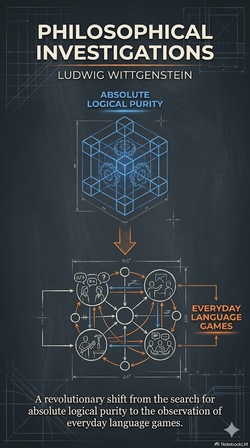
Ludwig Wittgenstein’s *Philosophical Investigations* upends traditional theories of language and meaning, rejecting his own earlier "picture theory" to argue that words gain significance not by corresponding to abstract entities, but through their use in everyday "language games"—interwoven acts of speech and action tied to specific life forms. Using vivid examples like Augustine’s account of language learning, the builder-assistant dialogue, and the duck-rabbit illusion, Wittgenstein dismantles the myth of a universal language essence. He introduces "family resemblance" to explain how concepts like "game" lack a shared core, linking instead through overlapping similarities. The work debunks private language, showing meaning depends on shared rules and public context. Ultimately, Wittgenstein frames philosophy not as a theory-building discipline, but as a "therapy" to dissolve confusion caused by linguistic misuse, guiding readers back to concrete, everyday word uses that give language its true purpose.