
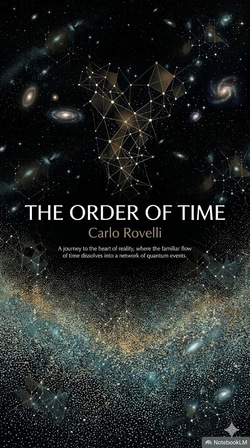
The Order of Time
Carlo Rovelli’s *The Order of Time* shatters our everyday assumptions about time, revealing a far stranger, more nuanced reality than the steady tick of a clock. Starting with Einstein’s relativity, he proves time isn’t universal—gravity slows its flow near massive objects, speed warps it at high velocities, and no single "now" exists across the cosmos. He then turns to thermodynamics, explaining how entropy (the measure of disorder) creates time’s irreversible arrow, rooted in Ludwig Boltzmann’s groundbreaking work linking entropy to molecular chaos. Moving to quantum gravity, Rovelli argues time is discrete, made of tiny "time atoms" called Planck time, and the universe is a network of fleeting events rather than static objects. Finally, he bridges cosmic physics and human experience, exploring how memory, perception, and our limited perspective shape the time we feel every day.