The City of God (Books 1-10)
Loading…

The City of God (Books 1-10)

Saint Augustine

4.71199 learners

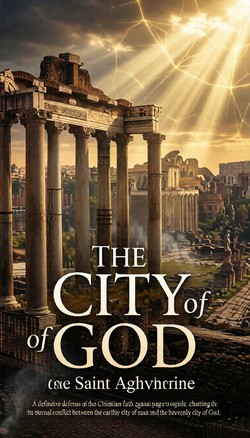
In 410 CE, when Gothic invaders sacked Rome, pagan critics blamed the disaster on Christianity’s rejection of traditional gods. In *The City of God* Books 1-10, Saint Augustine delivers a sharp, evidence-driven defense of his faith, dismantling pagan claims with historical context and theological rigor. He contrasts the safety Christian churches provided refugees during the sack—an act of mercy unheard of in pagan temple history—with the impotence of Rome’s gods, who failed to protect even their own sacred sites like Troy. Augustine dissects the moral decay of pagan rituals, from obscene theater offerings to violent temple practices, and argues Rome’s greatness stemmed from human ambition, not divine favor. He explores the tension between the City of God (the faithful community seeking eternal life) and the Earthly City (worldly pursuits of power and pleasure), delves into free will vs. fatalism, engages with Platonist philosophy, and establishes Christ as the only legitimate mediator between humanity and God, laying foundational groundwork for Christian political and theological thought.
RedemptionFree WillDivine ProvidenceSaint AugustineCity of God
War and Peace
Loading…

War and Peace

Leo Tolstoy

4.21100 learners

Leo Tolstoy’s magnum opus *War and Peace* isn’t just a historical novel—it’s an immersive tapestry of 19th-century Russian life, weaving together the fates of four noble families and the sweeping tides of war over 15 years (1805–1820). Begun as a story about the Decembrists, Tolstoy expanded his vision to encompass the Napoleonic Wars, culminating in the pivotal 1812 Russian Campaign. Through vivid, realistic battle scenes—from Austerlitz to Borodino—and intimate portraits of characters like the idealistic Andrei Bolkonsky, the searching Pierre Bezukhov, and the spirited Natasha Rostov, Tolstoy challenges the myth of "great men" shaping history, arguing instead that ordinary people are the true architects of change. Blending meticulous historical research, profound psychological insight, and unflinching critiques of aristocratic decay, the novel celebrates the redemptive power of love, community, and the quiet dignity of peace amid chaos.

Napoleonic Wars1812 Russian CampaignBolkonsky FamilyRostov FamilyBezukhov Family
The Apology of Socrates
Loading…

The Apology of Socrates

Plato

4.31060 learners

Recorded by Plato, *The Apology of Socrates* captures the philosopher’s iconic 399 BCE trial defense—but this is no ordinary legal plea. Socrates refuses to beg for acquittal or use the manipulative rhetoric favored by Athenian court speakers; instead, he frames the trial as a moral exhortation for the entire city. He challenges flaws in Athenian direct democracy, arguing jury members chosen by lack the wisdom and virtue to uphold true justice. Distinguishing his philosophical rhetoric from self-serving sophist tactics, Socrates insists speech must prioritize truth and moral virtue over winning arguments. His mission, sparked by the Delphic Oracle, is to act as an “intellectual midwife,” using relentless questioning to push others to confront their ignorance and care for their souls. Condemned to death, he embraces his fate, declaring the unexamined life is not worth living and imagining death as either a dreamless sleep or a chance to converse with great thinkers in the afterlife.

Athenian DemocracySocratic DialecticExamined LifeDelphic OracleIntellectual Midwifery
Augustine_ A Very Short Introduction(Henry Chadwick [Chadwick, Henry],2001)
Loading…

Augustine_ A Very Short Introduction(Henry Chadwick [Chadwick, Henry],2001)

4.51003 learners

Henry Chadwick’s *Augustine: A Very Short Introduction* offers a concise, illuminating exploration of one of Western civilization’s most pivotal thinkers. Spanning Augustine’s turbulent life—from youthful indulgences and his Manichaean phase to his conversion to Christianity and rise as Bishop of Hippo—the book unpacks the intellectual currents shaping his thought: Cicero’s philosophical spark, Neoplatonism’s metaphysical framework, and biblical truths anchoring his theology. Chadwick delves into Augustine’s core ideas: original sin, the tension between divine grace and human free will, the 'two cities' (earthly and heavenly) defining his political theology, and groundbreaking reflections on time and memory in *Confessions*. The book also examines his enduring legacy, from medieval scholasticism and the Protestant Reformation to modern debates on ethics, faith, and human nature. Accessible yet rigorous, this introduction reveals why Augustine remains a cornerstone of Western philosophy and Christian thought.

PredestinationFree WillAugustineOriginal SinCity of God
The Story of Philosophy
Loading…

The Story of Philosophy

Will Durant

4.4974 learners

Will Durant’s *The Story of Philosophy* reimagines Western thought as a living, relatable journey, ditching dry jargon to pair each philosopher’s core ideas with their life story and historical context. From ancient Athens, where Socrates challenged Athenian norms and laid the groundwork for ethical inquiry, to the Enlightenment’s fight for reason and freedom, and modern thinkers like Nietzsche and Dewey who redefined human purpose, Durant frames philosophy as a dialogue about life’s most urgent questions: What is justice? How do we find happiness? What does freedom truly mean? He distinguishes science’s focus on facts from philosophy’s pursuit of wisdom, showing how thinkers like Plato, Aristotle, and Spinoza shaped our understanding of ethics, politics, and human nature. More than a textbook, this book invites readers to see philosophy as a practical tool for navigating life’s chaos, linking timeless ideas to modern-day challenges.

PragmatismAristotleNietzscheSocratesWill to Power
Augustine: A Very Short Introduction
Loading…

Augustine: A Very Short Introduction

Henry Chadwick

0965 learners

This concise introduction by Henry Chadwick traces Augustine of Hippo’s transformative intellectual and spiritual journey—from his youthful skepticism and immersion in Manichaeism, to his pivotal encounter with Neo-Platonism that paved his path to Christian conversion. It unpacks the core ideas that made Augustine one of Western thought’s most influential figures: his nuanced views on evil as a misuse of free will, the necessity of divine grace over human self-reliance, the doctrine of original sin, and his groundbreaking explorations of the Trinity through psychological analogies. The book also delves into his seminal works, including *Confessions*, his intimate autobiographical meditation on faith and memory, and *City of God*, his sweeping response to Rome’s fall that redefined the relationship between secular and sacred. Chadwick contextualizes Augustine’s debates with heretics like the Donatists and Pelagians, highlighting how his teachings shaped medieval theology and continue to resonate in modern discussions of faith, ethics, and human nature.

PredestinationOriginal SinCity of GodDivine GraceAugustine of Hippo
We Are All Stardust
Loading…

We Are All Stardust

Li Yinhe

3.4496 learners

Looking up at the night sky, Li Yinhe confronts humanity’s tiny, fleeting place in the universe—a realization that once plunged her into existential despair. Turning away from the dead-end comfort of philosophers like Kierkegaard and Schopenhauer, she learns to embrace her stardust-like insignificance instead of fearing it. This shift frees her from trivial worldly worries, guiding her to prioritize what truly matters: love and beauty. In this intimate collection, Li explores the full spectrum of love—from fiery, lifelong passion (using Foucault’s relationship as a counterexample to the "fading passion" myth) to pure Platonic soul connection. She celebrates writing as a creative act of beauty, advocates for minimalist living to cut through life’s noise, and argues for spiritual freedom from societal norms and power’s constraints. Blending personal anecdotes, philosophical insights, and cultural observations, Li offers a roadmap for finding meaning in life’s brevity: reject the search for universal purpose, and instead craft your own through love, creativity, and intentional, joyful living. It’s a warm, wise guide to thriving amid the universe’s vast emptiness.

Spiritual Freedomminimalist livingExistential NihilismPassionate LovePlatonic Love
Insight

Plato Closest to Christianity

Plato's philosophy is closest to Christianity—he recognized a supreme God beyond the world, similar to Christian monotheism.

PhilosophyChristianityPlato
Scenario

Sapper Apolina Won Respect

19-year-old female sapper platoon leader Apolina won the respect of all skeptical male soldiers, after she found a hidden bomb in the officer canteen and saved dozens of lives in the unit.

RespectFrontlineFemale Sapper
Concept

Platonic Love Concept

Spiritual connection beyond physical—two souls resonating without worldly constraints.

IntimacyPlatonic LoveSpiritual Bond
Scenario

Greek Philosophers’ Retreat

Plato left public life to think—he saw action as messy. This started the split between thought and action in Western philosophy.

ActionGreek PhilosophersContemplation
Insight

Math is Key to Modern Science

Plato’s insight that math is the proper language to describe nature laid the foundation for all modern physics. Without mathematical formalization, physical insights cannot become precise, testable scientific theories.

Mathematicsscientific methodPhysics