

How To Think Straight about Psychology
Loading…

How To Think Straight about Psychology

Keith E. Stanovich

4.5881 learners

This eye-opening guide dismantles pervasive myths about psychology—from the overstated influence of Sigmund Freud to the misperception that it’s just “common sense.” Keith E. Stanovich lays bare the scientific core of psychology, explaining how it relies on falsifiable theories, operational definitions, and rigorous experimental control to uncover patterns in human behavior. He breaks down critical concepts like causal inference, probabilistic thinking, and cognitive biases that distort public understanding of research. The book also equips readers to distinguish legitimate psychological science from pseudoscience, teaching them to spot red flags like untestable claims, reliance on anecdotes, and rejection of peer review. By demystifying the field’s methods and addressing long-held misconceptions, it empowers anyone to think critically about psychological claims and apply scientific reasoning to everyday life.
Cognitive BiasesProbabilistic ThinkingFalsifiabilityPseudoscienceOperationalism
The Warren Buffett Portfolio
Loading…

The Warren Buffett Portfolio

Robert G. Hagstrom

4.2770 learners

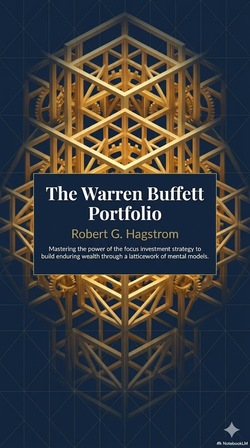
Written by Robert G. Hagstrom, *The Warren Buffett Portfolio* breaks down the legendary investor’s counterintuitive concentrated investing strategy, a sharp alternative to underperforming mainstream approaches like active management and index investing. Unlike active funds that churn 80% of holdings yearly and rarely beat the S&P 500, or index funds that only deliver average returns, Buffett’s method focuses on selecting 5-10 high-quality, undervalued companies with long-term competitive advantages, then betting big and holding for years while ignoring short-term market volatility. The book dives into the logic behind this strategy: Benjamin Graham’s value investing principles, probabilistic thinking rooted in statistics, Charlie Munger’s latticework of mental models, and behavioral finance to avoid emotional traps like the “Market Mr.” It uses real-world wins (Coca-Cola, Wells Fargo) and stories from fellow greats like Keynes and Philip Fisher to prove its effectiveness, guiding readers on applying Buffett’s criteria and embracing long-term compounding to build lasting wealth.

Probabilistic ThinkingValue InvestingBenjamin GrahamBehavioral FinanceMargin of safety
The Great Mental Models, Volume 1: General Thinking Concepts
Loading…

The Great Mental Models, Volume 1: General Thinking Concepts

Shane Parrish;Rhiannon Beaubien

4.3418 learners

Frustrated by the gap between academic theories and real-world decision-making during his early intelligence career, Shane Parrish turned to Charlie Munger’s "latticework of mental models" to navigate uncertainty. In *The Great Mental Models*, Parrish distills cross-disciplinary core principles into actionable cognitive tools—from the foundational "map is not the territory" to practical frameworks like the circle of competence, first principles thinking, and probabilistic reasoning. He walks readers through building, refining, and applying these models to break cognitive biases, avoid decision traps, and approach problems from multiple angles. Packed with real-world examples, from Warren Buffett’s investment strategies to the Cuban Missile Crisis, the book emphasizes that mastering these timeless models isn’t just about smarter thinking; it’s about developing a robust, adaptable decision-making system that thrives in complex, unpredictable environments.

Mental ModelsCircle of CompetenceFirst PrinciplesProbabilistic ThinkingSecond-Order Thinking
No more